President Donald Trump demanded Iran’s “unconditional surrender” as U.S. and Israeli forces intensified their military campaign, framing the escalating conflict as both a geopolitical turning point and a costly economic shock reverberating through global energy and financial markets.
Iran War Enters Week Two as Trump Issues Surrender Demand and Energy Markets Spike
The joint operation, dubbed Operation Epic Fury, began Feb. 28 when the United States and Israel launched coordinated strikes on Iranian missile facilities, nuclear infrastructure, naval assets and military leadership compounds. The campaign quickly expanded into one of the largest military offensives in the region in decades, involving hundreds of airstrikes, Tomahawk cruise missiles and armed drones targeting sites across Tehran, Isfahan and Qom. Early in the campaign, Iranian Supreme Leader Ayatollah Ali Khamenei and several senior commanders from the Islamic Revolutionary Guard Corps were killed, according to the U.S., Trump, and Israeli officials.
Iran responded with ballistic missiles and drone attacks targeting Israel and U.S. military bases across the Gulf region, including installations in Bahrain, Qatar, Kuwait and the United Arab Emirates (UAE). Some strikes caused casualties and infrastructure damage, while others disrupted commercial shipping lanes and forced evacuations of civilians from several regional cities. Oil shipping routes near the Strait of Hormuz, a chokepoint for roughly one-fifth of the world’s petroleum supply, experienced significant disruption.
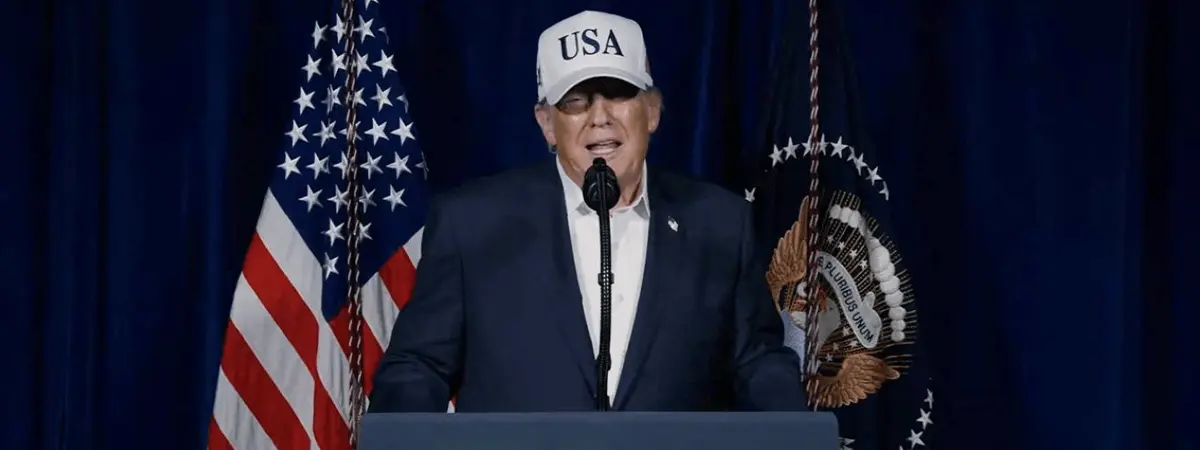 U.S. President Donald Trump discussing the conflict with Iran.
Trump took to Truth Social late March 6 with a blunt message about the trajectory of the conflict and his expectations for Tehran.
U.S. President Donald Trump discussing the conflict with Iran.
Trump took to Truth Social late March 6 with a blunt message about the trajectory of the conflict and his expectations for Tehran.
“Iran, which is being beat to HELL, has apologized and surrendered to its Middle East neighbors, and promised that it will not shoot at them anymore,” Trump wrote. “It is the first time that Iran has ever lost, in thousands of years, to surrounding Middle Eastern Countries.”
He added that Iran was “no longer the ‘Bully of the Middle East,’ they are, instead, ‘THE LOSER OF THE MIDDLE EAST,’ and will be for many decades until they surrender or, more likely, completely collapse.”
The U.S. president also signaled preparations for a broader regional evacuation effort.
“We are moving thousands of people out of various Countries throughout the Middle East,” Trump wrote in a separate post. “It is being done quietly, but seamlessly. The State Department, under Secretary Marco Rubio, is doing a great job!”
Trump’s most striking declaration came in a third message in which he ruled out negotiations unless Tehran fully capitulates. Trump wrote:
“There will be no deal with Iran except UNCONDITIONAL SURRENDER! After that, and the selection of a GREAT & ACCEPTABLE Leader(s), we … will work tirelessly to bring Iran back from the brink of destruction, making it economically bigger, better, and stronger than ever before.”
Iran’s government rejected the demand. President Masoud Pezeshkian called the proposal unrealistic and vowed that Iran would not capitulate despite heavy military losses and leadership upheaval.
The conflict has also produced immediate economic shockwaves. Energy markets reacted first, with Brent crude jumping above $93 per barrel and West Texas Intermediate approaching $91 during the first week of fighting. Analysts said fears of a disruption to shipping through the Strait of Hormuz triggered the largest weekly gain in oil futures in years.
“Oil already surged 34.5% this week — the biggest jump in history. Now, traders are pricing a 60% chance [that] the Strait of Hormuz closes for 7+ days,” one individual said on X.
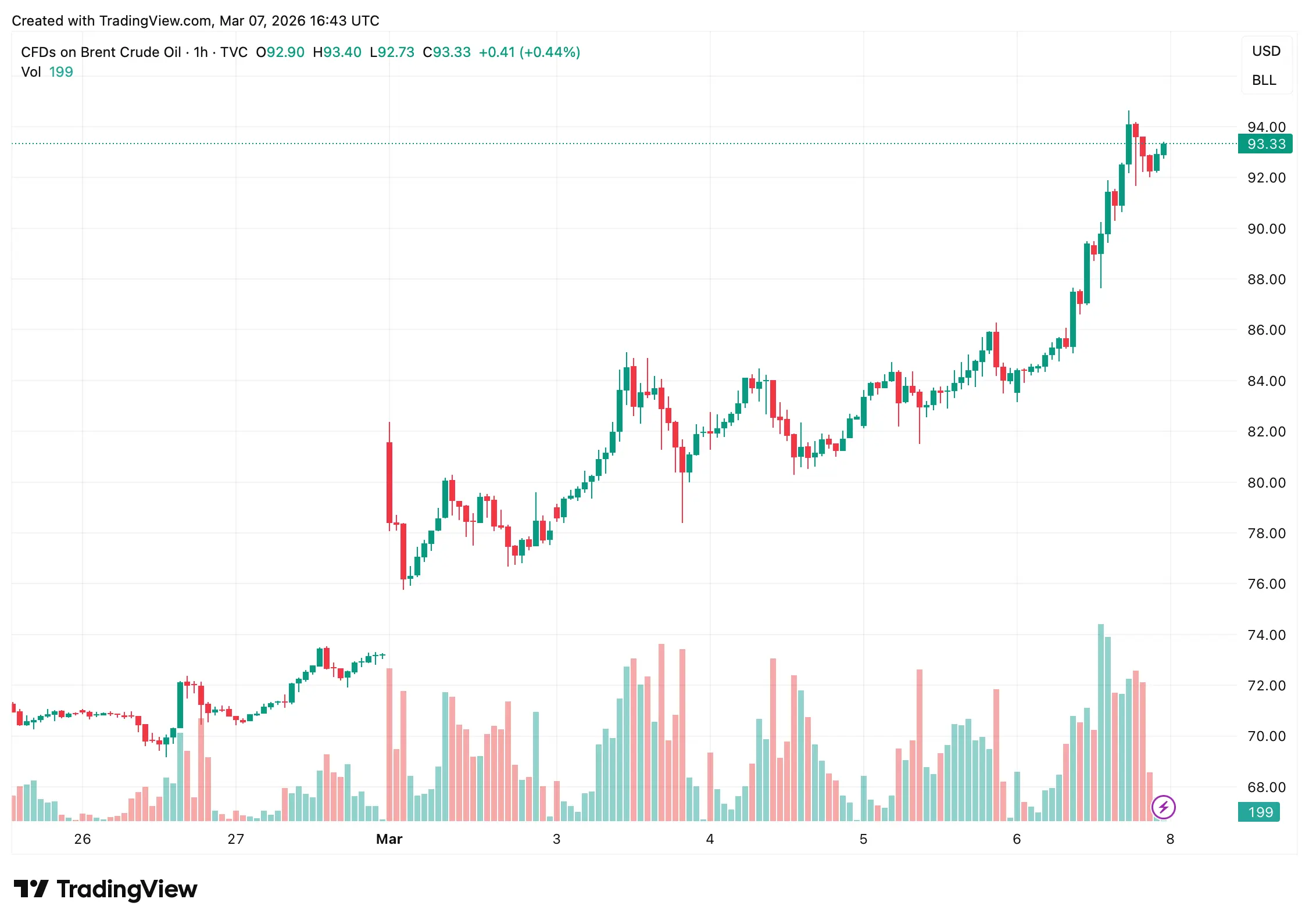 Brent crude prices on Saturday, March 7, 2026. Image source via Tradingview
Energy prices carry a ripple effect through the global economy. Oil is a primary input for transportation, aviation, manufacturing, and shipping, meaning sustained price increases can push inflation higher while slowing economic growth. Economists estimate that a prolonged disruption pushing crude toward $100 per barrel could add roughly 0.5 to 0.8 percentage points to inflation in major developed economies.
Brent crude prices on Saturday, March 7, 2026. Image source via Tradingview
Energy prices carry a ripple effect through the global economy. Oil is a primary input for transportation, aviation, manufacturing, and shipping, meaning sustained price increases can push inflation higher while slowing economic growth. Economists estimate that a prolonged disruption pushing crude toward $100 per barrel could add roughly 0.5 to 0.8 percentage points to inflation in major developed economies.
The United States is not immune. Gasoline prices at the pump have already begun climbing by several cents and as high as $0.50 more per gallon in parts of the country, and economists warn that sustained energy spikes could complicate Federal Reserve policy decisions. Higher fuel costs often translate into increased shipping costs, which ultimately flow through to consumer prices for goods ranging from food to electronics.
Financial markets have also reacted to the war with volatility. Major U.S. equity indexes experienced sharp swings during the first week of the conflict, while investors moved money into traditional safe-haven assets such as gold. Defense contractors, on the other hand, benefited from expectations of increased military spending and replenishment of precision munitions stockpiles.
Cryptocurrency markets also reacted, though not in a uniform fashion. Bitcoin initially fell sharply during the opening days of the conflict before rebounding as investors assessed inflation risks and liquidity conditions tied to the war.
Some individuals believe that a prolonged geopolitical crisis could eventually push more capital toward digital assets, particularly if central banks are forced to loosen monetary policy in response to economic strain.
Another economic dimension lies in the direct costs of war. Modern air campaigns rely heavily on precision-guided munitions, cruise missiles, and interceptor systems that cost hundreds of thousands — and sometimes millions — of dollars per unit. Sustaining hundreds of strikes per day can quickly consume large inventories of weapons and create pressure on defense manufacturing supply chains.
There are also indirect economic costs tied to military deployments, humanitarian evacuations, insurance premiums for shipping companies operating in the Persian Gulf, and disruptions to aviation routes across the region. Economists say that if the conflict remains limited and short-lived, the global economy could absorb the shock. A prolonged war, however, would likely produce broader consequences, including slower growth and sustained inflation pressures.
Despite the mounting costs and uncertainty, Trump has signaled that the campaign will continue until Iran yields.
“IRAN WILL HAVE A GREAT FUTURE,” Trump wrote in his Truth Social post. “MAKE IRAN GREAT AGAIN (MIGA!).”
For now, the conflict shows few signs of slowing, leaving markets, diplomats, and energy traders watching closely as military operations and economic repercussions unfold simultaneously.
FAQ 🇮🇱 🇺🇸 🇮🇷
- What did Donald Trump say about Iran during the war?
Trump said there will be “no deal with Iran except unconditional surrender,” calling the country the “loser of the Middle East” in Truth Social posts.
- What is Operation Epic Fury?
Operation Epic Fury is the joint U.S.-Israel military campaign launched Feb. 28, 2026 targeting Iranian missile, nuclear and military infrastructure.
- Why are oil prices rising during the Iran war?
Markets fear disruptions to the Strait of Hormuz, a major oil shipping route that handles roughly 20% of global petroleum supply.
- • How could the Iran war affect the global economy?
Higher energy prices, market volatility and rising defense spending could increase inflation and slow economic growth worldwide.


