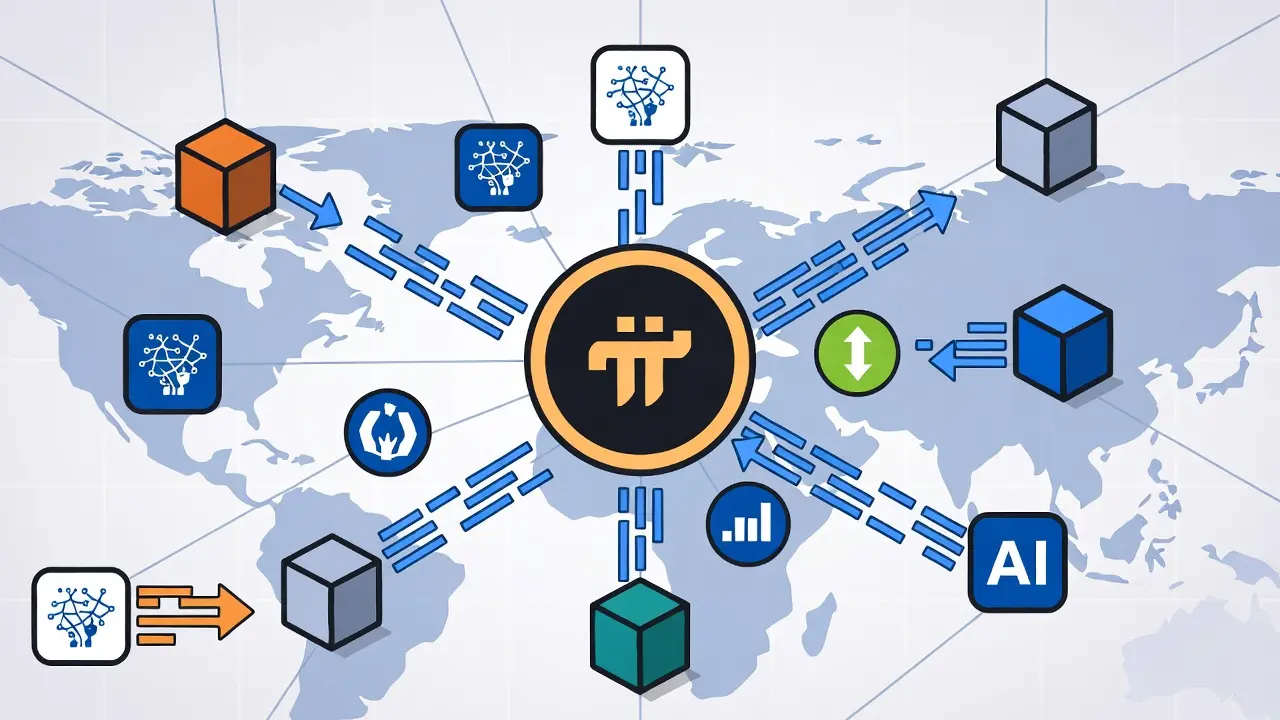
 Pi Network has begun testing artificial intelligence computing workloads on its global node infrastructure during a mandatory protocol upgrade, exploring whether its distributed node system can support decentralized AI processing tasks.
The March 2026 tests, conducted in collaboration with OpenMind, successfully processed object recognition tasks on node computers, as Pi Coin price surged over 20 percent in 30 days despite the unlocking of 189 million tokens into circulating supply, with the asset trading above its 20-day exponential moving average at $0.171.
Mandatory Protocol Upgrade Timeline
Pi Network’s Core Team has mandated a sequential protocol upgrade for all Mainnet nodes, requiring operators to update through multiple versions in a specific order. Nodes must progress through versions 19.1, 19.6, 19.9, 20.2, 21.1, 22.1, and ultimately 23.0, with version 20.2 required by March 12, 2026.
The upgrade process cannot skip versions, ensuring network stability and preparing infrastructure for planned technical changes. Nodes that fail to complete the required updates risk disconnection from the network. This structured approach maintains consensus integrity while enabling new capabilities.
AI Computing Tests on Node Infrastructure
Technical Experiment Details
During the upgrade phase, Pi Network conducted a case study in collaboration with OpenMind exploring whether node computers could handle basic artificial intelligence tasks. In the test, node operators ran software on their computers to process object recognition tasks, with the system analyzing AI-generated images and returning results within seconds.
The experiment demonstrates that Pi nodes may be capable of functions beyond blockchain transaction validation. The network’s distributed node infrastructure comprises over 350,000 nodes globally, with significant idle processing capacity that could potentially be leveraged for AI computing workloads.
Decentralized Computing Vision
The concept relies on utilizing unused CPU capacity from node computers to create a large distributed computing system. If scaled successfully, node operators might eventually provide AI computing power in exchange for Pi token rewards, creating an economic model where users contribute processing power and earn tokens.
This approach would transform Pi Network from a blockchain-only infrastructure into a distributed computing platform capable of supporting AI workloads while maintaining its core consensus functions.
Strategic Vision and Economic Context
Founder’s Perspective
Pi Network founder Chengdiao Fan has articulated the strategic rationale for AI integration, noting that artificial intelligence is already transforming global economic systems. As automation replaces certain types of human labor, Fan argues that new systems may be needed to distribute economic value more fairly.
Blockchain technology, combined with verified digital identities and decentralized networks, could support more inclusive economic participation during this transition. Fan suggests that Pi Network’s infrastructure—with millions of KYC-verified users and hundreds of thousands of nodes—could play a role in this evolving economic landscape.
User Base and Network Metrics
Pi Network reports over 350,000 active nodes and millions of KYC-verified users worldwide, providing substantial distributed computing potential. However, operational challenges remain, with some users continuing to report delays in the KYC verification process, highlighting the gap between long-term ambitions and current technical progress.
Pi Coin Price Performance and Technical Analysis
Supply Absorption
Pi Coin has demonstrated notable price resilience, surging over 20 percent in the past 30 days despite the unlocking of 189 million tokens into circulating supply during February 2026. Large unlock events typically suppress price action, but demand appears to have absorbed the additional supply without breaking the token’s price structure.
This performance stands out against broader market weakness, as geopolitical tensions between the US, Israel, and Iran have forced traders to pull capital from many digital assets. PI’s ability to appreciate during capital outflow conditions indicates strong underlying demand.
Technical Structure
Pi Coin’s daily chart shows the token bottoming near $0.13 on February 12, 2026, followed by a sustained uptrend within an ascending parallel channel—a bullish continuation structure characterized by higher lows and higher highs within a defined upward-sloping range.
The Relative Strength Index currently reads 65.49, indicating strong buy-side pressure while remaining below the critical 70 overbought threshold. This positioning suggests meaningful upside room remains before the rally risks becoming overextended.
Pi Coin trades above its 20-day exponential moving average at $0.171, a level that previously acted as resistance during the downtrend. This moving average now forms a support floor, absorbing downward pressure from bears. The 20-day EMA measures average price over 20 sessions with greater weight on recent prices; trading above this level indicates bullish dominance.
Key Price Levels
Immediate resistance stands at $0.207, with the upper boundary of the ascending channel at $0.222 representing the critical level for extending gains. A sustained break above $0.222 would open further upside potential.
Downside scenarios would see profit-taking push PI toward the 20-day EMA support at $0.171. Failure to hold this level could result in a decline to $0.166, falling below the ascending channel structure and invalidating the bullish outlook.
Future Development Path
Pi Network’s dual focus on protocol upgrades and AI infrastructure testing suggests long-term thinking beyond traditional cryptocurrency use cases. The combination of mandatory technical upgrades ensuring network stability and experimental AI computing exploring new utility creates multiple development vectors.
If AI computing tests prove successful, Pi Network could move closer to building a decentralized AI infrastructure powered by everyday users, potentially creating new economic participation models. However, operational hurdles in user verification and the gap between vision and current technical progress remain significant challenges.
FAQ: Pi Network AI Testing and Token Performance
Q: What AI computing tests is Pi Network conducting on its nodes?
A: Pi Network, in collaboration with OpenMind, has tested object recognition tasks on node computers, successfully processing AI-generated image analysis within seconds. The experiment explores whether the network’s 350,000+ global nodes can provide distributed computing power for AI workloads using idle CPU capacity.
Q: How has PI token price performed despite the February token unlock?
A: PI surged over 20 percent in the 30 days ending March 6, 2026, absorbing the 189 million tokens unlocked in February without breaking price structure. The token trades above its 20-day EMA at $0.171 with RSI at 65.49, indicating sustained demand and room for further upside.
Q: What are the key technical levels for PI token**?**
A: Immediate resistance is $0.207, with the critical breakout level at $0.222—the upper boundary of the ascending channel. Support sits at the 20-day EMA of $0.171, with downside risk to $0.166 if this level fails.
Q: What is the mandatory upgrade deadline for Pi Network nodes?
A: All Mainnet nodes must complete the upgrade to protocol version 20.2 by March 12, 2026. The upgrade must proceed sequentially through versions 19.1, 19.6, 19.9, 20.2, 21.1, 22.1, and finally 23.0. Nodes failing to update risk disconnection.


