As decentralized finance continues to expand, a growing number of digital assets are attempting to break down the barriers between traditional finance and blockchain technology. WLFI is one of the projects drawing significant market attention. It is not only a governance token for a decentralized initiative, but also intersects with traditional financial regulation, stablecoin strategy, political visibility, and market communication. For investors and blockchain participants alike, understanding WLFI’s positioning and potential risks is essential.
What Is WLFI? Project Background and Origins
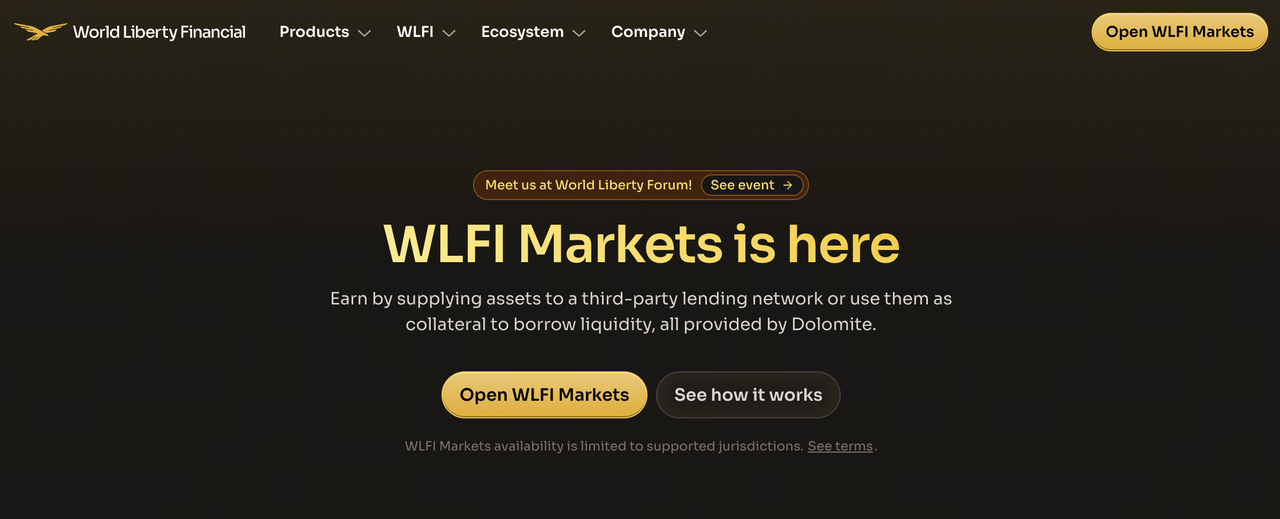
Image source: WLFI official website
WLFI (World Liberty Financial), is a decentralized finance ecosystem built on Ethereum. Its native token shares the same name, WLFI, and serves as both a governance and utility token. The project’s vision is to reshape financial services through blockchain technology, allowing users to access lending, deposits, trading, and other financial functions without relying on traditional intermediaries, while promoting a more open and transparent financial system.
The project was launched by World Liberty Financial Inc., with a team that includes professionals in finance, blockchain development, and regulatory compliance. It officially began operations in 2024, and the WLFI token was deployed on the Ethereum mainnet in September 2025. In its early stages, the project attracted attention from political figures and mainstream media, giving it a distinctive presence in brand visibility and public discussion.
WLFI’s Core Positioning and Target Market
WLFI positions itself as a bridge between traditional finance and decentralized finance, with several key focuses:
Decentralized Financial Infrastructure
WLFI aims to build an underlying protocol that supports a range of DeFi services, including lending, deposits, trading, and governance. Its goal is to remove intermediaries and information barriers, enabling users to operate directly on-chain.
Governance and Community Driven Model
WLFI functions as a governance token. Holders can propose and vote on key decisions such as protocol upgrades, fund allocation, and partnership directions. As a result, the project’s future development largely depends on community participation.
Market and User Positioning
The project seeks to attract users interested in DeFi investment, as well as individuals and institutions looking for alternatives to traditional financial channels. It also leverages political branding to increase awareness and adoption.
How Does the WLFI Project Operate? An Overview of Its Mechanisms and Structure
WLFI operates on a typical DeFi architecture, relying on smart contracts for automated execution. Its core mechanisms include:
Smart Contracts and On-Chain Governance
All WLFI related operations are executed through smart contracts deployed on the Ethereum network. The governance module allows token holders to lock their tokens to gain voting power. Voting outcomes can influence protocol parameters, token unlock schedules, and fund allocation strategies.
Decentralized Finance Functions
WLFI supports various DeFi activities, including collateralized lending, liquidity mining, and trading pair provision. By integrating across multiple chains (such as Solana and BNB Chain), the project seeks to increase user participation and improve transaction efficiency.
Stablecoin and Expansion Mechanism
The WLFI ecosystem has also introduced a USD pegged stablecoin called USD1, designed for DeFi payments and trading. USD1 is backed by assets such as cash and U.S. Treasury holdings, aiming to combine the efficiency of DeFi with the stability of traditional finance.
Products and Application Directions Within the WLFI Ecosystem
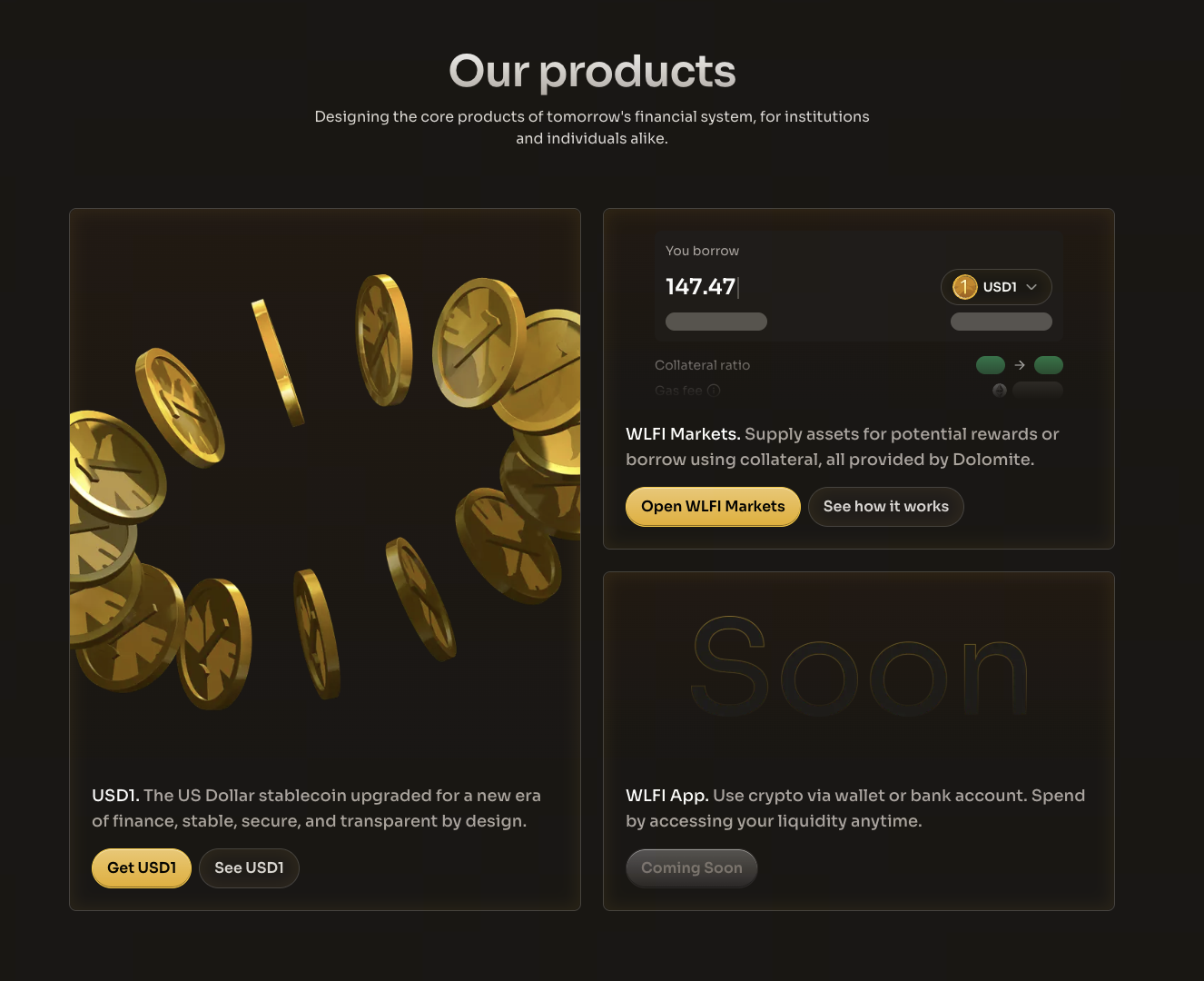
Image source: WLFI official website
WLFI is not just a single token project, but a multi module ecosystem that includes, but is not limited to:
- Decentralized trading: Users can swap tokens and provide liquidity through integrated trading protocols.
- Lending and yield strategies: By partnering with mainstream DeFi protocols, users can lend assets and optimize yield.
- Stablecoin USD1: Within the ecosystem, USD1 is used for purchases, settlement, and on chain payments, while integration with major blockchains enhances cross chain efficiency.
- Liquidity and rewards system: WLFI holders can participate in liquidity mining and staking rewards, increasing both user engagement and ecosystem liquidity.
Utility and Tokenomics of WLFI
- Governance utility: WLFI serves as the protocol’s governance token, allowing holders to vote on key parameters and resource allocation.
- Trading and fee discounts: The token can be used to pay transaction and platform service fees, with potential discounts or privileges.
- Ecosystem incentives: Users who lock tokens, stake, or participate in DAO voting may receive rewards. Contributions to the ecosystem can also earn WLFI or USD1 incentives.
- Tokenomics design: The total supply of WLFI is 100 billion tokens. A portion was released during the TGE, while another portion is allocated to ecosystem incentives and governance rewards. Some allocations are expected to unlock gradually through community voting and governance decisions, supporting long term ecosystem development.
How WLFI Differs From Similar Projects or Platforms
Compared to traditional DeFi projects, WLFI stands out in several ways:
| Comparison Dimension |
WLFI (World Liberty Financial) |
Traditional DeFi Governance Tokens (such as UNI, AAVE) |
Centralized Financial Platforms (CEX / FinTech) |
| Project Positioning |
Decentralized financial ecosystem plus governance token, emphasizing the connection between traditional finance and DeFi |
Focused on governance and incentives for a single DeFi protocol, such as trading or lending |
Provide custodial financial services and trading platforms |
| Core Objective |
Build a governable financial infrastructure while promoting the adoption of stablecoins and DeFi applications |
Optimize efficiency and liquidity within a single protocol |
Improve trading efficiency and overall user experience |
| Stablecoin Issuance |
Yes, USD1, a USD pegged stablecoin |
Typically do not directly issue stablecoins |
Yes, but issued and managed centrally by the platform |
| Primary Token Utility |
Governance voting, ecosystem incentives, and protocol participation |
Governance voting, fee sharing, and liquidity incentives |
Usually platform points or fee discount mechanisms |
| Governance Model |
On chain governance through a DAO mechanism, with WLFI holders participating in decision making |
Primarily DAO based governance, though usually with a narrower scope |
Centralized decision making by the company or management team |
| Technical Architecture |
Built on Ethereum, gradually expanding into a multi chain ecosystem |
Often single chain or specific Layer 2 based |
Private servers combined with limited on chain components |
| Degree of Decentralization |
Moderate, decentralized at the protocol level, but with relatively concentrated governance in early stages |
Moderate to high, generally more distributed as the protocol matures |
Low, highly centralized |
| Compliance and Regulatory Approach |
Actively exploring compliance, including stablecoin regulation and financial license applications |
Often limited compliance efforts or reactive responses to regulation |
Strong compliance, subject to financial regulatory authorities |
| Market Communication Characteristics |
Strong branding and media visibility, with notable public exposure |
Primarily driven by the crypto community and developers |
Focused on mainstream users and institutional clients |
| Risk Profile |
Market volatility, governance concentration, and regulatory uncertainty |
Protocol security and liquidity risks |
Custodial risk, as well as policy and operational risks |
Its core distinction lies in being more than a single function DeFi protocol. Instead, it builds a comprehensive financial ecosystem around a governance token, a stablecoin, and a compliance oriented financial pathway. By attempting to balance decentralized mechanisms with elements of the traditional financial system, WLFI expands its potential use cases and market visibility. At the same time, this positioning exposes it to greater challenges related to governance concentration, regulatory uncertainty, and long term execution capability.
Risks to Consider Before Participating in WLFI
As with any crypto project, it is essential to understand the potential risks:
- Market volatility risk: Token prices may be heavily influenced by macro market conditions, exchange liquidity, and shifts in large holder positions, leading to significant price fluctuations.
- Centralization concerns: Although positioned as decentralized governance, early share distribution and strategic decision making may be concentrated among the core team or major holders.
- Regulatory uncertainty: Given its involvement with stablecoins and financial services, the project may face regulatory adjustments or policy risks across jurisdictions. Recent reports indicate that related entities have applied for a U.S. federal bank trust charter to strengthen compliance.
- Fraud and impersonation risk: There have been cases of fraudulent projects and scams impersonating WLFI. Users are advised to verify smart contract addresses and rely only on official information channels.
In summary, the primary risks of participating in WLFI include significant price volatility, potential concentration of early governance power, and regulatory uncertainty surrounding stablecoins and financial compliance.
WLFI’s Current Development Progress and Market Focus
As of early 2026, several key developments have emerged within the WLFI ecosystem:
Token trading and liquidity growth
WLFI has been listed on multiple exchanges and is gradually expanding its circulating market. Some users are participating in trading and staking incentive programs.
Expansion of USD1 market size
USD1 has grown rapidly on chains such as Solana and has partnered with major exchanges for airdrop incentive campaigns, boosting user participation.
Compliance and institutional progress
The project entity is attempting to obtain a federal bank trust license to enhance the regulatory compliance of its stablecoin issuance.
Conclusion: WLFI’s Future Potential and Challenges
By combining DeFi governance with a stablecoin strategy, WLFI aims to build an open and transparent financial ecosystem. From token governance and user incentives to cross chain support and stablecoin applications, the framework demonstrates a degree of innovation. However, it also faces challenges including market volatility, regulatory pressure, and concerns over centralization. Its political visibility further adds complexity to its overall risk profile.
Ultimately, whether WLFI can realize its vision will depend on technical execution, real user adoption, and the stability of its broader market ecosystem.
FAQ
Q1: Is WLFI an investment or speculation?
A: WLFI is a governance and utility token. Participation may involve speculative elements, but it also enables involvement in ecosystem governance. Always conduct your own risk assessment.
Q2: How can the token be obtained?
A: WLFI can be acquired through exchanges or by participating in ecosystem activities. It may also be staked on certain platforms to earn rewards.
Q3: What is the relationship between WLFI and the stablecoin USD1?
A: WLFI is the governance token, while USD1 is the ecosystem’s USD pegged stablecoin. The two function together within the ecosystem.