As blockchain technology has evolved from a simple value transfer tool into a programmable infrastructure, Ethereum has gradually become a foundational platform within the Web3 ecosystem. It is widely used in decentralized finance (DeFi), NFTs, on-chain governance, and asset tokenization.
The value of Ethereum resides in its ultimate pursuit of “programmable sovereignty,” marking a profound transformation of human credit systems from centralized endorsement to code-based consensus. By continuously advancing Statelessness and Verkle Tree upgrades, Ethereum is lowering the threshold for node operation, ensuring high censorship resistance even as it scales massively. This balanced paradigm—integrating security, decentralization, and ecological compatibility—not only provides a standardized container for the future tokenization of trillion-dollar assets but also establishes an immovable technical foundation for an open, transparent, and borderless global digital collaboration network.
What Is Ethereum?
Ethereum is a decentralized, open source blockchain platform that supports smart contracts and decentralized applications, or dApps. Often described as a “world computer,” it does far more than enable peer to peer payments like Bitcoin. Ethereum provides a programmable infrastructure that allows developers to build financial protocols, games, and a wide range of onchain applications.
The concept was first outlined in a 2013 white paper by Vitalik Buterin, who envisioned a truly “programmable blockchain”. In 2014, the team launched a token sale that raised roughly 18 million US dollars worth of Bitcoin to fund development and bring the network to life.
On July 30, 2015, Ethereum’s mainnet officially went live, marking its transition from the early Frontier phase to a functioning smart contract platform. Since then, Ethereum has undergone multiple major upgrades and pivotal moments. One of the most significant was the hard fork following the DAO incident, which led to the split between Ethereum and Ethereum Classic. These events exposed both technical and governance risks, but they also strengthened the community’s ability to coordinate consensus and implement protocol upgrades.
Understanding the Core Architecture: How Ethereum Works
Ethereum functions like a globally distributed computer. Its layered architecture processes transactions, executes smart contracts, and reaches consensus in a way that keeps every node aligned on a single shared state.
Today, Ethereum is divided into two primary layers: the Execution Layer and the Consensus Layer. They communicate through the Engine API:
- The Execution Layer runs smart contracts and updates account states.
- The Consensus Layer determines block order and secures the network.
At the heart of the Execution Layer is the Ethereum Virtual Machine, or EVM. This Turing complete sandbox environment ensures that smart contract bytecode is interpreted and executed identically across all full nodes. When a user submits a transaction, the EVM consumes Gas, which functions as computational fuel, to measure and price each operation. This prevents infinite loops and resource abuse. Once execution is complete, state changes such as balance updates are broadcast and finalized through consensus, making them tamper proof.
| Architecture Layer |
Core Responsibilities |
Representative Clients |
| Execution Layer |
Transaction execution, EVM operation, state updates |
Geth, Erigon |
| Consensus Layer |
Block proposal and attestation, finality confirmation |
Prysm, Lighthouse |
| Network Layer |
P2P discovery and gossip propagation |
libp2p protocol |
The transaction flow is straightforward:
- A user signs a transaction, which includes a Nonce to prevent replay attacks, a Gas Limit to cap spending, and a Data field for contract calls.
- Validators package the transaction into a block, produced roughly every 12 seconds, and nodes across the network verify it.
- In September 2022, “The Merge” transitioned Ethereum from energy intensive Proof of Work to Proof of Stake, reducing energy consumption by 99.95 percent and replacing miners with validators.
Network Roles and Participant Structure
Ethereum relies on a diverse set of participants who collectively maintain the network. From validators securing consensus, to nodes storing data, to users interacting with applications, each role operates under clear incentives and penalties.
| Role |
Core Responsibilities |
Entry Requirements / Risks |
| Validator |
Proposes blocks and attests to transactions, maintaining PoS consensus |
Requires 32 ETH staked; subject to slashing penalties for misconduct or downtime |
| Full Node |
Verifies and stores the full blockchain data, propagates transactions |
Requires 2TB+ storage and high bandwidth; no direct financial rewards |
| Light Node |
Syncs only block headers and performs simplified payment verification (SPV) |
Can run on mobile-grade hardware; relies on full nodes for data |
| Sequencer |
Orders Layer 2 transactions and batches them for submission to Layer 1 |
Typically operated by the official L2 team; carries centralization risk |
Validators: The Backbone of Network Security
Under Proof of Stake, validators have replaced miners. By staking 32 ETH, a participant can activate a validator node and rotate through different responsibilities:
- Block Proposer: Builds and proposes new blocks.
- Attestor: Votes to confirm proposed blocks.
- Rewards and Penalties: Validators can earn an estimated 3 to 5 percent annual yield. However, prolonged downtime or malicious actions such as double signing can trigger slashing, which confiscates part of their staked ETH.
Account Types: EOA vs Contract Accounts
- Externally Owned Accounts, or EOAs, are controlled by private keys, typically through wallets such as MetaMask. They can initiate transfers and interact with smart contracts.
- Contract Accounts have no private keys. They are governed entirely by onchain code. Examples include DeFi lending protocols like Aave and decentralized exchanges such as Uniswap.
Node Layers and Infrastructure
- Data Layers: Full nodes validate all transactions independently. Archive nodes preserve every historical state, making them useful for analytics. Light nodes provide lower energy access for mobile wallets.
- Middleware Services: RPC providers such as Infura and Alchemy offer API access so developers do not need to maintain their own nodes. Staking pools like Lido allow users with less than 32 ETH to participate in staking and share rewards.
The Role and Economics of ETH
ETH is more than Ethereum’s native token. It serves as the economic engine of the ecosystem, functioning simultaneously as fuel, collateral, and a store of value.
- Calculating Fuel (Gas Fee): Every transaction and smart contract execution requires Gas, paid in ETH. This prevents spam and ensures network resources are properly priced.
- Security Collateral (Staking): Under Proof of Stake, ETH acts as the network’s security deposit. Validators lock up ETH to earn rewards and secure the chain against attacks.
- Medium of Value Transfer: ETH is the dominant settlement asset across Web3. It is used for payments, DeFi collateral, NFT purchases, and as a value anchor for tokenized real world assets.
The 2021 EIP-1559 upgrade fundamentally reshaped ETH’s monetary dynamics by introducing an automatic burn mechanism. Each transaction includes a base fee that is burned, while tips go to validators. As a result, ETH supply shifted from purely inflationary to dynamically balanced, with higher network activity accelerating token burns.
Staking incentives further encourage participation, enabling ETH holders to earn passive yield while contributing to network security.
| Participation Method |
Requirements / Features |
Expected Annual Yield |
| Independent Validator |
Requires 32 ETH and a dedicated server |
3% – 5% plus priority fee rewards |
| Liquid Staking (LSD) |
For example, Lido (stETH); minimum 0.01 ETH |
Approximately 3% – 4.5% after management fees |
| Restaking |
For example, EigenLayer; reuse staked ETH to secure additional services |
Additional yield on top of base staking rewards |
Layer 2: Ethereum’s Scaling Engine and Expanding Ecosystem
If Ethereum mainnet serves as the “settlement layer” for consensus, Layer 2 networks operate as high efficiency “execution layers”. Ethereum has evolved into a modular architecture that balances performance with decentralization through Layer 2 solutions.
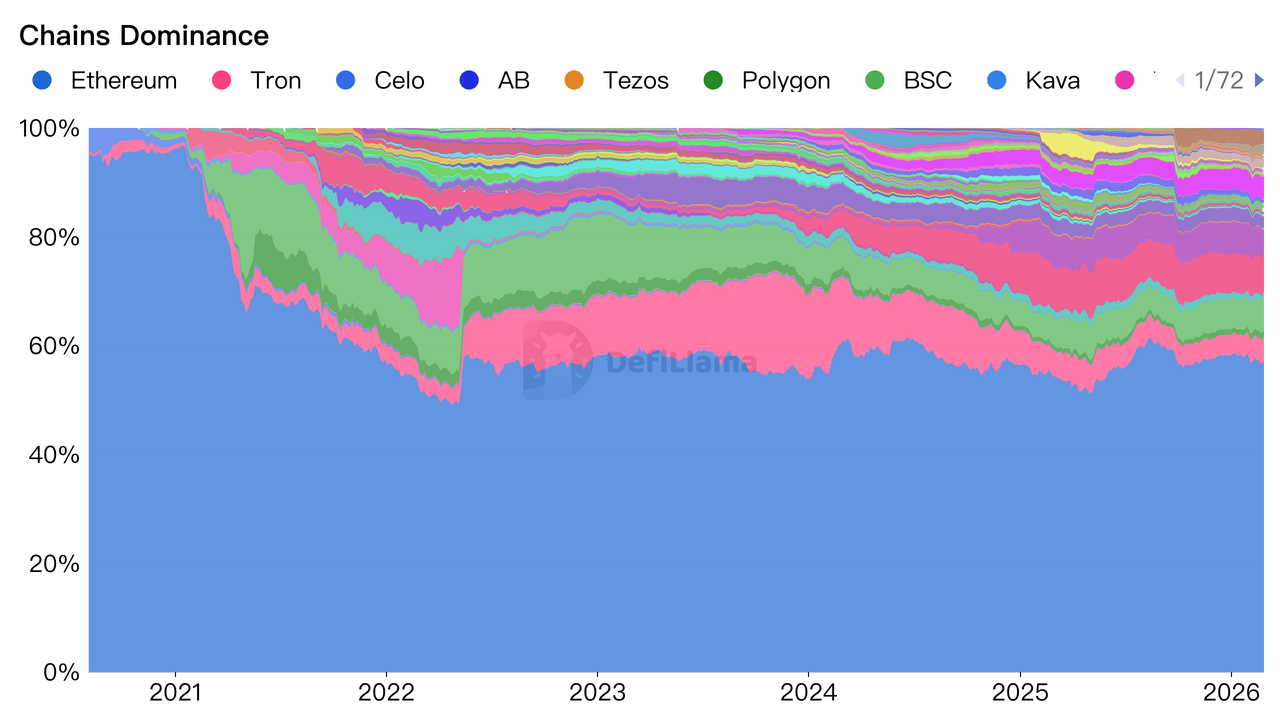
As of 2026, Ethereum remains the core of the blockchain industry. DeFi total value locked stands at roughly 53 billion US dollars, representing about 57% of the sector’s assets. Major protocols such as Uniswap V4, Aave, Lido, and Ethena continue to shape the evolution of decentralized finance.
To address high costs and slower throughput on mainnet, Layer 2 solutions became the primary scaling path:
- Rollups: Including Optimistic Rollups such as Arbitrum and Optimism, as well as ZK Rollups like zkSync and Starknet.
- The 2024 Dencun upgrade introduced Blob data storage, cutting Layer 2 transaction fees by over 90 percent and pushing average TPS beyond 5600, making large scale commercial use more realistic.
That said, Layer 2 development faces fresh debate.
- In February 2026, Vitalik Buterin suggested that the original vision of Layer 2 as “branded sharding” for Ethereum scalability may no longer hold in its original form.
Ethereum’s Strengths and Limitations
Ethereum is widely regarded as the “foundational operating system” of Web3. While it sets industry standards for decentralization and security, it still faces technical and governance challenges on the path to mass adoption.
It has the largest developer ecosystem, the deepest liquidity pool, and the broadest global recognition.
However, its limitations are clear, Mainnet throughput remains around 15 to 30 TPS, far below Visa’s 2000 plus. During peak periods, Gas fees have surged to 10 to 20 US dollars, straining user experience. Although Layer 2 solutions offload roughly 90 percent of activity, cross chain bridges and sequencers can introduce single points of failure.
Staking centralization is another concern. Liquid staking protocols such as Lido control over 32% of staked ETH, potentially affecting decentralization, though decentralized staking alternatives continue to develop.
Ethereum VS BTC
Ethereum and Bitcoin represent two distinct philosophies within blockchain. Ethereum focuses on programmable finance and application infrastructure, while Bitcoin emphasizes its role as digital gold. Their positioning, mechanisms, and ecosystems differ in fundamental ways.
| Dimension |
Ethereum (ETH) |
Bitcoin (BTC) |
| Positioning |
World computer / smart contract platform |
Digital gold / store of value |
| Consensus Mechanism |
PoS, Proof of Stake |
PoW, Proof of Work |
| Supply Cap |
No fixed hard cap, deflationary pressure via EIP 1559 |
21 million coins hard cap |
| Performance |
Layer 2 can exceed 5000+ TPS |
3–7 TPS on mainnet |
| 2026 Trend |
RWA tokenization, modular scaling architecture |
ETF adoption, institutional treasury reserves |
Common Misconceptions and Clarifications
Many newcomers hold outdated assumptions about Ethereum, often shaped by early congestion or misleading narratives. In reality, the network continues to evolve toward its original vision.
Misconception 1: ETH equals Ethereum
- ETH is the native token, used for fuel and staking. Ethereum is the underlying network and EVM execution environment. Gasoline is not the engine, and the two should not be confused.
Misconception 2: Ethereum will be replaced by a “killer chain”
- While high performance blockchains such as Solana and Sui are growing rapidly, Ethereum’s developer base and global consensus create powerful network effects that are difficult to displace.
Misconception 3: Gas fees are always high, and higher ETH price means higher fees
- Gas is priced in ETH, and congestion drives up gwei costs. After Layer 2 adoption and the Dencun upgrade, average Layer 2 fees have fallen to around 0.05 US dollars. ETH price appreciation does not directly increase Gas fees; network demand is the primary driver.
Misconception 4: Smart contracts are immutable and 100 percent secure
- Smart contracts can be upgradeable through proxy patterns, and vulnerabilities can exist even after audits. While risks remain, the deterministic design of the EVM and Ethereum’s economic penalty mechanisms often provide stronger guarantees than many centralized systems.
Conclusion
Since its launch in 2015, Ethereum has evolved from an ambitious “world computer” concept into a foundational layer of the Web3 era.
With its robust EVM compatibility, the largest global developer community, and a mature Proof of Stake consensus mechanism, Ethereum has achieved a strong balance between decentralization and security.
Looking ahead, Ethereum continues to power DeFi, NFTs, and DAOs, while increasingly integrating with traditional finance through the tokenization of real world assets. Although it faces ongoing challenges such as staking centralization and cross chain fragmentation, its clear roadmap and capacity for self evolution keep it firmly positioned at the center of the public blockchain landscape.
FAQs
When did Ethereum switch to Proof of Stake?
The Merge was completed on September 15, 2022, reducing energy consumption by 99.95 percent and replacing miners with validators.
Is ETH deflationary?
Yes. With EIP 1559 burning base fees, multiple periods since 2024 have seen net issuance turn negative.
Are Layer 2 networks secure?
Ethereum Layer 2 solutions inherit mainnet security. Optimistic Rollups typically include a seven day challenge period, while ZK Rollups rely on immediate cryptographic proofs.
How much are Ethereum Gas fees?
On Layer 1, peak fees range from 5 to 15 US dollars. On Layer 2, average fees typically range from 0.01 to 0.2 US dollars following Dencun, a reduction of around 90 percent. Tools such as L2Fees can provide real time Gas data.
How can I stake ETH to earn yield?
There are two main approaches. You can run your own validator node with 32 ETH and a dedicated server, or use protocols such as Lido and Rocket Pool, which lower the entry threshold to as little as 0.01 ETH.
Can Ethereum replace traditional finance?
Ethereum’s DeFi ecosystem has reached a scale comparable to small and midsize banks, but regulatory and compliance challenges remain significant.