When investors purchase stocks, they become partial owners of the company and are legally entitled to dividends, voting rights, and claims on remaining assets during liquidation. Unlike debt instruments, stocks do not provide fixed returns; their prices fluctuate based on company performance, market expectations, and changes in the macroeconomic environment.
The traditional stock market is global and highly scaled, encompassing tens of thousands of listed companies and daily trading volumes in the trillions of dollars. It plays a pivotal role in capital formation and resource allocation, enabling companies to secure long-term funding while allowing investors to participate in economic growth by holding shares.
This article systematically examines the workings of the TradFi stock market, including primary and secondary market processes, price discovery and order matching mechanisms, key market participants, regulatory frameworks and risks, and how crypto platforms expand user access to stock market exposure.
What Are TradFi Stocks? Understanding Stocks in the Traditional Financial System
In the Traditional Finance (TradFi) ecosystem, stocks (Stock / Equity) are core financial instruments representing company ownership. By purchasing stocks, investors become shareholders of publicly listed companies and are legally entitled to shareholder rights, including dividend rights, voting rights, and claims on remaining assets during company liquidation.
As assets, stocks are classic equity assets. Unlike debt-based investments, stocks do not guarantee fixed returns. Their value depends on business performance, profitability, and market expectations for future development. As a result, stock prices are continuously influenced by company fundamentals, macroeconomic conditions, and investor sentiment, leading to ongoing price fluctuations.
Within the TradFi stock market, stocks serve as both a critical tool for corporate financing and a central hub for capital allocation. Companies raise long-term capital through stock issuance, while investors participate in company growth and share economic gains by holding stocks. This mechanism forms the foundation of modern capital market operations, making stock investment an essential part of the traditional financial system.
How the Traditional Stock Market Operates: Primary and Secondary Market Process Overview
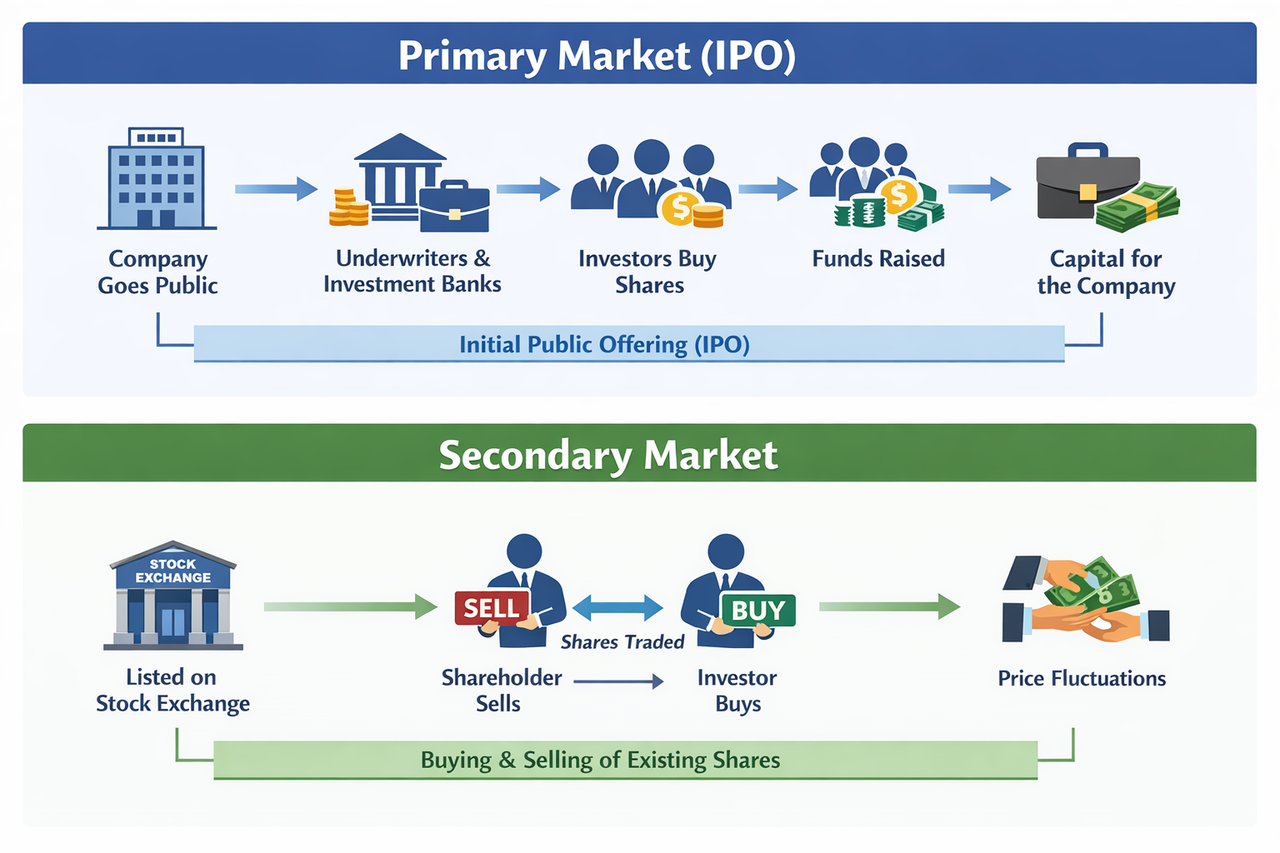
In the TradFi stock market, the primary market is responsible for stock issuance and corporate financing. When a company decides to go public, it typically conducts an Initial Public Offering (IPO) to issue new shares to the public. Investors subscribe to shares in the primary market, and their funds flow directly to the company for business expansion, debt repayment, or R&D investment. The offering price is usually determined collaboratively by the company, investment banks, and underwriters after evaluating company fundamentals and market conditions.
The secondary market is where issued shares are traded. Once listed, stocks can be freely bought and sold among investors, with funds transferring between investors rather than directly affecting the company’s cash flow. The secondary market’s main functions are to provide liquidity and price discovery, enabling investors to adjust their holdings flexibly based on market information.
In summary, the primary market solves the corporate financing challenge, while the secondary market addresses asset liquidity. Together, they form a complete and efficient operational system for the traditional stock market, providing a solid foundation for investor trading and corporate capital acquisition.
Stock Trading Mechanisms Explained: Order Matching and Price Discovery
In the TradFi stock market, stock trading is primarily accomplished through an order matching mechanism. Investors submit buy or sell orders to the exchange, and the matching system automatically pairs orders based on the “price priority, time priority” principle to complete the transaction.
The most common order types are market orders and limit orders. Market orders execute immediately at the best available price, prioritizing speed; limit orders execute only when the market price meets preset conditions, focusing on price control. This order system enhances trading efficiency and offers investors a wide range of risk management and strategy options.
Price discovery is a core function of the stock market. Stock prices are not set by any single institution; instead, they are dynamically formed through ongoing competition among buy and sell orders. Changes in company fundamentals, financial statements, macroeconomic data, and unexpected events are quickly reflected in market prices through investor trading, making stock prices an immediate reflection of market information.
Key Participants and Market Structure in the Traditional Stock Market
The TradFi stock market is made up of multiple participant types, forming a complete and efficient ecosystem. Listed companies are the issuers, raising funds to support business development through stock issuance. Investors include individual investors and institutional investors such as funds, insurance companies, pension funds, and hedge funds, who invest in stocks to participate in corporate growth and seek returns.
At the market structure level, exchanges are the core infrastructure—such as the New York Stock Exchange (NYSE) and NASDAQ—providing platforms for listing and trading stocks. Brokers, market makers, and clearing institutions also play critical roles, handling trade execution, liquidity provision, and settlement of funds and securities.
Regulatory agencies are indispensable to the TradFi stock market, setting market rules, overseeing trading activity, and ensuring fairness and transparency. The collaboration among participants and structural elements underpins the robust operation of the stock market, providing investors with a reliable trading and investment environment.
Regulatory Framework, Risks, and Limitations of the Traditional Stock Market
The TradFi stock market is subject to stringent regulation. Regulatory agencies require listed companies to regularly disclose financial information, prevent insider trading and market manipulation, and protect investor rights while maintaining fairness and transparency.
Despite this, the traditional stock market faces various investment risks and structural limitations. Market prices may be driven by investor sentiment and temporarily deviate from company fundamentals; information asymmetry is difficult to completely eliminate; and smaller investors are often disadvantaged in terms of expertise and access to information.
Other persistent issues include limited trading hours, high barriers to cross-border investment, and higher intermediary costs. These factors highlight the need for investors to assess their own risk tolerance, allocate portfolios rationally, and adopt diversified strategies when investing in stocks.
Stocks, Bonds, and ETFs: Essential Differences Every Investor Should Know
Among TradFi investment instruments, stocks, bonds, and ETFs (Exchange Traded Funds) are the most common financial products, but they differ significantly in risk-return characteristics and investment strategy.
Stocks (Stock / Equity) represent company ownership, offering high return potential but considerable price volatility, suitable for investors seeking capital growth and able to tolerate market fluctuations. Bonds (Bond) are debt instruments that provide fixed interest returns, with relatively lower risk—ideal for conservative investors and risk diversification.
ETFs (Exchange Traded Fund) typically track an index or asset portfolio, combining diversification and liquidity advantages, allowing investors to hold multiple assets within a single product and reduce the risk of individual securities. Understanding these core differences helps investors build rational asset allocation portfolios and optimize strategies based on risk tolerance and investment objectives.
How Crypto Platforms Enable Users to Access the Stock Market: Gate TradFi Case Study
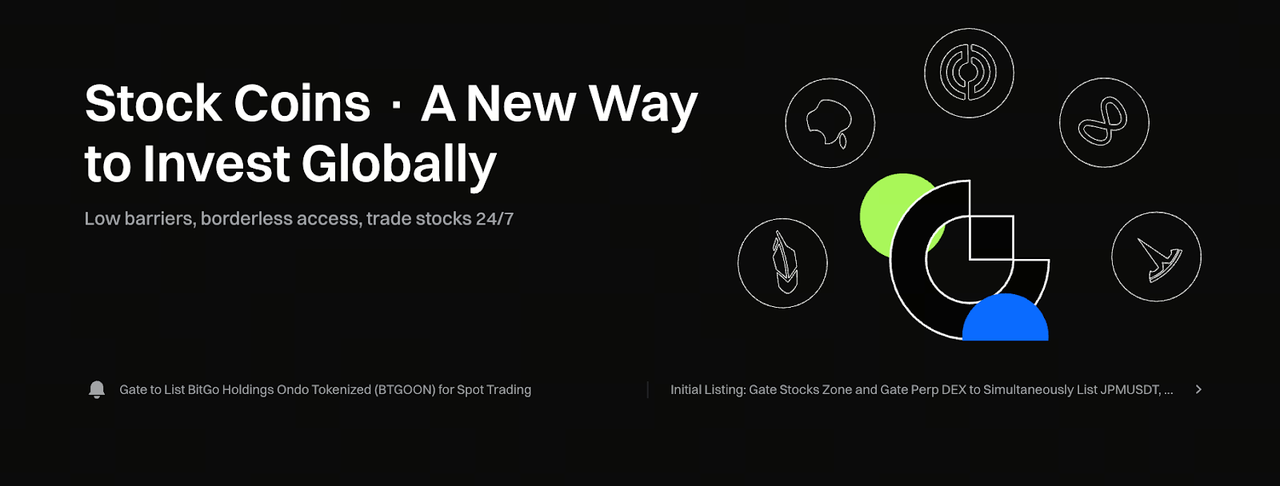
Image: https://www.gate.com/tokenized-stocks
As crypto assets and Traditional Finance (TradFi) converge, some crypto trading platforms now offer users convenient access to the stock market.
For example, Gate TradFi has launched products such as Stock Coins, allowing users to participate in stock-based transactions using USDT and other crypto assets via tokenized stocks or contract structures. Compared to traditional brokerage accounts, this approach is more flexible in terms of account opening, trading hours, and fund usage, supports fractional trading, and significantly lowers the minimum investment threshold.
It’s important to note that these tokenized stock products are not equivalent to directly holding the underlying stocks. Their prices are linked to the stock itself but may not include full shareholder rights. Investors should carefully review the compliance, settlement mechanisms, and platform risks before using these products.
Overall, Gate TradFi offers crypto users an innovative way to connect with the traditional stock market. This is best suited for crypto investors who have a clear understanding of product structure and risk, serving as a supplementary method for traditional stock investing.
Summary
To sum up, the TradFi stock market forms a complete financing and liquidity system through primary and secondary markets, and delivers efficient trading and transparency via order matching and price discovery. Understanding the key differences among stocks, bonds, and ETFs helps investors make informed asset allocation decisions and optimize their portfolios based on risk tolerance and investment objectives.
At the same time, the regulatory framework, information disclosure requirements, and market structure of the traditional stock market safeguard investor rights, but limitations such as market volatility, information asymmetry, limited trading hours, and cross-border investment barriers persist. As crypto assets and TradFi continue to merge, the Gate TradFi platform offers innovative investment channels like tokenized stocks and Stock Coins, enabling users to trade stocks with USDT and other crypto assets, supporting fractional investing and more flexible strategies.
Whether investing in stocks via traditional brokerage accounts or through tokenized trading on crypto platforms, investors should fully understand product features, risks, and opportunities, combine diversified asset allocation with long-term investment strategies, and aim for steady capital growth and effective risk management.
Further Reading