In a system without a central administrator, technical rules alone are rarely enough to sustain long term stability. By introducing LINK, Chainlink integrates service payments, node incentives, and performance guarantees into a unified economic framework. This structure allows the network to deliver reliable data services without relying on centralized trust. Understanding LINK helps clarify how oracle networks achieve sustainable operation from an economic perspective.
Why Do Decentralized Oracles Require a Token Incentive Mechanism?
In traditional data service models, quality is typically supported by corporate reputation, contractual obligations, or regulatory oversight. In a decentralized oracle network, however, node operators are distributed across different regions and organizations. There is no single legal entity or centralized authority to enforce standards of conduct.
Without incentives, nodes would have little motivation to maintain infrastructure or consistently provide high quality data. Without constraints, nodes might be tempted to behave maliciously in high value scenarios. Technical rules alone cannot guarantee long term reliability.
A token based incentive system ties economic rewards directly to node behavior. By rewarding correct performance and increasing the cost of misconduct, the network encourages participants to follow protocol rules. This alignment of incentives enables stable operation in an open environment.
What Are LINK’s Core Functions Within the Chainlink Network?
LINK is a functional token designed specifically to support oracle services, rather than to fulfill multiple financial roles. Its primary uses within the network include service payments, node incentives, and performance guarantees.
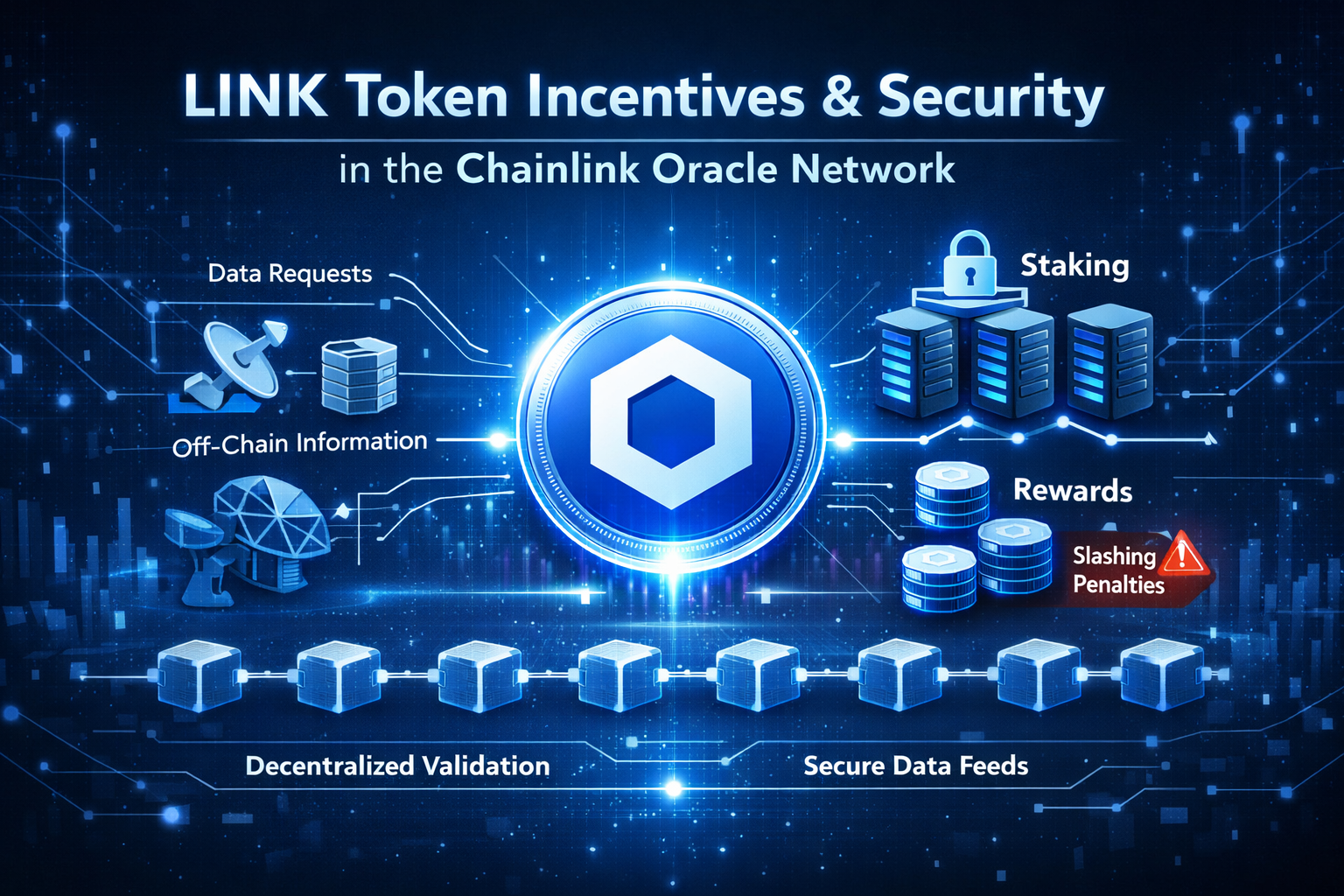
When a smart contract requests off chain data, the requester typically pays oracle service fees in LINK. This payment mechanism connects data demand with node supply, creating sustainable economic motivation for node operators.
LINK can also serve as a performance bond. In certain configurations, nodes are required to lock a specified amount of LINK as stake to demonstrate reliability and long term commitment.
Through these functions, LINK acts as both a medium of value transfer and a mechanism for enforcing responsible behavior, enabling oracle services to operate effectively in a decentralized setting.
How Does LINK Incentivize Oracle Nodes to Provide Reliable Data?
Oracle nodes must continuously maintain servers, data connections, and network infrastructure, all of which involve real operational costs. Without ongoing compensation, maintaining high quality service would be difficult.
As payment for services rendered, LINK rewards nodes once their submitted data is accepted by the network’s aggregation process. Nodes only receive compensation when their results align with accepted outcomes, encouraging accuracy and consistency.
A node’s historical performance influences its likelihood of being selected for future tasks. Nodes that operate reliably over time are more likely to receive assignments, creating a positive feedback loop between reputation and earnings.
This incentive structure encourages long term reliability rather than short term opportunistic behavior.
Is LINK Used to Penalize or Constrain Node Behavior?
Positive incentives alone are not enough to deter misconduct. Chainlink therefore incorporates economic constraints to raise the cost of violations. Under staking mechanisms, nodes must lock LINK as collateral. If a node seriously breaches protocol rules or provides malicious data, its staked assets may be subject to loss.
Even when direct penalties are not triggered, reputational damage can reduce a node’s chances of being selected in the future, limiting long term earnings.
The combination of economic penalties and reputational consequences makes sustained malicious behavior economically unattractive.
By linking node actions to financial outcomes, the network encourages compliance over repeated interactions.
How Does LINK Contribute to Chainlink’s Network Security?
Chainlink’s security depends not only on technical architecture but also on economic incentives. LINK requires nodes to weigh potential rewards against the cost of misconduct when delivering data, which increases the difficulty of manipulating the system.
As oracle services secure higher value use cases, the potential rewards for malicious behavior may increase. Through staking requirements and reward structures, LINK raises the economic cost of attacks, reducing their attractiveness.
In this way, LINK is not merely a payment token. It forms a foundational component of the network’s security model.
Is LINK Equivalent to a Governance Token?
In some blockchain systems, tokens serve payment, incentive, and governance roles simultaneously, which can create conceptual confusion. LINK’s primary purpose is to support oracle network operations and security mechanisms rather than to function as a comprehensive governance token.
Although certain protocol upgrades or parameter adjustments may involve community participation, LINK’s core utility remains focused on service payments and node incentives. Viewing LINK as a functional token helps clarify its role within the system.
What Are the Limitations of LINK’s Incentive Model?
No economic incentive system can eliminate risk entirely. The effectiveness of LINK’s model depends on factors such as the number of active nodes, the diversity of data sources, and appropriate configuration. If network participation is limited, incentives may not function as intended.
In extremely high value scenarios, attackers may still be willing to bear substantial costs, requiring continuous adjustment of staking ratios and node selection mechanisms.
Token incentives cannot independently verify the truthfulness of real world data. Their role is to constrain node behavior, not to guarantee absolute data accuracy.
The Role of LINK Within the Chainlink Ecosystem
| Function Dimension | LINK’s Role | Significance to the Network |
| Payment Medium | Used to pay for oracle service fees | Connects data demand with data supply |
| Node Incentive | Rewards nodes that complete tasks | Encourages the delivery of accurate data |
| Performance Guarantee | Staked as a service commitment | Increases the cost of misconduct |
| Reputation Impact | Influences a node’s selection odds | Promotes long term reliable service |
| Security Mechanism | Raises the economic cost of attacks | Enhances resistance to network manipulation |
Overall, LINK is not an external financial add on to the oracle network. It is an economic mechanism embedded within the system’s operational logic. Through payment, incentives, and accountability structures, it enables participants in an open environment to collaboratively provide reliable data services while maintaining long term network stability and security.
Conclusion
Within the Chainlink network, LINK functions as a payment medium, an incentive tool, and a vehicle for economic accountability. It enables decentralized oracles to operate sustainably without centralized management. By tying node behavior to economic outcomes, LINK enhances data service reliability and strengthens overall network security. Understanding its incentive model and limitations provides a clearer view of how oracle networks function at the system level.