In-Depth Guide to Gate Futures Trading: How Liquidation Mechanisms and Risk Controls Work

Beginner
Quick Reads
Last Updated 2026-03-25 05:35:54
Reading Time: 1m
This article uses Gate Exchange as a case study to thoroughly explain the forced liquidation mechanism and risk control logic in contract trading. It is designed to help beginners understand how maintenance margin and risk rate are calculated, so they can avoid involuntary liquidation resulting from misinterpreting system rules.

I. Why Most Contract Losses Originate from Risk Misjudgment
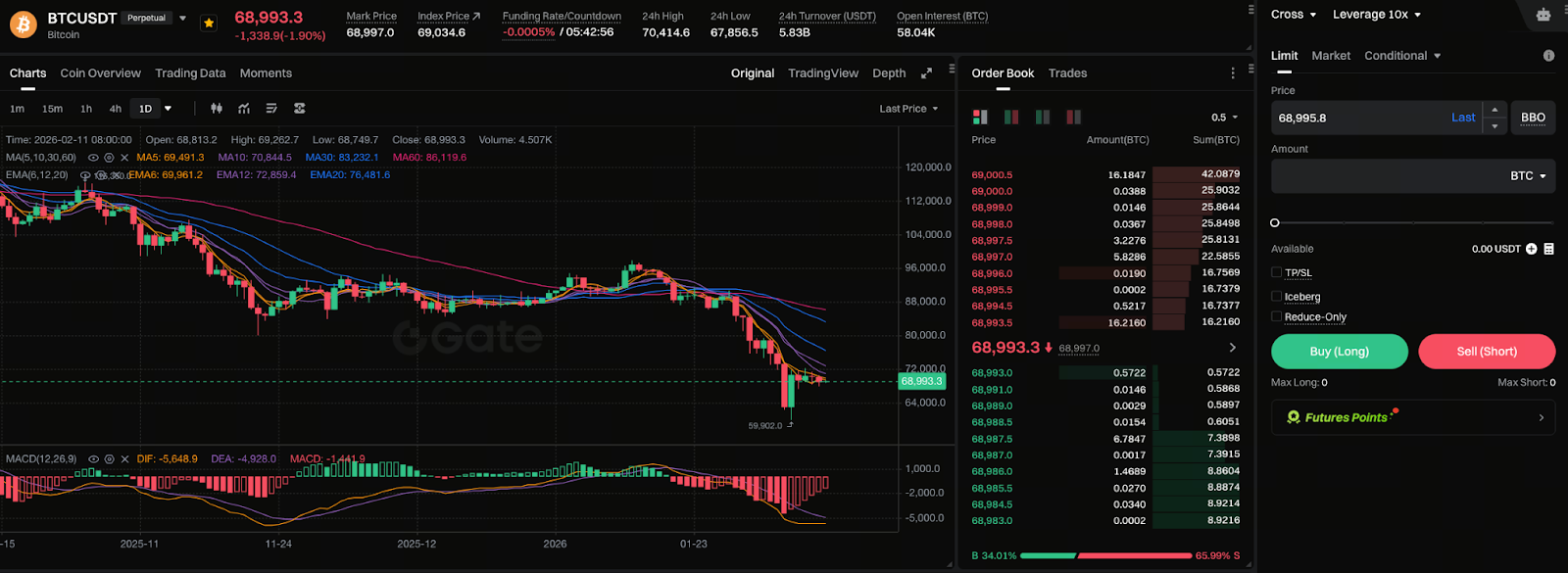

Chart: https://www.gate.com/futures/USDT/BTC_USDT

In contract trading, losses are rarely the result of incorrect market predictions. More often, they stem from a lack of understanding of risk structures.

Many beginners using Gate’s contract trading features tend to focus on:

  • Leverage multiples
  • Profit potential
  • Price volatility

However, they overlook a fundamental question: How is the risk ratio for an account calculated? Without a clear understanding of the liquidation mechanism, any leveraged trade is essentially conducted under unknown rules.

II. The Core of the Liquidation Mechanism

Liquidation (forced closing) is fundamentally an automated risk management process. When an account’s risk ratio drops below the maintenance margin requirement, the system must liquidate positions to prevent:

  • Negative account balances
  • Market liquidity disruptions
  • Unmanageable platform risks

On Gate’s contract trading platform, liquidation is not triggered instantly. Instead, it is determined by risk ratio calculations.

Understanding this distinction helps prevent the misconception that liquidation is “platform intervention.”

III. Gate’s Maintenance Margin and Risk Ratio Calculation Logic

Gate’s contract system uses a tiered maintenance margin framework.

This means:

  • The larger the position size
  • The higher the required maintenance margin ratio

This structure is a standardized approach to risk management. On the trading interface, users can monitor in real time:

  • Current risk ratio
  • Estimated liquidation price
  • Margin changes

These figures are not mere display data—they are essential for determining whether to reduce positions or add margin.

IV. How Partial Liquidation Mechanisms Reduce Systemic Risk

Unlike full liquidation, certain Gate contract products implement partial liquidation mechanisms.

The logic is as follows:

  • When the risk ratio reaches the warning threshold
  • The system first reduces a portion of the position
  • This lowers overall risk exposure

The purpose of this mechanism is to:

  • Reduce chain liquidations during sharp market movements
  • Provide traders with a buffer zone

For beginners, this approach offers a more user-friendly risk control design.

V. Risk Management Details Most Often Overlooked by Beginners

Common mistakes when using Gate’s contract trading features include:

  • Focusing only on the opening margin and ignoring the maintenance margin
  • Overlooking risk ratio changes after increasing positions
  • Blindly adding positions when unrealized losses grow

Contract trading risk does not increase linearly—it is structurally amplified.

If you ignore the risk ratio, higher leverage means less room for error.

VI. How to Proactively Manage Risk in Gate Contract Trading

If you are new to contracts, consider the following principles:

  • Select leverage based on your risk ratio tolerance, not on expected returns
  • Monitor the gap between liquidation price and current price regularly
  • Use isolated margin mode appropriately to control risk per position
  • Avoid blindly increasing positions during periods of high volatility

The core value of contract trading is not to maximize profits, but to enhance capital efficiency. Without effective risk control, any improvement in efficiency is meaningless.

Author: Max
Disclaimer
* The information is not intended to be and does not constitute financial advice or any other recommendation of any sort offered or endorsed by Gate.
* This article may not be reproduced, transmitted or copied without referencing Gate. Contravention is an infringement of Copyright Act and may be subject to legal action.

Related Articles

What is Fartcoin? All You Need to Know About FARTCOIN
Intermediate

What is Fartcoin? All You Need to Know About FARTCOIN

Fartcoin (FARTCOIN) is a representative meme coin within the Solana ecosystem based on an AI-driven narrative. Its core concept originated from an experiment aimed at exploring the "boundaries between AI Agents and humor." More than just a digital asset with social attributes, the project deeply couples absurd humor culture with on-chain financial logic by integrating autonomous AI interaction models.
2026-04-04 22:01:19
Gold Price Forecast for the Next Five Years: 2026–2030 Trend Outlook and Investment Implications, Could It Reach $6,000?
Beginner

Gold Price Forecast for the Next Five Years: 2026–2030 Trend Outlook and Investment Implications, Could It Reach $6,000?

Analyze current gold price trends alongside authoritative five-year forecasts, integrating an evaluation of market risks and opportunities. This gives investors insight into the potential trajectory of gold prices and the main drivers expected to shape the market over the next five years.
2026-03-25 18:13:30
Aster vs Hyperliquid: Which Perp DEX Will Prevail?
Beginner

Aster vs Hyperliquid: Which Perp DEX Will Prevail?

Aster and Hyperliquid are the two representative protocols of the "purpose-built L1 path" within the current decentralized perpetual exchange (Perp DEX) sector. As a pioneer in the field, Hyperliquid has built a deep liquidity moat through its highly mature order book architecture and strong community consensus. Conversely, Aster, as a rising challenger, seeks to leapfrog the competition in high-performance trading through more aggressive multi-chain aggregation logic, private transaction modules, and an underlying execution environment optimized for 2026 market demands.
2026-03-24 11:58:33
AI-Native Settlement Layers: How United Stables Is Building the Next Financial Rail
Beginner

AI-Native Settlement Layers: How United Stables Is Building the Next Financial Rail

Stablecoins were originally designed as dollar substitutes within exchanges, primarily used for asset pricing and trade settlement. As on-chain financial ecosystems have matured, their role has expanded beyond simple payments to include collateral assets, cross-chain liquidity mediums, and unified settlement units. In particular, as AI systems and automated agents begin to participate directly in economic activity, demand has risen sharply for programmable value units capable of instant settlement. This shift is pushing stablecoins toward the role of foundational financial infrastructure.
2026-03-25 03:16:17
Aerodrome Tokenomics: How ve(3,3) Powers Base's Most Profitable DEX
Beginner

Aerodrome Tokenomics: How ve(3,3) Powers Base's Most Profitable DEX

AERO is the native token of Aerodrome Finance, a core decentralized exchange and liquidity protocol in the Base ecosystem. It is primarily used for liquidity incentives and ecosystem operations. veAERO is a governance NFT that users receive by locking AERO, representing both voting power and the right to share protocol revenue. Through a dual track structure of AERO as a utility token and veAERO as a governance credential, Aerodrome separates liquidity usage value from long term governance power, allowing participants to act as liquidity providers, governance decision makers, and revenue sharers within the same system.
2026-03-25 06:40:31
Hybrid Collateral Stablecoins: Inside United Stables' Stability and Yield Architecture
Beginner

Hybrid Collateral Stablecoins: Inside United Stables' Stability and Yield Architecture

In the early stages of the crypto market, traditional stablecoins mainly relied on single-reserve or single-collateral models. Their primary focus was price stability and payment convenience, which allowed them to become foundational tools for on-chain trading and capital flows. As the market has entered a more mature financial phase, however, this structure has begun to reveal limitations, including high concentration risk and the difficulty of balancing liquidity with yield. These constraints have driven the evolution toward multi-layer collateral and portfolio-based designs, such as the dual-layer hybrid collateral architecture proposed by United Stables, which seeks to redefine the underlying logic of stable assets.
2026-03-25 03:17:39





