Gate Wallet Gas Station Explained: How Gas Management Is Evolving in the Multi-Chain Era

Beginner
Quick Reads
Last Updated 2026-03-25 15:40:03
Reading Time: 1m
Gate Wallet introduces the Gas Station feature, combining multi-chain gas payment and multi-asset top-up functions. Supporting a wide range of leading EVM networks, it helps users minimize gas management costs and ensures seamless Web3 operations.

New Challenges in Gas Management for the Multi-Chain Web3 Era

In the early days of Web3, users typically interacted with a single network, making gas management relatively straightforward. However, as Layer 2 solutions, public chains, and application-specific chains have proliferated, users now face increasingly fragmented transaction paths.

Today, users often operate on multiple EVM-compatible networks at the same time, each with distinct gas assets, balance management, and usage logic. If any part of this process is not properly prepared, transactions can be interrupted, disrupting the overall experience.

Gas is evolving from a simple “cost issue” into a broader “user experience issue.”

Gate Wallet’s Gas Station: Design Philosophy
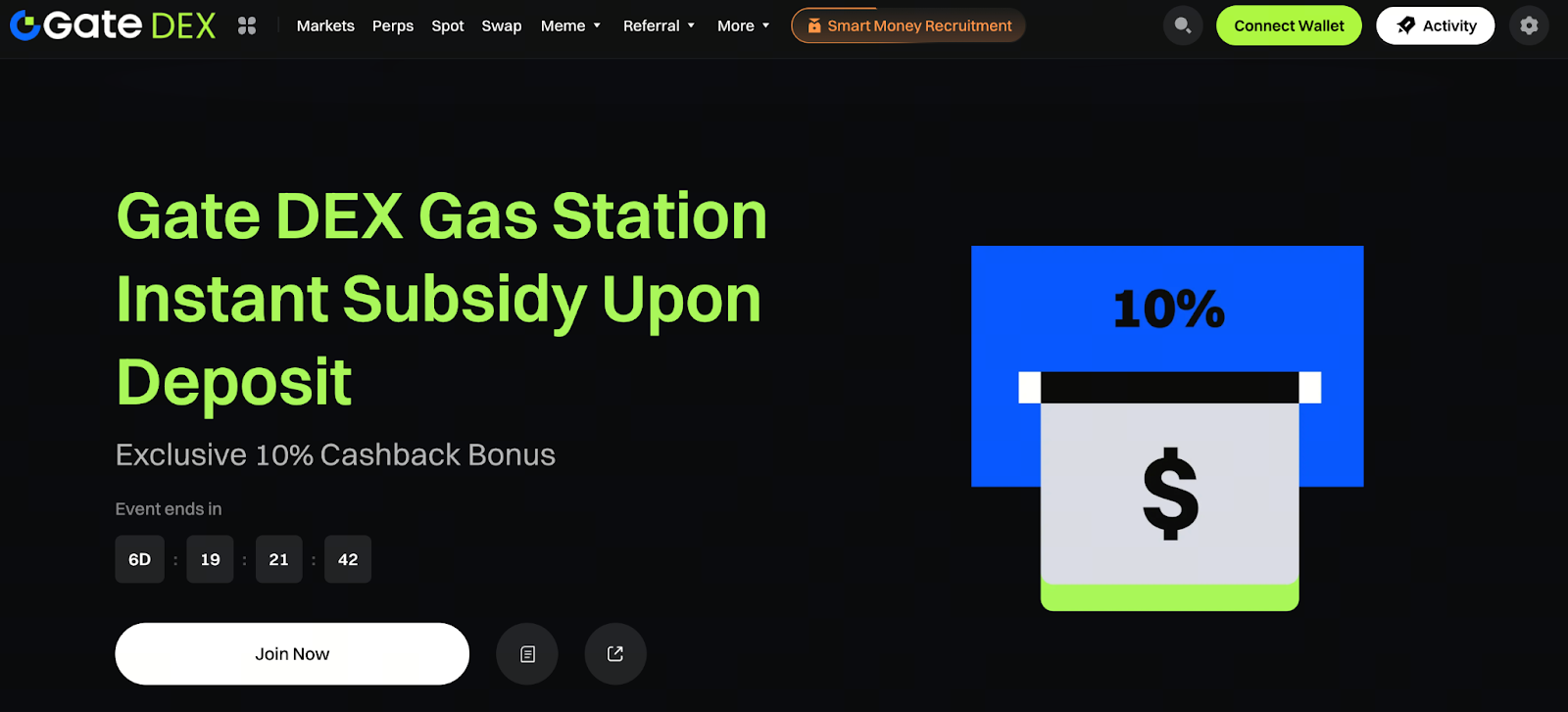

Image: https://web3.gate.com/campaigns/site-60

Gate Wallet’s Gas Station is not simply a subsidy or discount program. Instead, it aims to fundamentally reorganize how gas operates in a multi-chain environment.

The core idea is to turn gas into a platform-level capability, rather than a variable that users must manage separately for every transaction.

By centralizing complex gas logic within the wallet itself, Gate aims to minimize the preparatory steps users need to take before transacting, making on-chain interactions as seamless as using everyday tools.

How the Gas Account Mechanism Works

The Gas Station uses a dedicated gas account model. Each EVM wallet is linked to its own independent gas account, which covers network fees for on-chain activity.

If a user initiates a transaction on a network without enough native gas, the system automatically pays the fee from the gas account, ensuring the transaction is not interrupted. This process does not require additional smart contract authorizations and does not impact the user’s control over their main wallet assets.

This mechanism transforms unexpected gas shortages from an “operational risk” into a manageable background process.

Network Coverage and Supported Assets

Gate Wallet’s Gas Station currently supports a broad range of leading EVM networks, including Ethereum, BNB Smart Chain, Arbitrum, Base, Polygon, and Optimism, with ongoing expansion.

For funding, users can top up with more than 100 major cryptocurrencies, including GT, USDT, USDC, ETH, and BNB. This approach eliminates the need to repeatedly swap native tokens for different networks, making gas preparation more streamlined and unified.

Impact on Regular and High-Frequency Users

For regular users, the Gas Station reduces the “learning curve.” Even without understanding the gas mechanics of different chains, users can complete on-chain transactions smoothly.

For high-frequency users, this feature enhances operational stability by preventing delays caused by sudden gas shortages—especially valuable for those frequently interacting across chains or with multiple applications.

All user groups benefit directly from unified gas management.

Transparency, Security, and Control

Gate Wallet’s design prioritizes transparency without sacrificing convenience. Users can view gas account balances, payment history, and detailed spending records at any time for full oversight of their funds.

Moreover, the Gas Station does not require extra smart contract authorizations, reducing potential security risks and balancing emergency payments with asset safety.

Impact of Incentives on Usage Costs

To encourage adoption, Gate has launched limited-time incentives for the Gas Station, including preloaded subsidies for new users and cashback or referral bonuses for ongoing users.

While these incentives are not the core functionality, they effectively lower the barrier for users to try multi-chain transactions in the early stages, accelerating real-world adoption.

The Long-Term Value of Gate Gas Station

In the long run, the Gas Station is not a standalone feature but a critical component of Gate’s foundational Web3 user experience.

As multi-chain operations become the industry norm, platforms that best manage underlying complexity will be best positioned as stable Web3 gateways. By investing early in gas management, Gate is laying the groundwork for more frequent and diverse on-chain activity in the future.

Optimizing the core user experience rarely becomes an immediate focal point, but it ultimately determines a platform’s long-term competitiveness. The Gas Station is a concrete realization of this philosophy.

Author: Max
Disclaimer
* The information is not intended to be and does not constitute financial advice or any other recommendation of any sort offered or endorsed by Gate.
* This article may not be reproduced, transmitted or copied without referencing Gate. Contravention is an infringement of Copyright Act and may be subject to legal action.

Related Articles

What is Fartcoin? All You Need to Know About FARTCOIN
Intermediate

What is Fartcoin? All You Need to Know About FARTCOIN

Fartcoin (FARTCOIN) is a representative meme coin within the Solana ecosystem based on an AI-driven narrative. Its core concept originated from an experiment aimed at exploring the "boundaries between AI Agents and humor." More than just a digital asset with social attributes, the project deeply couples absurd humor culture with on-chain financial logic by integrating autonomous AI interaction models.
2026-04-04 22:01:19
Gold Price Forecast for the Next Five Years: 2026–2030 Trend Outlook and Investment Implications, Could It Reach $6,000?
Beginner

Gold Price Forecast for the Next Five Years: 2026–2030 Trend Outlook and Investment Implications, Could It Reach $6,000?

Analyze current gold price trends alongside authoritative five-year forecasts, integrating an evaluation of market risks and opportunities. This gives investors insight into the potential trajectory of gold prices and the main drivers expected to shape the market over the next five years.
2026-03-25 18:13:30
Aster vs Hyperliquid: Which Perp DEX Will Prevail?
Beginner

Aster vs Hyperliquid: Which Perp DEX Will Prevail?

Aster and Hyperliquid are the two representative protocols of the "purpose-built L1 path" within the current decentralized perpetual exchange (Perp DEX) sector. As a pioneer in the field, Hyperliquid has built a deep liquidity moat through its highly mature order book architecture and strong community consensus. Conversely, Aster, as a rising challenger, seeks to leapfrog the competition in high-performance trading through more aggressive multi-chain aggregation logic, private transaction modules, and an underlying execution environment optimized for 2026 market demands.
2026-03-24 11:58:33
AI-Native Settlement Layers: How United Stables Is Building the Next Financial Rail
Beginner

AI-Native Settlement Layers: How United Stables Is Building the Next Financial Rail

Stablecoins were originally designed as dollar substitutes within exchanges, primarily used for asset pricing and trade settlement. As on-chain financial ecosystems have matured, their role has expanded beyond simple payments to include collateral assets, cross-chain liquidity mediums, and unified settlement units. In particular, as AI systems and automated agents begin to participate directly in economic activity, demand has risen sharply for programmable value units capable of instant settlement. This shift is pushing stablecoins toward the role of foundational financial infrastructure.
2026-03-25 03:16:17
Aerodrome Tokenomics: How ve(3,3) Powers Base's Most Profitable DEX
Beginner

Aerodrome Tokenomics: How ve(3,3) Powers Base's Most Profitable DEX

AERO is the native token of Aerodrome Finance, a core decentralized exchange and liquidity protocol in the Base ecosystem. It is primarily used for liquidity incentives and ecosystem operations. veAERO is a governance NFT that users receive by locking AERO, representing both voting power and the right to share protocol revenue. Through a dual track structure of AERO as a utility token and veAERO as a governance credential, Aerodrome separates liquidity usage value from long term governance power, allowing participants to act as liquidity providers, governance decision makers, and revenue sharers within the same system.
2026-03-25 06:40:31
The ve(3,3) Flywheel Explained: How AERO Tokenomics Powers Aerodrome’s DeFi Economy
Beginner

The ve(3,3) Flywheel Explained: How AERO Tokenomics Powers Aerodrome’s DeFi Economy

In the competition for DeFi liquidity, high-inflation mining alone is no longer enough to build lasting advantages. Aerodrome applies the ve(3,3) economic model to redesign token emissions, voting mechanisms, and revenue distribution, creating a liquidity flywheel centered on governance and cash flow. This article examines AERO tokenomics, the veAERO locking mechanism, and protocol revenue models to explain how Aerodrome builds a sustainable DeFi economic system.
2026-03-25 06:41:58





