Summary
-
The crypto market offers abundant trading data but lacks systematic post-trade review. The introduction of AI has upgraded trading behavior analysis from simple statistics to structured, intelligent analysis.
-
Through a layered Agent architecture, OpenClaw connects “understanding, decision-making, and execution,” upgrading AI from an information analysis tool into an actionable task execution system.
-
Through MCP and modular Skills, Gate for AI standardizes trading, data, and analytical capabilities, enabling AI to participate directly in market analysis and trade execution.
-
Centered on the closed loop of “indicator analysis, behavior evaluation, risk identification, and optimization recommendations,” the AI advisory system enables automated and explainable trade review.
-
Current AI advisory systems already have practical value, but they still rely mainly on rules and statistics. In the future, they will evolve toward deeper quantitative modeling and more intelligent decision-making.
Introduction
With the development of artificial intelligence technologies, AI is being applied more and more widely in the financial sector. In investing, AI can help users analyze market information, summarize trading behavior, and support investment decision-making.
In the cryptocurrency market, trading is fast-paced and highly volatile. Investors often generate large volumes of trading records, but these data usually lack systematic post-trade review and analysis. Many traders can only evaluate their performance through simple profit-and-loss statistics, while finding it difficult to analyze their trading habits, strategy effectiveness, and potential problems in depth. Therefore, if AI can be used to automatically analyze users’ trading histories and generate structured review reports, investors will be better able to understand their own trading behavior.
OpenClaw is an open-source AI Agent framework that integrates large language models with external tools and data systems, enabling AI to perform tasks. Through OpenClaw, developers can build intelligent agent systems capable of calling APIs, analyzing data, and generating reports. Based on this framework, this paper designs and implements a prototype AI investment advisory system. The core function of the system is to conduct post-trade review analysis on users’ trading histories. By calculating key trading indicators and combining them with AI analysis, the system generates trade review reports to help users optimize their trading strategies.
OpenClaw Architecture Analysis
OpenClaw adopts a layered agent architecture, which can be divided into the control interface layer, message communication layer, gateway layer, agent runtime environment, and tools and capability layer. The core feature of this structure is that it decouples user entry, task scheduling, agent execution, and external tool invocation, thereby supporting the automated handling of complex tasks.
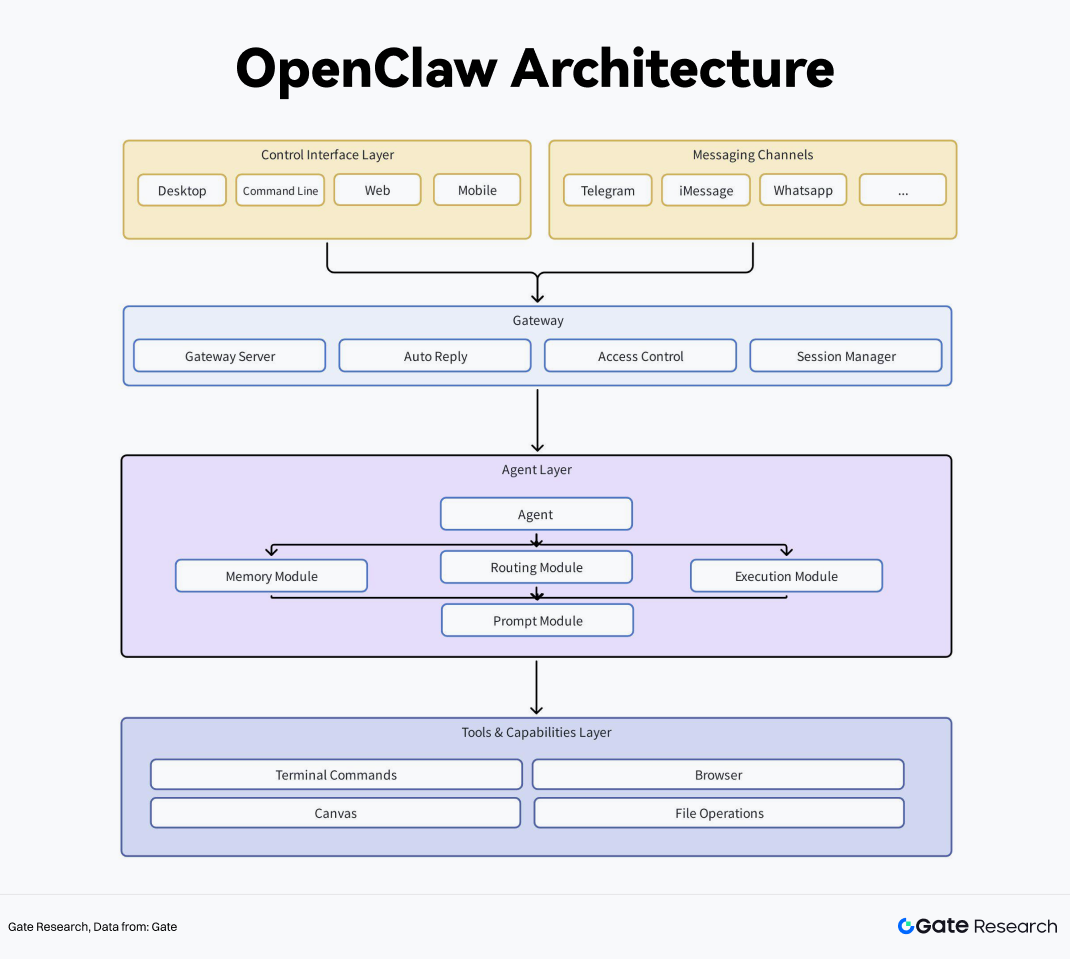
The control interface layer is responsible for receiving user requests and supports multiple interaction methods, including desktop, command line, web interface, and mobile devices. Running in parallel with it, the message communication layer connects external communication channels such as iMessage, WhatsApp, and Feishu, enabling the system not only to respond to active requests but also to distribute tasks and return results in messaging scenarios.
The gateway is the core hub of OpenClaw. The gateway server is responsible for unified access from different request sources and provides capabilities such as auto-reply, access control, and session management. On the one hand, it manages user session states to ensure continuity in multi-turn interactions; on the other hand, it handles request dispatching by forwarding external input to the lower-level agent runtime environment for processing.
At the execution layer, the agent runtime environment is responsible for specific task execution. This layer centers on agents and combines memory retrieval, tool executors, and prompt builders to complete reasoning and action generation. Among them, memory retrieval supplements contextual information, tool executors invoke external capabilities, and prompt builders integrate tasks, context, and tool results before passing them to the large language model, thus forming a complete intelligent decision-making chain.
The tools and capability layer provides agents with external execution abilities, including terminal commands, browsers, canvas, file operations, and scheduled tasks. This layer determines that OpenClaw can not only “understand problems” but also “execute tasks.” For AI investment advisory scenarios, this layer can be further extended with specialized tools for trading data queries, market data retrieval, indicator calculation, and message pushing.
OpenClaw Use Cases in the Crypto Market
OpenClaw’s applications in the crypto market are mainly reflected in integrating large language models with exchange interfaces, on-chain data, market analysis modules, and news/event sources. This enables Agents not only to “answer questions,” but also to carry out tasks such as market interpretation, account inquiry, trade execution, risk identification, and automated decision support. Gate for AI is a typical example.
3.1 Introduction to Gate for AI
Gate for AI is a crypto-financial infrastructure designed for AI Agents. Through MCP (Model Context Protocol) and a modular Skills system, it provides unified interfaces for trading, data, and analytical capabilities to agents such as OpenClaw, ChatGPT, and Claude. This system allows AI to directly access both centralized exchange (CEX) and decentralized exchange (DEX) capabilities, thereby carrying out complex tasks such as trade execution, market analysis, and asset management.
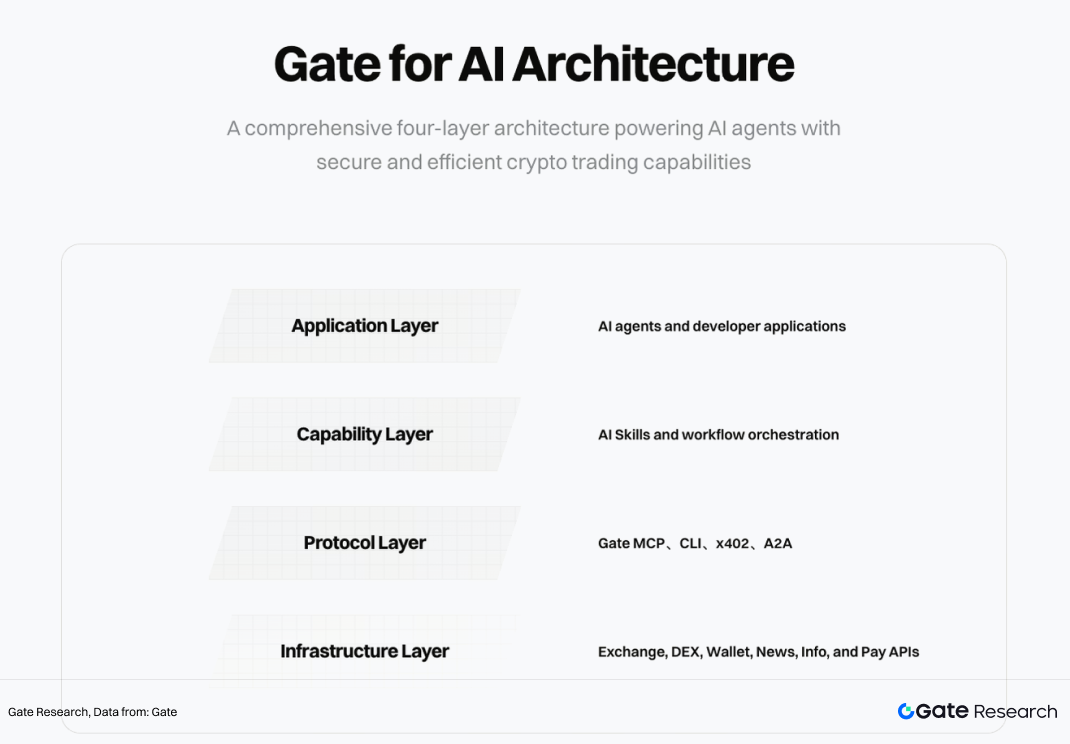
In terms of capabilities, Gate for AI supports five core functions: Trade, Analyze, Manage, Monitor, and Query on-chain data. These capabilities are exposed through standardized interfaces, allowing AI Agents to directly call underlying services without relying on a UI, thereby enabling automated decision-making and execution.
The system consists of five core modules. First, Gate Exchange for AI provides centralized trading capabilities, including spot, futures, and account management, and exposes them to Agents in the form of structured APIs. Second, Gate DEX for AI provides on-chain trading capabilities, supporting Swap, Perps, and multi-chain asset operations, enabling Agents to directly participate in the Web3 ecosystem. Third, Gate Wallet for AI provides secure wallet infrastructure, protecting asset security through plug-in mechanisms and hardware isolation. Fourth, Gate News for AI provides real-time market news and sentiment data, supporting information subscription and analysis. Finally, Gate Info for AI provides on-chain data and project information query capabilities, supplying data support for AI analysis.
Technically, Gate for AI uses MCP as its core interface protocol. MCP allows AI models to call external systems through standardized endpoints, enabling unified access to exchanges, wallets, and on-chain data. For example, public MCP interfaces can provide market quotes and candlestick data, while private MCP interfaces support trade execution and account management. In addition, the DEX, information, and news modules each provide independent endpoints, forming a complete data and capability system.
On top of MCP, Gate introduces the Skills mechanism, which packages complex capabilities into reusable modular tools. For example, capabilities such as market analysis, spot trading, futures trading, risk assessment, and news interpretation can each be invoked as independent Skills. After receiving a user request, an AI Agent can automatically match and trigger the relevant Skill, complete task execution by loading the corresponding instructions, and invoke MCP tools.
3.2 Three Typical Cases
The following are three representative application cases:
3.3.1 BTC/ETH Market Trend Analysis Assistant Relevant capabilities: gate-info-trendanalysis, gate-info-coinanalysis, gate-info-marketoverview
In this case, users can directly ask questions such as “How is BTC trending today?”, “Is ETH a good buy right now?”, or “How is the broader market overall?” The Agent first calls tools for market snapshots, candlestick data, technical indicators, and market overviews, and then the large language model produces a combined analysis of price trends, support and resistance levels, technical strength, and market sentiment.
Case value:
-
Replaces the need to manually switch between multiple market pages
-
Automatically converts indicator results into natural-language analysis
-
Supports both single-coin analysis and full-market overview
3.3.2 Intelligent Spot/Futures Trading Execution Assistant Relevant capabilities: gate-exchange-spot, gate-exchange-futures, gate-exchange-trading-copilot, gate-exchange-unified
In this case, users can express trading intent in natural language, such as “Help me buy BTC,” “Move ETH’s stop-loss to a certain price,” or “Check my current positions and assess the risk.” After understanding the user’s intent, the Agent calls exchange interfaces to query account status, positions, and open order information, and then completes operations such as placing orders, modifying orders, canceling orders, or conducting risk checks.
Case value:
-
Converts complex trading operations into natural-language commands
-
Can combine account status with risk judgment before execution
-
Suitable for building integrated trading copilots
3.3.3 News Event-Driven Market Explanation System
Relevant capabilities: gate-news-briefing, gate-news-eventexplain, gate-news-listing
In this scenario, users can ask questions such as “Why did BTC just drop?”, “What important news is there today?”, or “What new coins have recently been listed on exchanges?” The Agent calls news search, latest event stream, and announcement interfaces, and combines them with market data to judge the direction of the news event’s impact on price, ultimately outputting a structured explanation.
Case value:
-
Quickly identifies the reasons behind market anomalies
-
Connects news with price fluctuations
-
Strengthens the Agent’s market “explanatory capability,” rather than merely “reporting data”
AI Investment Advisory Architecture Based on OpenClaw
A professional AI investment advisory report should be built around the closed loop of “data analysis + behavior evaluation + decision recommendations.” Its core content includes the following aspects:
-
Overall performance and key indicators: summarizes account returns during the analysis period, including total return, number of trades, win rate, profit/loss ratio, and maximum drawdown, in order to quickly assess trading performance.
-
Trading behavior and strategy analysis: identifies users’ trading habits by analyzing holding periods, trading frequency, position distribution, and long/short preferences, and evaluates strategy effectiveness and market timing ability in combination with market conditions.
-
Risk assessment: focuses on identifying potential risk factors such as concentrated positions, overtrading, or high-volatility exposure, and analyzes their impact on earnings stability.
-
Problem summary and optimization recommendations: summarizes the core problems based on the above analysis and provides actionable improvement directions, such as optimizing position management, adjusting trading rhythm, or improving stop-loss mechanisms.
The overall structure follows a concise analytical path from indicator statistics to behavior and strategy analysis, then risk identification, and finally optimization recommendations, ensuring both professionalism and practical guidance value.
To realize automated AI investment advisory report generation, this section proposes building an AI investment advisory system for the crypto market based on the OpenClaw framework and combined with Gate MCP interfaces.
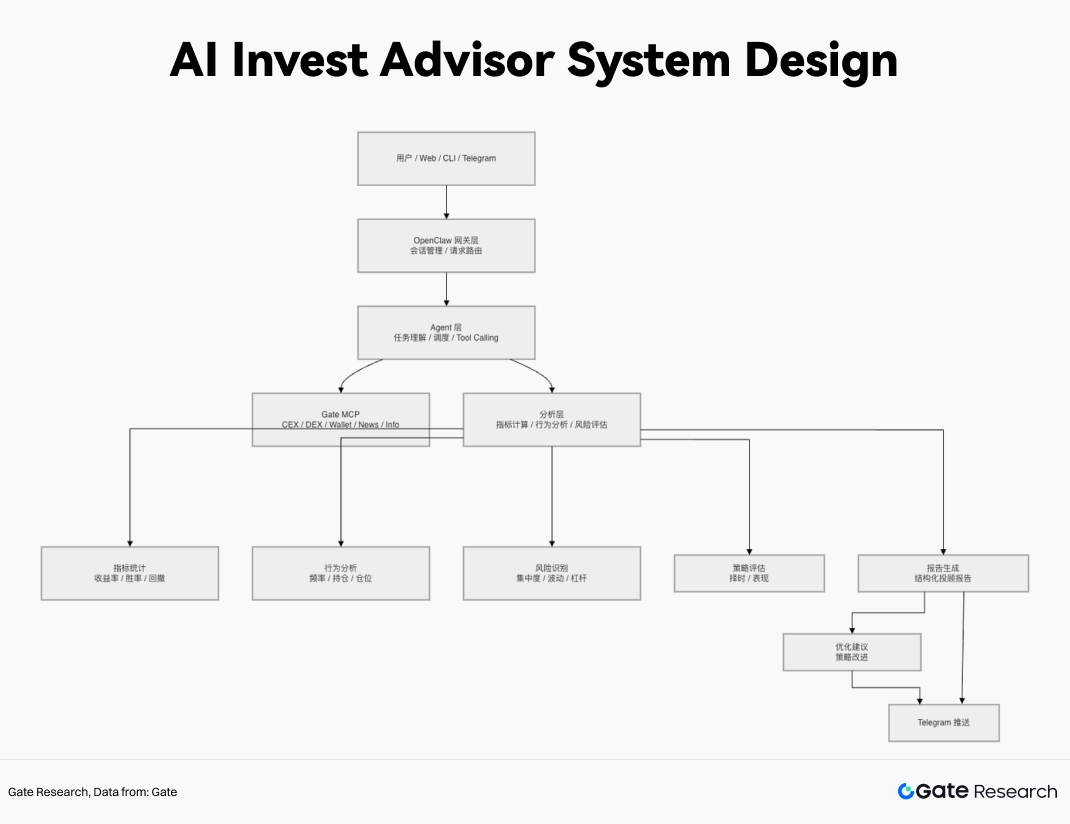
At the data layer, the system obtains users’ trading records, position information, and market data through Gate MCP, and provides them to the Agent in structured form. This establishes a unified data foundation for subsequent quantitative analysis and strategy evaluation.
At the analysis layer, the system builds indicator calculation and behavior analysis modules around the core structure of investment advisory reports. First, it quantitatively measures overall account performance, including key indicators such as total return, number of trades, win rate, profit/loss ratio, and maximum drawdown. Second, by analyzing holding periods, trading frequency, position distribution, and long/short preference, it identifies users’ trading behavior characteristics and evaluates strategy effectiveness and market timing ability in combination with market data. At the same time, the system evaluates risk exposure and identifies potential risks arising from concentrated positions, overtrading, or high-volatility assets.
At the Agent layer, OpenClaw is responsible for task understanding and workflow scheduling. Based on user requests, the Agent automatically calls Gate MCP data interfaces and analysis tools to complete the full process of “data acquisition, indicator calculation, and result integration,” and uses the large language model to explain and reason about the analytical results.
At the output layer, the system generates structured investment advisory reports based on the analytical results. The report includes overall performance assessment, trading behavior analysis, risk identification, and optimization recommendations, such as improving position management, adjusting trading frequency, or refining risk control strategies. Reports can be displayed and pushed through channels such as Telegram.
Results Demonstration
After execution, the user receives a daily investment analysis report covering the most recent 24 hours. The following is an example of the actual output:
📊 AI Investment Advisory Daily Report
Date: 2025-03-18
Analyzed account: Gate trading account
Main trading pairs: BTC/USDT, ETH/USDT
-
Daily Performance Overview
Daily return: +2.1%
Number of trades: 5
Win rate: 60% Largest single-trade profit: +3.4%
Largest single-trade loss: -1.8%
👉 Overall daily performance showed a small profit with controllable volatility
-
Trading Behavior Analysis
Trading was concentrated during the European and U.S. trading sessions
The main strategy was short-term trend following
Average holding time was about 2.5 hours
There was one momentum-chasing entry (opening a long position at a high level)
👉 Behavioral characteristics: active trading style with a relatively fast pace
-
Market and Timing Performance
BTC showed an intraday oscillating upward structure
Successfully captured 2 trend segments (profitable trades) There were 2 ineffective trades during the sideways phase
👉 Timing ability: good trend judgment, but insufficient recognition of sideways markets
-
Risk Assessment
Position usage was relatively high (peaking at about 70%)
One trade had no stop-loss set
High-frequency operations caused a certain amount of cost drag
👉 Main current risks: overtrading + oversized positions
-
Optimization Recommendations
Reduce trading frequency in choppy markets
Control position size per trade (recommended <50%)
Set stop-losses for all trades (≤2%)
Prioritize entering during periods with clear trends
-
Brief Summary
The day’s strategy was overall effective and able to generate profits during trending conditions, but there were ineffective trades and risk exposure during sideways phases. If trading rhythm and position management are optimized, return stability is likely to improve further.
From the output of this AI investment advisory report, it can be seen that the system is able to generate structured analytical content based on trading data and provide targeted optimization recommendations by combining key indicators, behavior analysis, and risk assessment. The report not only covers core indicators such as return, win rate, and maximum drawdown, but also further analyzes trading frequency, position distribution, and timing ability, making the results somewhat explainable and actionable. However, from a professional perspective, the current analysis is still mainly driven by statistics and rules, and there is still room for improvement in deep market environment modeling and strategy attribution. In the future, more sophisticated quantitative models and multi-factor analysis methods can be introduced.
Conclusion
Based on the OpenClaw framework and combined with the data and trading capabilities provided by Gate MCP, this paper designs and implements an AI investment advisory system for the crypto market. By constructing a complete workflow of “data access, indicator analysis, intelligent decision-making, and report generation,” the system realizes the automation of trade review analysis.
On this basis, the system performs systematic analysis of account performance, trading behavior, and risk exposure around the core structure of an investment advisory report, and generates structured reports and optimization recommendations through a large language model. At the same time, chart visualization and message push mechanisms are introduced to improve the practicality of the system and the user experience.
Overall, this system verifies the feasibility of the “LLM + MCP + Agent” architecture in financial analysis scenarios and provides an implementation path with real engineering value for the application of AI in crypto investment assistance.
References:
Gate Research is a comprehensive blockchain and cryptocurrency research platform that provides deep content for readers, including technical analysis, market insights, industry research, trend forecasting, and macroeconomic policy analysis.
Disclaimer
Investing in cryptocurrency markets involves high risk. Users are advised to conduct their own research and fully understand the nature of the assets and products before making any investment decisions. Gate is not responsible for any losses or damages arising from such decisions.