New Asset Roles Emerging from the Ethereum Consensus Upgrade
 With Ethereum’s shift to a new consensus mechanism, the entire blockchain network’s operating model has undergone a major transformation. The traditional system—where miners competed using hash power to secure the network—has been steadily replaced by asset staking.
In this new structure, ETH’s value is no longer determined solely by market price movements. Holders can now participate in network validation with their assets and earn ongoing on-chain rewards. As a result, ETH is evolving beyond a digital asset, taking on the characteristics of an income-generating asset and assuming a more diverse role within the blockchain ecosystem.
Liquidity Challenges of Traditional Staking Models
While staking provides stable on-chain returns, traditional models typically require assets to be locked for a set period. This approach can create limitations in real-world investment scenarios.
For instance, when short-term trading opportunities arise, locked assets cannot be reallocated immediately. During periods of rapid market change, investors lose the flexibility to adjust their portfolios. Extended lock-up periods can also reduce the overall agility of an investment portfolio.
In the highly volatile crypto marketplace, liquidity is closely tied to investment efficiency. As a result, the market is increasingly seeking solutions that offer both yield and flexibility.
Liquid Staking: Greater Flexibility for ETH Holders
To address the constraints of asset lock-up, liquid staking has emerged as a leading model in the marketplace.
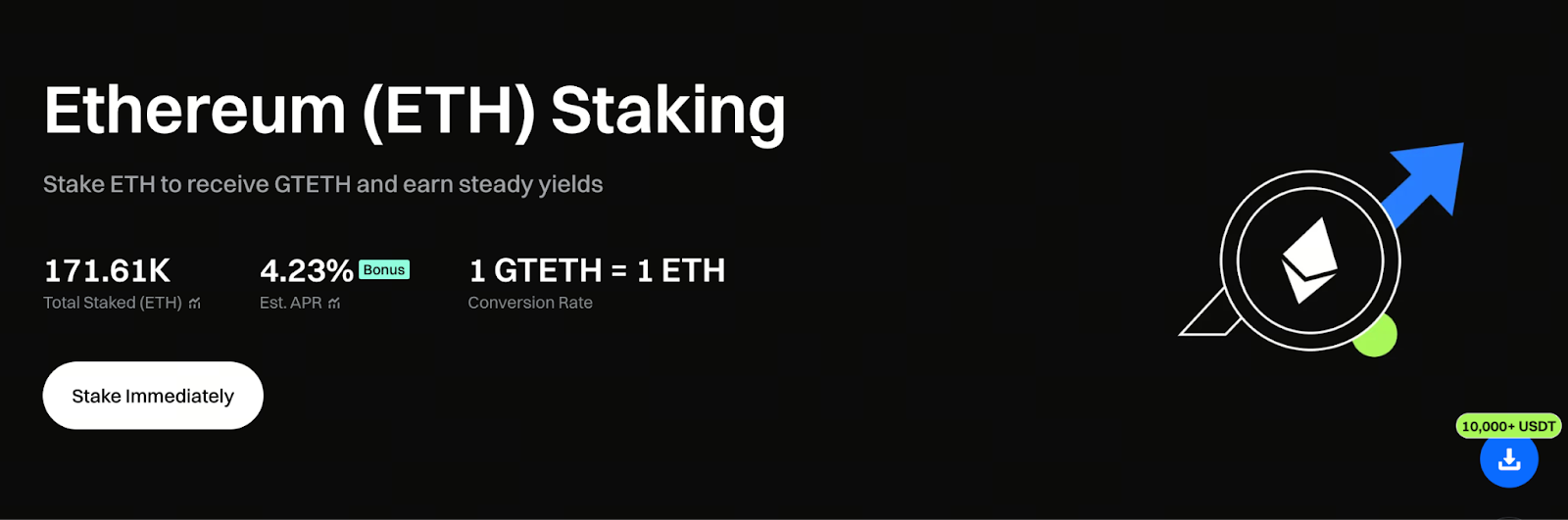
Under Gate’s ETH staking mechanism, when users stake ETH, the system issues an equivalent amount of GTETH as proof of assets. This means users maintain a tradable asset while participating in staking. Unlike traditional staking, GTETH rewards are not distributed as additional tokens; instead, they are reflected over time in the asset’s value. Staking returns naturally accumulate in the overall value of GTETH.
Platform-Based Staking Lowers Entry Barriers
In the early days, becoming an Ethereum validator required significant capital and technical expertise. Setting up nodes, managing servers, and ensuring network stability demanded both time and technical resources.
For many retail investors, these requirements made participation challenging. Platform-based staking services have simplified the process. Users only need to deposit ETH into the designated mechanism to earn staking returns, without managing node operations or system maintenance.
Additionally, GTETH is fully backed by ETH reserves—each GTETH corresponds to actual staked ETH—making the system transparent and easy to understand.
GTETH Sources of Return and Key Influencing Factors
GTETH returns are primarily derived from two sources:
-
On-chain validation rewards. Staked ETH participates in Ethereum’s block validation and network security, earning block rewards according to protocol rules. These returns are gradually reflected in GTETH’s accumulated value.
-
During special events, the platform may introduce additional incentive programs, providing extra sources of return for staking participants.
Actual returns are variable and may be influenced by factors such as total staked volume, block production efficiency, and network performance. The platform also typically charges a service fee to cover node maintenance and system operations.
Start your on-chain mining income journey now by participating in Gate ETH staking: https://www.gate.com/staking/ETH?ch=ann46659
Investment Strategy Flexibility with Liquid Staking
Compared to traditional staking, the greatest advantage of liquid staking is asset utility. Investors holding GTETH can earn on-chain returns while maintaining capital flexibility. When market conditions shift, it’s easier to adjust asset allocations or incorporate assets into more complex investment strategies. Staking is no longer just about locking assets for yield—it’s now an asset management tool that integrates seamlessly with broader investment strategies.
Enhancing Capital Efficiency in Volatile Markets
Crypto markets are known for high volatility, where opportunity and risk coexist. When assets are locked for long periods, investors may struggle to respond quickly to market changes.
GTETH transforms previously locked staking equity into a tradable asset, allowing investors to maintain liquidity while earning on-chain rewards. This design boosts asset efficiency and aligns with the fast-paced nature of the crypto marketplace.
Summary
As the Ethereum ecosystem matures, investors’ expectations for asset efficiency continue to rise. Beyond potential price appreciation, on-chain returns and capital liquidity are becoming central to asset allocation decisions. Gate’s liquid staking mechanism converts ETH that would otherwise be locked into tradable GTETH, enabling investors to benefit from both staking yields and asset flexibility. In a rapidly evolving crypto market, tools that balance yield and liquidity are increasingly essential—and liquid staking is quickly becoming a key asset management strategy within the Ethereum ecosystem.