What Are Gate ETF Leveraged Tokens?
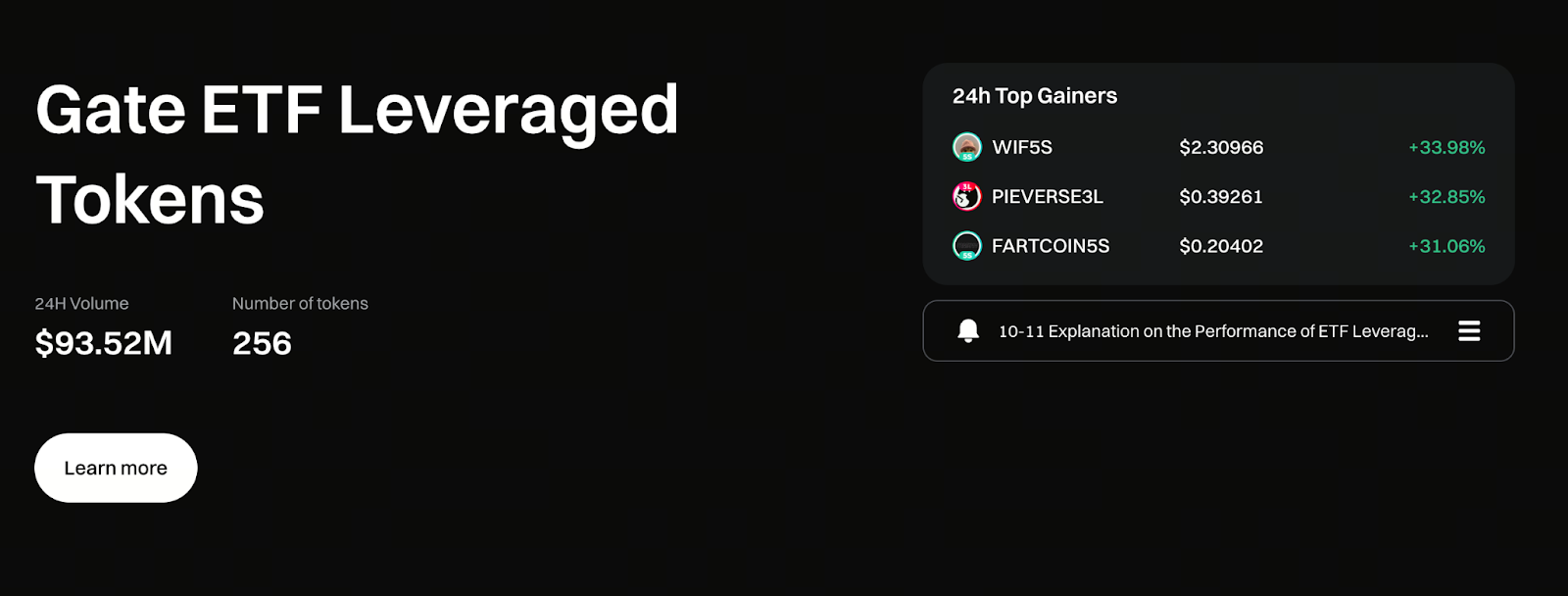
Image: https://www.gate.com/leveraged-etf
Gate ETF Leveraged Tokens are crypto derivative tokens built on perpetual contract strategies. Their primary goal is to provide users with fixed-multiple (e.g., 2x, 3x) amplified returns or losses.
Unlike traditional contract trading, ETF leveraged tokens are directly tradable digital assets. Users can access leveraged exposure by simply buying and selling them, just like spot trading.
For example:
- Bullish tokens: BTC3L, ETH3L
- Bearish tokens: BTC3S, ETH3S
When the underlying asset exhibits a clear trend, ETF leveraged tokens can proportionally magnify gains or losses.
Core Mechanisms of Gate ETF Leveraged Tokens
Gate ETF leveraged tokens are not simple price trackers. Instead, they achieve target leverage through dynamically managed perpetual contract positions.
1. Auto Rebalancing Mechanism
To maintain a fixed leverage ratio, the system automatically adjusts positions under certain conditions. This rebalancing serves two main purposes:
- Risk control
- Ensuring the token’s leverage properties remain effective over time
Compared to manually managing contract positions, this mechanism is more suitable for users seeking to reduce operational complexity.
2. No Forced Liquidation
ETF leveraged tokens do not have a liquidation threshold like traditional contracts. Even during sharp market swings, tokens are not forcibly reduced to zero. Instead, the rebalancing mechanism manages risk exposure.
It’s important to note that “no forced liquidation” does not mean “no risk”—extreme market conditions can still cause significant drawdowns.
3. Management Fee Structure
To maintain the underlying contract positions, ETF leveraged tokens charge a daily management fee. This ongoing cost makes them unsuitable for long-term holding.
What Trading Scenarios Are Gate ETF Leveraged Tokens Suitable For?
ETF leveraged tokens are not universal investment tools—they are highly scenario-specific trading products.
1. Clear Trending Markets
When the market is in a sustained uptrend or downtrend, ETF leveraged tokens can significantly amplify returns, making them ideal for trend-following strategies.
2. Short-Term and Swing Trading
Because of rebalancing and management fees, ETF leveraged tokens are best suited for short holding periods, such as intraday or multi-day swing trading—not long-term holding.
3. Hedging Spot Positions
Some traders use bearish ETF leveraged tokens to hedge spot positions, helping reduce overall account volatility during downturns.
Potential Risks of ETF Leveraged Tokens
Although Gate ETF leveraged tokens are easy to operate, they still carry the following risks:
1. Net Value Decay in Sideways Markets
In range-bound markets, frequent rebalancing can cause gradual net value decay. Even if the price returns to its original level, the token’s net value may fall below the starting point.
2. Leverage Magnifies Losses
If your market direction is incorrect, losses are also magnified, requiring robust risk management.
3. Not Suitable for Long-Term Holding
Management fees and volatility decay mean ETF leveraged tokens are not intended as long-term “buy and hold” assets.
How to Use Gate ETF Leveraged Tokens Rationally
The following principles are critical when using ETF leveraged tokens:
- Only participate when the trend is clear
- Strictly control position size
- Do not treat them as long-term investments
- Combine with spot or other low-risk assets
Position ETF leveraged tokens as “tactical tools” rather than “core holdings” to align with their intended design.
Conclusion: The Role of Gate ETF Leveraged Tokens
Gate ETF leveraged tokens are not designed for all investors—they serve as an efficient tool for active traders.
They can deliver significant returns in trending markets, but require extra caution in sideways conditions. Understanding how they work and their risk boundaries is far more important than simply chasing high returns.
As the crypto market matures, products like Gate ETF leveraged tokens—which bridge spot and contract trading—are becoming the choice of a growing number of traders.