FDIC Pushes Forward the GENIUS Act: U.S. Banks May Soon Be Allowed to Issue Stablecoins

Beginner
Quick Reads
Last Updated 2026-03-26 20:39:57
Reading Time: 1m
As the FDIC begins implementing the GENIUS Act, the timeline for U.S. banks to issue stablecoins is coming into sharper focus. This article explores the potential impact of bank-issued stablecoins, drawing on the latest regulatory developments and market pricing.

Key Signals from the Latest FDIC Policies
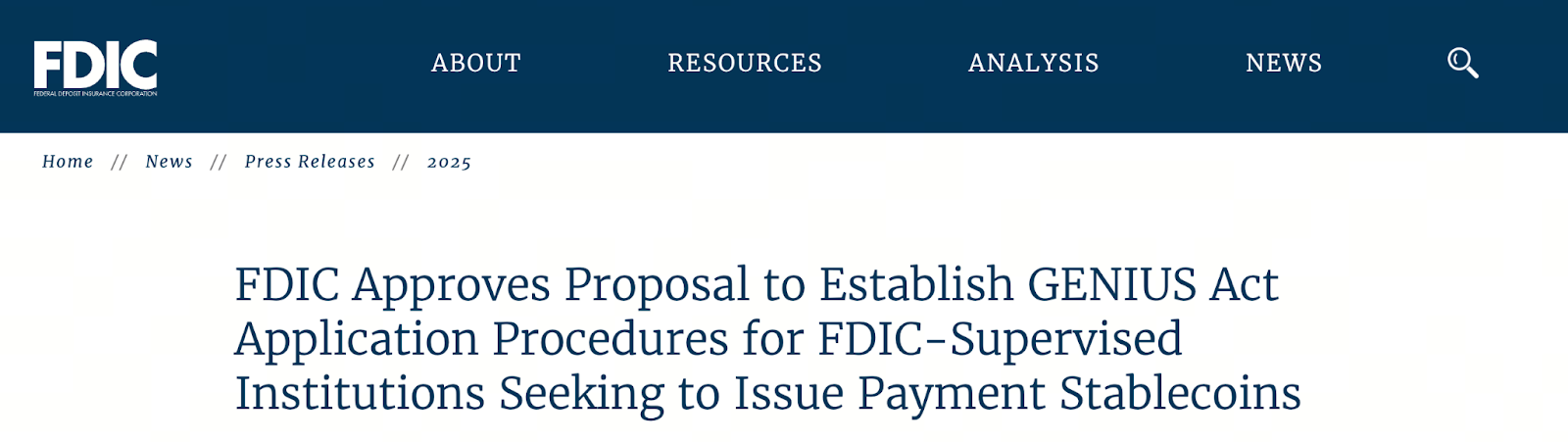

Source: https://www.fdic.gov/news/press-releases/2025/fdic-approves-proposal-establish-genius-act-application-procedures-fdic

At the end of 2025, the Federal Deposit Insurance Corporation (FDIC) officially introduced a stablecoin implementation framework based on the GENIUS Act. This marks the first time US federal authorities have provided a clear, lawful pathway for banks to issue stablecoins, representing a major regulatory milestone.

The FDIC’s approach does not promote unchecked innovation. Instead, it prioritizes compliance, control, and risk isolation. Banks seeking to issue stablecoins must establish subsidiaries, maintain separate asset accounting, and submit to ongoing oversight. This shift demonstrates that US regulators have moved from debating whether to permit stablecoins to focusing on how to allow them safely.

This policy shift is pivotal for the market. It signals that stablecoins are no longer just tools for crypto-native firms—they are being integrated into the mainstream financial system.

Core Regulatory Principles of the GENIUS Act

The GENIUS Act establishes a unified legal and regulatory framework for US dollar-backed payment stablecoins. Key requirements include:

  • Stablecoins must be backed 1:1 by highly liquid assets
  • Reserves must be regularly disclosed and audited
  • Issuers must implement robust anti-money laundering (AML) and risk management systems
  • Stablecoin reserves cannot be used for high-risk investments

These provisions directly address longstanding concerns about stablecoin transparency and systemic risk. Unlike previous state-level or gray-area compliance approaches, the GENIUS Act significantly boosts regulatory credibility for stablecoins.

For US banks, the Act provides a clear legal foundation to participate in stablecoin issuance within a compliant framework.

How US Banks Can Enter the Stablecoin Market

In practice, US banks cannot issue stablecoins overnight. Under the FDIC framework, banks must:

  • Set up a dedicated stablecoin-issuing entity
  • Submit detailed business models and technical architecture documentation
  • Demonstrate the security and liquidity of their reserve assets
  • Undergo ongoing regulatory oversight and stress testing

This process means that large commercial or systemically important banks will likely lead the way, while smaller banks may face higher technical and compliance barriers.

Once launched, bank-issued stablecoins are expected to find early use in cross-border payments, institutional clearing, and corporate settlements.

Stablecoin Market Pricing and Capital Structure Shifts

Currently, major stablecoins such as USDC and USDT remain close to their $1 peg, reflecting continued market confidence.

However, as expectations for bank-issued stablecoins grow, the market is reassessing the credit profiles of different stablecoins. Stablecoins issued by banks and regulated by agencies like the FDIC may be seen by institutional investors as lower-risk alternatives.

This could reshape capital flows among stablecoins over the medium to long term, rather than causing immediate price volatility.

Implications of Bank Stablecoins for the Crypto Industry

Should US banks formally enter the stablecoin sector, several impacts are likely:

  • Heightened competition in payment systems: Bank stablecoins could challenge existing crypto stablecoins in payment applications
  • Higher compliance standards: Regulatory requirements may raise the industry’s entry bar
  • Greater institutional participation: Traditional institutions may more readily accept bank-issued digital dollars

Over time, this shift represents not a squeeze on the crypto industry, but a structural upgrade.

Risks Investors Should Monitor

Despite positive policy momentum, uncertainties remain:

  • Rules are still in early implementation and may be revised
  • The rollout of bank stablecoins could be slower than market expectations
  • Competition among stablecoins may intensify differentiation

Investors should focus on how regulatory changes affect industry structure, rather than short-term price swings.

Looking Ahead: Future Trends

The GENIUS Act and ongoing FDIC rulemaking are paving the way for US banks to issue stablecoins. In the coming years, stablecoins are poised to become a crucial bridge between traditional finance and blockchain, expanding well beyond their current role as crypto trading instruments.

Author: Max
Disclaimer
* The information is not intended to be and does not constitute financial advice or any other recommendation of any sort offered or endorsed by Gate.
* This article may not be reproduced, transmitted or copied without referencing Gate. Contravention is an infringement of Copyright Act and may be subject to legal action.

Related Articles

What is Fartcoin? All You Need to Know About FARTCOIN
Intermediate

What is Fartcoin? All You Need to Know About FARTCOIN

Fartcoin (FARTCOIN) is a representative meme coin within the Solana ecosystem based on an AI-driven narrative. Its core concept originated from an experiment aimed at exploring the "boundaries between AI Agents and humor." More than just a digital asset with social attributes, the project deeply couples absurd humor culture with on-chain financial logic by integrating autonomous AI interaction models.
2026-04-04 22:01:19
Gold Price Forecast for the Next Five Years: 2026–2030 Trend Outlook and Investment Implications, Could It Reach $6,000?
Beginner

Gold Price Forecast for the Next Five Years: 2026–2030 Trend Outlook and Investment Implications, Could It Reach $6,000?

Analyze current gold price trends alongside authoritative five-year forecasts, integrating an evaluation of market risks and opportunities. This gives investors insight into the potential trajectory of gold prices and the main drivers expected to shape the market over the next five years.
2026-03-25 18:13:30
Aster vs Hyperliquid: Which Perp DEX Will Prevail?
Beginner

Aster vs Hyperliquid: Which Perp DEX Will Prevail?

Aster and Hyperliquid are the two representative protocols of the "purpose-built L1 path" within the current decentralized perpetual exchange (Perp DEX) sector. As a pioneer in the field, Hyperliquid has built a deep liquidity moat through its highly mature order book architecture and strong community consensus. Conversely, Aster, as a rising challenger, seeks to leapfrog the competition in high-performance trading through more aggressive multi-chain aggregation logic, private transaction modules, and an underlying execution environment optimized for 2026 market demands.
2026-03-24 11:58:33
AI-Native Settlement Layers: How United Stables Is Building the Next Financial Rail
Beginner

AI-Native Settlement Layers: How United Stables Is Building the Next Financial Rail

Stablecoins were originally designed as dollar substitutes within exchanges, primarily used for asset pricing and trade settlement. As on-chain financial ecosystems have matured, their role has expanded beyond simple payments to include collateral assets, cross-chain liquidity mediums, and unified settlement units. In particular, as AI systems and automated agents begin to participate directly in economic activity, demand has risen sharply for programmable value units capable of instant settlement. This shift is pushing stablecoins toward the role of foundational financial infrastructure.
2026-03-25 03:16:17
Aerodrome Tokenomics: How ve(3,3) Powers Base's Most Profitable DEX
Beginner

Aerodrome Tokenomics: How ve(3,3) Powers Base's Most Profitable DEX

AERO is the native token of Aerodrome Finance, a core decentralized exchange and liquidity protocol in the Base ecosystem. It is primarily used for liquidity incentives and ecosystem operations. veAERO is a governance NFT that users receive by locking AERO, representing both voting power and the right to share protocol revenue. Through a dual track structure of AERO as a utility token and veAERO as a governance credential, Aerodrome separates liquidity usage value from long term governance power, allowing participants to act as liquidity providers, governance decision makers, and revenue sharers within the same system.
2026-03-25 06:40:31
Hybrid Collateral Stablecoins: Inside United Stables' Stability and Yield Architecture
Beginner

Hybrid Collateral Stablecoins: Inside United Stables' Stability and Yield Architecture

In the early stages of the crypto market, traditional stablecoins mainly relied on single-reserve or single-collateral models. Their primary focus was price stability and payment convenience, which allowed them to become foundational tools for on-chain trading and capital flows. As the market has entered a more mature financial phase, however, this structure has begun to reveal limitations, including high concentration risk and the difficulty of balancing liquidity with yield. These constraints have driven the evolution toward multi-layer collateral and portfolio-based designs, such as the dual-layer hybrid collateral architecture proposed by United Stables, which seeks to redefine the underlying logic of stable assets.
2026-03-25 03:17:39





