As one of the most representative insurance groups in the world, AIG (American International Group) has long focused on property insurance, liability insurance, commercial insurance, and risk management services. It provides a wide range of insurance solutions for corporate clients, institutional investors, and individual users. With a business network spanning many countries and regions, AIG has become an important participant in the international insurance market.
For investors studying the insurance industry, AIG is not just an insurance company. It is also an important window into the global risk management market, corporate insurance demand, and broader trends in the insurance sector.
What Is AIG (American International Group)
From a business perspective, AIG belongs to the insurance industry. Its core businesses include property insurance, liability insurance, commercial insurance, and related risk management services. Unlike banks, which generate income through lending, an insurance company’s main role is to help clients transfer risk and earn profits through premium income and investment returns.
AIG is the stock ticker of American International Group. The company is headquartered in New York, United States, and is one of the world’s best-known insurance and risk management groups.
AIG serves a very broad customer base, including large multinational corporations, small and medium-sized businesses, and some individual clients. Because its business covers multiple industries and regions, the company is involved in a wide range of economic activities, including manufacturing, aviation, energy, healthcare, and international trade.
In the global insurance market, AIG has long been regarded as one of the representative companies among large comprehensive insurance groups. Its business scale and level of internationalization give it significant influence within the industry.
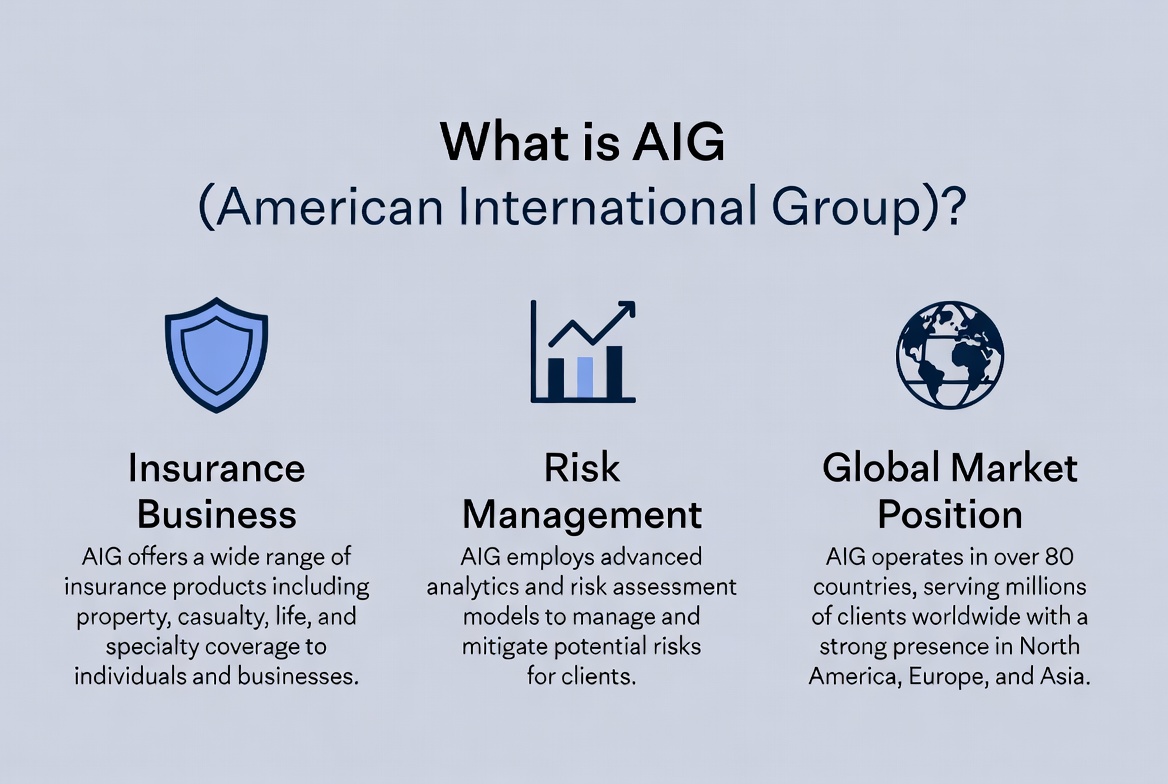
The History and Market Positioning of American International Group
AIG was founded in 1919 and has a history of more than 100 years. The company began with international insurance operations, then gradually expanded into global markets and grew into one of the world’s leading insurance groups.
Over the past several decades, AIG has gone through multiple stages, including rapid expansion, global development, and business restructuring. In particular, the company has built deep experience in large corporate insurance and multinational risk management, while establishing a service network across major economies around the world.
Today, AIG’s market positioning is more focused on property and commercial insurance. Compared with some insurers that mainly focus on personal auto and home insurance, AIG is better suited to serving corporate clients and complex risk scenarios, such as large engineering projects, cross-border trade activities, and professional liability insurance.
This positioning allows the company to remain competitive in the global commercial insurance market, while also making risk management capability one of its core competitive strengths.
How AIG’s Insurance Business Works
An insurance company’s business model is built on the mechanism of risk pooling. After customers pay premiums, the insurance company assumes the potential risk of losses within the agreed scope. When an insured event occurs, the company pays claims according to the contract.
AIG builds risk pools by covering a large number of customers and different categories of risk. Since not all customers will file claims at the same time, insurance companies can use statistical principles to manage overall risk levels and achieve long-term operations through reasonable pricing.
In addition to premium income, insurance companies also invest and manage premium funds. Before claim obligations arise, these funds can generate investment returns, which become an important source of profit for insurance companies.
For AIG, the focus of its business is not only selling insurance products, but also assessing risk, managing risk, and designing protection plans that meet customer needs. Risk pricing and underwriting capabilities often have a direct impact on an insurance company’s long-term profitability.
AIG’s Property and Commercial Insurance System
Property and commercial insurance are among AIG’s core business segments and are also important sources of the company’s revenue.
Property insurance mainly helps clients deal with risks such as building damage, equipment damage, natural disasters, and other property losses. For example, factories, office buildings, logistics warehouses, and commercial facilities may all need this type of insurance coverage.
Commercial insurance covers a broader range of business operating risks, including liability insurance, professional liability insurance, cyber insurance, employee-related insurance, and industry-specific insurance solutions. As the modern business environment becomes increasingly complex, commercial insurance is becoming more important.
For large multinational companies, operations often involve multiple countries and regions, which means they need unified global insurance solutions. With its international network and professional risk management capabilities, AIG can help clients build cross-regional protection systems. This is one of its key advantages in the commercial insurance market.
Why Risk Management Has Become Central to AIG’s Business
The essence of the insurance industry is not selling policies, but managing risk. Risk management capability determines whether an insurance company can operate steadily over the long term.
For AIG, risk assessment runs through the entire business process. Before underwriting, the company needs to analyze a client’s risk level. During the underwriting process, it needs to continuously monitor potential changes in risk. After a claim event occurs, it also needs to control claim costs and improve risk models.
As the global economic environment changes, the types of risks businesses face are becoming increasingly complex. From cyberattacks to supply chain disruptions, from natural disasters to volatility in global trade, companies need more professional risk management services. As a result, insurance companies are gradually evolving from simple claim-paying institutions into comprehensive risk management service providers.
AIG’s long-standing focus on corporate insurance has allowed it to accumulate extensive experience in complex risk analysis and the design of professional insurance solutions. This capability not only affects customer choice, but also directly influences the company’s profitability and market position.
AIG’s Role in the Global Insurance Market
The global insurance market is an important part of the modern financial system. Through risk pooling, the insurance industry helps businesses and individuals carry out economic activity, thereby improving society’s overall ability to withstand risk.
As one of the world’s large insurance groups, AIG plays an important role in the international insurance market. The company serves clients across multiple countries and regions, and its insurance products cover many industries, including aviation, energy, manufacturing, healthcare, finance, and technology.
For multinational companies, international operations often involve different legal environments and risk factors. With its global operating network, AIG can help companies build a unified risk management framework, reducing operational uncertainty.
From an industry perspective, AIG is not only an insurance service provider, but also an important participant in the global risk management ecosystem. Its business activities are closely connected to international trade, capital markets, and corporate operations.
How AIG Differs from Chubb and Travelers
AIG, Chubb, and Travelers are all important companies in the U.S. insurance industry, but their business priorities differ clearly.
| Company |
Core Positioning |
Main Strengths |
| AIG |
Global commercial insurance group |
International footprint and corporate risk management |
| Chubb |
High-end property and liability insurance |
High-end clients and global insurance services |
| Travelers |
Leading U.S. property insurance company |
Domestic market coverage and stable operations |
AIG’s most distinctive feature is its broad international business coverage and long-term focus on the large corporate insurance market. Chubb has strong competitiveness in the high-end insurance market, while Travelers is more focused on property insurance in the U.S. domestic market.
Therefore, although all three companies belong to the insurance industry, they differ in customer structure, market layout, and risk management strategy.
AIG’s Main Use Cases
AIG’s insurance products are widely used across many areas of modern economic activity.
Large enterprises are among AIG’s most important customer groups. When companies build factories, conduct international trade, operate logistics networks, or manage employees, they need corresponding insurance solutions to reduce risk exposure.
Energy, aviation, healthcare, and manufacturing are also major application areas. These industries usually face higher operational risks, so their demand for professional insurance and risk management services is relatively strong.
In addition, as the digital economy develops, demand continues to grow for cyber insurance, data risk management, and new forms of liability insurance. AIG is also expanding related businesses to meet the emerging risk challenges companies face.
How to Buy AIG (American International Group) Stock
AIG is listed on the New York Stock Exchange (NYSE), with the stock ticker AIG. Investors can usually buy AIG shares through a brokerage account that supports U.S. stock trading, allowing them to participate in the development of the global insurance industry.
The operating performance of insurance companies is usually affected by premium growth, changes in loss ratios, investment returns, and the overall economic environment. Therefore, when investors follow AIG, they often pay close attention to key indicators such as underwriting profit, the combined ratio, and investment portfolio performance.
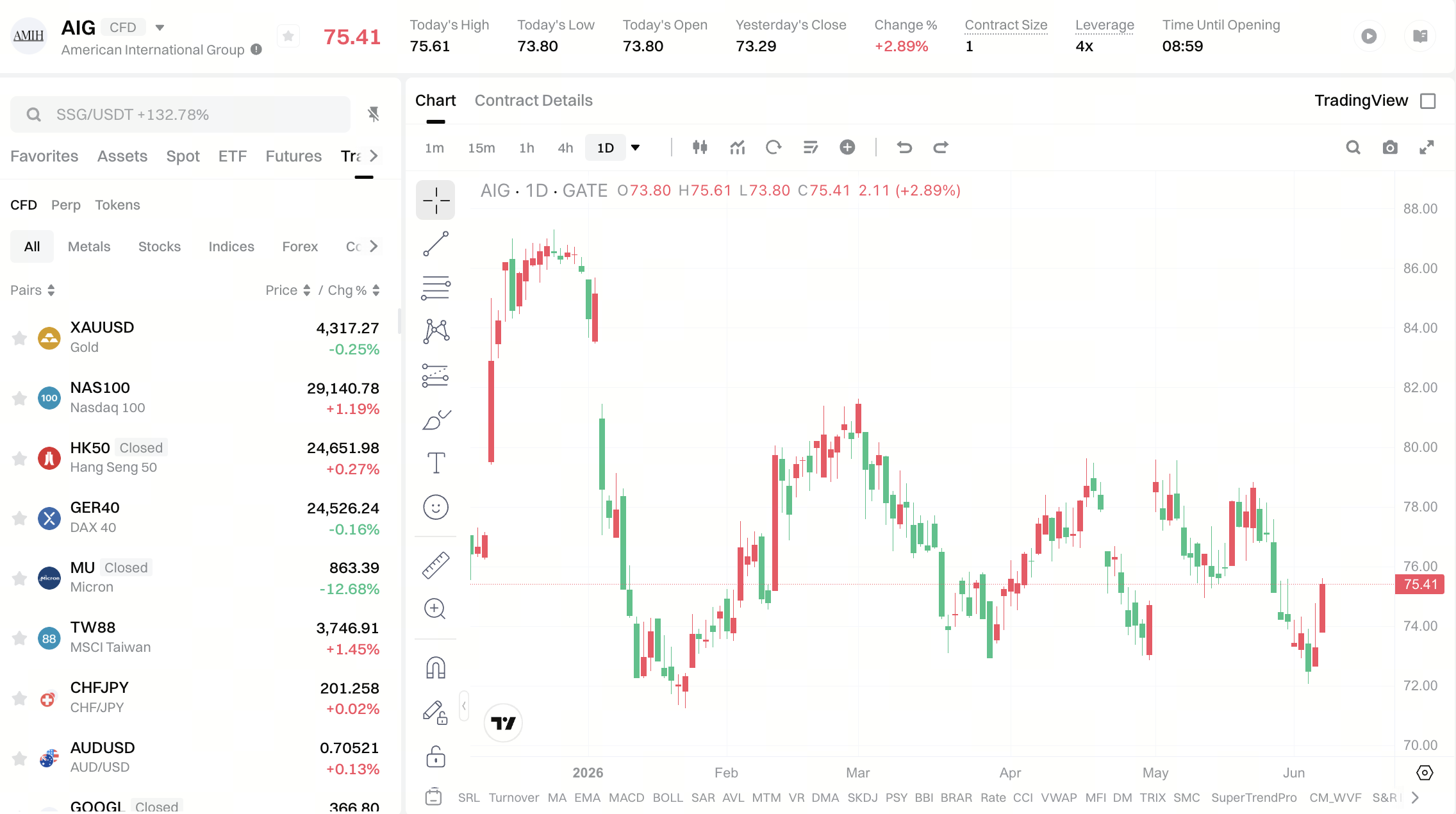
As digital asset markets and traditional financial markets gradually become more integrated, some platforms have begun offering financial products linked to U.S. stock prices. Gate TradFi is continuing to expand its coverage of traditional financial assets, allowing users to follow digital assets, U.S. stocks, ETFs, indexes, and commodity markets within the same account environment. Some markets also offer Gate CFD products, providing more options for cross-market asset management.
No matter how investors choose to participate in the market, they should fully understand the relevant product mechanisms, risk characteristics, and local regulatory requirements.
AIG’s Strengths and Limitations
AIG’s greatest strengths lie in its global business network and risk management capabilities built over many years. The company serves many large corporate clients and holds a strong market position in commercial insurance and specialty insurance.
At the same time, the insurance industry has relatively high barriers to entry. Underwriting experience, risk models, capital strength, and brand reputation all require long-term accumulation, which gives large insurance groups strong competitive barriers.
However, AIG also faces challenges common across the insurance industry. For example, more frequent natural disasters, rising claim costs, and fluctuations in financial markets may all affect an insurer’s profitability. In addition, the insurance industry is strictly regulated, and capital management requirements are relatively high. As a result, AIG has the long-term development advantages of the insurance industry, but it must also continue to respond to the challenges created by a complex risk environment.
Summary
AIG (American International Group) is one of the world’s best-known insurance groups. Its core businesses cover property insurance, commercial insurance, and risk management services. By helping businesses and individuals transfer risk, manage risk, and build protection systems, AIG holds an important position in the global insurance market. As corporate demand for risk management grows, international business activity expands, and emerging risks continue to appear, the importance of the insurance industry continues to rise. AIG also continues to play a role as an important participant in the global insurance ecosystem.
FAQs
What kind of company is AIG?
AIG is the stock ticker of American International Group and is one of the world’s best-known insurance and risk management groups.
What are AIG’s main businesses?
Its main businesses include property insurance, commercial insurance, liability insurance, and corporate risk management services.
How does AIG make money?
The company mainly earns profits through premium income and investment returns on insurance funds.
What is commercial insurance?
Commercial insurance mainly helps companies manage various risks in the course of business operations, such as property losses, liability disputes, and operational interruptions.
How is AIG different from Chubb?
AIG places more emphasis on global corporate insurance and risk management services, while Chubb has strong influence in the high-end insurance market.
Why is risk management important?
Risk management can help companies reduce potential losses and improve operational stability. It is also the core foundation of value creation in the insurance industry.