Every day, the U.S. energy market needs to move large volumes of crude oil, natural gas and natural gas liquids, while building and maintaining the infrastructure required for this activity demands long term investment and specialized operating capabilities. Enterprise Products Partners holds an important position in the U.S. energy supply chain by operating these critical assets. Understanding how EPD generates revenue also helps explain why midstream energy companies have a distinct commercial value within the energy industry.
Unlike oil and natural gas producers, whose revenue is closely tied to energy prices, EPD mainly earns revenue from pipeline transportation, storage services, natural gas liquids processing and terminal facility operations. Because most of these businesses are linked to energy flow demand, the company’s revenue structure is usually more stable than that of traditional energy producers.
Unlike upstream oil and gas companies, which focus on resource extraction, Enterprise Products Partners’ main business centers on energy transportation and logistics. The company owns pipeline systems, storage and transportation facilities, natural gas liquids processing networks and export terminals across multiple key energy regions in the United States, providing infrastructure services to energy producers, refiners and chemical customers.
Because it operates under an MLP (Master Limited Partnership) structure, EPD is classified in the U.S. capital market as an energy infrastructure company. Its operating performance is usually closely linked to energy transportation demand, infrastructure utilization rates and growth in U.S. energy production, rather than being directly affected by oil price fluctuations in the same way as traditional oil and gas companies.
What Are Enterprise Products Partners’ Revenue Sources
Enterprise Products Partners has a relatively diversified set of revenue sources, but its core business still revolves around energy infrastructure services. By operating a logistics network that covers multiple types of energy products, the company provides customers with transportation, storage, processing and export support, earning service revenue in return.
From a business model perspective, EPD does not depend on a single business segment. Instead, it has built a complete energy infrastructure ecosystem. This model helps improve asset utilization and strengthens revenue stability. As U.S. energy production grows and export volumes expand, different business lines create synergies that support the company’s development.
Overall, EPD’s revenue structure mainly includes the following areas:
| Revenue Source |
Main Content |
| Pipeline transportation revenue |
Transportation services for crude oil, natural gas and NGLs |
| Storage and terminal revenue |
Storage and transportation facilities and logistics services |
| Natural gas liquids processing revenue |
Fractionation, processing and value added services |
| Export business revenue |
Services related to international energy trade |
| Other infrastructure revenue |
Services for petrochemical and industrial customers |
This diversified revenue structure allows Enterprise Products Partners to cover multiple stages of the energy supply chain and reduce reliance on any single market.
How the Pipeline Transportation Business Generates Revenue
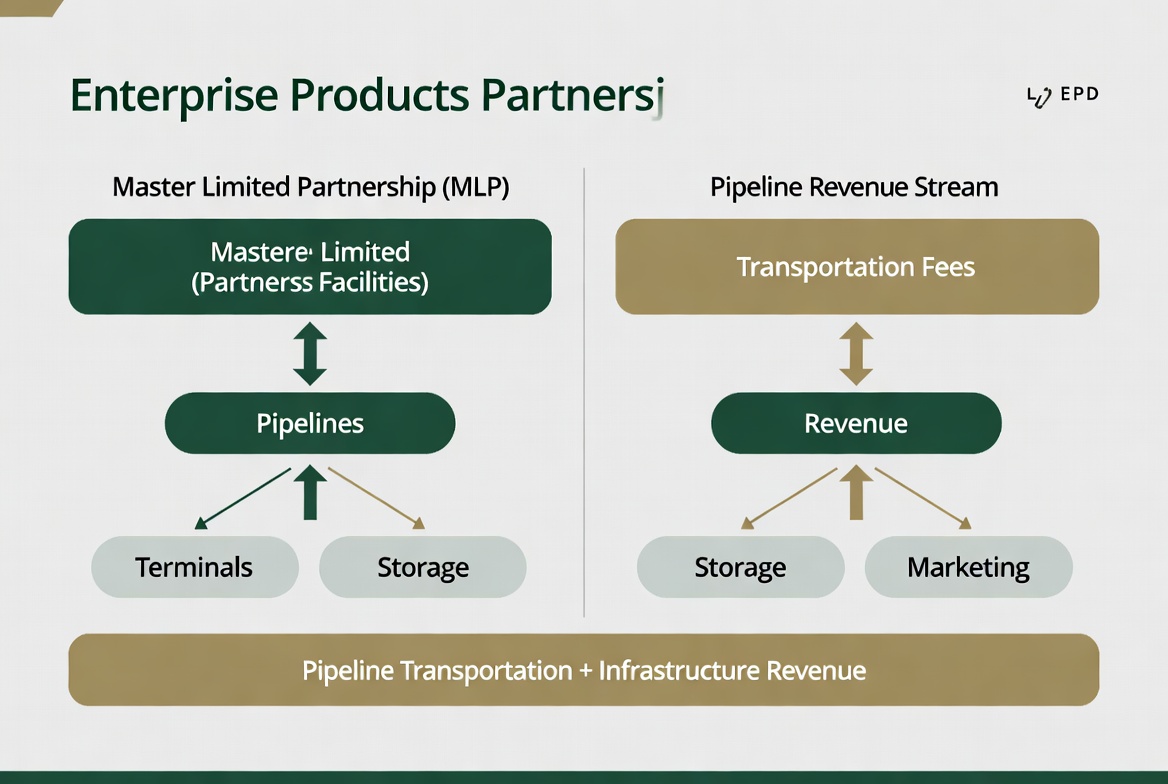
Pipeline transportation is one of EPD’s most important sources of revenue. In the United States, energy production regions and consumer markets are often located in different areas, so large volumes of crude oil, natural gas and natural gas liquids must move through long distance transportation networks.
Enterprise Products Partners builds and operates tens of thousands of miles of energy pipeline systems, providing customers with continuous transportation capacity. Energy producers typically pay service fees based on transportation volume, transportation distance or contract terms, while EPD is responsible for maintaining pipeline operations and ensuring transportation efficiency.
This model is somewhat similar to a toll road system. Whether energy prices rise or fall, transportation demand continues as long as energy keeps moving. For that reason, pipeline transportation often provides a relatively stable source of cash flow. For EPD, its large scale pipeline network is not only a revenue base, but also an important asset for building competitive advantages in the industry.
How Storage and Terminal Facilities Contribute to Growth
Beyond transportation, storage facilities and terminal networks are also important sources of revenue for EPD. Energy market supply and demand often change, and storage and transportation facilities help customers manage inventory and improve supply chain efficiency.
For example, refineries may need a continuous supply of crude oil, but crude oil production does not always move in sync with demand. Large storage facilities can create a buffer between production and consumption, reducing the impact of market volatility. Customers usually pay storage fees and related logistics service fees, and this revenue forms an important part of EPD’s business.
Terminal facilities are responsible for energy gathering, distribution and transshipment. Whether for domestic transportation or international exports, large volumes of energy products must be loaded, unloaded and distributed through terminal networks. As U.S. energy exports grow, terminal facilities have become increasingly important and have also become a new source of growth for Enterprise Products Partners.
How the Natural Gas Liquids Processing Business Expands the Revenue Structure
The natural gas liquids (NGL) business is one of the key features that distinguishes Enterprise Products Partners from many other midstream companies. NGLs mainly include products such as ethane, propane and butane. These products are not only energy commodities, but also important raw materials for the chemical industry.
During natural gas production, natural gas liquids usually need to be separated and processed before entering the market. EPD owns a large number of natural gas liquids processing facilities, enabling it to help customers complete processing and transportation while earning service revenue. This means the company provides not only logistics capacity, but also participates in the value added process for energy products.
As global chemical demand grows, U.S. natural gas liquids exports continue to expand. Enterprise Products Partners has built a complete value chain around natural gas liquids, covering gathering, processing and export, making this business an increasingly important part of its revenue structure. Compared with pure transportation, natural gas liquids processing typically offers a richer range of services and broader customer demand.
Why Long Term Contracts Strengthen Business Stability
Long term contracts are an important feature of EPD’s business model and a key source of revenue stability. Energy infrastructure construction requires substantial capital investment, so customers often prefer to secure transportation and storage capacity in advance to protect supply chain reliability.
Many energy producers, refiners and chemical companies sign multi year contracts with Enterprise Products Partners. During the contract period, customers pay transportation fees or service fees according to agreed terms, while EPD provides the corresponding infrastructure support. This model improves revenue predictability and reduces the impact of short term market volatility on operating performance.
From an industry perspective, midstream energy companies usually have a more stable cash flow structure than upstream oil and gas companies. Even when energy prices fluctuate, infrastructure service demand often continues as long as energy still needs to be transported and stored. For that reason, the long term contract model is viewed as one of the important competitive advantages of EPD’s business model.
How to Buy EPD (Enterprise Products Partners) Stock
EPD is the ticker symbol for Enterprise Products Partners, which is traded on the New York Stock Exchange. Traditionally, investors can buy EPD through a brokerage account that supports U.S. stock trading, allowing them to participate in the development of the U.S. energy infrastructure industry.
Because Enterprise Products Partners’ business is closely linked to the U.S. energy transportation network, natural gas liquids exports and the energy supply chain, it is often viewed as one of the companies to watch when assessing the U.S. energy market. Its operating performance is usually affected by factors such as energy production volumes, infrastructure utilization rates and international energy trade activity.
As digital asset markets and traditional financial markets gradually converge, more trading tools linked to energy company price movements have appeared. For example, some platforms offer CFD products linked to stock prices, allowing users to participate in market movements through price changes without directly holding the underlying stock assets.
Taking Gate TradFi as an example, users can follow different markets within the same account environment, including digital assets, stocks, ETFs, indices and commodities. Some markets also provide Gate CFD products, offering more options for cross market asset allocation and price tracking.
Regardless of how investors choose to participate in the market, they should fully understand the product structure, trading rules and regulatory requirements in their own region.
Summary
Enterprise Products Partners’ business model is built on energy infrastructure operations. Through pipeline transportation, storage services, natural gas liquids processing and export terminal operations, the company covers multiple stages of the energy supply chain and forms a diversified revenue structure. The long term contract model further improves revenue stability, making EPD one of the most representative companies in the U.S. midstream energy industry.
FAQs
How does EPD mainly make money?
EPD mainly earns revenue through pipeline transportation, storage services, natural gas liquids processing and export terminal operations.
Is EPD an oil production company?
No. EPD is a midstream energy company. It mainly provides transportation, storage and logistics services, rather than oil and natural gas extraction.
Why can pipeline transportation generate stable revenue?
Because energy producers need to continuously transport crude oil and natural gas, and transportation services are usually charged through long term contracts, which gives the business relatively stable revenue.
Why is the natural gas liquids business important?
Natural gas liquids are widely used in chemicals, plastics manufacturing and energy markets, so related processing and transportation demand exists over the long term.
How do long term contracts help stabilize EPD’s operations?
Long term contracts lock in customer demand and service revenue, improving cash flow predictability and reducing the impact of market volatility.
What is the biggest difference between EPD and other energy companies?
EPD mainly operates energy infrastructure and earns service fees, while many traditional energy companies rely on revenue from producing and selling oil and gas resources.