ALEXKHAN

vip
Age 1.7 Year
Peak Tier 0
No content yet
#MyGateTradeStory
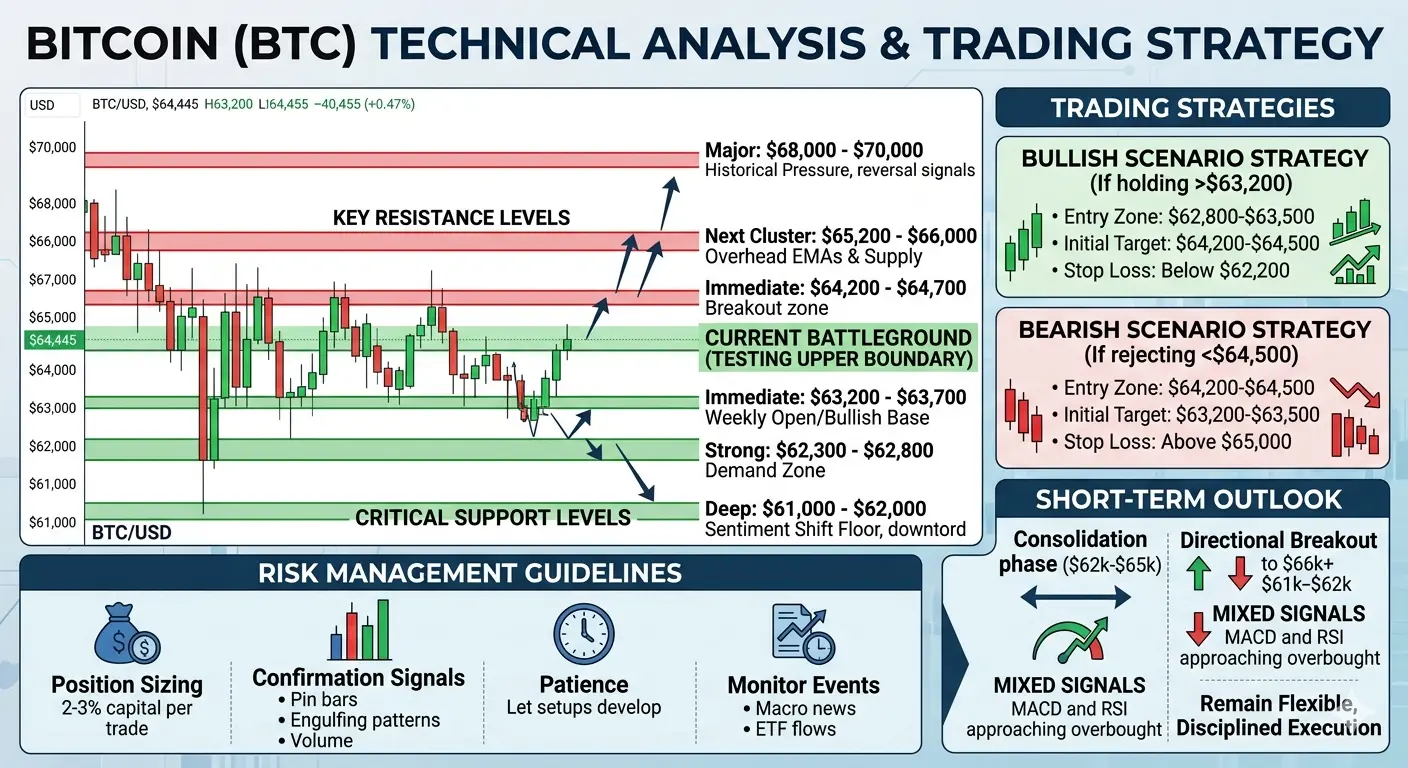
Bitcoin Technical Analysis & Trading Strategy
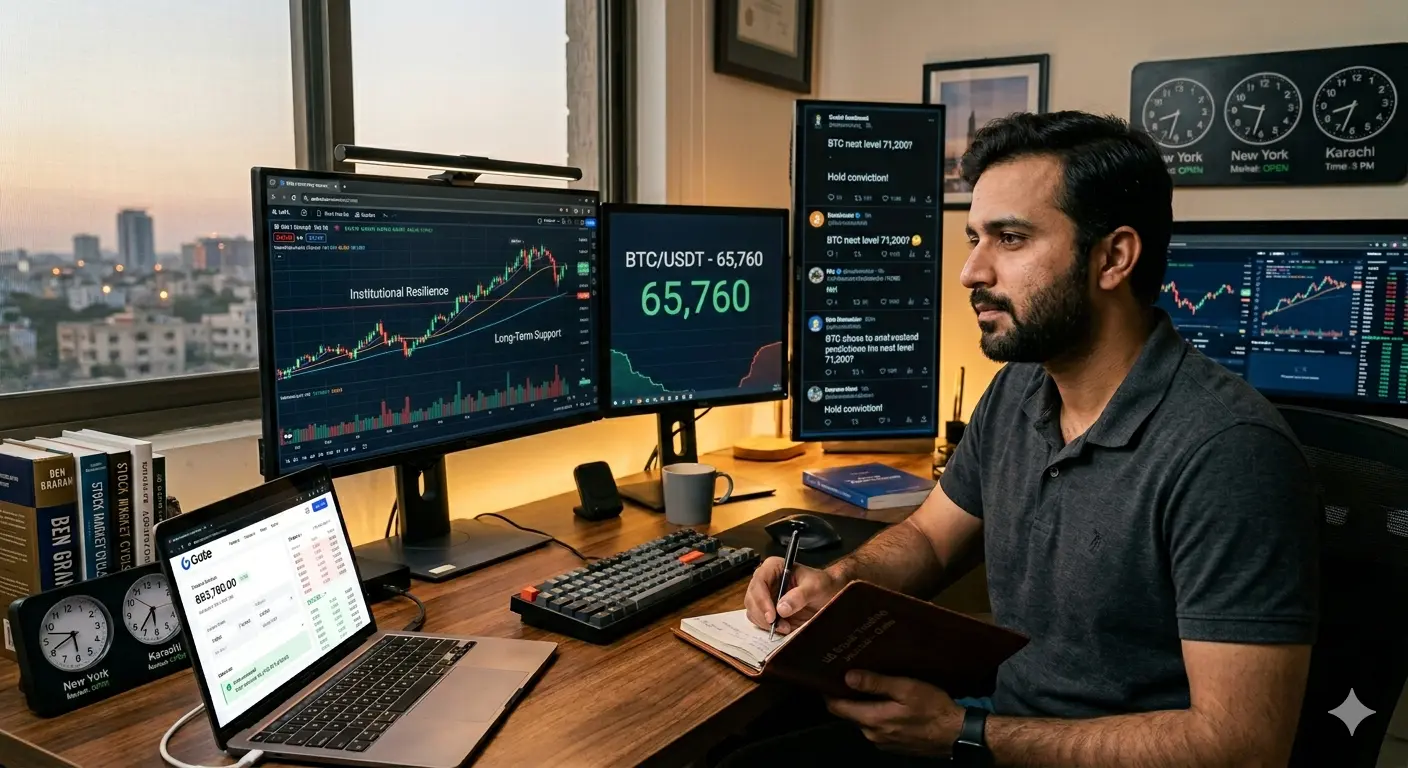
BTC is currently trading around **$64,445**, positioned in a critical zone where multiple technical factors converge. This analysis provides detailed support and resistance levels with actionable trading insights for informed decision-making.
Current Market Structure
Bitcoin has established a trading range between approximately **$62,300 and $64,500**. The price is testing the upper boundary of this range, which represents a key decision point for traders. The current level sits near recent highs and aligns with the upper Bolling
BTC0.34%
HighAmbition
#MyGateTradeStory
Bitcoin Technical Analysis & Trading Strategy
BTC is currently trading around **$64,445**, positioned in a critical zone where multiple technical factors converge. This analysis provides detailed support and resistance levels with actionable trading insights for informed decision-making.
Current Market Structure
Bitcoin has established a trading range between approximately **$62,300 and $64,500**. The price is testing the upper boundary of this range, which represents a key decision point for traders. The current level sits near recent highs and aligns with the upper Bollinger Band, indicating potential resistance pressure.
Key Resistance Levels
**Immediate Resistance: $64,200 - $64,700**
This zone represents the current battleground where sellers are actively defending. A decisive breakout above this level with strong volume could trigger momentum toward higher targets. Traders should watch for sustained closes above $64,500 as confirmation of bullish continuation.
Next Resistance Cluster: $65,200 - $66,000
This area contains overhead EMAs and represents short-term supply where profit-taking typically occurs. Breaking through this cluster would open the path toward the psychological $67,000 level and potentially $68,000-$70,000.
Major Resistance: $68,000 - $70,000
Historical price action shows significant selling pressure in this region. A clean breakout above $70,000 would signal a potential trend reversal with targets extending toward $72,000-$75,000.
Critical Support Levels
Immediate Support: $63,200 - $63,700
This zone aligns with recent consolidation areas and the weekly open. Holding above this level maintains the bullish structure and provides a foundation for potential upside moves.
Strong Support: $62,300 - $62,800
This represents a demand zone where buyers have previously stepped in. A bounce from this area with bullish reversal candles would present favorable long entry opportunities.
Deep Support: $61,000 - $62,000
Breaking below this psychological floor would shift market sentiment bearish, with potential downside extension toward $59,000-$60,000. This level acts as a safety net for the current structure.
Trading Strategy Recommendations
Bullish Scenario Strategy
If BTC holds above $63,200 and shows bullish reversal patterns, consider long positions with the following parameters:
Entry Zone: $62,800 - $63,500 on confirmed bullish candles
Initial Target: $64,200 - $64,500
Extended Target: $65,200 - $66,000
Stop Loss: Below $62,200
Look for confirmation signals including bullish engulfing patterns, pin bars, or morning star formations on hourly and four-hour timeframes. Volume expansion during the bounce adds conviction to the setup.
Bearish Scenario Strategy
If BTC rejects from $64,500 and forms bearish reversal patterns, consider short positions:
Entry Zone: $64,200 - $64,500 on rejection candles
Initial Target: $63,200 - $63,500
Extended Target: $62,300 - $62,800
Stop Loss: Above $65,000
Bearish signals include shooting stars, bearish engulfing patterns, or breakdowns below rising trendlines with increased selling volume.
Risk Management Guidelines
Position sizing remains crucial for sustainable trading. Consider allocating only 2-3 percent of capital per trade to manage downside exposure effectively. Use stop losses religiously and avoid moving them against your position once established.
Wait for clear confirmation before entering trades. Avoid chasing prices during volatile spikes. Patience in letting setups develop according to your plan typically yields better results than impulsive entries.
Monitor macroeconomic events and Bitcoin-specific news that could trigger sudden volatility. ETF flows, regulatory developments, and large institutional movements can rapidly shift market sentiment.
Short-Term Outlook
The current price action suggests a consolidation phase within the $62,000-$65,000 range. The direction of the breakout from this range will likely determine the next significant move. A sustained break above $64,700 targets $66,000+ while failure to hold $63,200 risks a retest of $61,000-$62,000.
Technical indicators show mixed signals with MACD and RSI indicating momentum building but approaching overbought conditions on shorter timeframes. This suggests caution and the importance of waiting for confirmation rather than anticipating moves.
Traders should remain flexible and ready to adapt as price action unfolds. The current environment rewards disciplined execution of predefined strategies rather than emotional reactions to price fluctuations.
@Gate_Square
repost-content-media
  • Reward
  • 1
  • Repost
  • Share
HighAmbition:
that's good 👍
#MyGateTradeStory
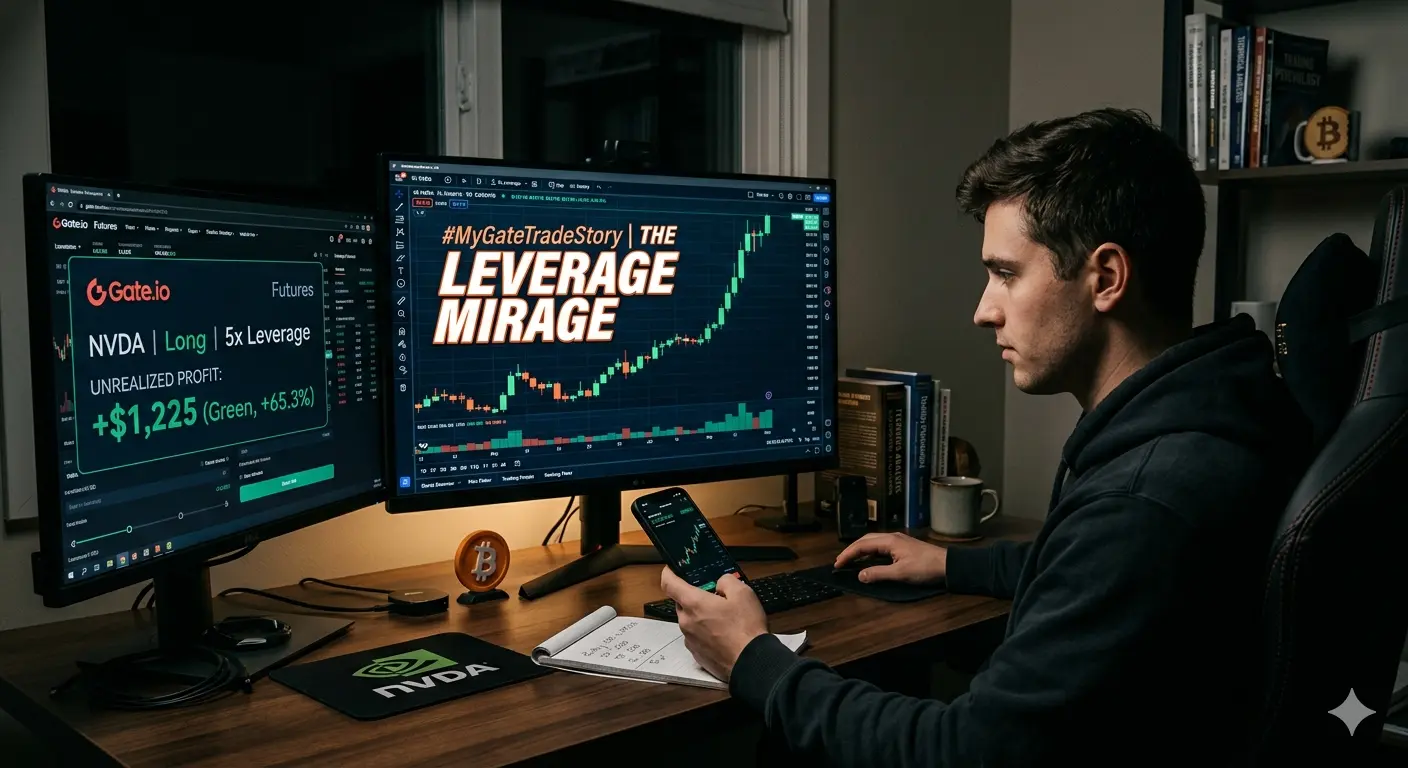
The Leverage Mirage: When 10x Becomes a Trap
The Hook
Everyone tells you leverage is dangerous. What they do not tell you is that leverage feels like genius when it works. The problem is not the loss. The problem is what the win does to your brain.
The Setup**ll
I had been watching NVDA for months. Not trading it. Just watching. The stock moved from $86 in April to over $200 by October. Every week I told myself I would enter. Every week I found a reason to wait. The chart looked extended. The valuation seemed stretched. Some analyst warned about China risks.
Then came the pu
BTC0.35%
ETH2.45%
HighAmbition
#MyGateTradeStory
The Leverage Mirage: When 10x Becomes a Trap
The Hook
Everyone tells you leverage is dangerous. What they do not tell you is that leverage feels like genius when it works. The problem is not the loss. The problem is what the win does to your brain.
The Setup**ll
I had been watching NVDA for months. Not trading it. Just watching. The stock moved from $86 in April to over $200 by October. Every week I told myself I would enter. Every week I found a reason to wait. The chart looked extended. The valuation seemed stretched. Some analyst warned about China risks.
Then came the pullback. NVDA dropped from $212 to $185 in three sessions. The financial media called it a correction. The technical analysts pointed to support levels. The options market showed fear. I saw opportunity.
I had $2,000 in my futures account. Not life-changing money. Not even serious money. But enough to matter to me. I had done three trades before this. One small win on BTC. Two losses on ETH. My account sat at $1,850. Down 7.5% overall. Not catastrophic. Just annoying.
The Trade
I entered NVDA long at $187.50. The plan was simple. 5x leverage. Stop loss at $182. Target at $200. Risk $150. Potential reward $625. Clean risk-reward. Technical setup. Logical entry.
The first day NVDA closed at $189. Small green candle. I felt smart. The second day it hit $192. I moved my stop to breakeven. The third day it touched $195. I started calculating my profits. $375 unrealized. Almost 20% account growth in three days.
Then Jensen Huang spoke at a conference. Mentioned something about demand exceeding supply. The stock gapped up to $202 at market open. I was up $725. My account balance showed $2,575. I had turned $1,850 into $2,575 in four trading days.
I did not close the position.
The Shift
This is where the story turns. Not because of the market. Because of me.
I started checking my phone every ten minutes. I joined three NVDA trading groups on Telegram. I followed six new analysts on X. I read every article about AI demand and data center spending. I became an expert in H100 chip supply chains overnight.
The stock moved to $208. My unrealized profit hit $1,025. My account showed $2,875. I started thinking about what I could do with the money. Pay off some debt. Upgrade my laptop. Maybe withdraw half and let the rest run.
I moved my stop loss to $195. Guaranteed profit of $375. Still a great trade. But I could not bring myself to close it. The chart looked parabolic. The momentum felt unstoppable. Every dip was buying opportunity. Every green candle confirmed my genius.
The Framework: The Leverage Mirage
I need to name what happened. The Leverage Mirage. It is the optical illusion created by leveraged profits. When you make 50% on a 5x position, your brain records it as skill. When you make 100% on a 10x position, your brain records it as destiny.
The Leverage Mirage has three stages. First, the Distortion Phase. Your perception of risk changes. Positions that once felt large now feel small. Leverage that once scared you now feels conservative. Your mental account size inflates to match your unrealized profits.
Second, the Identity Phase. You stop being someone who trades. You become a trader. The label attaches itself to your self-concept. Losses become personal failures. Wins become personal victories. The market becomes a scoreboard for your worth.
Third, the Trap Phase. You cannot exit because exiting means the game ends. The trade becomes larger than the profit. It becomes proof. Proof that you belong. Proof that you are different from the retail crowd. Proof that you can beat the market.
The Breakdown*l
NVDA hit $215 on the sixth day. My account showed $3,100. I had nearly doubled my money in six sessions. I started planning my next trade. Maybe add to the position. Maybe find another AI stock. The market was giving out free money and I had finally found the line.
Then the news hit. Regulatory concerns. Export restrictions. Something about China H20 chips. NVDA dropped 6% in premarket. I watched it happen on my phone at 6 AM. The stock opened at $202. My stop loss triggered at $195. The gap down blew through my mental stop before I could react.
I closed at $194.50. The final numbers were brutal. Entry $187.50. Exit $194.50. Profit $350. After fees and funding costs, $320. A 17% account gain. Still a winning trade. Still better than my previous results.
But it felt like a loss. Because in my mind, I had made $1,200. Because I had watched $3,100 evaporate into $2,170. Because the Leverage Mirage had shown me a version of myself that did not exist.
The Aftermath
I did not trade for three weeks. Not because of the money. Because of what I discovered about myself.
I realized that the $320 profit was the only real number. Everything else was fiction. Unrealized gains are not gains. Leveraged profits are not skills. The market does not owe anyone a continuation of momentum.
I went back to my journal. The one I kept sporadically. I found entries from before the trade. I had written about patience. About process over outcome. About not falling in love with positions. I had broken every rule I set for myself.
The Leverage Mirage had made me forget who I was. A beginner with inconsistent results. Someone still learning. Someone who got lucky on a momentum trade and confused luck with edge.
The Correction
I changed three things after that trade.
First, I separated my trading journal from my profit and loss statement. The journal records decisions. The PnL records outcomes. I review the journal weekly. I look at PnL monthly. Decisions matter more than results in the short term.
Second, I implemented a leverage ladder. Maximum 3x for my first ten trades in any new market. Maximum 5x after twenty profitable trades. No exceptions. The Leverage Mirage feeds on high leverage. Starve it.
Third, I created a profit-taking protocol. At 50% of initial target, close 25% of position. At 75% of target, close another 25%. Let the rest run with trailing stop. The protocol removes decision-making at the worst possible time. When I am winning and cannot think straight.
The Reflection
I still watch NVDA. It trades above $230 now. I could have made more by holding. That thought still visits me sometimes. But I have learned to recognize it as the Mirage whispering. The what-if game is how the Mirage keeps you trapped in the past.
The truth is I got lucky. I entered a momentum stock at the right moment. I rode a wave created by AI euphoria and institutional buying. I had no edge. I had timing. Timing is not repeatable. Edge is.
The Leverage Mirage taught me that my biggest risk is not the market. It is the version of me that emerges when trades go well. That version is impulsive, overconfident, and convinced of his own genius. He needs rules because he cannot be trusted.
The Question
Every trader has a Mirage trade. The one that showed you what was possible. The one that changed how you see yourself. The one that almost destroyed you.
Mine was NVDA at 5x leverage. A $320 profit that felt like a $900 loss. A winning trade that taught me more than any losing trade ever could.
What is your Mirage trade? And more importantly, what rules have you built to keep that version of yourself from taking over when the next winning streak begins?
@Gate_Square
repost-content-media
  • Reward
  • 1
  • Repost
  • Share
HighAmbition:
that's good
#MyGateTradeStory
BTC Current Status
Current Price: 65,737 USDT
24h Change: +1.93% (+1,247 USDT)
24h High: 65,866
24h Low: 63,617
24h Volume: 48,536 BTC / 3.13B USDT
---
Key Technical Levels
Support Levels:
- Immediate Support: 65,358 (recent consolidation zone)
- Strong Support: 63,600-64,000 (recent breakout level)
- Major Support: 61,800 (bearish pennant breakdown retest zone)
- Critical Support: 59,100 (recent low, must hold for bulls)
Resistance Levels:
- Immediate Resistance: 66,000-66,500 (psychological round number)
- Key Resistance: 69,124 (TBO Support/Resistance flip zone)
- Major R
BTC0.34%
HighAmbition
#MyGateTradeStory
BTC Current Status
Current Price: 65,737 USDT
24h Change: +1.93% (+1,247 USDT)
24h High: 65,866
24h Low: 63,617
24h Volume: 48,536 BTC / 3.13B USDT
---
Key Technical Levels
Support Levels:
- Immediate Support: 65,358 (recent consolidation zone)
- Strong Support: 63,600-64,000 (recent breakout level)
- Major Support: 61,800 (bearish pennant breakdown retest zone)
- Critical Support: 59,100 (recent low, must hold for bulls)
Resistance Levels:
- Immediate Resistance: 66,000-66,500 (psychological round number)
- Key Resistance: 69,124 (TBO Support/Resistance flip zone)
- Major Resistance: 72,000-74,000 (previous supply zone)
- Breakout Target: 77,000-78,000 (if 69K breaks)
---
Price Forecast & Trading Strategy
Short Term (1-7 days):
BTC is attempting to stabilize after breaking above the bearish pennant resistance. The price needs to hold above 65,358 to maintain bullish momentum. A close above 69,124 would confirm trend reversal.
Medium Term (1-4 weeks):
If 69,124 resistance breaks, next target is 72,000-74,000 zone. Failure to hold 63,600 support risks retest of 61,800 and potentially 59,100.
Long Term (1-3 months):
BTC is 26 months post-halving, historically a late-cycle phase. Expect volatility with potential for 77,000-82,000 if macro conditions improve.
---
Trading Plan
Entry Strategy:
- Aggressive Entry: Long above 65,500 with stop at 64,800
- Conservative Entry: Wait for breakout above 69,124 with volume confirmation
Stop Loss Levels:
- Tight SL: 64,500 (below recent support)
- Standard SL: 63,500 (below major support cluster)
- Swing SL: 61,500 (below structural low)
Take Profit Targets:
- TP1: 68,500 (resistance cluster)
- TP2: 72,000 (supply zone)
- TP3: 77,000 (major resistance)
Risk Management:
- Position size: 2-3% risk per trade
- Leverage: Max 3-5x for futures
- R:R Ratio: Minimum 1:2
---
Market Sentiment
Fear and Greed Index: 20 (Extreme Fear)
Technical Indicators: 3 buy signals vs 11 sell signals (bearish bias short-term)
EMA Composite: Bearish
The market is in Extreme Fear, which historically presents buying opportunities for patient traders. However, confirmation above 69,124 is needed before aggressive bullish positioning.
---
Bottom Line
BTC is at a critical juncture. The breakout above the bearish pennant is encouraging, but price remains below the key 69,124 TBO level. Watch for:
1. Hold above 65,358 for bullish continuation
2. Break above 69,124 for trend reversal confirmation
3. Loss of 63,600 support signals deeper correction to 61,800-59,100
Plan your trades accordingly with proper risk management.@Gate_Square
repost-content-media
  • Reward
  • 1
  • Repost
  • Share
HighAmbition:
that's good
#MyGateTradeStory
ETH Current Status
Current Price: 1,723.46 USDT
24h Change: +2.51% (+42.22 USDT)
24h High: 1,732.06
24h Low: 1,654.19
24h Volume: 1,687,550 ETH / 2.85B USDT
Key Technical Levels
Support Levels:
- Immediate Support: 1,700 (psychological level)
- Strong Support: 1,654 (recent low, must hold)
- Major Support: 1,620-1,640 (consolidation zone)
- Critical Support: 1,563 (recent breakdown level)
Resistance Levels:
- Immediate Resistance: 1,750-1,760
- Key Resistance: 1,800 (previous breakdown point)
- Major Resistance: 1,850-1,900 (supply zone)
- Breakout Target: 2,000+ (if 1,900 b
ETH2.43%
BTC0.34%
HighAmbition
#MyGateTradeStory
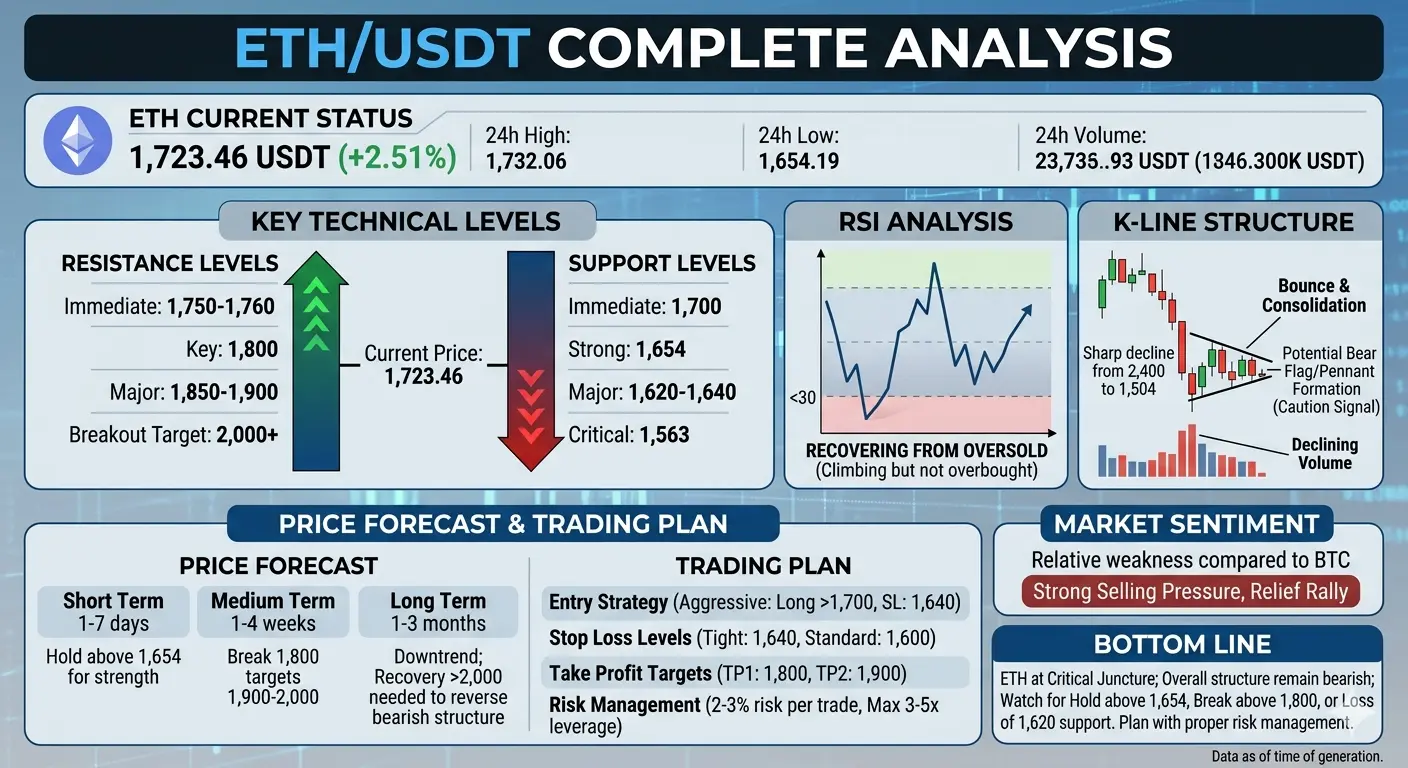
ETH Current Status
Current Price: 1,723.46 USDT
24h Change: +2.51% (+42.22 USDT)
24h High: 1,732.06
24h Low: 1,654.19
24h Volume: 1,687,550 ETH / 2.85B USDT
Key Technical Levels
Support Levels:
- Immediate Support: 1,700 (psychological level)
- Strong Support: 1,654 (recent low, must hold)
- Major Support: 1,620-1,640 (consolidation zone)
- Critical Support: 1,563 (recent breakdown level)
Resistance Levels:
- Immediate Resistance: 1,750-1,760
- Key Resistance: 1,800 (previous breakdown point)
- Major Resistance: 1,850-1,900 (supply zone)
- Breakout Target: 2,000+ (if 1,900 breaks)
RSI Analysis
Based on the K-line data, ETH recently experienced a massive sell-off from 2,400+ levels down to 1,504, followed by a bounce to current levels. The RSI would be recovering from oversold conditions (likely below 30 during the 1,504 low). Current price action suggests RSI is climbing but not yet overbought.
K-Line Structure Analysis
Recent price action shows:
- Sharp decline from 2,400 to 1,504 (capitulation)
- Bounce to 1,732 (current level)
- Consolidation between 1,620-1,730
- Volume declining on recent candles (caution signal)
The structure resembles a bear flag/pennant formation, which is concerning for bulls.
Price Forecast and Trading Strategy
Short Term (1-7 days):
ETH is attempting to stabilize after the sharp decline. The price needs to hold above 1,654 to maintain any bullish momentum. A close above 1,750 would signal strength.
Medium Term (1-4 weeks):
If 1,800 resistance breaks, next target is 1,900-2,000. Failure to hold 1,620 support risks retest of 1,563 and potentially new lows below 1,500.
Long Term (1-3 months):
ETH is in a downtrend on higher timeframes. Recovery above 2,000 is needed to reverse the bearish structure. Until then, rallies are likely to be sold.
Trading Plan
Entry Strategy:
- Aggressive Entry: Long above 1,700 with stop at 1,640
- Conservative Entry: Wait for breakout above 1,800 with volume confirmation
Stop Loss Levels:
- Tight SL: 1,640 (below recent support)
- Standard SL: 1,600 (below major support cluster)
- Swing SL: 1,550 (below structural low)
Take Profit Targets:
- TP1: 1,800 (resistance cluster)
- TP2: 1,900 (supply zone)
- TP3: 2,000 (psychological level)
Risk Management:
- Position size: 2-3% risk per trade
- Leverage: Max 3-5x for futures
- R:R Ratio: Minimum 1:2
Market Sentiment
ETH is showing relative weakness compared to BTC. The sharp decline from 2,400+ to 1,504 indicates strong selling pressure. The current bounce is technically a relief rally until proven otherwise.
Bottom Line
ETH is at a critical juncture. The bounce from 1,504 is encouraging, but the overall structure remains bearish. Watch for:
1. Hold above 1,654 for bullish continuation
2. Break above 1,800 for trend reversal confirmation
3. Loss of 1,620 support signals deeper correction to 1,563-1,500
Plan your trades accordingly with proper risk management.@Gate_Square
repost-content-media
  • Reward
  • 1
  • Repost
  • Share
HighAmbition:
that's good
#MyGateTradeStory
LAB has emerged as one of the most talked-about tokens in the cryptocurrency space during June 2026, capturing attention with a dramatic price rally that pushed it into the top 200 rankings on CoinMarketCap. The token, associated with a digital real estate investment ecosystem that assists developers in fragmenting and tokenizing real estate assets, surged over 192 percent in a single week, reaching an all-time high near 24.79 USDT before experiencing significant corrections. As of mid-June 2026, LAB trades around 11.30 USDT, reflecting a volatile journey from earlier lows n
HighAmbition
#MyGateTradeStory
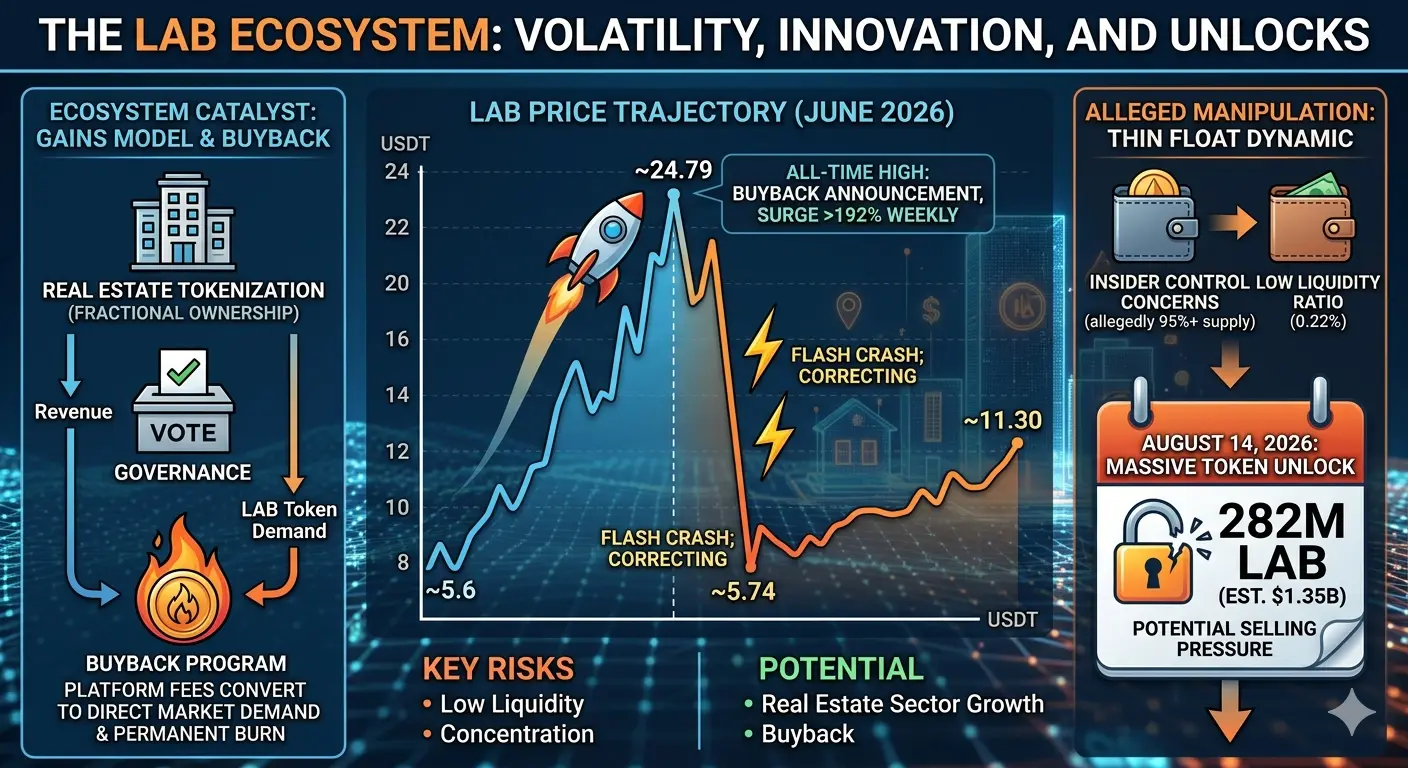
LAB has emerged as one of the most talked-about tokens in the cryptocurrency space during June 2026, capturing attention with a dramatic price rally that pushed it into the top 200 rankings on CoinMarketCap. The token, associated with a digital real estate investment ecosystem that assists developers in fragmenting and tokenizing real estate assets, surged over 192 percent in a single week, reaching an all-time high near 24.79 USDT before experiencing significant corrections. As of mid-June 2026, LAB trades around 11.30 USDT, reflecting a volatile journey from earlier lows near 5.46 USDT just weeks prior.
The roots of LAB lie in the LABS Group project, which began with a vision to democratize and tokenize real estate. The project positions itself as a digital ecosystem that bridges traditional property investment and blockchain technology, allowing fractional ownership of real estate assets through tokenized representation on the blockchain. This concept enables secondary trading on digital exchanges, theoretically increasing liquidity and accessibility for investors who might otherwise be excluded from high-value property markets. The LAB token itself operates under the GAINS model, which stands for Governance, Access, Incentives, Nomination, and Staking. Under this framework, token holders gain voting rights on matters of interest within the ecosystem, early access to projects generated by the platform, incentive rewards, nomination rights, and the ability to stake tokens for additional yield. Staking generates fee revenue sharing, and the project recently expanded this utility by introducing a buyback program.
The catalyst behind LABs explosive rally in early June 2026 was the announcement of a strategic buyback program. LABtrade unveiled details indicating that revenue generated across the entire ecosystem would be converted into direct market demand for the native LAB token. Every trade, product interaction, and activity across the LAB ecosystem would contribute to this broader buyback mechanism, which purchases LAB from the open market and burns it, removing supply permanently. The announcement triggered an immediate price surge exceeding 200 percent, pushing LAB from earlier levels to hit 21 USDT and beyond. The buyback concept appealed to traders because a sustainable mechanism funded by platform fees could theoretically create consistent buying pressure and a deflationary effect on the token supply, similar to models employed by other exchange tokens in the crypto industry.
However, the rally also attracted significant scrutiny. On-chain investigators raised concerns about market manipulation, alleging that insiders control over 95 percent of LABs circulating supply. Bubblemaps, a blockchain analytics platform, flagged suspicious wallet movements involving approximately 200 million LAB tokens valued at around 200 million dollars surfacing amid the buyback campaign and a market cap surge that briefly exceeded 7 billion dollars in fully diluted valuation. These allegations pointed to a low-float dynamic where thin real liquidity amplified price movements, making the token particularly susceptible to sharp swings in both directions. The fully diluted valuation reached as high as 6 billion dollars during the peak, while the actual freely tradable float represented only a fraction of the total supply, creating a disconnect between market cap figures and genuine liquidity depth.
The price action itself tells a story of extreme volatility. Starting from levels around 5.6 USDT in late May 2026, LAB climbed steadily through 6, 7, 8, and 9 USDT before accelerating sharply. By early June, the token broke through 11 USDT, then surged past 13, 15, 18, 19, and ultimately reached 22.46 USDT before the monumental candle that saw intraday highs near 24.79 USDT and intraday lows dipping to 5.74 USDT in a single four-hour period. This extraordinary range reflected both the euphoria of the buyback announcement and the rapid profit-taking that followed. After the peak, LAB declined through 15.80, 13.96, and then bounced to 17.99 before another wave of selling drove it back down to 12.80, then 12.48, and eventually toward the 9 USDT range. The token subsequently experienced a recovery wave back to 13 USDT before gradually drifting lower through 12, 11, 10, 9, and briefly touching 7.28 USDT before another recovery cycle brought it back to the current level around 11.30 USDT.
A pivotal event on LABs calendar is the scheduled unlock of approximately 282 million LAB tokens on August 14, 2026. At early June prices, these tokens were valued at approximately 1.35 billion dollars. The unlock represents a significant increase in circulating supply that could fundamentally alter the supply-demand dynamics that have characterized the tokens recent price behavior. Market participants are already pricing in what August 14 might look like, with some expressing concern that the influx of newly unlocked tokens could create substantial selling pressure. Locked holders have been sitting on gains they could not realize during the rally, and the first unlocks starting around July and August have been a source of frustration for some traders who attempted hedging strategies that failed to protect their positions adequately.
The broader context of real estate tokenization as a sector provides an important backdrop for understanding LABs positioning. Real estate tokenization refers to the process of converting real estate assets into digital tokens that represent ownership shares, created and managed on a blockchain. These tokens represent a share of the real estate asset that can be bought, sold, or traded on various platforms, similar to how stocks are traded on exchanges. The concept gained traction as the benefits of blockchain, including transparency, immutability, and ease of transfer, became more apparent. The first significant tokenization projects involved luxury properties and commercial real estate, demonstrating the potential for democratizing access to high-value assets. Within this growing niche, LAB aims to serve as an ecosystem that connects developers, investors, and secondary market participants.
From a technical analysis perspective, the daily Connors RSI reached 95.40 during the peak rally, signaling extreme overbought conditions. The MACD remained bullish at 0.6395 over 0.9109, and the Coppock Curve at 125.43 confirmed a strong long-term uptrend. However, the thin float and a 0.22 percent liquidity ratio mean that volatility cuts both ways. The 24-hour trading volume has fluctuated significantly, ranging from as low as 513 LAB units during quiet periods to over 142,980 LAB units during the peak volatility candle, with corresponding USDT turnover ranging from under 500,000 to over 178 million dollars. The most recent data shows LAB with a 24-hour change of approximately 19.3 percent, an open price near 9.47 USDT, and a last price of 11.30 USDT, indicating that the token continues to exhibit significant intraday movement even after the initial rally and correction phases.
Looking ahead, several factors will shape LABs trajectory. The buyback program, if executed consistently, could provide ongoing demand support and reduce circulating supply over time, creating a deflationary pressure that benefits token holders. However, the upcoming 282 million token unlock in August 2026 poses a counterbalancing risk that could overwhelm buyback-driven demand if a substantial portion of newly unlocked holders decide to sell. The concentration of supply among insiders raises questions about the tokens governance and distribution, and the low liquidity ratio means that even moderate selling pressure could produce outsized price declines. Investors considering LAB should weigh these competing dynamics carefully, recognizing that the tokens utility within a real estate tokenization ecosystem provides a fundamental use case, but the supply structure and unlock timeline create significant uncertainty around medium-term price stability.
The real estate tokenization space itself continues to evolve, with discussions on social platforms focusing on institutional moves such as Goldman Sachs-backed initiatives, live tokenizations on various blockchain networks, and platforms offering fractional luxury property ownership. LABs ability to differentiate itself within this competitive landscape will depend on the depth of its developer partnerships, the quality of tokenized assets available on its platform, and the effectiveness of its ecosystem governance through the GAINS model. The project has gained strategic partnerships covering America, Europe, and the Greater China Region, and received strategic investment from YBB Foundation, suggesting some degree of institutional recognition. Whether these partnerships translate into meaningful adoption and revenue generation sufficient to sustain the buyback program at scale remains the critical question for the tokens long-term viability.@Gate_Square
repost-content-media
  • Reward
  • 1
  • Repost
  • Share
HighAmbition:
that's good
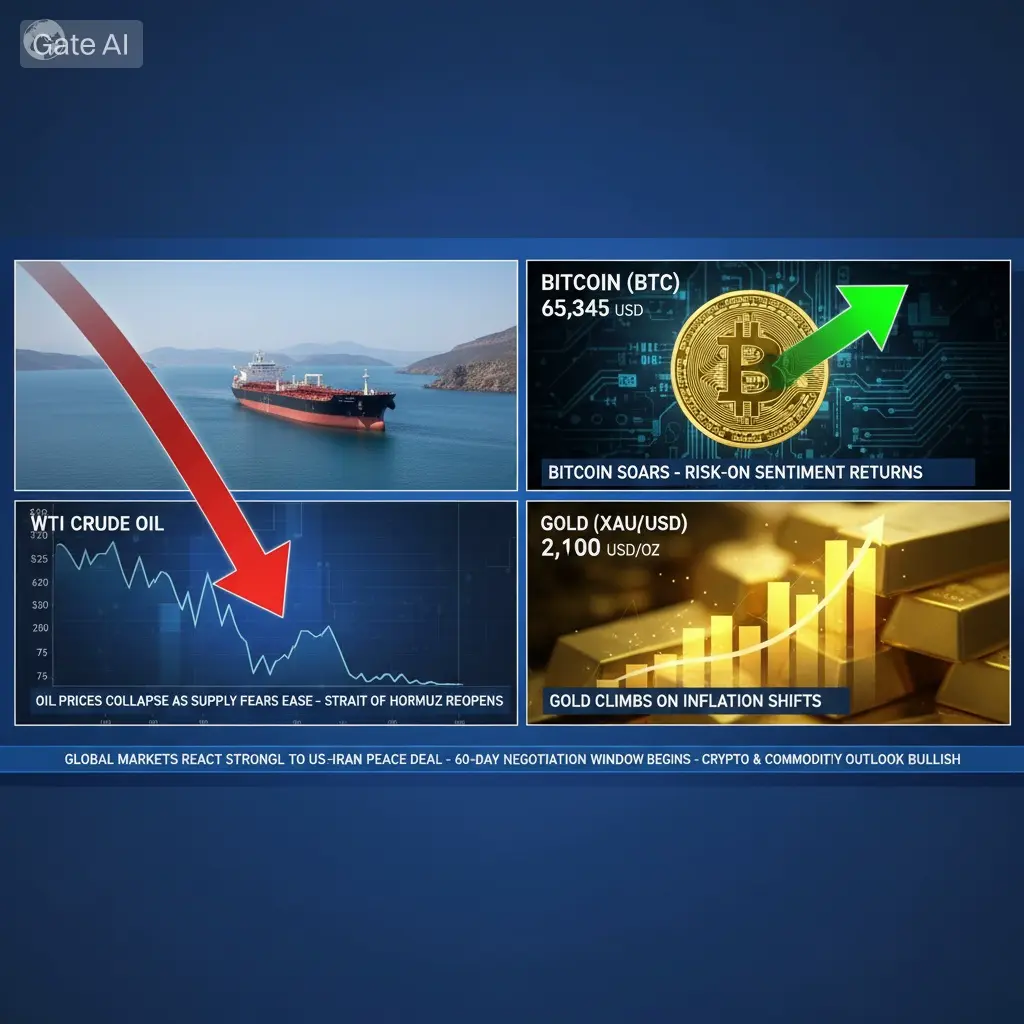
#USIranPeaceDealReachedStraitOfHormuzToOpen
Point One: Peace Agreement Terms and Diplomatic Background
The announced peace agreement between the United States and Iran marks one of the most consequential geopolitical shifts of 2026. After months of escalating tensions, both sides have reportedly agreed on a framework aimed at ending conflict and restoring regional stability. The deal includes commitments from Iran not to pursue nuclear weapons in exchange for the release of approximately $25–35 billion in frozen assets by the United States. A 60-day ceasefire period is expected to allow techn
BTC0.34%
ETH2.43%
SOL3.43%
XRP3.49%
HighAmbition
#USIranPeaceDealReachedStraitOfHormuzToOpen
Point One: Peace Agreement Terms and Diplomatic Background
The announced peace agreement between the United States and Iran marks one of the most consequential geopolitical shifts of 2026. After months of escalating tensions, both sides have reportedly agreed on a framework aimed at ending conflict and restoring regional stability. The deal includes commitments from Iran not to pursue nuclear weapons in exchange for the release of approximately $25–35 billion in frozen assets by the United States. A 60-day ceasefire period is expected to allow technical negotiations on sanctions relief and verification mechanisms. Pakistan has been reported as playing a supporting mediating role during diplomatic communication channels.
Point Two: Strategic Importance of the Strait of Hormuz and Reopening Process
The Strait of Hormuz is one of the most critical maritime chokepoints in the global economy, handling around 20% of global oil trade and nearly 14 million barrels per day under normal conditions. During the conflict, flows reportedly dropped to nearly 7 million barrels per day, causing supply uncertainty and increasing global energy costs. Reopening the strait is expected to restore shipping confidence, reduce insurance premiums, stabilize freight costs, and gradually normalize global energy logistics. Full recovery may take weeks due to operational and security clearance requirements.
Point Three: Crude Oil Price Reaction and Supply Recovery Outlook
Oil markets reacted sharply to the peace announcement. Brent crude fell to around $83.82 per barrel while WTI dropped to approximately $80.95 per barrel, reflecting rapid removal of geopolitical risk premiums. Earlier during peak tensions, Brent briefly surged above $100 per barrel, highlighting how sensitive energy markets are to supply shocks. Analysts expect oil to stabilize in the $75–$85 range, while WTI may trade between $72–$82, depending on global demand trends and speed of supply normalization. A residual geopolitical premium of around $5–$10 per barrel may still persist due to long-term structural risk in the region.
Point Four: Gold Price Response and Safe-Haven Demand Dynamics
Gold has experienced significant volatility in 2026, previously reaching highs near $5,595 per ounce, before correcting toward approximately $4,300 per ounce. The easing of geopolitical tensions has reduced immediate safe-haven demand, leading to downward pressure on prices. However, gold remains structurally supported by central bank accumulation, long-term inflation hedging, and global reserve diversification trends. In the short term, reduced uncertainty may continue to cap upside momentum, but any renewed geopolitical instability or shift toward monetary easing could quickly reintroduce strong demand.
Point Five: Bitcoin and Crypto Market Reaction to De-escalation
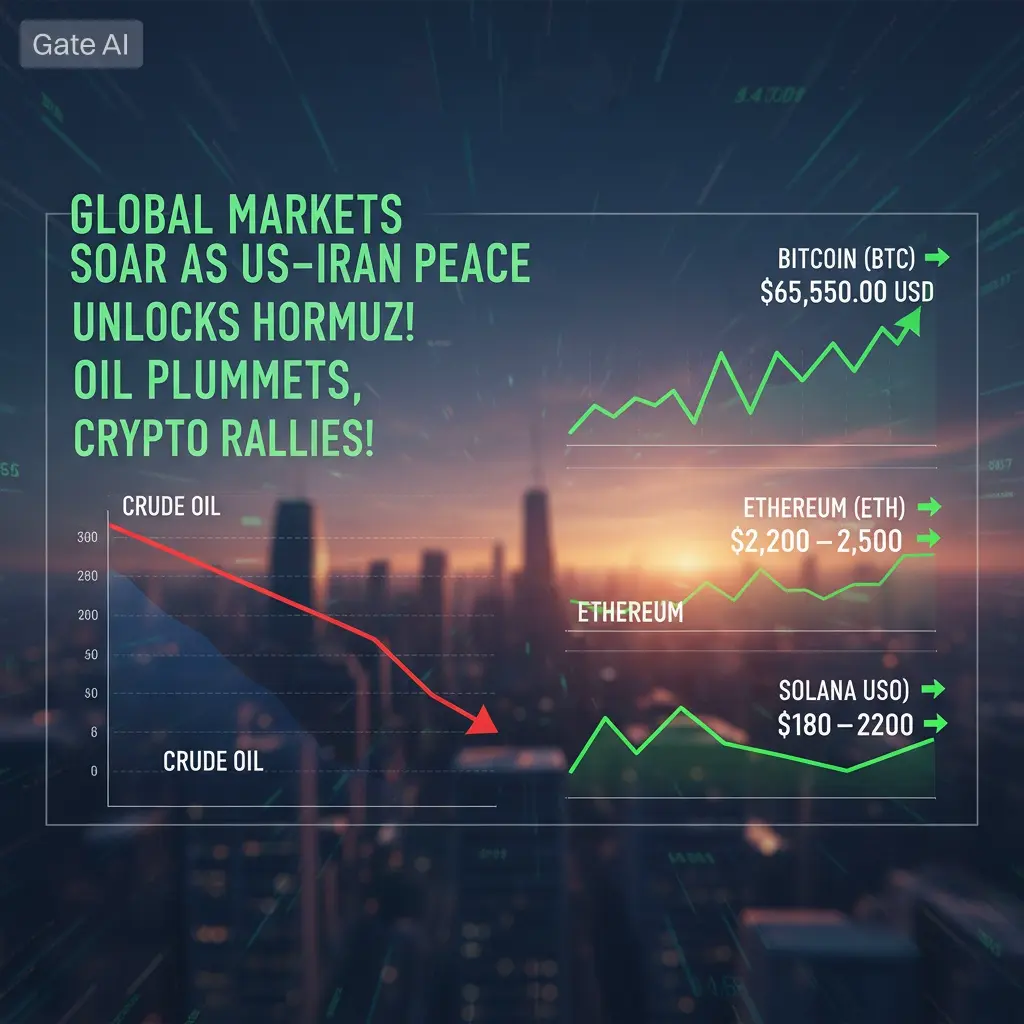
Cryptocurrency markets have responded positively to improving macro sentiment. Bitcoin is trading around $65,650, while Ethereum is near $1,740, Solana around $75, XRP at $1.17, and Dogecoin at $0.088. The broader crypto market is benefiting from expectations of lower inflation, improved liquidity conditions, and reduced geopolitical risk. If macro stability continues, Bitcoin could gradually retest higher resistance zones, while altcoins may experience stronger percentage-based recoveries due to higher volatility and speculative inflows.
Point Six: Global Stock Markets and Risk Appetite Ripple Effects
Global equity markets have strengthened as investors rotate back into risk assets. Lower oil prices reduce input and transportation costs for corporations, improving margins across multiple sectors including aviation, logistics, manufacturing, and technology. Growth-oriented sectors are particularly sensitive to interest rate expectations, and easing inflation pressure may support higher valuations. Emerging markets may also benefit from reduced energy import costs and improved foreign capital inflows, strengthening overall global risk appetite.
Point Seven: Interconnected Macro Transmission Between Oil, Gold, and Crypto
Oil acts as the primary driver of global macro conditions, influencing inflation, monetary policy, and liquidity cycles. Rising oil prices tighten financial conditions and increase inflation expectations, often leading to higher interest rates that negatively impact both gold and cryptocurrencies. Conversely, falling oil prices ease inflation pressure and improve liquidity conditions, supporting risk assets. Gold functions as both an inflation hedge and geopolitical safe haven, while cryptocurrencies perform best in environments of abundant liquidity and strong investor confidence. This interconnected structure means that changes in oil prices directly influence nearly all major asset classes simultaneously.
Point Eight (Final): Comprehensive Market Assessment and Forward Outlook
The US-Iran peace agreement and reopening of the Strait of Hormuz represent a major turning point for global financial markets. Current price levels — Brent $83.82, WTI $80.95, gold $4,300, Bitcoin $65,650, Ethereum $1,740, Solana $75, XRP $1.17, and Dogecoin $0.088 — reflect a rapid repricing of geopolitical risk across all asset classes. If implementation proceeds smoothly, oil could gradually stabilize toward $75–$80, Bitcoin may retest $70,000+ levels, Ethereum could move toward $2,000–$2,500, Solana may recover above $100, XRP could aim toward $1.40–$1.60, and Dogecoin may attempt a return toward $0.10+. Global equities may continue to strengthen if inflation eases and monetary policy expectations turn more supportive.
My personal thoughts and detailed reflection: In my view, this development represents a rare macro reset where geopolitics directly shifts the entire structure of global financial pricing. What stands out most is how quickly markets have transitioned from fear-based pricing to expectation-based optimism, especially in oil and risk assets. I personally believe this is not just a short-term reaction but a deeper sentiment shift where liquidity, growth expectations, and investor psychology are all being rebalanced. However, I also feel that this optimism is still fragile. The agreement has not yet been fully tested in real-world implementation, and even small delays in shipping normalization or political disagreements could reintroduce volatility. From a broader perspective, I see this as a phase where markets are trying to “price peace,” but the final confirmation will only come once ground-level stability in the Strait of Hormuz is fully restored.@Gate_Square
repost-content-media
  • Reward
  • 1
  • Repost
  • Share
HighAmbition:
that's good
#TradFiCFDGoldMasters
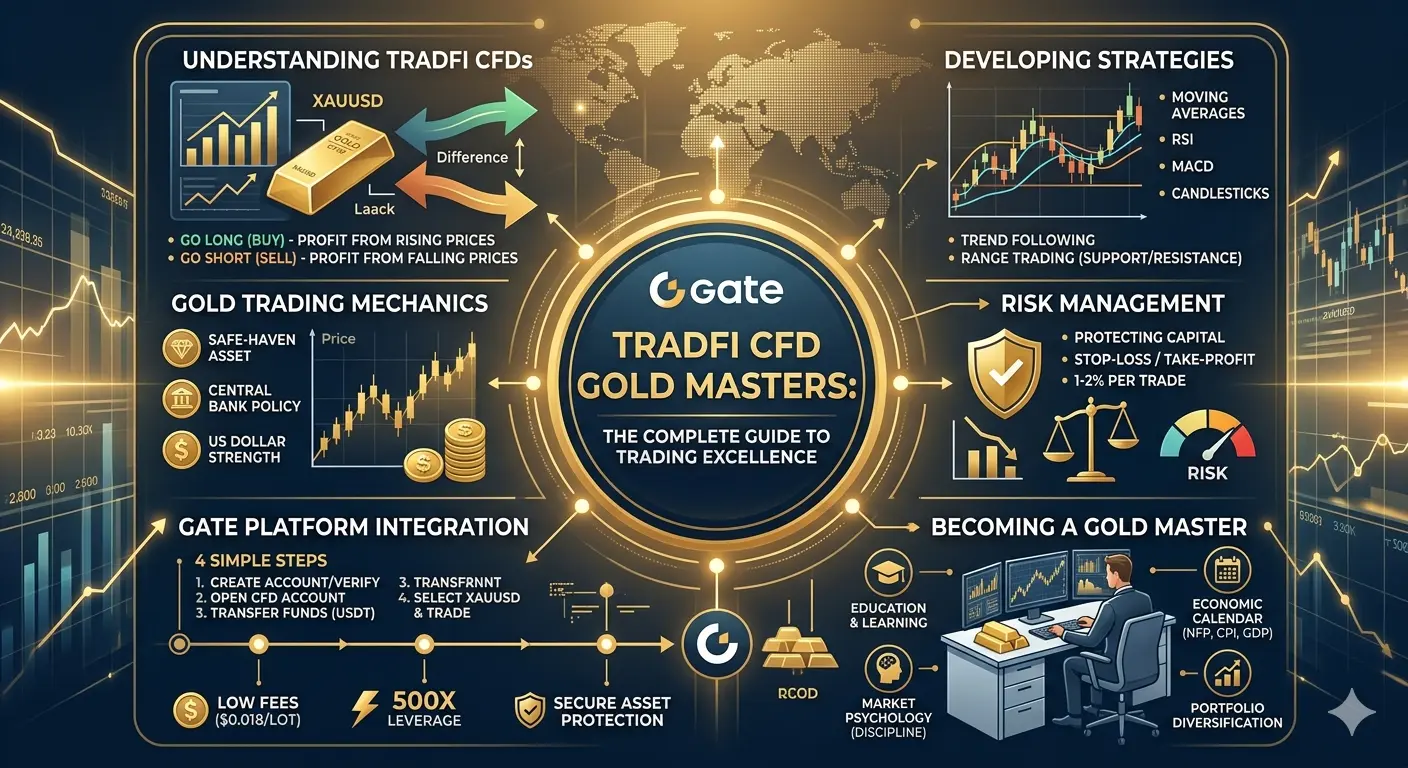
Traditional Finance (TradFi) represents the established financial system encompassing banks, stock markets, commodity exchanges, and foreign exchange markets. When combined with modern trading instruments like Contracts for Difference (CFDs), we create powerful opportunities for traders to access global markets with unprecedented flexibility.
A Contract for Difference (CFD) is a sophisticated financial derivative allowing traders to speculate on price movements of underlying assets without actually owning them. This mechanism enables participants to profit from both risi
XAU0.07%
XAG-0.97%
XPT-0.48%
HighAmbition
#TradFiCFDGoldMasters
Traditional Finance (TradFi) represents the established financial system encompassing banks, stock markets, commodity exchanges, and foreign exchange markets. When combined with modern trading instruments like Contracts for Difference (CFDs), we create powerful opportunities for traders to access global markets with unprecedented flexibility.
A Contract for Difference (CFD) is a sophisticated financial derivative allowing traders to speculate on price movements of underlying assets without actually owning them. This mechanism enables participants to profit from both rising and falling markets by exchanging the difference in asset prices between opening and closing trades. CFDs eliminate physical delivery requirements, making them attractive for traders seeking exposure to precious metals, currencies, stock indices, and commodities.
The mechanics of CFD trading are straightforward. When opening a CFD position, you agree with your broker to exchange the difference between entry and exit prices. Take a long position (buy) if you believe prices will increase, or a short position (sell) if you anticipate decline. Profit or loss equals price movement multiplied by position size. This structure allows participation with significantly less capital than traditional investing, thanks to leverage.
Gold maintains its position as one of the most sought-after trading instruments. As a safe-haven asset, gold performs well during economic uncertainty, inflation concerns, and geopolitical tensions. Key price drivers include central bank monetary policies, US dollar strength, inflation data, geopolitical events, and supply-demand dynamics.
Becoming a Gold Master requires developing comprehensive trading strategies. Trend following involves using technical indicators like moving averages, RSI, and MACD to determine market direction. Range trading works well when prices move sideways within support and resistance levels. Traders buy near support and sell near resistance, profiting from predictable oscillations.
Fundamental analysis plays a crucial role. Gold Masters monitor economic calendars tracking non-farm payrolls, CPI figures, GDP reports, and central bank announcements. Understanding how these indicators impact gold prices allows anticipation of market movements. When inflation exceeds expectations, gold prices often rise as investors seek protection.
Risk management separates successful traders from amateurs. Professional traders risk only one to two percent of capital per trade. Setting appropriate stop-loss orders protects against adverse movements, while take-profit levels lock in gains. Maintaining favorable risk-reward ratios ensures long-term profitability.
Leverage represents both opportunity and risk. While it amplifies potential profits, it equally magnifies losses. Responsible usage involves understanding margin requirements and never overextending beyond risk tolerance. Conservative leverage ratios help preserve capital while gaining experience.
Technical analysis forms the foundation of successful trading. Gold Masters develop proficiency in reading charts, identifying patterns like head and shoulders, double tops and bottoms, and using candlestick analysis for market sentiment insights. Support and resistance levels offer valuable reference points for trade planning.
Market psychology significantly impacts trading outcomes. Fear and greed drive movements, often causing prices to overshoot valuations. Understanding crowd psychology helps identify when markets become excessively bullish or bearish. Maintaining emotional discipline and sticking to predetermined plans are essential for success.
Gate platform provides exceptional infrastructure for aspiring Gold Masters. The platform offers comprehensive CFD trading capabilities covering gold, silver, platinum, crude oil, stock indices, and popular equities. Users trade using USDT as margin, providing seamless integration between cryptocurrency and traditional markets.
Gate CFD features industry-leading low fees starting from just $0.018 per lot. With access to nearly 300 global assets and leverage up to 500x, traders construct diversified portfolios. Multi-signature cold storage security protects user funds.
Getting started involves four simple steps. Create a Gate account and complete verification. Open a CFD trading account by accepting the service agreement. Transfer funds to your CFD account. Select your desired trading pair like XAUUSD for gold and begin trading. The interface supports both long and short positions.
The Gate TradFi CFD Gold Masters program represents a community of dedicated traders who mastered gold trading through CFD instruments. This initiative provides educational resources, competitive events with substantial prize pools, and learning opportunities from experienced traders.
Successful trading requires continuous learning. Markets evolve constantly, and strategies need refinement. Gold Masters commit to ongoing education, staying informed about macroeconomic developments and risk management best practices. Detailed trading journals track performance and identify improvement areas.
The relationship between gold and other markets provides additional insights. Gold often exhibits inverse correlation with the US dollar and real interest rates. Understanding these intermarket relationships helps make informed decisions and anticipate potential shifts.
Timing considerations play a crucial role. The London session sees significant gold movements as European markets open. The New York session brings additional volatility. Asian sessions establish important support and resistance levels. Successful traders align strategies with session characteristics.
Economic calendar awareness separates professionals from amateurs. Major announcements cause significant volatility. Gold Masters plan trading around high-impact events, positioning before anticipated moves or avoiding excessive uncertainty.
Portfolio diversification benefits from gold CFD positions. Gold's low correlation with traditional assets makes it an excellent diversifier. During equity downturns, gold often maintains value, providing portfolio protection. Strategic allocation improves overall risk-adjusted returns.
The psychological aspects deserve serious attention. Fear of missing out, attachment to losing positions, and overconfidence after winning streaks represent common pitfalls. Developing self-awareness and maintaining objective decision-making processes overcome these challenges.
Technology has revolutionized gold CFD accessibility. Modern platforms provide real-time price feeds, advanced charting, automated trading options, and mobile accessibility. These tools enable continuous market monitoring and effective position management from anywhere.
Regulatory considerations matter for responsible trading. Understanding legal frameworks, tax implications, and platform compliance ensures sustainable activities. Gate operates with appropriate regulatory oversight, providing transparent service terms.
The future of gold CFD trading appears promising as traditional finance and digital asset markets converge. Platforms bridging these worlds position users advantageously for evolving market structures. Gold Masters developing expertise now will capitalize on future opportunities.
In conclusion, becoming a Gold Master through TradFi CFD trading represents an achievable goal for dedicated individuals willing to invest time in education and practice. Understanding traditional finance principles, mastering CFD mechanics, developing robust strategies, and utilizing quality platforms like Gate create the foundation for success. The journey requires patience, discipline, and continuous improvement, but the rewards of financial independence and market mastery make the effort worthwhile.@Gate_Square #MyGateTradeStory
repost-content-media
  • Reward
  • 1
  • Repost
  • Share
HighAmbition:
that's good
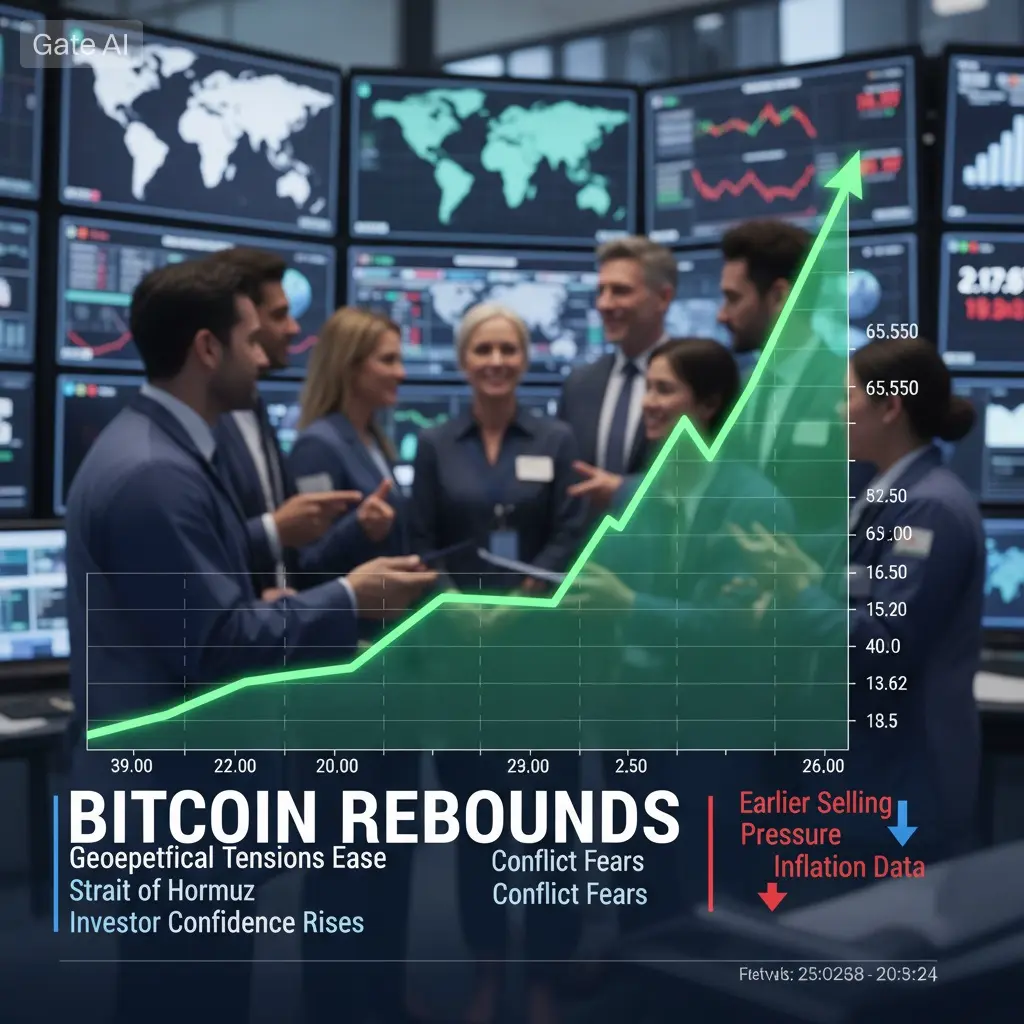
#BitcoinBouncesBack
The cryptocurrency market has once again demonstrated its remarkable ability to weather geopolitical storms, with Bitcoin staging an impressive recovery from recent lows. After experiencing significant downward pressure that pushed prices toward the $59,000 level, Bitcoin has bounced back strongly, reclaiming the $65,550 mark as positive developments emerge regarding the Iran situation.
The recent volatility in Bitcoin's price was largely driven by escalating tensions surrounding the Strait of Hormuz, one of the world's most critical oil shipping chokepoints. When Iran clo
BTC0.34%
HighAmbition
#BitcoinBouncesBack
The cryptocurrency market has once again demonstrated its remarkable ability to weather geopolitical storms, with Bitcoin staging an impressive recovery from recent lows. After experiencing significant downward pressure that pushed prices toward the $59,000 level, Bitcoin has bounced back strongly, reclaiming the $65,550 mark as positive developments emerge regarding the Iran situation.
The recent volatility in Bitcoin's price was largely driven by escalating tensions surrounding the Strait of Hormuz, one of the world's most critical oil shipping chokepoints. When Iran closed this vital waterway following military confrontations, global markets reacted with heightened anxiety. The Strait of Hormuz handles approximately 20% of the world's energy supply, making any disruption a significant concern for global economic stability.
Bitcoin's journey through this turbulence tells a compelling story of market resilience. The digital asset initially faced substantial selling pressure as investors sought safety in traditional haven assets. Prices declined sharply from the $70,000 region, eventually finding support near $59,000. This represented a significant correction that tested the conviction of even the most steadfast Bitcoin holders. However, the cryptocurrency's underlying fundamentals and growing institutional acceptance provided a solid foundation for recovery.
The turning point came as economic data and geopolitical developments began to shift in a more favorable direction. Recent releases showing elevated Consumer Price Index and Producer Price Index figures initially added to market pressure, contributing to Bitcoin's decline toward the $59,000 support level. These inflation indicators typically create headwinds for risk assets, and Bitcoin was no exception during this period of heightened uncertainty.
The real catalyst for Bitcoin's bounce back emerged from an unexpected source. President Donald Trump announced that a peace deal with Iran would be signed, with the Strait of Hormuz reopening immediately afterward. This development removed a significant overhang from global markets and provided the spark needed for Bitcoin's recovery
Bitcoin's price action following this announcement demonstrated the cryptocurrency's sensitivity to macroeconomic developments. The digital asset quickly reversed its earlier losses, climbing from the $64,450 support zone and successfully breaking through the $65,550 resistance level. This recovery represents more than just a technical bounce; it reflects growing confidence that the worst of the geopolitical uncertainty may be passing.
The significance of this price movement extends beyond the immediate numbers. Bitcoin's ability to recover from the $59,000 level and reclaim $65,550 showcases the asset's maturing market structure. Unlike earlier cycles where similar geopolitical events might have triggered prolonged bearish sentiment, the current market demonstrated remarkable resilience. Buyers stepped in at key support levels, preventing a deeper decline and establishing a foundation for the subsequent rally.
Technical analysts have noted that Bitcoin's recovery has occurred without the formation of bearish chart patterns that might typically signal further downside. Open interest data suggests that this bounce may have staying power, with market participants showing renewed appetite for exposure to the leading cryptocurrency.
The broader implications of this bounce back are worth considering. Bitcoin's performance during this period of geopolitical stress reinforces its position as a distinct asset class with its own dynamics. While traditional markets often move in lockstep during crisis periods, Bitcoin has shown an ability to decouple and chart its own course based on a combination of technical factors and evolving market sentiment.
Looking ahead, the reopening of the Strait of Hormuz represents a removal of significant uncertainty from global markets. For Bitcoin, this could provide the stability needed for prices to consolidate gains and potentially push toward higher levels. The successful defense of the $59,000 support zone and the breakout above $65,550 establishes a new technical framework that traders will be watching closely.
Investors should remain mindful that cryptocurrency markets remain inherently volatile, and geopolitical developments can shift rapidly. However, Bitcoin's performance through this recent episode demonstrates the asset's growing maturity and its ability to attract buying interest even during periods of heightened uncertainty. The bounce back from $59,000 to $65,550 serves as a reminder of why Bitcoin continues to capture the attention of both retail and institutional investors worldwide.
@Gate_Square #USIranPeaceDealReachedStraitOfHormuzToOpen
repost-content-media
  • Reward
  • 1
  • Repost
  • Share
HighAmbition:
that's good
#MiCATransitionEndsGateRemainsCompliant
The European Union has reached a defining moment in the history of digital asset regulation. The Markets in Crypto-Assets regulation, commonly known as MiCA, was adopted as Regulation (EU) 2023/1114 on May 31, 2023, and it represents the first comprehensive legal framework governing crypto-assets across all 27 EU member states. MiCA covers crypto-asset issuance, public offerings, admission to trading, and the authorization and supervision of crypto-asset service providers. It was designed to bring uniform rules to a market that previously operated under
HighAmbition
#MiCATransitionEndsGateRemainsCompliant
The European Union has reached a defining moment in the history of digital asset regulation. The Markets in Crypto-Assets regulation, commonly known as MiCA, was adopted as Regulation (EU) 2023/1114 on May 31, 2023, and it represents the first comprehensive legal framework governing crypto-assets across all 27 EU member states. MiCA covers crypto-asset issuance, public offerings, admission to trading, and the authorization and supervision of crypto-asset service providers. It was designed to bring uniform rules to a market that previously operated under fragmented and inconsistent national laws, creating uncertainty for both businesses and investors.
MiCA was not implemented overnight. The regulation was deployed in two phases. Stablecoin rules under Titles III and IV took effect from June 30, 2024, while rules for crypto-asset service providers under Title V applied from December 30, 2024. Alongside these phased implementations, a transitional grandfathering period was granted to existing crypto-asset service providers that were already operating legally before MiCA came into force. This transition period, which varied between 12 and 18 months depending on each member state's choice, allowed those providers to continue offering services without immediate full compliance, provided they applied for authorization within the specified deadlines.
That transitional period has now come to an end. As of July 1, 2026, any entity that continues to provide crypto-asset services to EU-based clients without MiCA authorization will be operating in breach of EU law. French regulators have already warned that crypto companies without EU licences face blacklisting and prosecution if they continue seeking EU customers beyond the June 30 deadline. This is not a theoretical risk; enforcement actions are already being prepared across multiple jurisdictions. The era of operating in regulatory gray zones within Europe is officially over.
This is where Gate stands out. Gate did not wait until the final deadline to align itself with MiCA requirements. Through its Malta-based entity, Gate Technology Ltd, Gate obtained a full MiCA license to provide exchange and custody services under the supervision of the Malta Financial Services Authority. Malta has emerged as a strategic hub for European crypto operations, offering a transparent and forward-looking regulatory environment that aligns perfectly with Gate's vision for secure, scalable, and innovative digital asset services. Building on this MiCA license, Gate further secured a Payment Institution license under the EU's Second Payment Services Directive (PSD2) from the same authority, making it one of the few crypto-native companies in Europe to achieve this level of regulatory approval.
The significance of Gate's dual licensing cannot be overstated. The MiCA license ensures that Gate meets all requirements for operating a crypto-asset exchange and providing custody services across the European Union. The PSD2 Payment Institution license enables Gate to expand compliant payment services throughout the EU via passporting rights, which means a single authorization in Malta grants legal permission to operate in all member states. Together, these licenses create a seamless, secure, and efficient ecosystem where traditional finance mechanisms and Web3 applications converge under full regulatory oversight.
Gate Technology Ltd CEO Giovanni Cunti emphasized that securing the Payment Institution license positions Gate to build a secure, scalable bridge between traditional finance and Web3, delivering compliant payment solutions to clients across Europe. He noted that this accomplishment marks a critical step in aligning with MiCA's regulatory framework and establishes a strong foundation for future financial services, ensuring regulatory certainty for both institutional and retail clients in the dynamic European market.
For users, the practical meaning of MiCA transition ending and Gate remaining compliant is straightforward and reassuring. Gate will not shut down in Europe. There are no regulatory issues threatening its operations. Its services across the European Union will continue uninterrupted. Users who trade on Gate can be confident that the platform operates within a legally approved framework, subject to oversight by a recognized financial authority, and held to standards that protect investor interests. This compliance signals stability, trust, and long-term commitment to the European market.
The broader impact on the crypto market is equally significant. MiCA's full enforcement introduces requirements around transparency, capital reserves, governance, and consumer protection that raise the bar for every operator in the European space. Crypto-asset service providers must now demonstrate adequate safeguards, publish clear and accurate information about the assets they list, and maintain operational standards comparable to traditional financial institutions. For issuers of e-money tokens and asset-referenced tokens, MiCA imposes specific authorization regimes and ongoing disclosure obligations, ensuring that stablecoins offered in the EU meet rigorous standards of reliability and reserve backing.
These requirements will inevitably reshape the competitive landscape. Platforms that failed to secure MiCA authorization before the deadline will either exit the European market or face enforcement. Those that prepared early, like Gate, will benefit from the confidence that compliance inspires among users and institutional partners alike. In the long term, MiCA is likely to drive greater institutional adoption of crypto-assets in Europe, because regulated environments reduce perceived risk and create pathways for traditional financial institutions to engage with digital assets more comfortably.
Gate's global compliance strategy extends well beyond Europe. The company operates regulated entities across multiple jurisdictions including Malta, Cyprus, the Bahamas, Japan, Australia, and Dubai. This multi-jurisdictional approach ensures that wherever Gate operates, it meets local regulatory requirements and maintains the standards of security and transparency that users expect. The European MiCA compliance is one pillar of this broader framework, but it reinforces a pattern that defines Gate's approach globally: proactive preparation, thorough licensing, and operational integrity.
The message for the crypto community is clear. The transition period that once allowed flexibility is finished. Strict, comprehensive regulations now govern crypto operations throughout the European Union. Gate had already prepared for this reality well in advance. Its systems, security protocols, and operational processes have been aligned with MiCA requirements, placing it firmly within the legally approved and safe operating zone. Users can trade with full confidence, knowing that Gate is not merely surviving the regulatory shift but thriving within it, setting an example for the industry on how compliance and innovation coexist successfully.
For anyone evaluating which platform to trust in this new regulatory era, Gate's track record speaks convincingly. Founded in 2013, Gate serves over 50 million users globally and ranks among the top crypto exchanges worldwide. Its proactive compliance posture, dual MiCA and PSD2 licensing in Malta, and continued investment in regulatory readiness across all markets demonstrate a commitment that goes beyond meeting minimum requirements. Gate chose to exceed them, and that choice positions it as one of the most reliable and future-ready platforms in the evolving European crypto landscape.
@Gate_Square
repost-content-media
  • Reward
  • 1
  • Repost
  • Share
HighAmbition:
that's good
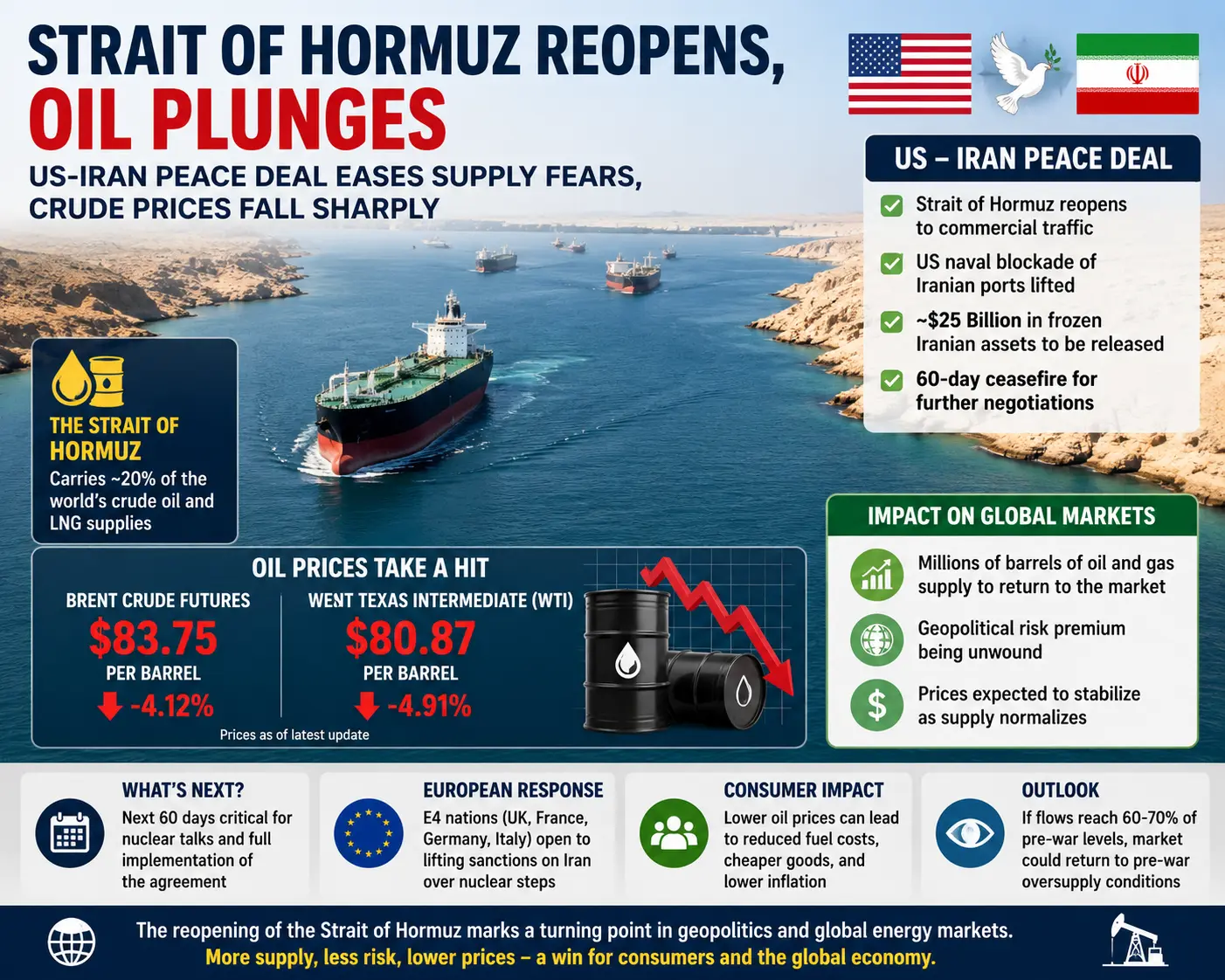
#StraitOfHormuzReopensOilPlunges
The Strait of Hormuz, one of the world's most critical maritime chokepoints, has officially reopened following a peace agreement between the United States and Iran. This development has sent shockwaves through global energy markets, resulting in a dramatic decline in oil prices. The hashtag StraitOfHormuzReopensOilPlunges encapsulates this significant geopolitical and economic event that is reshaping the global energy landscape.
The Strait of Hormuz serves as a vital artery for global oil transportation, with approximately twenty percent of the world's crude o
NG1.81%
HighAmbition
#StraitOfHormuzReopensOilPlunges
The Strait of Hormuz, one of the world's most critical maritime chokepoints, has officially reopened following a peace agreement between the United States and Iran. This development has sent shockwaves through global energy markets, resulting in a dramatic decline in oil prices. The hashtag StraitOfHormuzReopensOilPlunges encapsulates this significant geopolitical and economic event that is reshaping the global energy landscape.
The Strait of Hormuz serves as a vital artery for global oil transportation, with approximately twenty percent of the world's crude oil and liquefied natural gas flowing through this narrow waterway. When the strait was closed due to military conflict between the US and Iran, it created an unprecedented supply disruption that lasted for more than three months. The reopening of this crucial passage marks a turning point in Middle Eastern geopolitics and has immediate implications for global energy security.
Current oil prices reflect the market's swift reaction to this news. Brent crude futures have fallen significantly, dropping to approximately $83.75 per barrel, representing a decline of over four percent. The US West Texas Intermediate crude has experienced an even steeper fall, reaching around $80.87 per barrel with a decrease of nearly five percent. These price movements demonstrate how sensitive global oil markets remain to supply disruptions and geopolitical developments in the Middle East.
The peace deal between the United States and Iran represents a significant diplomatic breakthrough. Under the terms of the agreement, the Strait of Hormuz will reopen to commercial traffic, and a US naval blockade of Iranian ports will be lifted. The draft agreement also includes provisions for releasing approximately twenty-five billion dollars in frozen Iranian assets and potential sanctions waivers on Iranian oil exports. A sixty-day ceasefire period has been established to allow for further negotiations on a more comprehensive agreement.
The impact on global oil supply cannot be overstated. During the closure of the Strait of Hormuz, the world lost millions of barrels of oil and gas supply daily. The reopening means that Middle Eastern producers can gradually resume their production and export activities. However, analysts caution that full restoration of pre-war supply levels may take time due to damage sustained during the conflict and logistical challenges in the region.
Market analysts have provided various perspectives on the price outlook. Some experts believe that oil prices could stabilize around current levels as supply gradually returns to normal. The geopolitical risk premium that had been built into crude prices is now being unwound as traders price in the prospect of restored oil flows. Commonwealth Bank of Australia commodities strategist Vivek Dhar suggests that oil flows through the Strait of Hormuz only need to reach sixty to seventy percent of pre-war levels to return oil markets to pre-war oversupply expectations.
The European response to this development has been significant as well. The E4 nations, comprising the United Kingdom, France, Germany, and Italy, have indicated their willingness to lift sanctions on Iran in response to steps regarding its nuclear program. This multilateral approach could further facilitate Iran's reintegration into global energy markets and contribute to price stabilization.
Looking ahead, several factors will influence oil price trajectories. The speed at which Middle Eastern producers can resume full production capacity remains uncertain. Additionally, the outcome of the next round of negotiations over the next sixty days, particularly regarding Iran's nuclear program, will be crucial. Market participants are also monitoring global demand patterns, with some analysts expressing concerns about potential demand destruction due to slower economic growth in major consuming economies.
The reopening of the Strait of Hormuz represents more than just a return to normalcy for oil markets. It signals a potential shift in Middle Eastern geopolitics and could pave the way for more stable energy supplies in the region. However, the experience of the past three months has highlighted the vulnerability of global energy infrastructure to geopolitical shocks and the need for diversified supply chains.
For consumers and businesses worldwide, the decline in oil prices offers some relief from the inflationary pressures that had been building due to high energy costs. Lower oil prices typically translate into reduced transportation costs, cheaper manufacturing inputs, and potentially lower prices for goods and services. However, the full impact on consumer prices may take time to materialize as existing inventories are worked through the supply chain.
In conclusion, the StraitOfHormuzReopensOilPlunges event marks a significant moment in global energy markets. The combination of restored supply flows, reduced geopolitical risk, and the potential for increased Iranian oil exports has created a bearish environment for oil prices. While uncertainties remain regarding the full implementation of the peace deal and the pace of supply recovery, the immediate market reaction has been overwhelmingly positive for consumers and energy-importing nations. The coming months will be critical in determining whether this represents a temporary price adjustment or a more fundamental shift in the global oil market dynamics.
@Gate_Square #MyGateTradeStory #USIranPeaceDealReachedStraitOfHormuzToOpen
repost-content-media
  • Reward
  • 1
  • Repost
  • Share
HighAmbition:
that's good
Gate Square | Jun 15 Discussion: #BitcoinBouncesBack
Bitcoin Bounces Back: How the US-Iran Peace Agreement Is Reshaping Markets
On June 14, 2026, the world witnessed a historic breakthrough. The United States and Iran announced they have reached a comprehensive peace agreement, declaring an immediate and permanent ceasefire on all fronts, including the conflict in Lebanon. This memorandum of understanding, finalized after 15 hours of intense negotiations with Qatari mediators, calls for the toll-free reopening of the Strait of Hormuz and the immediate removal of the US naval blockade on Irani
HighAmbition
Gate Square | Jun 15 Discussion: #BitcoinBouncesBack
Bitcoin Bounces Back: How the US-Iran Peace Agreement Is Reshaping Markets
On June 14, 2026, the world witnessed a historic breakthrough. The United States and Iran announced they have reached a comprehensive peace agreement, declaring an immediate and permanent ceasefire on all fronts, including the conflict in Lebanon. This memorandum of understanding, finalized after 15 hours of intense negotiations with Qatari mediators, calls for the toll-free reopening of the Strait of Hormuz and the immediate removal of the US naval blockade on Iranian ports. A formal signing ceremony is scheduled for June 19 in Switzerland, with a 60-day framework established for further technical discussions on sanctions relief, nuclear issues, and economic reconstruction. The deal also includes the unfreezing of approximately 25 billion dollars in Iranian assets and Iran's commitment to nuclear non-weaponization. The United has congratulated both parties, and world leaders from the UK, France, and across the Gulf have praised the diplomatic effort. This is not just a geopolitical milestone; it is a seismic shift for global financial markets, and the ripple effects are already being felt across crypto, oil, and gold.
Discussion Topic 1: Will the US-Iran Agreement Support Further Crypto Gains?
The immediate market reaction was unmistakable. Bitcoin surged past 65,000 dollars within hours of the announcement, recovering from weeks of war-driven selling pressure that had pushed it as low as 61,100 just days earlier. The logic is straightforward: the ceasefire removes the single largest geopolitical risk that has been dragging on risk appetite throughout the spring. When military strikes were paused in late March, Bitcoin rallied above 71,000, giving us a blueprint for how crypto responds to de-escalation. The current bounce is driven by the same mechanics: reduced uncertainty frees up capital that had been parked in defensive positions, and that capital flows back into risk assets like Bitcoin and the broader crypto market. However, in my view, the sustainability of this rally depends on several factors beyond just geopolitics. The war has been a persistent drag, yes, but Bitcoin is still roughly 49 percent below its October 2025 all-time high of 126,080 dollars. Inflation expectations remain elevated, and the Fed's tightening stance has not softened. The ceasefire eases one headwind, but rate policy and macro liquidity conditions still govern the medium-term direction. I believe the agreement creates a favorable tailwind for crypto in the short term, but investors should temper expectations. A move toward 70,000 is plausible if the signing ceremony proceeds smoothly and the Strait reopens without complications, but the real breakout requires a shift in monetary policy. Watch the 60-day negotiation window closely. If sanctions relief proceeds smoothly and oil supply normalization drives inflation lower, the path to a sustained crypto rally becomes much clearer. On Gate, you can track Bitcoin's real-time price action and use contract trading tools to position yourself for both upside and downside scenarios as this situation evolves.
Discussion Topic 2: BTC Is Back Above 65K — What Is the Outlook From Here?
Bitcoin reclaiming the 65,000 level is psychologically significant, but the technical picture tells a more nuanced story. Before the peace deal news, Bitcoin had been trapped below a bearish pennant resistance line, and while Thursday's breakout above that pattern was encouraging, confirmation was still missing. The key level to watch is the TBO support-resistance zone just under 64,000 dollars. A sustained close above that zone would shift the narrative from a reaction bounce to a confirmed reversal. Until that happens, this move should be treated as a relief rally rather than a trend change. My outlook is cautiously optimistic. The immediate catalyst is powerful: a permanent ceasefire and the reopening of one of the world's most critical shipping lanes removes a massive overhang on global markets. Lower oil prices mean lower inflation expectations, which in turn reduce the pressure on central banks to keep rates elevated. This chain reaction benefits risk assets across the board, and Bitcoin is the most sensitive to these shifts. However, I would not chase this rally blindly. Bitcoin has already run nearly 4,000 dollars from its Thursday low, and short-term overextension is a real risk. The 68,000 to 70,000 zone represents the next major resistance cluster, and getting through it will require more than just peace deal euphoria. We need follow-through in the form of declining inflation data, dovish Fed signaling, or sustained institutional inflows. The SpaceX IPO on Friday also created a competing narrative that could temporarily divert capital away from crypto. In my view, the best approach is to scale into positions gradually rather than going all-in at current levels. Use pullbacks toward the 62,000 to 63,000 zone as entry opportunities if the broader thesis holds. On Gate, the K-line and technical analysis tools can help you identify these key levels and time your entries with precision.
Discussion Topic 3: With Oil Falling and Gold Rising, How Are You Positioning in Commodities?
The commodity divergence is perhaps the most fascinating market story right now. Oil prices collapsed more than 4 percent immediately after the deal, with Brent crude falling 3.51 dollars to 83.82 dollars per barrel and US West Texas Intermediate dropping 3.93 dollars to 80.95 dollars. The logic is clear: the Strait of Hormuz carries roughly 20 percent of the world's oil supply, and its effective closure since February had driven oil prices up more than 40 percent, creating what the International Energy Agency called the biggest energy supply crisis in history. Reopening the strait without tolls will gradually restore that supply, and the market is pricing in a swift normalization. However, oil is still over 60 percent higher than at the start of the year, and mines still need to be cleared from the strait before full shipping resumes. The drop is significant but the baseline is still elevated. I expect oil to continue trending lower over the coming weeks as tankers resume transit, but the pace depends on how quickly de-mining operations proceed and whether Iran's regulatory role over the strait introduces any friction. Gold, meanwhile, rose more than 2 percent, trading above 4,300 dollars per ounce. This seems counterintuitive at first glance. Why would gold rise when geopolitical risk is declining? The answer lies in the inflation-interest rate dynamic. Lower oil prices ease inflation concerns, which reduces the pressure for central banks to raise rates further. A softer dollar and lower rate expectations are bullish for gold, even as geopolitical risk premiums fade. KCM Trade analyst Tim Waterer explained it well: lower oil prices and a softer dollar from reduced geopolitical risk are calming inflation expectations, which benefits gold. But I would add a caveat. Gold has fallen about 20 percent since the war began, and at least 270 tons of gold in exchange-traded funds are in loss-making territory below 4,250 dollars. The current bounce is real but fragile. The 50-day moving average at 4,446 dollars and the bull-bear line at 4,481 dollars represent the next upside targets. If gold fails to break those levels, the bounce could reverse quickly. My positioning strategy is straightforward. I am tactically bullish on gold toward the 4,450 zone but would take partial profits there rather than holding for a full reversal to the January highs. For oil, I am bearish on a multi-week timeframe but cautious about shorting aggressively until the strait physically reopens and shipping data confirms the supply recovery. Gate's TradFi platform now offers commodity CFDs on gold, oil, and forex, allowing you to trade these diverging trends with leverage and precision. Whether you want to go long on gold or short on oil, you can execute both views from a single account.
Conclusion: A New Chapter for Global Markets
This peace agreement marks the beginning of a new chapter. The ceasefire removes the most acute geopolitical risk facing markets today, but the transition from war to peace is never linear. The 60-day negotiation window will determine whether this deal becomes a durable settlement or merely a pause in tensions. For crypto, the short-term bias is bullish, but sustainability requires macro cooperation from central banks. For commodities, the divergence between falling oil and rising gold reflects a complex rebalancing of inflation expectations, currency dynamics, and risk sentiment. Position yourself thoughtfully, use the tools available on Gate, and stay nimble. Markets are moving fast, and the opportunities are real, but so are the risks.
#USIranPeaceDealReachedStraitOfHormuzToOpen #StraitOfHormuzReopensOilPlunges
repost-content-media
  • Reward
  • 1
  • Repost
  • Share
HighAmbition:
good 👍
#GateLaunchesHongKongStockTrading
GateLaunchesHongKongStockTrading: A Revolutionary Step in Global Investment
Gate Has Officially Launched Hong Kong Stock Trading
Gate, one of the world's leading cryptocurrency exchanges, has taken another groundbreaking step by officially launching Hong Kong stock trading services. This expansion represents a significant milestone in Gate's mission to bridge the gap between traditional finance and digital assets, offering users unprecedented access to global equity markets through a single, unified platform.
What This Launch Means for Investors
The introduct
TRAHK-0.68%
US2000-1.55%
TW880.10%
HighAmbition
#GateLaunchesHongKongStockTrading
GateLaunchesHongKongStockTrading: A Revolutionary Step in Global Investment
Gate Has Officially Launched Hong Kong Stock Trading
Gate, one of the world's leading cryptocurrency exchanges, has taken another groundbreaking step by officially launching Hong Kong stock trading services. This expansion represents a significant milestone in Gate's mission to bridge the gap between traditional finance and digital assets, offering users unprecedented access to global equity markets through a single, unified platform.
What This Launch Means for Investors
The introduction of Hong Kong stock trading on Gate opens doors to one of Asia's most dynamic and liquid financial markets. Hong Kong Stock Exchange stands as the world's leading venue for IPOs and serves as a critical gateway connecting international investors with Asian markets. By adding Hong Kong stocks to its already robust US stock offering, Gate has created a comprehensive global trading ecosystem that empowers investors to diversify their portfolios like never before.
Key Features and Benefits
Seamless Access to Over 1,000 Hong Kong-Listed Stocks
Gate's Hong Kong stock trading service provides access to more than 1,000 stocks listed on the Hong Kong Stock Exchange's Main Board and GEM. This includes exposure to some of Asia's most prominent companies such as Tencent Holdings, HSBC Holdings, CATL, China Mobile, Xiaomi Corporation, Meituan, BYD Company, Ping An Insurance, AIA Group, and Hong Kong Exchanges and Clearing. These companies represent diverse sectors including technology, finance, telecommunications, automotive, and insurance, offering investors a wide array of investment opportunities.
Unified Account System
One of the most compelling features of Gate's Hong Kong stock trading is the unified account system. Users can manage both US stocks and Hong Kong stocks through the same account, enabling seamless fund management, position tracking, and portfolio management. This integration eliminates the need for multiple brokerage accounts and simplifies the investment process significantly.
USDT-Based Trading
Gate has revolutionized traditional stock trading by enabling users to trade Hong Kong stocks using USDT. This innovative approach removes the barriers associated with currency conversion and traditional banking requirements. Investors no longer need to open separate brokerage accounts or convert funds into Hong Kong dollars. By leveraging USDT, Gate has made global equity investment accessible to cryptocurrency users worldwide.
Competitive VIP Benefits
Gate's VIP tier system extends to Hong Kong stock trading, offering exclusive benefits to active traders. Users can upgrade to VIP status with just $2,000 in holdings and enjoy trading fees as low as 0.023%. Additionally, VIP members receive dedicated 1-on-1 account manager services, ensuring personalized support for their investment journey.
How to Access Hong Kong Stock Trading
Getting started with Hong Kong stock trading on Gate is straightforward. Users need to update their Gate App to version 8.23.5 or above. Once updated, they can access the stock trading section through the TradFi category, the Markets section, or by searching directly. To begin trading, users simply transfer USDT from their Spot Account or Unified Account to their Stock Account.
Trading hours for Hong Kong stocks follow the Hong Kong Stock Exchange schedule, with sessions running from 01:30 to 04:00 UTC and 05:00 to 08:00 UTC. It is important to note that trading is only available during regular market hours, with no pre-market or after-hours sessions currently offered.
Building on Success: From US Stocks to Hong Kong Stocks
Gate's expansion into Hong Kong stocks builds upon the tremendous success of its US stock trading platform, which already supports over 10,000 US-listed stocks and ETFs. The US stock service covers major exchanges including NYSE, Nasdaq, NYSE Arca, NYSE American, and BATS, with fractional trading starting from as low as 0.01 shares. By adding Hong Kong stocks to this impressive lineup, Gate has created one of the most comprehensive global trading platforms in the industry.
Why This Matters for Global Investors
The launch of Hong Kong stock trading on Gate represents more than just a new product offering. It signifies Gate's commitment to democratizing access to global financial markets. Hong Kong serves as a crucial financial hub connecting East and West, and by providing access to this market, Gate enables investors to participate in Asia's economic growth story.
Hong Kong Stock Exchange has consistently ranked among the world's top exchanges for IPO fundraising, attracting companies from mainland China and beyond. The exchange's Stock Connect program has further strengthened its position as a bridge between international investors and Chinese capital markets. By offering Hong Kong stock trading, Gate positions its users to benefit from these market dynamics.
Special Launch Promotion
To celebrate the launch of Hong Kong stock trading, Gate is offering an exciting promotion where users can share over $182,000 in stock rewards from leading companies including Tencent, Meituan, BYD, and Xiaomi. New users who complete their first Hong Kong stock trade can claim Tencent stock as a reward. Additionally, the Value Investment Plan, Trading Challenge, and Top Gainer Prediction events are live, offering more opportunities to earn rewards.
Gate's Vision for the Future
Gate's launch of Hong Kong stock trading aligns with its broader vision of creating a comprehensive financial ecosystem that seamlessly integrates traditional finance with digital assets. The platform continues to expand its offerings, recently launching futures stocks with TRAHK perpetual contracts and introducing indices trading with contracts tracking major global benchmarks including the Russell 2000, MSCI Taiwan Index, and Hang Seng China Enterprises Index.
This strategic expansion demonstrates Gate's commitment to innovation and user-centric development. By continuously adding new asset classes and trading options, Gate ensures that its users have access to the tools and opportunities they need to build diversified, resilient portfolios.
Conclusion
GateLaunchesHongKongStockTrading marks a significant milestone in the evolution of global investment platforms. By combining the accessibility of cryptocurrency trading with the stability and growth potential of traditional equity markets, Gate has created a unique value proposition for investors worldwide. Whether you are a seasoned trader looking to diversify into Asian markets or a newcomer seeking exposure to global equities, Gate's Hong Kong stock trading service offers an unparalleled combination of convenience, variety, and innovation.
Join millions of users worldwide who trust Gate for their investment needs. Experience the future of global finance today by exploring the exciting opportunities available through Gate's Hong Kong stock trading platform.
@Gate_Square #MyGateTradeStory
repost-content-media
  • Reward
  • 1
  • Repost
  • Share
HighAmbition:
To The Moon 🌕
#MyGateTradeStory
My US Stock Trading Journey: From Uncertainty to Strategic Confidence
Trading US stocks on Gate has been one of the most transformative experiences in my investment career. Unlike the round-the-clock nature of cryptocurrency markets, US stocks follow a disciplined rhythm that taught me the value of patience and preparation.
When I first started exploring US stocks through Gate's platform, I was drawn to the familiarity of companies I had grown up with. Names like Apple, Microsoft, and Tesla were not just ticker symbols. They were companies whose products I used daily, whose
HighAmbition
#MyGateTradeStory
My US Stock Trading Journey: From Uncertainty to Strategic Confidence
Trading US stocks on Gate has been one of the most transformative experiences in my investment career. Unlike the round-the-clock nature of cryptocurrency markets, US stocks follow a disciplined rhythm that taught me the value of patience and preparation.
When I first started exploring US stocks through Gate's platform, I was drawn to the familiarity of companies I had grown up with. Names like Apple, Microsoft, and Tesla were not just ticker symbols. They were companies whose products I used daily, whose earnings calls I could follow, and whose business models I could understand. This familiarity gave me an edge that I never felt in more speculative markets.
My first significant trade came during a period of market volatility. The Federal Reserve had just signaled potential rate changes, and the market was reacting with heightened sensitivity. I had been watching a particular tech stock that had been beaten down by broader market sentiment, despite reporting strong quarterly earnings. The disconnect between the company's fundamentals and its stock price created what I believed was a compelling opportunity.
I spent days analyzing the situation. I reviewed the company's balance sheet, listened to the earnings call multiple times, and compared its valuation metrics against historical averages and industry peers. The stock was trading at a price-to-earnings ratio significantly below its five-year average, even though revenue growth remained robust. This was not a gamble. It was a calculated decision based on thorough research.
The entry point I chose was not perfect. The stock continued to drift lower for several days after I opened my position. Those were uncomfortable days. I questioned my analysis, wondered if I had missed something the market was seeing, and fought the urge to cut my losses. But I reminded myself that I had entered this trade with a thesis, and nothing in the subsequent news flow invalidated that thesis. The company's competitive position had not deteriorated. Its cash flow remained strong. The market was simply pricing in fear rather than fundamentals.
Patience proved to be the right approach. Over the following weeks, as quarterly results validated my research and broader market sentiment stabilized, the stock recovered. By the time I closed my position three months later, I had captured a meaningful return. More importantly, I had gained something far more valuable than profit: confidence in my analytical process.
This experience taught me several lessons that continue to shape my US stock trading strategy today. First, understanding the business behind the ticker symbol matters enormously. When you know what a company does, who its competitors are, and what drives its revenue, you can evaluate opportunities with greater clarity. Second, volatility creates opportunity, but only for those who have done the work to understand what an asset is truly worth. Third, timing entries and exits perfectly is nearly impossible, so focus on building positions in quality assets at reasonable prices rather than chasing perfect execution.
The US stock market also taught me about the importance of macro awareness. Federal Reserve policy, employment data, inflation reports, and geopolitical developments all influence market direction. I developed a routine of checking economic calendars and understanding how different data points might impact my positions. This does not mean trying to predict every market move, but rather being prepared for scenarios that might require adjusting my strategy.
Risk management became another cornerstone of my approach. I learned to size my positions appropriately, never risking more than I could afford to lose on any single trade. I set clear stop-loss levels based on technical support levels and my risk tolerance, and I adhered to them even when emotions urged me to hold on just a little longer. This discipline saved me from significant losses on several occasions when trades moved against me.
Diversification across sectors proved equally important. I made a conscious effort to build exposure across technology, healthcare, consumer discretionary, and financial sectors. This approach meant that when one area of the market struggled, others often provided balance. It also forced me to learn about industries I had previously ignored, broadening my understanding of the economy and uncovering opportunities I might otherwise have missed.
The psychological aspect of trading US stocks deserves mention. The market opens at a specific time, creates clear daily patterns, and closes with defined settlement. This structure creates natural rhythms for analysis and reflection. I developed habits around reviewing pre-market news, monitoring positions during trading hours, and conducting post-market analysis to prepare for the next session. These routines helped me stay disciplined and avoid impulsive decisions.
One of the most valuable aspects of trading US stocks on Gate has been access to extended hours trading. The ability to react to earnings reports and news events outside regular market hours has been crucial. Several of my most profitable trades came from positioning ahead of earnings announcements or responding to after-hours developments that the regular session had not yet priced in.
Looking ahead, I remain optimistic about US stock opportunities. The market continues to offer exposure to innovative companies driving technological advancement, healthcare breakthroughs, and sustainable energy solutions. While volatility will always be present, the long-term trajectory of well-managed businesses creating value for shareholders remains compelling.
My advice to anyone considering US stock trading is to start with education. Understand the companies you are investing in, develop a clear thesis for each position, and establish risk management rules before you begin. The market rewards preparation and punishes impulsiveness. Start small, learn from your experiences, and gradually build your confidence and position sizes as you develop your edge.
Trading US stocks has not just been about financial returns. It has been a journey of continuous learning, self-discipline, and strategic thinking. Every trade, whether profitable or not, has contributed to my growth as an investor. The markets are an endless classroom, and I remain eager to learn more with each passing session.
@Gate_Square
repost-content-media
  • Reward
  • 1
  • Repost
  • Share
HighAmbition:
2026 GOGOGO 👊
#MyGateTradeStory
My Gate Trading Moment: The Day BTC Taught Me Patience
Every trader remembers that one trade that changed everything. For me, it was not the biggest win or the most painful loss, but a simple lesson about patience that reshaped my entire approach to the crypto market.
It was early June 2026, and Bitcoin was trading around the 65760 range. The market had been choppy for weeks, with institutional outflows creating uncertainty and many retail traders panicking at every dip. I had been watching BTC closely, analyzing the technical patterns forming on the charts. The bearish penn
BTC0.34%
HighAmbition
#MyGateTradeStory
My Gate Trading Moment: The Day BTC Taught Me Patience
Every trader remembers that one trade that changed everything. For me, it was not the biggest win or the most painful loss, but a simple lesson about patience that reshaped my entire approach to the crypto market.
It was early June 2026, and Bitcoin was trading around the 65760 range. The market had been choppy for weeks, with institutional outflows creating uncertainty and many retail traders panicking at every dip. I had been watching BTC closely, analyzing the technical patterns forming on the charts. The bearish pennant structure was evident, and sentiment was turning negative across social media platforms.
Most traders I knew were either selling in fear or waiting on the sidelines. But something about the price action felt different this time. Bitcoin was holding above key support levels despite the negative news flow. The resilience was remarkable, and I noticed that long-term holders were not distributing their coins aggressively.
I decided to open a long position on Gate, not because I predicted an immediate moon shot, but because the risk-reward ratio had shifted in favor of buyers. The 60000 level had been tested multiple times and was holding firm. I set my stop loss carefully and sized my position according to my risk management rules.
What happened next taught me the value of conviction. While others panic sold during minor dips, I held my position. Strategy, the corporate Bitcoin holder, resumed their buying spree, purchasing over 1550 BTC at an average price of 65332. This institutional confidence restored market sentiment, and BTC began its gradual climb.
The trade did not make me rich overnight, but it taught me something more valuable. In crypto, patience is not just a virtue, it is a strategy. The market rewards those who can stay calm when others are fearful, who can see beyond the daily noise and focus on the bigger picture.
My advice to new traders entering the crypto space is simple: do not chase pumps, and do not panic at dumps. Build your analysis, trust your research, and always manage your risk. Bitcoin has been here for over a decade, surviving countless crashes and corrections. The technology is sound, the adoption is growing, and the long-term trend remains intact.
Trading is not about being right every time. It is about managing your risk so that when you are right, your winners pay for your losers and then some. That June trade on Gate taught me that lesson in the most practical way possible, through real market experience with real money on the line.
Today, I approach every trade with the same mindset. Analyze the market structure, identify key levels, manage risk, and let the trade play out. Sometimes the best trade is the one you hold, not the one you take.
This is my Gate trading moment. What is yours?
@Gate_Square
repost-content-media
  • Reward
  • 1
  • Repost
  • Share
HighAmbition:
good 💯
#MyGateTradeStory
GT Token Technical Analysis and Trading Levels
GateToken GT is currently trading at approximately 6.86 USDT with a market cap of around 730 million dollars. The token has experienced significant volatility, currently trading about 73 percent below its all-time high of 25.38 USDT reached in January 2025. This analysis provides key support and resistance levels along with suggested stop loss and take profit targets for traders.
Current Market Structure
The technical picture for GT shows a bearish bias on higher timeframes. The price is trading below the 50-day simple moving av
GT0.29%
BTC0.34%
ETH2.43%
HighAmbition
#MyGateTradeStory
GT Token Technical Analysis and Trading Levels
GateToken GT is currently trading at approximately 6.86 USDT with a market cap of around 730 million dollars. The token has experienced significant volatility, currently trading about 73 percent below its all-time high of 25.38 USDT reached in January 2025. This analysis provides key support and resistance levels along with suggested stop loss and take profit targets for traders.
Current Market Structure
The technical picture for GT shows a bearish bias on higher timeframes. The price is trading below the 50-day simple moving average at approximately 6.99 USDT and well below the 200-day simple moving average at around 8.03 USDT. Short-term moving averages are generating mixed signals, with the 5-day, 10-day, and 20-day averages showing buy signals while longer-term averages remain in sell territory.
Key Resistance Levels
Understanding resistance zones helps identify where price advances may face selling pressure.
R3 Strong Resistance: 7.38 USDT. This represents a major barrier approximately 7.5 percent above current price. A breakout above this level would signal strong bullish momentum.
R2 Resistance: 7.19 USDT. This secondary resistance zone sits about 4.8 percent above spot price and often acts as a pivot point for price action.
R1 Resistance: 6.99 USDT. This immediate resistance aligns with the 50-day moving average and represents the first hurdle for any upward move, roughly 2 percent above current price.
Key Support Levels
Support zones indicate where buying interest may emerge to halt price declines.
S1 Strong Support: 6.55 USDT. This critical support level sits approximately 4.5 percent below current price and has historically provided a floor for price action.
S2 Support: 6.36 USDT. This secondary support zone offers additional downside protection around 7 percent below current levels.
S3 Major Support: 6.16 USDT. This represents a significant floor approximately 10 percent below spot price, where strong buying interest typically emerges.
Technical Indicators Overview
The Relative Strength Index currently reads around 38, indicating the token is approaching oversold territory but has not reached extreme conditions. The MACD on hourly timeframes shows bearish momentum at approximately negative 290, suggesting short-term downward pressure persists. Market sentiment remains neutral with the Fear and Greed index at 52, indicating balanced market conditions.
Suggested Stop Loss and Take Profit Levels for Long Positions
Entry Zone: 6.70 to 6.86 USDT. This range allows accumulation near current market price while waiting for confirmation of support.
Stop Loss: Below 6.55 USDT. Placing stops beneath the S1 support level protects against a breakdown of the current support structure.
Take Profit 1: 6.99 USDT. This target captures the move to R1 resistance and the 50-day moving average, offering approximately 2 percent upside from entry.
Take Profit 2: 7.19 USDT. This secondary target reaches the R2 resistance zone, providing roughly 5 percent upside potential.
Take Profit 3: 7.38 USDT. For extended moves, this target captures the strong resistance level, offering approximately 8 percent upside from entry.
Suggested Stop Loss and Take Profit Levels for Short Positions
Entry Zone: 6.95 to 7.00 USDT. This range offers entry near the R1 resistance where selling pressure typically emerges.
Stop Loss: Above 7.20 USDT. Placing stops above the R2 resistance protects against a breakout scenario.
Take Profit 1: 6.55 USDT. This target captures the move to S1 support, offering approximately 6 percent downside from entry.
Take Profit 2: 6.36 USDT. This secondary target reaches the S2 support zone, providing roughly 8 percent downside potential.
Risk Management Considerations
Position sizing should account for GT's volatility and current bearish structure. The token has printed 40 percent green days versus 60 percent red days over the past month, indicating a slight seller dominance in recent price action. Twenty-four hour trading volume sits at approximately 3.38 million dollars, representing about 0.5 percent of market cap, suggesting relatively quiet market participation that could lead to sharper moves on increased activity.
Market Correlation Factors
GT tends to follow broader cryptocurrency market movements, particularly Bitcoin and Ethereum correlation. Traders should monitor major market movements as GT often amplifies these trends. Token unlock schedules and treasury releases can create predictable sell pressure, so monitoring official announcements regarding supply changes is advisable.
Warning and Disclaimer
Cryptocurrency trading involves substantial risk of loss. The technical levels provided are based on historical price action and indicator readings, not guarantees of future performance. Markets can move rapidly against positions, and stop losses may not execute at desired levels during volatile conditions. Past performance does not indicate future results. This analysis is for informational purposes only and does not constitute financial advice. Always conduct your own research, consider your risk tolerance, and never trade with capital you cannot afford to lose. The cryptocurrency market operates 24 hours with high volatility, and prices can gap significantly during low liquidity periods.
Additional Risk Factors
Exchange risk exists as GT is primarily traded on Gate exchange. Liquidity risk should be considered as lower volume can lead to slippage on larger orders. Regulatory risk remains present in the cryptocurrency space with potential for sudden policy changes. Technology risk includes potential smart contract vulnerabilities or exchange technical issues. Market manipulation risk exists in lower volume tokens where large holders can influence price action.
Conclusion
GT currently presents a technically weak picture with price below key moving averages. Traders should wait for confirmation of trend reversal before establishing significant long positions. Short-term traders may find opportunities at defined support and resistance levels with proper risk management. Long-term investors should consider dollar-cost averaging strategies rather than large single entries given the current bearish structure. Always use appropriate position sizing and maintain disciplined risk management practices.@Gate_Square
repost-content-media
  • Reward
  • 1
  • Repost
  • Share
HighAmbition:
thnxx for the update
#MyGateTradeStory
My Gate Trade Story: From 50 USDT Voucher to a Hard Lesson in Timing
Every trader remembers that one trade that taught them more about the market than any book ever could. Mine started with a simple notification from Gate Plaza.
It was a regular day when I received the news that my post had been selected as featured content in the Gate community event. The reward was a 50 USDT feature voucher. At that moment, I felt a mix of excitement and responsibility. This was not just free money, it was an opportunity to prove that I could turn a small starting point into something mean
BLESS7.13%
HighAmbition
#MyGateTradeStory
My Gate Trade Story: From 50 USDT Voucher to a Hard Lesson in Timing
Every trader remembers that one trade that taught them more about the market than any book ever could. Mine started with a simple notification from Gate Plaza.
It was a regular day when I received the news that my post had been selected as featured content in the Gate community event. The reward was a 50 USDT feature voucher. At that moment, I felt a mix of excitement and responsibility. This was not just free money, it was an opportunity to prove that I could turn a small starting point into something meaningful.
I decided to use the voucher on BLESS token. The strategy seemed straightforward. The voucher had a 7-day validity period, which meant I needed to act quickly but also wisely. I watched the price action carefully, waiting for the right moment to enter.
When BLESS was trading at 0.055, I saw what I believed was an opportunity. The market was showing momentum, and I decided to open a short position. My analysis suggested that the price might retrace, and I could capture a quick profit within the voucher timeframe.
What happened next taught me one of the most valuable lessons in trading. Within minutes, BLESS surged from 0.055 to 0.08. The move was so rapid that my position went from manageable to critical in what felt like seconds. The 70 USDT I had built up from the original 50 USDT voucher suddenly shrank to just 10 USDT.
Looking back, I made several mistakes that day. First, I underestimated the volatility of low-cap tokens. Second, I failed to set proper stop losses because I was focused on maximizing the voucher value within the limited timeframe. Third, I did not fully understand the SP feature at that time, which could have helped me manage the risk better.
But the most important mistake was emotional. I became attached to the voucher amount rather than treating it as risk capital. When the trade started moving against me, I hesitated to cut losses because I did not want to waste the opportunity. That hesitation cost me dearly.
The voucher expired shortly after, leaving me with only 10 USDT from what could have been a profitable learning experience. Yet, looking at that 10 USDT remaining in my account, I realized something important. The market had given me a lesson worth far more than the 40 USDT I lost.
Trading is not about winning every trade. It is about surviving long enough to learn from your mistakes. That day, I learned about the importance of time management in trading, the danger of emotional attachment to positions, and the critical need to understand every tool available on the platform before using them.
Today, when I trade on Gate, I approach every position with a clear plan. I set stop losses before entering. I never risk more than I can afford to lose. And most importantly, I treat every trade as a learning opportunity, whether it results in profit or loss.
The 50 USDT voucher was not just a reward. It was my tuition fee for one of the most important lessons in my trading journey. And that lesson continues to guide my decisions every time I open a position.
To all the new traders on Gate, remember this. Your losses are not failures. They are the price of education in the most competitive classroom in the world. Keep learning, keep adapting, and never stop improving your strategy.
This is my Gate trade story. What is yours?
#我的Gate交易时刻
@Gate_Square
repost-content-media
  • Reward
  • 1
  • Repost
  • Share
HighAmbition:
thank you for information
#PredictWorldCupWin40000U
The 2026 FIFA World Cup is underway, and Group H kicks off with a compelling clash between reigning European champions Spain and World Cup debutants Cape Verde on Tuesday, June 15 at Atlanta Stadium. For Spain, this is the start of a campaign where anything short of lifting the trophy will feel like a disappointment. For Cape Verde, this is simply the biggest day in their entire football history. Let me break down the tactical dynamics, form, prediction market odds, and my final verdict on who takes the win.
Spain enters this World Cup as one of the outright favorite
KALSHI-4.08%
HighAmbition
#PredictWorldCupWin40000U
The 2026 FIFA World Cup is underway, and Group H kicks off with a compelling clash between reigning European champions Spain and World Cup debutants Cape Verde on Tuesday, June 15 at Atlanta Stadium. For Spain, this is the start of a campaign where anything short of lifting the trophy will feel like a disappointment. For Cape Verde, this is simply the biggest day in their entire football history. Let me break down the tactical dynamics, form, prediction market odds, and my final verdict on who takes the win.
Spain enters this World Cup as one of the outright favorites to win the tournament. Polymarket currently gives Spain a 17 percent probability of lifting the trophy, making them the standalone frontrunner. Their Euro 2024 triumph over England in Berlin confirmed that La Roja has returned to the pinnacle of European football. Since the start of Euro 2024, Spain have played 26 matches across all competitions, suffering just one defeat against Portugal in the Nations League final. That consistency over two years is extraordinary and speaks volumes about the quality Luis de la Fuente has cultivated.
Cape Verde, ranked 69th by FIFA, topped their CAF qualifying group to earn a historic first World Cup appearance. For a nation of roughly 600,000 people, qualification alone is an achievement deserving immense respect. Coach Bubista has built a side that relies on tactical discipline, collective commitment, and extreme motivation to compensate for the obvious gap in individual quality. They arrive in high spirits after winning their last three matches.
Spain's recent form is outstanding. They have won five of their last six matches, including a 3-1 victory over Peru in their final pre-tournament friendly. Even more telling, Spain have scored at least two goals in each of their last 13 consecutive matches across all competitions. That consistent attacking output reflects the potency de la Fuente's system generates through fluid positional play, intelligent pressing, and devastating transitions.
Cape Verde have not lost any of their last six matches and have scored two or more goals in each of their last three away fixtures, averaging 2.00 goals per away match. They are not a side that simply retreats and hopes to survive. They carry attacking ambition, which matters because purely defensive approaches against Spain tend to eventually crack under sustained pressure.
Spain's squad is loaded with world-class talent. Lamine Yamal, the 18-year-old Barcelona phenomenon, has returned to full training alongside Nico Williams after a brief fitness concern. Yamal's dribbling, vision, and chance creation make him one of the most dangerous young players in world football. Williams provides pace and directness on the opposite flank, preventing opponents from focusing solely on Yamal. In midfield, Pedri remains the heartbeat of this side with his passing range and ability to dictate tempo. Zubimendi provides the defensive stability that allows creative players to flourish, and Ferran Torres offers versatile finishing that deepens Spain's attacking options.
For Cape Verde, Ryan Mendes is the figurehead. With 22 goals in 97 caps, he is the highest goalscorer in Cape Verde's history and carries the hopes of his entire nation. Cape Verde's likely lineup features Vozinha in goal, a back four of Moreira, Costa, Pico, and Paulo, a midfield of Semedo and Pina, and an attacking unit of Mendes, Monteiro, Cabral, and Dailon. This reflects their intention to stay compact while using Mendes and wide players for counter-attacks.
On Polymarket, Spain is priced at approximately 91.5 cents for the win, implying a 91.5 percent probability. The draw sits around 6.5 cents, while Cape Verde is at just 2.5 cents, reflecting a mere 2.5 percent chance of an outright victory. On Kalshi, Spain is at minus-953, translating to roughly 90.5 percent, with the draw at plus-1,311 and Cape Verde at plus-2,865. The total goals line is set at 3.5, and the Asian handicap line of minus-2.5 at 1.82 odds suggests traders expect Spain to win by at least three goals.
Spain will almost certainly control possession from the first whistle. Against Cape Verde's expected low block, Spain will probe patiently, using Yamal and Williams to stretch the defensive line while Pedri and Zubimendi seek vertical passing lanes. Once Spain finds the opening goal, Cape Verde must push forward, opening transitional spaces that Spain's attackers thrive on. This is where multiple goals become probable as Cape Verde's defensive discipline fractures under sustained pressure.
Cape Verde's best chance lies in the opening 30 minutes before Spain settles. If Mendes or Cabral can produce a moment of quality on a counter-attack or set piece, the entire dynamic shifts. However, sustaining that scenario over 90 minutes remains extremely unlikely given the squad quality gap.
One caveat worth noting is Spain's mixed record in World Cup opening matches. They have won just two of their last five opening games at major tournaments, including a shock loss to Switzerland in 2010. However, that pattern is now 16 years old, and this current generation appears more mature and consistent.
After weighing all evidence, form, tactical considerations, and market signals, my verdict is clear. Spain wins 3-0. Their attacking quality is simply too overwhelming for a debutant defense that has never faced this level of opposition. Yamal and Williams will create constant danger, Pedri ensures tempo control, and Torres converts chances rather than wasting them. Cape Verde's discipline is admirable, but motivation alone cannot bridge the gap between the second-ranked team and the 69th-ranked debutant.
The 3-0 scoreline reflects my expectation that Spain scores once in the first half after sustained pressure, then adds two more after Cape Verde are forced to open up. I do not expect Cape Verde to score because Spain's defensive structure, anchored by Cubarsi and protected by Zubimendi, is extremely difficult to breach for sides with limited attacking depth.
From a prediction market angle, the Spain win at 91.5 cents offers limited upside since the high probability is already priced in. More interesting opportunities may exist in total goals above 3.5 or Spain covering the minus-2.5 Asian handicap at 1.82, both aligning with my 3-0 prediction.
While making your predictions, remember that Gate is running an incredible World Cup campaign where you can share a 40,000 prize pool by posting on Gate Square. Use PredictWorldCupWin40000U with your match analysis and trading strategies. Each day 10 Prediction Kings share 500 in position vouchers, 50 lucky participants share 1,000 weekly, and the leaderboard offers World Cup jerseys, experience vouchers, and position vouchers worth up to 1,000 for top performers. The campaign runs through July 21. Head to the official Gate World Cup campaign page to get started.
Spain's quality prevails. La Roja begins their journey toward what many believe could be a second World Cup title. My final prediction: Spain 3-0 Cape Verde.
#PredictWorldCupWin40000U
repost-content-media
  • Reward
  • 1
  • Repost
  • Share
HighAmbition:
thanks for sharing
#BitmineAdds100kETH
BitMine Immersion Technologies, an Ethereum-focused treasury company chaired by Tom Lee, continues to attract strong market attention with its aggressive accumulation strategy. The firm recently added approximately 100,000 ETH, reinforcing one of the most significant institutional Ethereum buying trends in 2026. This analysis breaks down the nine key aspects of this development and its broader market implications.
Point One: Understanding BitMine and Its Strategy
BitMine Immersion Technologies is positioning itself as a major Ethereum treasury entity similar to a Bitcoin-f
ETH2.43%
HighAmbition
#BitmineAdds100kETH
BitMine Immersion Technologies, an Ethereum-focused treasury company chaired by Tom Lee, continues to attract strong market attention with its aggressive accumulation strategy. The firm recently added approximately 100,000 ETH, reinforcing one of the most significant institutional Ethereum buying trends in 2026. This analysis breaks down the nine key aspects of this development and its broader market implications.
Point One: Understanding BitMine and Its Strategy
BitMine Immersion Technologies is positioning itself as a major Ethereum treasury entity similar to a Bitcoin-focused corporate reserve model. The company follows an aggressive accumulation strategy, consistently acquiring large ETH positions on a weekly basis.
As of June 2026, BitMine’s total holdings are estimated at over 5.5 million ETH, representing approximately 4.5%–4.6% of total circulating supply. This makes it one of the largest known Ethereum holders globally.
A significant portion—around 85% to 92%—is staked, allowing the firm to generate continuous yield while maintaining long-term exposure. The company is also preparing additional capital raises exceeding $300 million+ to further expand its ETH accumulation strategy.
Point Two: The Scale of Recent Purchases
The latest acquisition of approximately 100,000 ETH reflects a capital deployment of nearly $170 million to $200 million, depending on execution price levels.
Some recent large-scale transactions in the market suggest even higher accumulation levels, with total weekly purchases occasionally exceeding 120,000–130,000 ETH, valued at roughly $200 million to $230 million+.
This consistent buying pattern highlights institutional conviction and sustained demand pressure on Ethereum’s supply structure.
Point Three: Market Impact on Ethereum Price
Ethereum has shown controlled volatility rather than sharp upward spikes, despite heavy institutional accumulation.
Current ETH price levels are estimated around $1,900 to $2,200, with recent highs approaching $2,300+ in strong momentum phases.
While institutional buying provides a strong structural support zone, broader macro conditions and market liquidity cycles continue to influence price action. The repeated accumulation creates a long-term price floor effect, reducing deep downside risk during corrections.
Point Four: Institutional Confidence Signal
BitMine’s strategy reflects strong institutional confidence in Ethereum’s long-term role in digital finance.
The company’s treasury position—estimated at $10B+ total assets including crypto and cash equivalents—shows deep commitment to ETH as a core reserve asset.
Such large-scale accumulation signals that institutional players increasingly view Ethereum as a strategic macro asset rather than a speculative instrument, especially as staking yields provide additional structural incentives.
Point Five: Ethereum Supply Dynamics
BitMine’s control of nearly 5% of circulating ETH supply, combined with staking of the majority of holdings, significantly reduces liquid market supply.
Ethereum’s deflationary pressure is further supported by:
EIP-1559 fee burning mechanism
Increased staking participation across institutions
Long-term holding behavior from treasury entities
This combination creates a tightening supply environment where available trading liquidity becomes increasingly limited during demand surges.
Point Six: Price Forecasts and Technical Outlook
Ethereum price forecasts for 2026 vary widely depending on market conditions:
Conservative Range: $2,000 – $2,800
Moderate Bull Case: $3,200 – $5,500
Extended Bull Cycle Scenario: $6,500 – $9,000
Extreme Bull Market Projection: $10,000 – $12,000+
Technical indicators show ETH maintaining strength above long-term moving averages, with RSI levels suggesting neutral-to-bullish momentum structure.
Key macro drivers include ETF inflows, staking growth, and Layer 2 ecosystem expansion.
Point Seven: Trader Sentiment and Market Psychology
Market sentiment has become increasingly reactive to institutional accumulation signals.
Traders view BitMine’s consistent purchases as:
A structural demand anchor
A psychological support factor
A long-term bullish confirmation signal
However, sentiment remains mixed due to ETF flow fluctuations and broader macro uncertainty. Despite this, institutional accumulation continues to dominate long-term market narratives.
Point Eight: Trading Strategies for ETH Investors
Several trading approaches are emerging in the current environment:
1. Accumulation Strategy:
Gradual buying in the $1,900–$2,100 range, focusing on long-term positioning.
2. Swing Trading Strategy:
Entry: $1,850 – $2,050
Targets: $2,400 – $2,800
Extended target: $3,200+
3. Breakout Strategy:
A confirmed break above $2,400 may trigger accelerated momentum toward higher resistance zones.
Risk Management:
Protective levels generally sit below $1,700, depending on volatility conditions.
Point Nine: Future Outlook and Key Levels to Watch
Key factors influencing Ethereum’s next major move include:
Continued institutional accumulation from treasury companies
ETF inflows and macro liquidity conditions
Expansion of staking participation
Layer 2 ecosystem growth and network activity
Important price zones:
Support: $1,900 / $1,700
Resistance: $2,400 / $2,800
Mid-term breakout zone: $3,200+
Bull cycle extension range: $5,000 – $9,000
If institutional demand continues at current levels, Ethereum could enter a long-term supply squeeze phase, potentially driving accelerated price discovery.
Conclusion
BitMine’s acquisition of 100,000 ETH reinforces a powerful institutional trend shaping Ethereum’s long-term market structure. While short-term price action remains influenced by macro volatility, the underlying accumulation narrative suggests strengthening fundamentals.
If institutional demand continues expanding alongside staking growth, Ethereum may be entering a structural revaluation phase over the coming market cycle.@Gate_Square #BlackRockReducesBTCIncreasesETH
repost-content-media
  • Reward
  • 1
  • Repost
  • Share
HighAmbition:
To The Moon 🌕
#SpaceX认购规模超2500亿美元
The SpaceX initial public offering represents one of the most significant financial events in recent market history. With investor demand exceeding $250 billion against a $75 billion fundraising target, the oversubscription rate of approximately 3.5 to 4 times demonstrates extraordinary market appetite for this aerospace and technology giant. The company plans to sell approximately 555.6 million shares at $135 per share, resulting in a valuation of approximately $1.77 trillion, which would position SpaceX as the seventh most valuable company in the United States and surpas
HighAmbition
#SpaceX认购规模超2500亿美元
The SpaceX initial public offering represents one of the most significant financial events in recent market history. With investor demand exceeding $250 billion against a $75 billion fundraising target, the oversubscription rate of approximately 3.5 to 4 times demonstrates extraordinary market appetite for this aerospace and technology giant. The company plans to sell approximately 555.6 million shares at $135 per share, resulting in a valuation of approximately $1.77 trillion, which would position SpaceX as the seventh most valuable company in the United States and surpass Tesla's current market capitalization of around $1.6 trillion.
SpaceX has established itself as a dominant force across multiple sectors including commercial space launch, satellite internet connectivity through Starlink, and artificial intelligence through its xAI division. The company generated approximately $15 billion in revenue during 2025, with Starlink contributing roughly 61 percent of total revenue. This diversified revenue stream provides a foundation for sustainable growth, though the recent merger with xAI has transformed the company from profitable to loss-making in the short term.
The IPO pricing at $135 per share reflects aggressive growth expectations built into the valuation. Morningstar has placed a fair value estimate of $780 billion on SpaceX, representing approximately 48 percent below the IPO target valuation. This significant discrepancy between market pricing and independent valuation estimates suggests that current pricing incorporates substantial future growth that has not yet materialized. The company has outlined ambitious plans including solar-powered data centers in space and targets a total addressable market of $28.5 trillion, with nearly $23 trillion attributed to enterprise artificial intelligence applications.
The allocation structure for this IPO includes an unusually large retail component, with approximately 30 percent of the offering reserved for individual investors. This approach leverages Elon Musk's substantial following among retail investors while broadening the ownership base. However, the massive oversubscription means that most retail participants will likely receive partial allocations rather than full subscription amounts.
From a growth perspective, SpaceX operates in sectors with substantial expansion potential. The global space economy continues to expand rapidly, with satellite internet representing a particularly attractive market given the billions of people worldwide lacking reliable internet access. The company's vertical integration and technological advantages in reusable rocket technology provide competitive moats that could sustain margins over time. Nevertheless, the valuation assumes flawless execution of ambitious projects including the fully reusable Starship vehicle and orbital artificial intelligence infrastructure.
The timing of this IPO coincides with heightened interest in artificial intelligence investments and continued enthusiasm for Elon Musk's business ventures. The listing on Nasdaq under ticker symbol SPCX is scheduled for June 12, 2026, following pricing determination on June 11. Goldman Sachs serves as lead underwriter for the offering.
For investors considering participation, several factors warrant careful evaluation. The current pricing embeds years of future growth, meaning the company must execute flawlessly to justify valuations. Competition in satellite internet is intensifying with Amazon's Project Kuiper and other entrants pursuing similar markets. Regulatory risks exist around spectrum allocation and space debris management. The company's pivot toward artificial intelligence integration introduces execution risks around technology development timelines.
The massive oversubscription indicates strong institutional confidence, but also creates potential for post-IPO volatility as initial trading may not reflect fundamental value. Historical patterns for highly anticipated IPOs often include initial price spikes followed by stabilization as supply and demand reach equilibrium. Investors should consider their time horizon and risk tolerance when evaluating position sizing.
Question One: Did you participate in the Gate SpaceX IPO subscription?
Participation in IPO subscriptions requires careful consideration of several factors including portfolio allocation, risk tolerance, and investment timeline. For those who participated through Gate's platform, the subscription process involves locking funds during the allocation period with final share distribution dependent on overall demand relative to available supply. Given the oversubscription levels, participants should expect partial fills rather than complete allocation of requested amounts.
The Gate platform provides retail access to IPO shares that would traditionally be reserved for institutional investors. This democratization of IPO access represents a significant development for individual investors seeking exposure to high-profile offerings. However, participants should understand that IPO investments carry inherent risks including price volatility and potential for immediate losses if aftermarket trading declines below subscription prices.
Question Two: What do you think the final price of SPCX will be? How much room for growth is there?
The final IPO pricing has been set at $135 per share based on available information. Post-listing price performance will depend on multiple factors including initial trading dynamics, broader market conditions, and investor sentiment toward growth stocks. Highly anticipated IPOs frequently experience initial price premiums as demand from investors who missed the allocation window enters the market through secondary trading.
Growth potential for SpaceX exists across multiple vectors. The Starlink satellite constellation continues expanding coverage and subscriber base, with potential to serve underserved markets globally. Commercial launch services benefit from increasing demand for satellite deployment and potential space tourism development. The artificial intelligence integration through xAI opens additional revenue streams though this area remains speculative with unproven monetization models.
The $28.5 trillion total addressable market cited by SpaceX represents theoretical maximum opportunity rather than near-term revenue potential. Actual growth realization depends on successful execution of ambitious technological development programs including Starship reusability, orbital data centers, and artificial intelligence infrastructure deployment. These projects carry substantial technical and financial risks that could delay or prevent achievement of projected milestones.
Analyst estimates vary considerably regarding fair value. Conservative valuations around $780 billion suggest limited upside from current pricing levels, while bullish scenarios envision SpaceX becoming the world's largest company based on successful execution of multi-planetary expansion and artificial intelligence dominance. The wide range of outcomes reflects fundamental uncertainty about timing and success of transformative projects.
Personal Perspective
From an analytical standpoint, SpaceX represents a compelling long-term investment thesis with significant near-term valuation risk. The company possesses genuine technological advantages and operates in expanding markets with substantial growth potential. However, the current valuation appears to fully discount years of successful execution, leaving limited margin for error or delays.
The massive oversubscription demonstrates market confidence but also creates potential for disappointment if post-IPO trading fails to deliver immediate gains. Historical precedent suggests that highly hyped IPOs often underperform in the months following listing as initial enthusiasm moderates and fundamental performance becomes the primary valuation driver.
For investors with long-term horizons and appropriate risk tolerance, SpaceX offers exposure to transformative technologies with potential to reshape multiple industries. However, position sizing should reflect the speculative nature of current valuations and the extended timeline required for many growth initiatives to mature. Dollar-cost averaging into positions over time may prove more prudent than concentrated initial allocations given valuation uncertainty.
The integration of artificial intelligence capabilities adds complexity to the investment thesis. While AI represents a significant growth opportunity, it also introduces competitive dynamics and capital requirements that differ from SpaceX's traditional aerospace business. Success in this area is less certain given intense competition from established technology companies and well-funded startups.
Overall, SpaceX deserves consideration as a portfolio holding for investors seeking exposure to space economy and artificial intelligence themes, but current pricing requires careful evaluation of risk-adjusted return potential relative to alternative investments in these sectors.@Gate_Square #CertifiedCreatorPromotionTask
repost-content-media
  • Reward
  • Comment
  • Repost
  • Share
#PredictWorldCupShare40000U
The 2026 FIFA World Cup kicks off this Friday with two exciting Group A fixtures that promise to set the tone for the tournament. As a football enthusiast and prediction market participant, I want to share my detailed analysis for both matches: Mexico versus South Africa and South Korea versus Czech Republic.
Match One: Mexico versus South Africa
Mexico enters this tournament as co-hosts and clear favorites in Group A. The match takes place at the iconic Estadio Azteca in Mexico City, giving El Tri a significant home advantage that cannot be understated. The stadiu
HighAmbition
#PredictWorldCupShare40000U
The 2026 FIFA World Cup kicks off this Friday with two exciting Group A fixtures that promise to set the tone for the tournament. As a football enthusiast and prediction market participant, I want to share my detailed analysis for both matches: Mexico versus South Africa and South Korea versus Czech Republic.
Match One: Mexico versus South Africa
Mexico enters this tournament as co-hosts and clear favorites in Group A. The match takes place at the iconic Estadio Azteca in Mexico City, giving El Tri a significant home advantage that cannot be understated. The stadium atmosphere will be electric, with passionate Mexican supporters creating an intimidating environment for any visiting team.
From a tactical perspective, Mexico under head coach Javier Aguirre has developed a solid 4-3-3 formation that emphasizes direct wide play and aggressive pressing. Captain Edson Alvarez anchors the midfield, providing defensive stability and distribution. Up front, veteran striker Raul Jimenez leads the line, supported by dynamic wingers Roberto Alvarado and Alexis Vega. The presence of young talent like 17-year-old Gilberto Mora adds creativity and unpredictability to their attack.
Mexico's recent form has been encouraging. They won the Concacaf Gold Cup last summer, defeating the United States 2-1 in the final. Their friendly matches have shown a team that is organized defensively and dangerous on set pieces. The psychological advantage of opening the World Cup at home cannot be ignored.
South Africa, on the other hand, returns to the World Cup stage for the first time since hosting the tournament in 2010. They are the lowest-ranked team in Group A and face an uphill battle against the hosts. However, they have demonstrated resilience in qualifying and will look to harness their underdog spirit.
South Africa's tactical approach typically relies on compact defending and quick counterattacks. They will need to be disciplined at the back and take advantage of any set-piece opportunities. The pressure of facing the hosts in the opening match could work against them, as Mexico will be highly motivated to start their campaign with a victory.
My prediction for this match is a Mexico win, likely by a 2-0 or 2-1 scoreline. The home advantage, superior individual quality, and tournament experience give Mexico a clear edge. South Africa will put up a fight, but the combination of Mexican attacking prowess and the hostile home crowd should see El Tri secure all three points.
Match Two: South Korea versus Czech Republic
The second Group A match features an intriguing contest between South Korea and Czech Republic at Estadio Akron in Guadalajara. This match is much more evenly balanced and could go either way, making it an interesting prospect for prediction markets.
South Korea enters this World Cup with mixed emotions. Their qualifying campaign was solid, conceding only eight goals throughout the process. However, recent form has been concerning, with heavy defeats to Brazil and Ivory Coast raising questions about their readiness for the tournament. Head coach Hong Myung-bo has faced criticism for his tactical decisions, and the team atmosphere appears strained.
The South Korean squad revolves around their captain and talisman, Son Heung-min. The Tottenham Hotspur forward scored ten goals during qualifying and remains their primary attacking threat. At 33 years old, this could be his final World Cup, and he will be determined to make it memorable. Supporting Son are players like Lee Kang-in and Kim Min-jae, who provide quality in midfield and defense respectively.
Tactically, South Korea has experimented with different formations, including a back three system. Their defensive organization is generally strong, but questions remain about their ability to create consistent goal-scoring opportunities beyond Son's individual brilliance.
Czech Republic qualified for this World Cup through back-to-back penalty shootout victories in the UEFA play-offs, demonstrating their mental toughness and resilience. While they may lack the star power of some other teams, their collective spirit and tactical discipline make them dangerous opponents.
The Czech team features striker Patrik Schick as their main goal threat. He provides a reliable focal point in attack and is capable of scoring from various situations. Their set-piece routines are particularly well-organized, and they will look to exploit any defensive lapses from South Korea.
Tactically, the Czech Republic tends to play a structured, organized game with emphasis on defensive solidity and quick transitions. Their experience in high-pressure situations during qualifying should serve them well in this tournament opener.
My prediction for this match is a closely contested draw, likely 1-1. South Korea has the advantage of possessing a world-class player in Son Heung-min, but their recent poor form and internal issues are concerning. Czech Republic's resilience and tactical organization could frustrate the Koreans, and I believe they have enough quality to secure a point. Alternatively, a narrow Czech victory would not surprise me given South Korea's current struggles.
Prediction Market Perspective
From a prediction market standpoint, both matches offer interesting opportunities. Mexico versus South Africa appears to be the more straightforward prediction, with Mexico heavily favored due to home advantage and superior quality. The South Korea versus Czech Republic match presents more uncertainty, which could create value for those willing to take calculated risks.
The World Cup is a tournament where form and rankings sometimes go out the window, replaced by passion, pressure, and the unpredictable nature of knockout football.
However, based on current form, tactical analysis, and historical patterns, my predictions stand as follows:
Mexico will defeat South Africa by two goals to nil, capitalizing on home advantage and superior attacking options. The match between South Korea and Czech Republic will end in a draw, with both teams showing respect for each other's defensive capabilities while struggling to create clear-cut chances.
These opening matches will set the tone for Group A, and I am excited to see how the tournament unfolds. The beauty of the World Cup lies in its ability to surprise us, and while predictions are based on analysis and data, the drama of the beautiful game often defies expectations.
I encourage everyone to participate in the Gate Square prediction event and share their own analysis. The combination of football knowledge and prediction market engagement makes this World Cup experience even more thrilling. Good luck to all participants, and may the best predictions win.#PredictWorldCupShare40000U @Gate_Square
repost-content-media
  • Reward
  • 1
  • Repost
  • Share
HighAmbition:
good information 👍👍
  • Pinned