#USIranNegotiationGame
The US-Iran confrontation is the defining geopolitical crisis of 2026. It traces to nuclear negotiation collapse in June 2025 over fundamental disagreements on Iran's enrichment program, ballistic missiles, and sanctions relief. Trump withdrew from the 2015 JCPOA in 2018 believing it only delayed Iran's nuclear path. Multiple negotiation rounds in Oman through 2025 and early 2026 saw the US demanding Iran end all enrichment and constrain its missile program. Iran rejected both, insisting on enrichment rights under international treaties and viewing missiles as sovereign defense. Iran proposed limited civilian enrichment using IR-6 centrifuges to 20 percent purity, with the IAEA documenting 45.5 kg of uranium already enriched to 20 percent in fuel assemblies. The US considered this insufficient and dangerous.
When talks collapsed, on February 28, 2026 the US and Israel launched coordinated strikes on Iranian military and nuclear infrastructure, triggering the Iran War. Iran's immediate response was devastating: Tehran moved to close the Strait of Hormuz, the 21-nautical-mile chokepoint through which roughly 20 percent of the world's daily oil supply passes. This created a global energy crisis forcing the US to engage on terms Iran could influence.
A ceasefire brokered by Pakistan on April 8, 2026 was fragile from the start. Iran initially rejected a draft before agreeing to a two-week pause. The ceasefire was extended multiple times. By late May, both sides appeared converging on a 60-day memorandum: extend ceasefire, reopen Hormuz within 30 days, and launch formal nuclear talks. The US would withdraw forces from Iranian ports and end its naval blockade. Iran would restore shipping and remove mines. The US insisted Iran could not impose tolls on transiting vessels and would maintain Hormuz oversight.
US CHANGES TERMS AND IRAN THREATENS COUNTER-MOVES
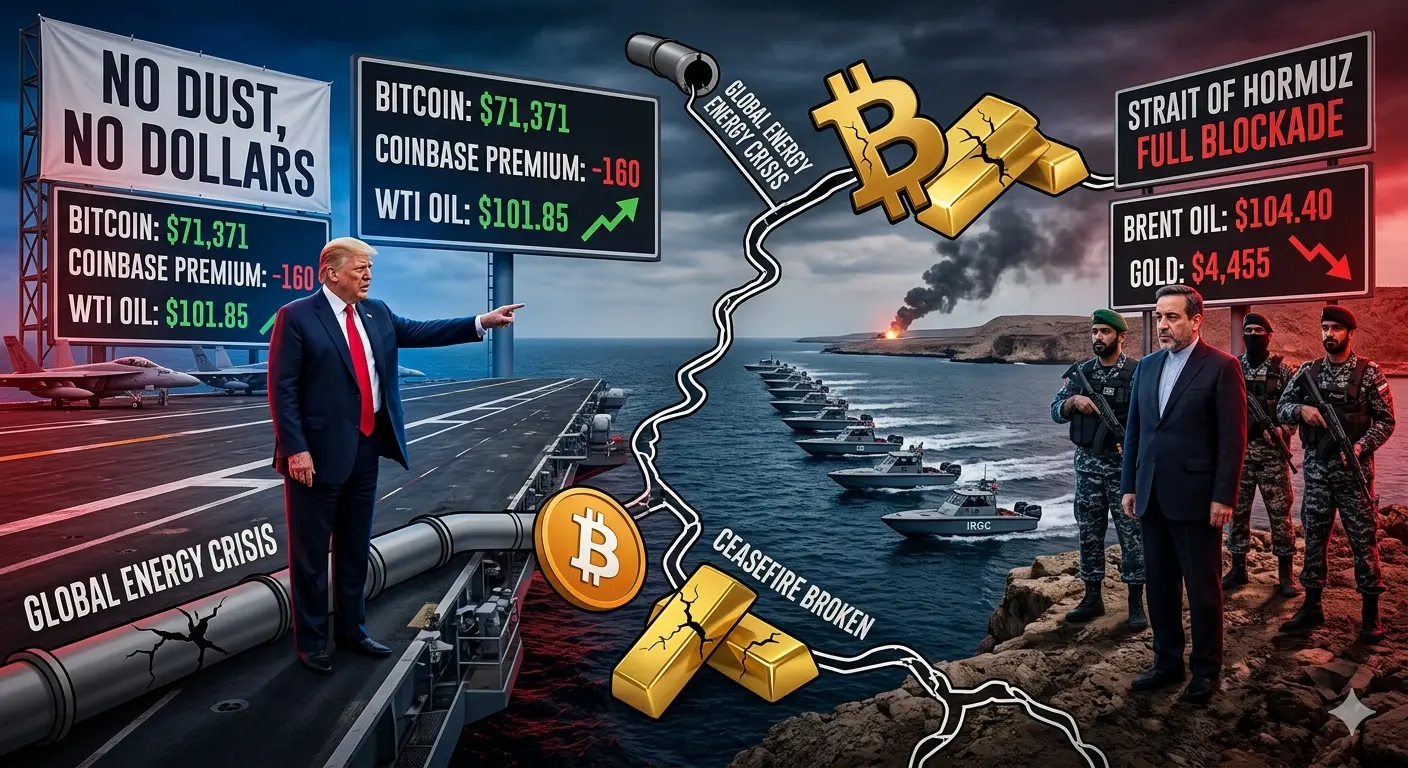
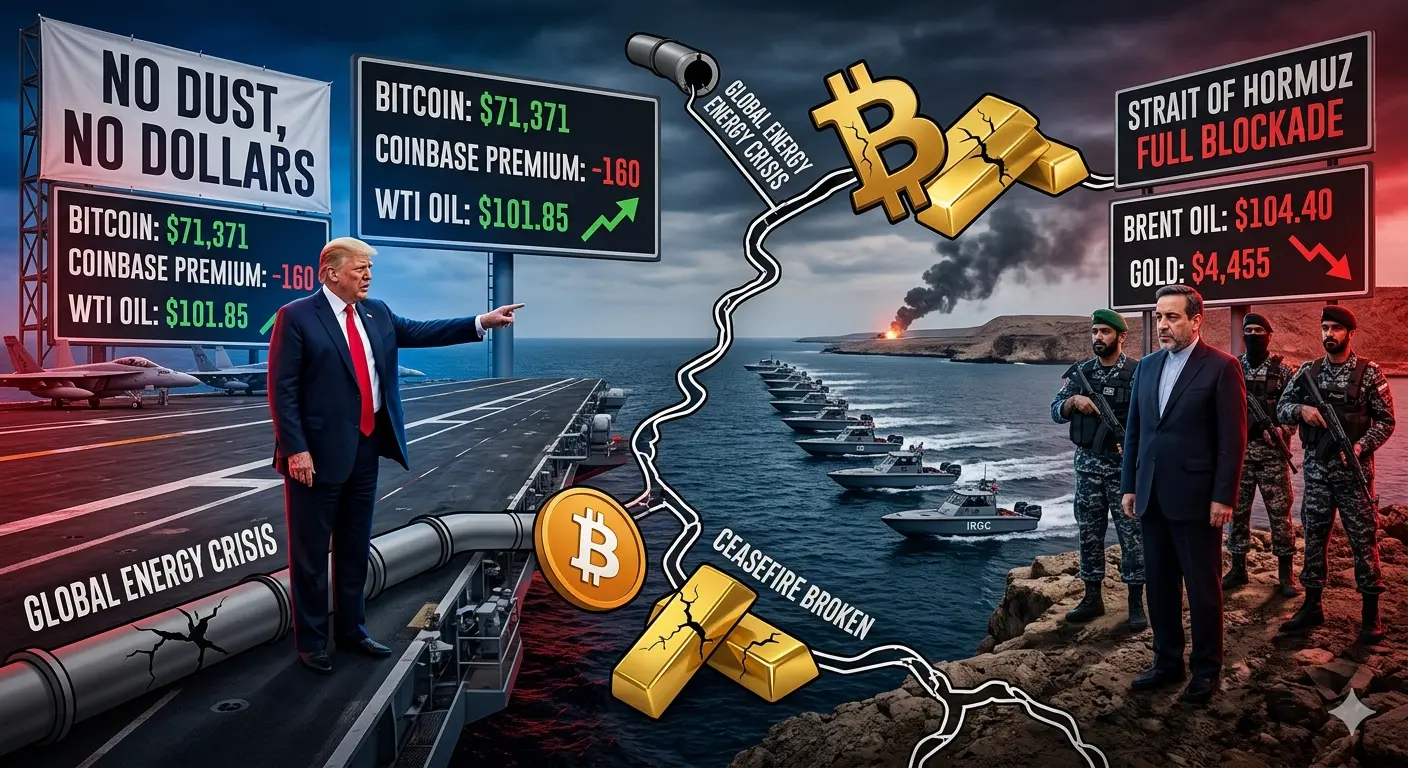
The critical turning point came when Trump modified key terms. He insisted Iran's enriched uranium must be immediately turned over to the US for destruction or destroyed on-site, using "no dust, no dollars" to demand total nuclear capitulation as a precondition for economic relief. Trump also declared Iran would not control Hormuz and the US would "watch over it," removing any possibility Iran could retain sovereignty or revenue from the waterway.
Iran viewed these changes as unilateral demands stripping its leverage while offering nothing concrete. Iran had discussed maintaining strait control and potentially charging transiting vessels, ideas the US rejected. Iran then issued counter-threats: if the US continued violating ceasefire conditions, particularly by allowing Israel to expand Lebanon operations against Hezbollah, Iran would consider the ceasefire broken on all fronts. Foreign Minister Araghchi stated the ceasefire was "unequivocally on all fronts, including Lebanon."
IRAN HALTS NEGOTIATIONS AND VOWS FULL HORMUZ BLOCKADE
On June 1, 2026, Iran executed its threat. The IRGC-affiliated Tasnim announced negotiators would stop exchanging messages with the US through intermediaries, citing continued Israeli operations in Lebanon and ceasefire violations on all fronts. Tehran would move to completely block the Strait of Hormuz. This was the most dramatic escalation since the war began, ending diplomacy and threatening tighter energy chokehold. Oil leapt more than 5 percent within hours. Trump told CNBC "I don't care if they're over," calling talks "very boring." The US struck Iranian military sites over the weekend, and Iran's Guards targeted a US base in Kuwait in retaliation. The ceasefire exists on paper only. War escalation risk is real if the full blockade triggers a US military response to force Hormuz open, or if Israel's deepening Lebanon operations prompt coordinated Iranian retaliation.
CAN WAR RESUME FULL-SCALE?
Military strikes are already happening on both sides despite the nominal ceasefire. The US conducts "self-defense" strikes on Iranian sites. Iran's Guards fire ballistic missiles at US bases. Hormuz is tightening further. This is essentially a slow-burn conflict that could ignite into wider confrontation at any trigger point.
BITCOIN: CURRENT PRICE AND WHY THE MARKET IS DROPPING
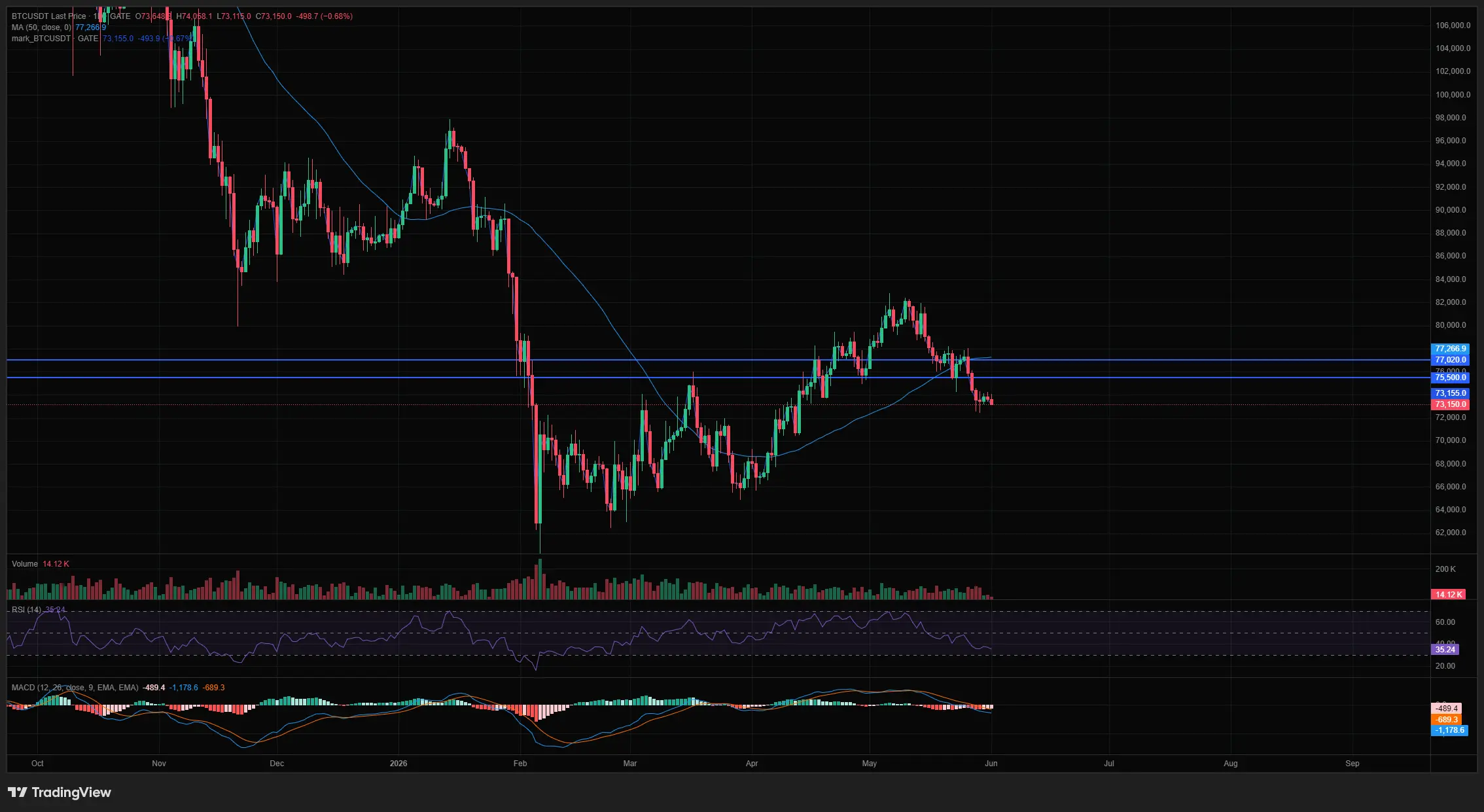
Bitcoin trades around $71,371 as of June 1, 2026, a dramatic decline from the peak above $126,000. The Coinbase Bitcoin Premium Index fell to negative 160, lowest since February when BTC bottomed near $60,000, signaling collapsed US institutional demand. Spot ETFs recorded seven consecutive outflow days, and an investor sold $1.29 billion of BlackRock's Bitcoin ETF in a dark pool. Strategy sold 32 BTC between May 26-31 at average $77,135, its first net disposal in four years.
The decline reasons are multifaceted. First, the Iran war created massive macro uncertainty, BTC plunging 19 percent into mid-$60,000s when conflict began. Second, rising oil from Hormuz blockade stokes inflation fears, with markets pricing 50 percent probability of a Fed rate hike before year-end and 39 percent chance of a December quarter-point increase per CME FedWatch. Higher rates reduce attractiveness of non-yielding Bitcoin. Third, miners sell aggressively: Bitdeer sold over 206 BTC in a single week. Fourth, options data shows 30 percent chance BTC falls below $80,000 by late June. The broader crypto market shrunk to $2.57 trillion, down 5.57 percent weekly, showing 69 percent correlation with gold.
BTC FORECAST AND TRADING STRATEGY
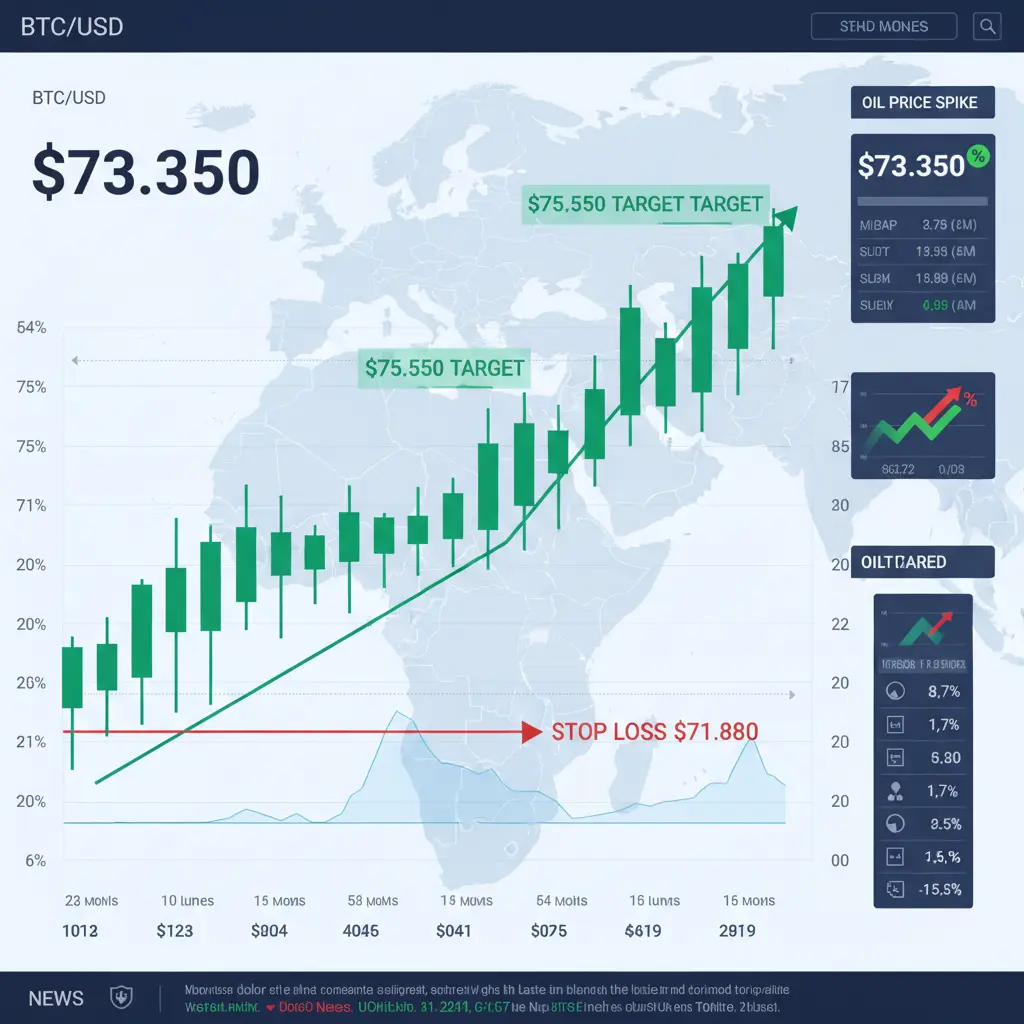
If Iran's full Hormuz blockade pushes oil above $100 with intensifying inflation and rate expectations, BTC could test $65,000-$70,000 support and potentially $60,000. However, on Deribit the $80,000 call emerged as most popular trade, indicating positioning for rebound. If a deal materializes, relief rally could push toward $80,000 and potentially $100,000. Range-bound trading between $65,000-$80,000 likely persists until conflict clarity emerges. Key support at $65,700 and below $60,000. Resistance at $80,000 and $100,000. Strategy: scale into positions at support with tight risk management rather than chasing momentum in a headline-driven market where a single announcement moves prices 5 percent.
OIL: HOW HIGH PRICES HAVE CLIMBED
As of June 1, 2026, WTI opened at $88.92 and Brent at $92.54. By afternoon after Iran's blockade announcement, WTI surged to approximately $101.85 and Brent to $104.40. Earlier in the week, WTI fell to $88.53 and Brent to $94.91 on May 27 when reports suggested Hormuz traffic would restore within one month. By May 28, prices jumped over 3 percent after Iran's Guards targeted a US Kuwait base. June 1, prices leapt more than 5 percent after Iran halted negotiations.
Before February 28 strikes, analyst consensus was $63.85 for Brent and $60.38 for WTI. Forecasts revised upward three times since. HSBC raised 2026 Brent average to $95 citing longer Hormuz closure. JPMorgan revised to $96 for Brent full-year 2026, up from $60. The 2026 Brent peak reached approximately $117-$120 during worst Hormuz closure. Prices are about 20 percent below that peak after May's 19 percent monthly decline, worst since COVID. WTI projected within $71.73-$106.74 in June per LiteFinance.
OIL FORECAST AND TRADING STRATEGY
If Iran's full blockade sustains through July, WTI could retest $100-$106 and Brent could push toward $110-$120. If a deal emerges and Hormuz opens within 30 days, WTI could drop to $75-$85 and Brent to $80-$90. Environment favors momentum trading on breakout signals. Position sizing must be conservative given 5 percent intraday swings. Brent support at $89-$91, resistance at $104-$120 depending on blockade severity.
GOLD: CURRENT SITUATION AND FORECAST
Gold trades approximately $4,455-$4,517 per ounce as of June 1, 2026. Forbes reports $4,458.08, down 1.86 percent over 24 hours. Trading Economics shows $4,483.93, down 1.27 percent. CNBC reports $4,517.37. Kitco reports spot at $4,455.28, down 1.9 percent. Gold futures at $4,476, micro futures at $4,713.10. Gold remains 31 percent above its year-ago level near $3,304. The metal surged past $5,000 for the first time in January 2026 on safe-haven demand and central bank accumulation. World Gold Council reported global demand at 1,231 tonnes in Q1 2026, highest January-to-March figure on record. Gold set a weekly low of $4,450 on June 1.
The decline reflects rising oil stoking inflation, pushing the dollar higher and raising yields. Markets price 50 percent probability of a Fed rate hike this year. Higher yields and stronger dollar increase gold's opportunity cost as a non-yielding asset, creating downward pressure even as geopolitical risk supports defensive allocation. UBS cut year-end gold forecast from $5,900 to $5,500 citing elevated yields and dollar strength. JPMorgan forecasts $5,000 average for 2026, previously $6,300. HSBC expects $5,000 in first half. Resistance at $4,500-$4,514, deeper at $4,546-$4,550. Support below $4,400.
GOLD FORECAST AND TRADING STRATEGY
If conflict escalates with sustained blockade pushing oil above $100, inflation could push gold toward $4,700-$5,000 on safe-haven demand. Fed rate hikes could cap upside and pull below $4,400. If Hormuz resolves, oil collapses, inflation eases, rate pressure diminishes, gold could rally toward $5,000-$5,500 as lower rates benefit non-yielding assets. UBS's Staunovo noted gold and oil will deliver outsized gains even after the war ends. Near-term range $4,400-$4,700 with breakout potential toward $5,000 on either escalation or resolution.
BTC VS OIL VS GOLD: THE INTERCONNECTED CRISIS
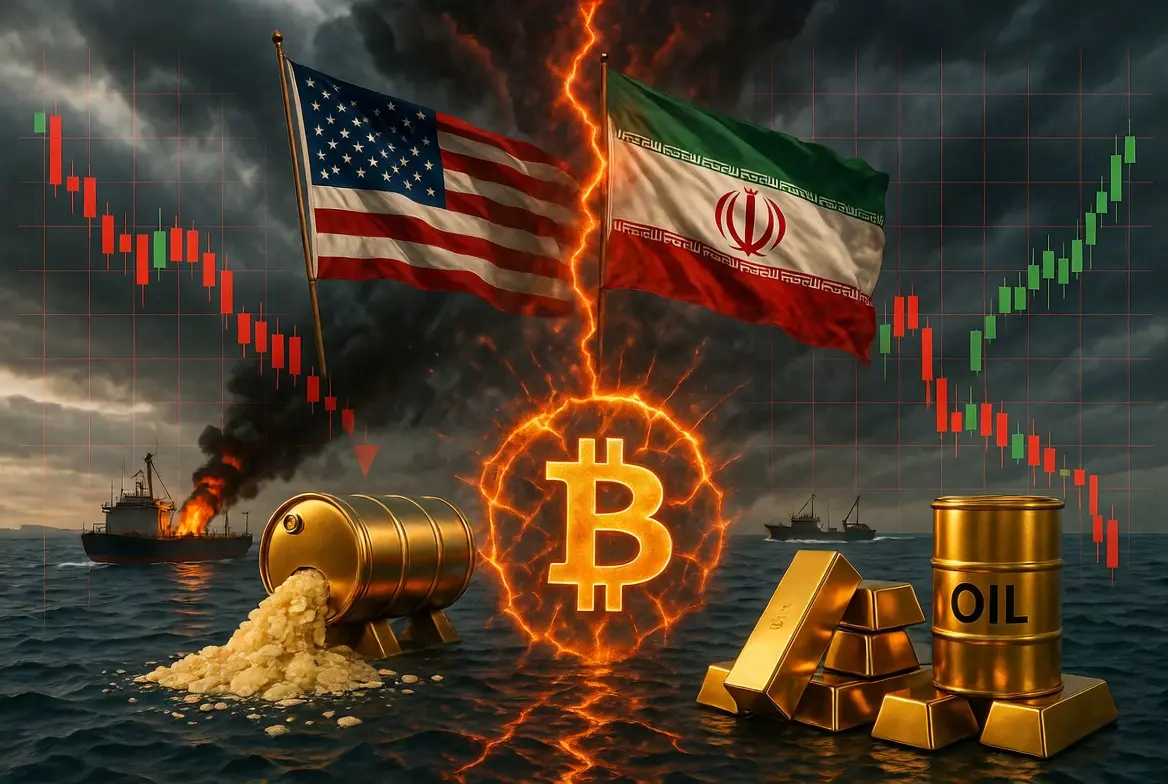
Oil is the direct casualty and most headline-sensitive, surging 3-5 percent on blockade news, dropping 4-6 percent on ceasefire optimism. Oil volatility feeds inflation expectations driving Fed policy impacting both gold and Bitcoin. Higher oil means higher inflation, higher rate hike probabilities, stronger dollar, higher yields, downward pressure on both gold and Bitcoin. Geopolitical risk works oppositely with more safe-haven demand. Currently the macro channel dominates: when oil surges and rate fears rise, both gold and Bitcoin fall together, as June 1 showed gold dropping 1.9 percent and Bitcoin near $71,000 while oil jumped above $100.
WHAT TRADERS ARE THINKING AND NEXT STEPS
Bitcoin options show bifurcated sentiment: $80,000 call most popular on Deribit, but 30 percent probability of falling below $80,000 by late June indicates substantial downside awareness. Coinbase Premium collapse and seven ETF outflow days confirm US institutional capital retreating. Oil traders positioned for sustained high prices with downside hedges, those buying near $60 before conflict holding massive profits. Gold traders split between dip-buying toward $5,000-plus year-end and those believing rate fears cap below $4,700 for months.
Price ceilings for 2026: Bitcoin could reach $80,000-$100,000 on resolution or drop to $60,000 on escalation. Oil could reach $110-$120 Brent on sustained blockade or fall to $80-$90 on Hormuz reopening. Gold could reach $5,000-$5,500 on improved conditions or languish near $4,200-$4,500 on rate hikes. Position sizing and risk management matter more than directional conviction where a single announcement moves prices 5 percent in minutes.
The US-Iran confrontation is the defining geopolitical crisis of 2026. It traces to nuclear negotiation collapse in June 2025 over fundamental disagreements on Iran's enrichment program, ballistic missiles, and sanctions relief. Trump withdrew from the 2015 JCPOA in 2018 believing it only delayed Iran's nuclear path. Multiple negotiation rounds in Oman through 2025 and early 2026 saw the US demanding Iran end all enrichment and constrain its missile program. Iran rejected both, insisting on enrichment rights under international treaties and viewing missiles as sovereign defense. Iran proposed limited civilian enrichment using IR-6 centrifuges to 20 percent purity, with the IAEA documenting 45.5 kg of uranium already enriched to 20 percent in fuel assemblies. The US considered this insufficient and dangerous.
When talks collapsed, on February 28, 2026 the US and Israel launched coordinated strikes on Iranian military and nuclear infrastructure, triggering the Iran War. Iran's immediate response was devastating: Tehran moved to close the Strait of Hormuz, the 21-nautical-mile chokepoint through which roughly 20 percent of the world's daily oil supply passes. This created a global energy crisis forcing the US to engage on terms Iran could influence.
A ceasefire brokered by Pakistan on April 8, 2026 was fragile from the start. Iran initially rejected a draft before agreeing to a two-week pause. The ceasefire was extended multiple times. By late May, both sides appeared converging on a 60-day memorandum: extend ceasefire, reopen Hormuz within 30 days, and launch formal nuclear talks. The US would withdraw forces from Iranian ports and end its naval blockade. Iran would restore shipping and remove mines. The US insisted Iran could not impose tolls on transiting vessels and would maintain Hormuz oversight.
US CHANGES TERMS AND IRAN THREATENS COUNTER-MOVES
The critical turning point came when Trump modified key terms. He insisted Iran's enriched uranium must be immediately turned over to the US for destruction or destroyed on-site, using "no dust, no dollars" to demand total nuclear capitulation as a precondition for economic relief. Trump also declared Iran would not control Hormuz and the US would "watch over it," removing any possibility Iran could retain sovereignty or revenue from the waterway.
Iran viewed these changes as unilateral demands stripping its leverage while offering nothing concrete. Iran had discussed maintaining strait control and potentially charging transiting vessels, ideas the US rejected. Iran then issued counter-threats: if the US continued violating ceasefire conditions, particularly by allowing Israel to expand Lebanon operations against Hezbollah, Iran would consider the ceasefire broken on all fronts. Foreign Minister Araghchi stated the ceasefire was "unequivocally on all fronts, including Lebanon."
IRAN HALTS NEGOTIATIONS AND VOWS FULL HORMUZ BLOCKADE
On June 1, 2026, Iran executed its threat. The IRGC-affiliated Tasnim announced negotiators would stop exchanging messages with the US through intermediaries, citing continued Israeli operations in Lebanon and ceasefire violations on all fronts. Tehran would move to completely block the Strait of Hormuz. This was the most dramatic escalation since the war began, ending diplomacy and threatening tighter energy chokehold. Oil leapt more than 5 percent within hours. Trump told CNBC "I don't care if they're over," calling talks "very boring." The US struck Iranian military sites over the weekend, and Iran's Guards targeted a US base in Kuwait in retaliation. The ceasefire exists on paper only. War escalation risk is real if the full blockade triggers a US military response to force Hormuz open, or if Israel's deepening Lebanon operations prompt coordinated Iranian retaliation.
CAN WAR RESUME FULL-SCALE?
Military strikes are already happening on both sides despite the nominal ceasefire. The US conducts "self-defense" strikes on Iranian sites. Iran's Guards fire ballistic missiles at US bases. Hormuz is tightening further. This is essentially a slow-burn conflict that could ignite into wider confrontation at any trigger point.
BITCOIN: CURRENT PRICE AND WHY THE MARKET IS DROPPING
Bitcoin trades around $71,371 as of June 1, 2026, a dramatic decline from the peak above $126,000. The Coinbase Bitcoin Premium Index fell to negative 160, lowest since February when BTC bottomed near $60,000, signaling collapsed US institutional demand. Spot ETFs recorded seven consecutive outflow days, and an investor sold $1.29 billion of BlackRock's Bitcoin ETF in a dark pool. Strategy sold 32 BTC between May 26-31 at average $77,135, its first net disposal in four years.
The decline reasons are multifaceted. First, the Iran war created massive macro uncertainty, BTC plunging 19 percent into mid-$60,000s when conflict began. Second, rising oil from Hormuz blockade stokes inflation fears, with markets pricing 50 percent probability of a Fed rate hike before year-end and 39 percent chance of a December quarter-point increase per CME FedWatch. Higher rates reduce attractiveness of non-yielding Bitcoin. Third, miners sell aggressively: Bitdeer sold over 206 BTC in a single week. Fourth, options data shows 30 percent chance BTC falls below $80,000 by late June. The broader crypto market shrunk to $2.57 trillion, down 5.57 percent weekly, showing 69 percent correlation with gold.
BTC FORECAST AND TRADING STRATEGY
If Iran's full Hormuz blockade pushes oil above $100 with intensifying inflation and rate expectations, BTC could test $65,000-$70,000 support and potentially $60,000. However, on Deribit the $80,000 call emerged as most popular trade, indicating positioning for rebound. If a deal materializes, relief rally could push toward $80,000 and potentially $100,000. Range-bound trading between $65,000-$80,000 likely persists until conflict clarity emerges. Key support at $65,700 and below $60,000. Resistance at $80,000 and $100,000. Strategy: scale into positions at support with tight risk management rather than chasing momentum in a headline-driven market where a single announcement moves prices 5 percent.
OIL: HOW HIGH PRICES HAVE CLIMBED
As of June 1, 2026, WTI opened at $88.92 and Brent at $92.54. By afternoon after Iran's blockade announcement, WTI surged to approximately $101.85 and Brent to $104.40. Earlier in the week, WTI fell to $88.53 and Brent to $94.91 on May 27 when reports suggested Hormuz traffic would restore within one month. By May 28, prices jumped over 3 percent after Iran's Guards targeted a US Kuwait base. June 1, prices leapt more than 5 percent after Iran halted negotiations.
Before February 28 strikes, analyst consensus was $63.85 for Brent and $60.38 for WTI. Forecasts revised upward three times since. HSBC raised 2026 Brent average to $95 citing longer Hormuz closure. JPMorgan revised to $96 for Brent full-year 2026, up from $60. The 2026 Brent peak reached approximately $117-$120 during worst Hormuz closure. Prices are about 20 percent below that peak after May's 19 percent monthly decline, worst since COVID. WTI projected within $71.73-$106.74 in June per LiteFinance.
OIL FORECAST AND TRADING STRATEGY
If Iran's full blockade sustains through July, WTI could retest $100-$106 and Brent could push toward $110-$120. If a deal emerges and Hormuz opens within 30 days, WTI could drop to $75-$85 and Brent to $80-$90. Environment favors momentum trading on breakout signals. Position sizing must be conservative given 5 percent intraday swings. Brent support at $89-$91, resistance at $104-$120 depending on blockade severity.
GOLD: CURRENT SITUATION AND FORECAST
Gold trades approximately $4,455-$4,517 per ounce as of June 1, 2026. Forbes reports $4,458.08, down 1.86 percent over 24 hours. Trading Economics shows $4,483.93, down 1.27 percent. CNBC reports $4,517.37. Kitco reports spot at $4,455.28, down 1.9 percent. Gold futures at $4,476, micro futures at $4,713.10. Gold remains 31 percent above its year-ago level near $3,304. The metal surged past $5,000 for the first time in January 2026 on safe-haven demand and central bank accumulation. World Gold Council reported global demand at 1,231 tonnes in Q1 2026, highest January-to-March figure on record. Gold set a weekly low of $4,450 on June 1.
The decline reflects rising oil stoking inflation, pushing the dollar higher and raising yields. Markets price 50 percent probability of a Fed rate hike this year. Higher yields and stronger dollar increase gold's opportunity cost as a non-yielding asset, creating downward pressure even as geopolitical risk supports defensive allocation. UBS cut year-end gold forecast from $5,900 to $5,500 citing elevated yields and dollar strength. JPMorgan forecasts $5,000 average for 2026, previously $6,300. HSBC expects $5,000 in first half. Resistance at $4,500-$4,514, deeper at $4,546-$4,550. Support below $4,400.
GOLD FORECAST AND TRADING STRATEGY
If conflict escalates with sustained blockade pushing oil above $100, inflation could push gold toward $4,700-$5,000 on safe-haven demand. Fed rate hikes could cap upside and pull below $4,400. If Hormuz resolves, oil collapses, inflation eases, rate pressure diminishes, gold could rally toward $5,000-$5,500 as lower rates benefit non-yielding assets. UBS's Staunovo noted gold and oil will deliver outsized gains even after the war ends. Near-term range $4,400-$4,700 with breakout potential toward $5,000 on either escalation or resolution.
BTC VS OIL VS GOLD: THE INTERCONNECTED CRISIS
Oil is the direct casualty and most headline-sensitive, surging 3-5 percent on blockade news, dropping 4-6 percent on ceasefire optimism. Oil volatility feeds inflation expectations driving Fed policy impacting both gold and Bitcoin. Higher oil means higher inflation, higher rate hike probabilities, stronger dollar, higher yields, downward pressure on both gold and Bitcoin. Geopolitical risk works oppositely with more safe-haven demand. Currently the macro channel dominates: when oil surges and rate fears rise, both gold and Bitcoin fall together, as June 1 showed gold dropping 1.9 percent and Bitcoin near $71,000 while oil jumped above $100.
WHAT TRADERS ARE THINKING AND NEXT STEPS
Bitcoin options show bifurcated sentiment: $80,000 call most popular on Deribit, but 30 percent probability of falling below $80,000 by late June indicates substantial downside awareness. Coinbase Premium collapse and seven ETF outflow days confirm US institutional capital retreating. Oil traders positioned for sustained high prices with downside hedges, those buying near $60 before conflict holding massive profits. Gold traders split between dip-buying toward $5,000-plus year-end and those believing rate fears cap below $4,700 for months.
Price ceilings for 2026: Bitcoin could reach $80,000-$100,000 on resolution or drop to $60,000 on escalation. Oil could reach $110-$120 Brent on sustained blockade or fall to $80-$90 on Hormuz reopening. Gold could reach $5,000-$5,500 on improved conditions or languish near $4,200-$4,500 on rate hikes. Position sizing and risk management matter more than directional conviction where a single announcement moves prices 5 percent in minutes.