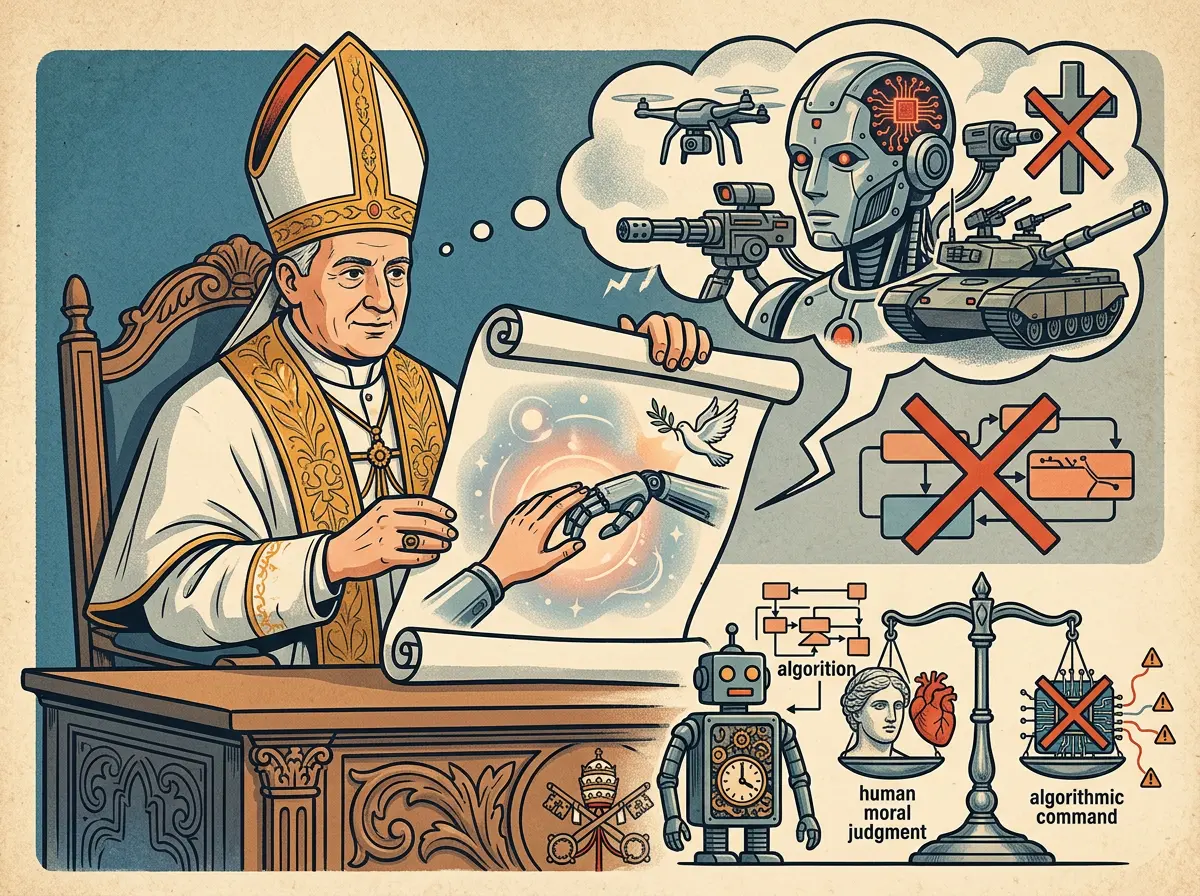
Pope Leo XIV (the first U.S.-born pope in Catholic Church history) officially released his first encyclical, “Magnifica Humanitas” (“Great Humaneness”), at the Vatican on May 25, claiming that irreversible lethal decisions should be entrusted to AI systems that are “unacceptable,” and calling on AI developers to work for the public interest rather than for profit.
Key Claims of the Encyclical: AI Regulation, Transparency, and the “Just War” Theory
Leo XIV wrote clearly: “Talking abstractly about ethics is not enough; what is needed is a robust legal framework, independent oversight, informed users, and a political system that does not shift responsibility.” The encyclical criticizes the “culture of power” driving the AI arms race—especially in the development of remote warfare methods—arguing that, given advances in war technology, the Catholic Church’s “just war” theory has become “obsolete.” Leo XIV calls on AI developers to increase transparency and accountability, ensuring that AI weapons decision-making processes are clear and transparent, while also criticizing the dangers posed to children and vulnerable groups by the concentration of vast data and power in the hands of a few.
Tradition of Social Justice: The “New Encyclical” Continues and Apologizes for the History of Slavery
The encyclical applies core concepts of Catholic social teaching—justice, solidarity, the dignity of labor, and the universal use of resources—to the AI revolution. Leo XIV wrote: “Pursuing higher profits cannot be a justification for systematic sacrifices of jobs, because human beings are the end, not the means.” At the press conference, the Holy See also issued the first-ever apology statement acknowledging the role it played in legitimizing slavery.
Anthropic Attends the Vatican Launch Event and Expert Assessment
A representative from Anthropic attended the Vatican launch ceremony. (It is currently engaged in a legal lawsuit with the Trump administration regarding its AI technology usage rights; the Trump administration previously ordered U.S. institutions to stop using its technology.) A law professor at the University of Our Lady of Law School and chair of Meta’s supervisory commission, Paul Carrozza, said: “I am confident this will be a document of decisive significance for our time.” The Vatican said that inviting Anthropic to participate is part of its decade-long efforts to hold a dialogue with Silicon Valley about the human costs of AI.
FAQ
When did Leo XIV take office, and how long after taking office was the encyclical published?
Leo XIV is the first U.S.-born pope in Catholic Church history; “Magnifica Humanitas” is his first encyclical issued after taking office. The document was signed on May 15, 2026, and was officially released publicly at the Vatican on May 25.
Is “Do Not Entrust Lethal AI Weapon Decisions to Machines” the pope’s formal doctrinal position?
Yes. The encyclical is one of the most authoritative teaching documents the pope can issue, and Leo XIV explicitly states in the text that irreversible lethal decisions should be entrusted to an AI system that is “unacceptable.” This stance sharply contrasts with the Trump administration’s approach of easing AI regulation.
Does the Vatican’s invitation to Anthropic to attend represent approval of that company?
The Vatican said the invitation is part of its decade-long dialogue efforts with Silicon Valley about the human costs of AI, and not an endorsement of Anthropic. Brian Boyd of the nonprofit “Institute for Life Futures” said this is recognition of a company “bearing enormous risks and responsibilities,” rather than a seal of approval.


