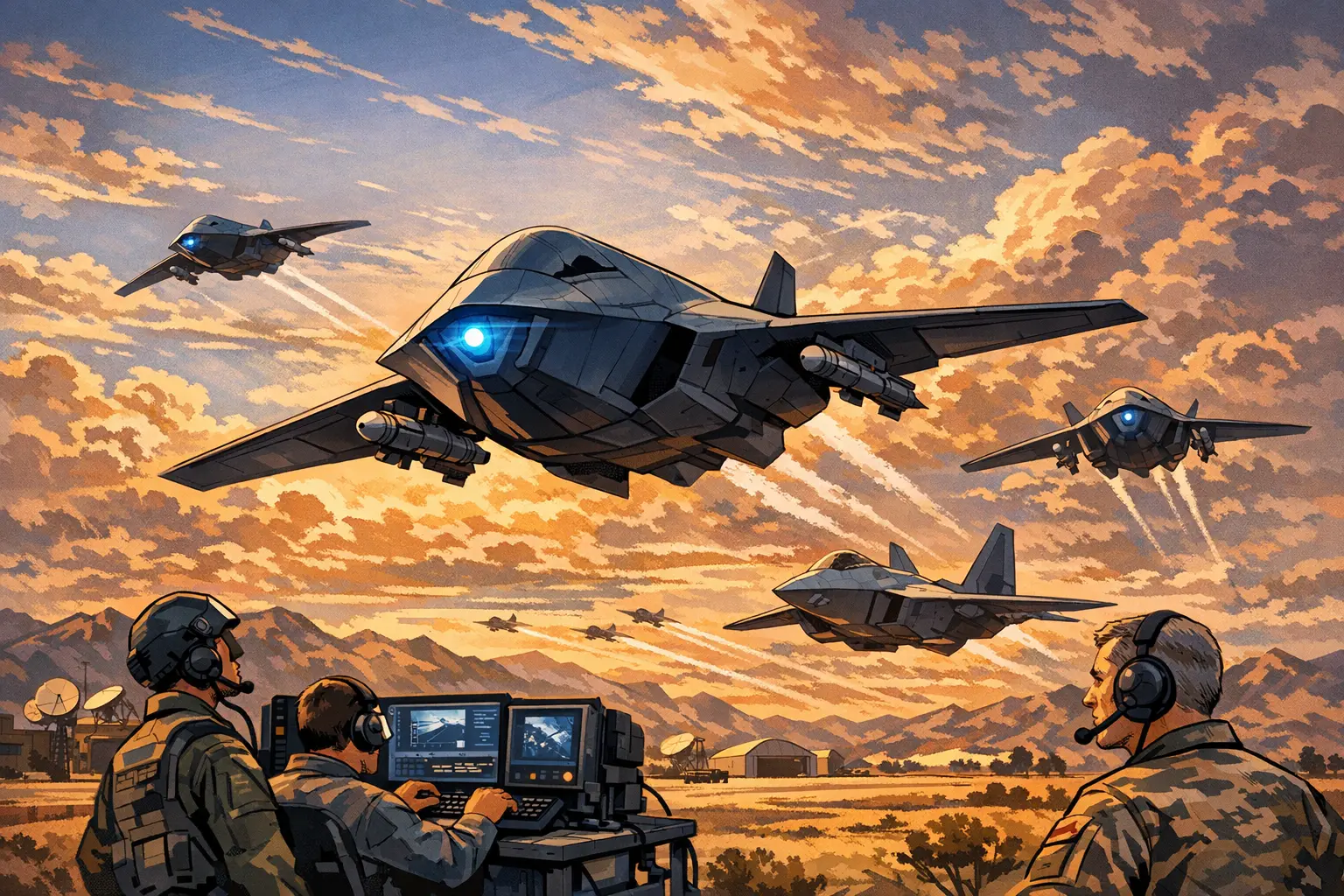
Defense technology company Shield AI announced on June 17 that it has received a production contract from the U.S. Air Force to implement the Hivemind mission autonomy software for the Collaborative Combat Aircraft (CCA) program. The contract uses the Autonomy Government Reference Architecture (A-GRA), separating the mission autonomy software from the aircraft itself, so the Air Force can integrate and upgrade software across multiple platforms without redesigning the airframe, thereby accelerating innovation, reducing integration costs, and lowering program risk.
U.S. Air Force A-GRA Architecture: A Technical Path Where Mission Autonomy Software Is Independent of Aircraft Platforms
This production contract reflects the Air Force’s “software-first” autonomy development strategy, as well as its decision to evaluate mission autonomy as an independent capability within the CCA program. With A-GRA, the Air Force can independently and rapidly iterate on mission autonomy software upgrades across multiple platforms without redesigning the airframe; this approach can maintain competitiveness, reduce integration risk, and integrate the Hivemind system into the Air Force’s broader CCA ecosystem rather than being limited to a single aircraft platform.
Christian Gutierrez, senior vice president of Hivemind, said: “Mission autonomy is a foundational capability for the future Air Force. This model from the Air Force can speed up the pace of innovation, rapidly deploy operational capabilities, and provide warfighters with greater combat advantages.”
Hivemind’s Technical Capabilities: Sensing, Decision-Making, and Collaborative Combat Behavior
Hivemind is a platform-independent software that complies with A-GRA standards. It can play the role of a human pilot or operator, enabling unmanned systems to sense, decide, and act. Unlike traditional autopilot systems (which only follow preset routes), Hivemind can bypass or handle dynamic obstacles, execute collaborative tactics with peer systems and piloted aircraft, respond to unexpected situations, and safely complete missions as part of a human-machine team.
Under the scope of the contract, Shield AI will focus on enabling collaborative combat autonomous behaviors in which multiple autonomous aircraft coordinate under human supervision. The goal is to reduce operator workload and enable large-scale collaborative operations.
Shield AI’s Existing Deployment in the CCA Program: YFQ-44A Flight Testing
Earlier this year, after a competitive evaluation, Shield AI was selected as the Air Force’s mission autonomy supplier for the CCA program to support Technology Maturation and Risk Reduction (TMRR) efforts. Currently, the Hivemind system is undergoing flight testing on Anduril’s YFQ-44A aircraft as part of ongoing development work.
Founded in 2015, Shield AI is a venture-backed defense technology company. Its products include Hivemind autonomous software, as well as the V-BAT and X-BAT unmanned aerial systems. The company has offices in the United States, Europe, the Middle East, and Asia-Pacific.
Frequently Asked Questions
How does A-GRA (Autonomy Government Reference Architecture) achieve separation between software and the aircraft?
According to contract documentation, A-GRA is a standard reference architecture adopted by the Air Force that allows mission autonomy software (such as Hivemind) to be developed and deployed independently of a specific aircraft platform. This means the Air Force can upgrade autonomy software without redesigning the airframe and integrate the same software set into multiple different aircraft platforms, thereby accelerating software iteration and reducing integration costs.
What is the fundamental difference between Hivemind and traditional autopilot systems?
According to Shield AI’s technical overview, traditional autopilot systems typically follow preset routes; Hivemind, however, can sense the environment, make decisions, and take actions. This includes bypassing dynamic obstacles, executing collaborative tactics with piloted aircraft, responding to unexpected situations, and operating as an independent autonomous unit within a human-machine team framework.
Which aircraft platform is Hivemind currently being tested on?
According to Shield AI’s statement, Hivemind is currently undergoing flight testing on Anduril’s YFQ-44A aircraft as part of continued development for the CCA program.


