However, a probability advantage does not guarantee the outcome. In this tournament, Argentina have repeatedly completed comebacks even when they were not favored by the data models. The actual results of this team have diverged from pre-match probability forecasts on multiple occasions. The prediction market’s 59% vs. 41% is not a verdict—it’s a starting point that needs interpretation. Gate’s prediction market also simultaneously launched a World Cup Final Prediction Challenge. By participating, users can share a $50,000 USDT prize pool.
Two completely different paths to qualification
Spain and Argentina’s qualification routes in this World Cup show almost opposite characteristics.
Spain’s group-stage opener ended in a 0–0 draw against Cape Verde, which briefly sparked doubts from outside observers. But afterward, the team adjusted quickly: a 4–0 thrashing of Saudi Arabia, a 1–0 win over Uruguay, a 3–0 elimination of Austria, a 1–0 narrow victory over Portugal, and a 2–1 win against Belgium. In the semifinals, Spain delivered a 2–0 rout of France—the team widely seen as the biggest title favorite. In seven matches, Spain conceded just one goal; in the first six, they kept clean sheets. Goalkeeper Unai Simón set a World Cup record for consecutive minutes without conceding, reaching 650 minutes. Spain’s run of unbeaten matches on the international stage has extended to 37, matching the record set by Italy in 2021.
Argentina’s path to qualification, by contrast, has been full of drama. They won all three group matches—3–0 vs. Algeria, 2–0 vs. Austria, and 3–1 vs. Jordan. But once the knockout stage began, each match became a test to the absolute limits of both psychology and stamina: in the Round of 32, they edged Cape Verde 3–2 in extra time; in the Round of 16, after falling behind 0–2, they staged a three-goal comeback to beat Egypt; in the quarterfinals, they defeated Switzerland 3–1 in extra time. In the semifinals, with England leading 1–0 at the 85th minute—an apparent dead end—Argentina scored twice within seven minutes to complete the comeback. In regulation time, Argentina amassed 5 wins and 2 draws in total; among those, two knockout matches required extra time and two relied on comebacks in the dying moments to advance.
These path differences themselves are shaping each team’s final match state. Spain built an almost airtight defensive system and a steadily rising confidence curve through seven matches. Argentina, meanwhile, “hammered out” survival instincts under extreme pressure through seven “dances on the edge of a cliff.” These two different qualification logics will collide head-on in the final.
Head-on tactical style showdown
The final is widely seen as the ultimate dialogue between two football philosophies.
Under head coach De la Fuente, Spain have built an extremely complete possession-based, control-and-pass system, expected to use a 4–3–3 formation. The midfield trio of Rodri, Pedri, and Fabián Ruiz controls ball possession and the tempo of the match. At the data level, Spain complete 28 consecutive passes of 9 touches or more per 90 minutes on average—ranked first among all teams at this World Cup. Captain Rodri has recorded 655 successful passes, making him the player with the most successful passes in the World Cup final stage since statistical records began in 1966. Center-back Cubas, aged 19, ranks second with 550 successful passes; he averages more than 22 passes that break through the opponent’s back line, with a pass success rate as high as 94%. In terms of their off-ball defensive phase, Spain spend 12.2% of the time in regaining possession—highest among all teams that reached the quarterfinal stage. In attacking sequences, 31% end with them entering the opponent’s penalty area.
Argentina’s tactical logic centers on the individual creativity of Messi. The team is adept at using a numerical advantage in midfield to create pressure and launch attacks through Messi’s link-up plays. Argentina’s offensive output is also astonishing—they have scored 19 goals in this tournament and have scored at least 2 goals in 13 consecutive World Cup matches, setting a competition record. But the goals are highly concentrated among the front three: Messi with 8, Lautaro Martínez with 5, and Álvarez with 2. This concentration is both Argentina’s offensive weapon and Spain’s clear defensive target.
From tactical matchups, both teams emphasize ball control and vertical attacks, and the midfield battle will directly determine the game’s trajectory. Spain’s advantage lies in the cohesion of their possession approach and the stamina reserves of a youthful squad. Argentina, meanwhile, have more final-stage experience and the ability to produce top-level single-point explosive moments.
Spain’s defensive stability is the biggest constraint Argentina’s offense must face. Argentina’s attacking pattern heavily relies on Messi receiving and distributing in the middle-to-front zones, while Spain’s counter-pressing system is precisely strong at creating local numerical advantages and cutting off passing lanes in the opponent’s moment of ball control. This means that if Argentina cannot generate effective outlet plays in the very short transition window between attack and defense, their offensive efficiency could be significantly compressed.
Messi vs. Yamal: a cross-generational key matchup
The most narrative-tension element of this final is the matchup between 39-year-old Messi and 19-year-old Yamal. The two are separated by 20 years, representing the offensive core of two generations: Argentina’s and Spain’s.
Messi’s performance in this World Cup has been legendary. In seven matches, he scored 8 goals and delivered 4 assists, directly contributing to 12 goals. He continues to lead on the World Cup all-time top scorers list with 21 goals, becoming the first player to score in nine consecutive World Cup matches, and also the first player in history to have recorded assists in six World Cups. In the semifinal against England, Messi completed 10 successful dribbles and provided multiple assists, becoming the first player in World Cup history (with statistical tracking) to achieve at least 10 successful dribbles in a single match and also provide multiple assists. As of now, Messi tops this World Cup’s dribbles chart with 25 successful dribbles.
Yamal has also turned in impressive numbers. In seven matches, he recorded 22 successful dribbles, ranking second in the tournament. Despite only 1 goal, his involvement and breakthrough ability have consistently created space for teammates. In his 11 head-to-head meetings with Mbappé, Yamal has an overwhelming record of 9 wins and 2 losses, and he is 6-for-6 in single-match knockout games. In all major competitions he has started in (the Euros + the World Cup), Spain have won all 12 matches.
From a data comparison, Messi clearly has the edge in goal and assist output efficiency, while Yamal’s advantage lies in his age and stamina reserves—the key variables being whether the 39-year-old’s physical condition can sustain high-intensity duels for 90 minutes and even up to 120 minutes, and whether the 19-year-old’s impact can be converted into a decisive offensive threat on the final stage. Messi’s stamina limitations begin to show after 60 minutes, while Yamal—after leaving the pitch early due to a collision in the semifinals—has already returned to normal training. If the match goes to extra time, the changing balance in stamina could become a decisive factor.
Prediction market pricing logic: what does 59% mean?
Gate’s prediction market shows Spain at 59% and Argentina at 41%, and this probability distribution is highly close to The Athletic’s 59% vs. 41% and Opta’s 59.6% vs. 40.4%. The convergence from multiple data sources is not accidental—it reflects a systematic assessment by the market and models of the same set of match information, including both teams’ qualification performances, tactical data, injuries, and so on.
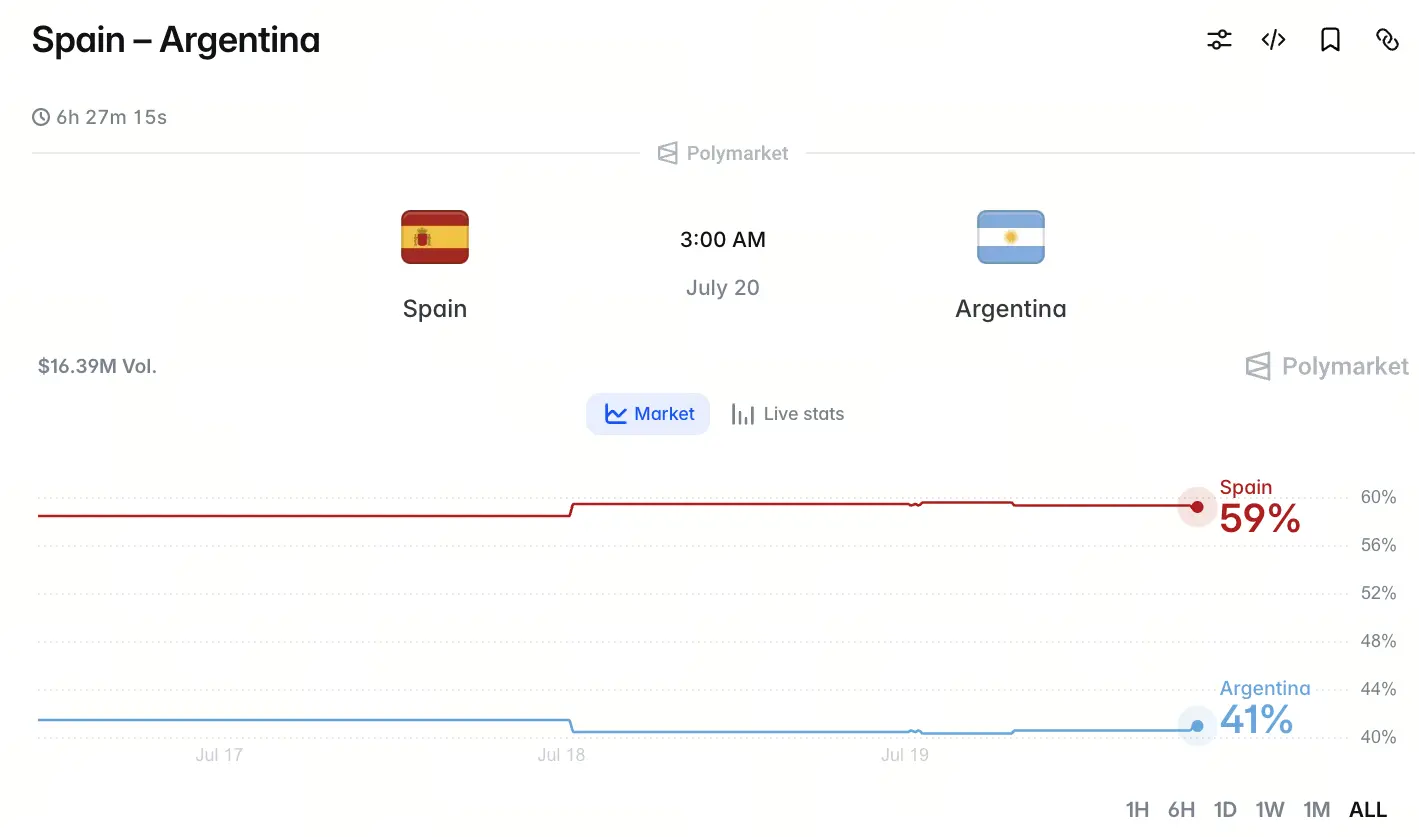
The core pricing mechanism of prediction markets is based on tradable shares: each contract pays out $1 if the event happens; otherwise, it pays out $0, and the contract price fluctuates between 0 and $1. The price itself directly reads as the implied probability. When the market gives Spain a 60% chance of winning, it means the trading price of the “Spain to win the title” share is about $0.60—that is the equilibrium price produced by thousands of traders wagering real money. The efficiency of this pricing mechanism rests on two key premises: participants have sufficient information and different risk preferences, and the market has enough liquidity and trading depth.
Prediction market pricing efficiency also depends on information diversity and trading depth among participants. As a crypto-native platform, Gate’s participants span multiple time zones globally and have strong information aggregation capabilities, helping prices reflect new information more quickly. However, no market can completely eliminate noise trading and emotional swings, which is one source of divergence between probability distributions and actual results. Before the semifinals, the market gave France an advancement probability of about 59% to 60%, and Spain only 40% to 41%, but the actual result was Spain winning by a two-goal margin. This case itself serves as a reminder: a probability advantage must be translated into performance on the pitch, and that translation process is full of uncertainty.
Argentina’s “resilience in the jaws of defeat” is a typical source of that uncertainty. In this tournament, they have completed comebacks multiple times when probability models didn’t favor them and the match situation was extremely unfavorable—down 0–2 at the 78th minute in the Round of 16 versus Egypt and eventually won 3–2; in the semifinals, they were down 0–1 to England at the 85th minute and still scored two goals within the final seven minutes. This repeated validation of comeback ability under extreme pressure is a variable that no data model can fully quantify.
FAQ
Q: How is the 59% win probability shown by the Gate prediction market calculated?
The prediction market’s win probability is not computed by the platform itself. Instead, it is reflected directly in the market price formed by contracts tied to users’ buying/selling and the event outcome. Each contract pays out $1 if the event happens; otherwise, it pays out $0. The contract price fluctuates between $0 and $1. The price itself represents the implied probability the market assigns to that outcome. With Spain’s share quoted at $0.59, the market believes Spain’s chance to win the title is 59%.
Q: What does Spain’s defensive record of conceding just 1 goal in seven matches mean?
Before this World Cup, Spain kept clean sheets in their first six matches, and goalkeeper Unai Simón set the World Cup record for 650 consecutive minutes without conceding. This data indicates that Spain’s defensive system—including high defensive pressure, counter-pressing efficiency, and goalkeeper stability—maintained extremely high consistency throughout the tournament. In the final, Argentina will face the tournament’s most solid defensive team, and their attacking efficiency will face a severe test.
Q: Argentina has reversed course multiple times to qualify—can this “resilience in the jaws of defeat” be replicated in the final?
In this tournament, Argentina have already completed comebacks from losing positions multiple times—down 0–2 to Egypt in the Round of 16 and ultimately turned it into a 3–2 win, and in the semifinals, after being down 0–1 to England at the 85th minute, they completed a 2–1 turnaround. This repeatedly validated comeback ability is built on Messi’s individual creativity, the team’s psychological resilience, and their experience in big matches. But in the final against Spain’s possession-based system, Argentina’s opportunities will be far fewer than in any previous match, making the difficulty of a comeback much higher.
Q: How do you participate in Gate’s World Cup Final prediction challenge?
Users need to click the “立即参与” button on the event page to complete registration and identity verification. After registering, you participate in the “World Cup Daily Focus Matches” prediction; completing at least one prediction trade of no less than 50 USDT qualifies you for the rewards. The prediction results do not affect whether you receive rewards. Rewards are issued in the form of prediction market experience vouchers, and the profits generated from the experience vouchers can be withdrawn.