On June 25, Eastern Time, Apple announced global price increases on multiple product lines including Mac, iPad, Vision Pro, HomePod, with the highest increase reaching $300. Among them, the base model MacBook Air rose by $200 to $1,299, the base model MacBook Pro rose by $300 to $1,999, and the iPad Air saw a 25% increase. This price adjustment did not involve iPhone, Apple Watch, or AirPods, but the breadth of coverage is relatively rare in Apple's history.
In a statement, Apple said that the rapid expansion of AI data centers has led to an abnormal surge in memory and storage demand, and the company has "never seen a component price rise so much and so fast." CEO Tim Cook described the situation as "once in a century." Apple had previously been trying to absorb the costs internally to avoid passing them on to consumers, but now it has reached a point where it has to raise prices on multiple products.
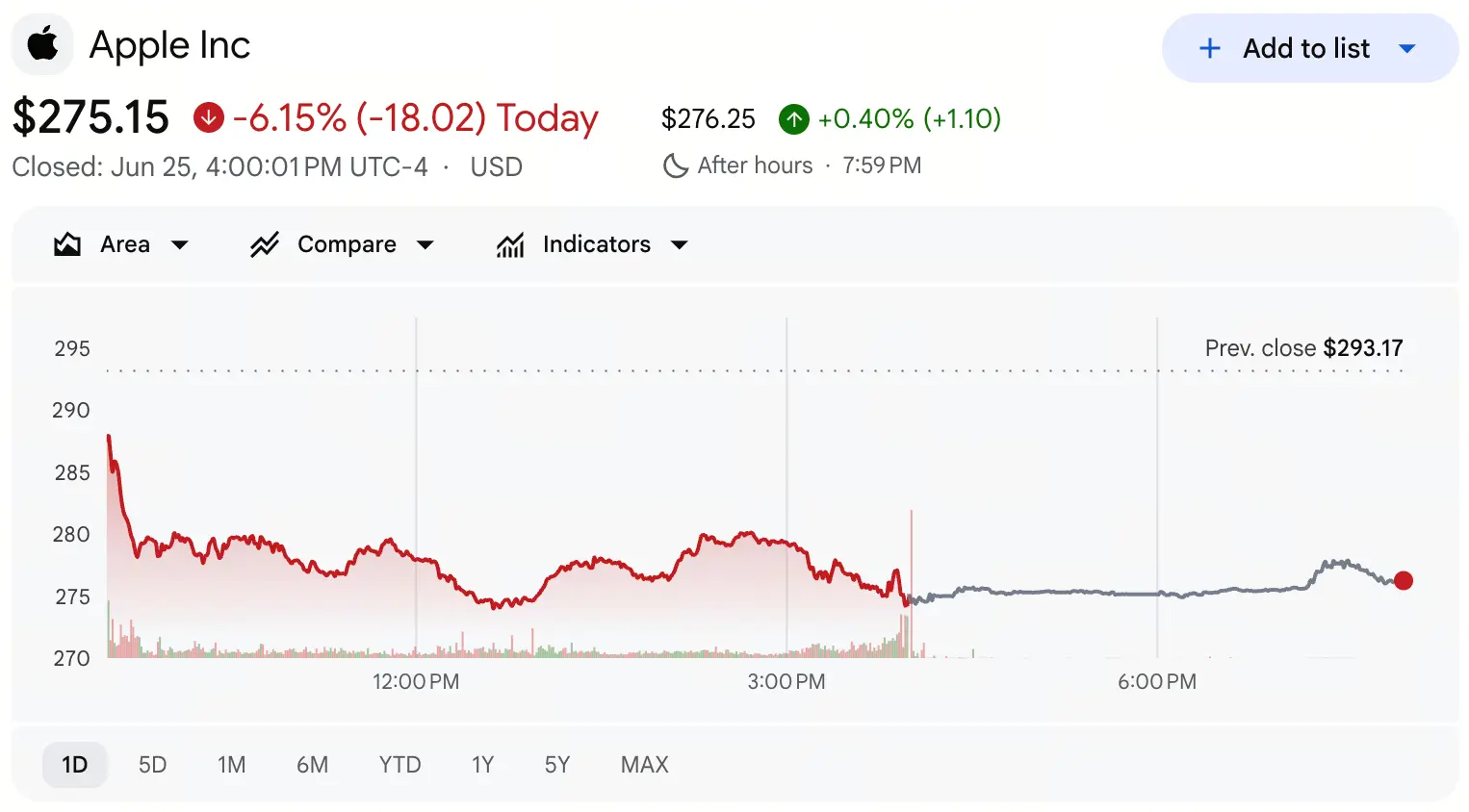
After the announcement, Apple's stock price during the day once fell 6.6% to $273.75, the biggest intraday drop since April 2025; it eventually closed down 6.1% at $275.15. Market cap evaporated by $263.5 billion overnight. Trading volume reached 107 million shares, still holding a positive gain of about 1.21% year-to-date.
How does the memory chip supercycle transmit to consumer electronics terminals?
The direct driver of this price increase is the epic surge in memory chip prices. According to Counterpoint Research data, memory and storage prices have quadrupled over the past three quarters, primarily because suppliers have shifted more production capacity to high-bandwidth memory (HBM) required for AI servers.
Micron Technology's fiscal Q3 2026 earnings report released the day prior provided the most direct evidence: revenue of $41.46 billion, up 346% year-on-year; adjusted operating income of $33.68 billion, up 1,252.6% year-on-year. More importantly, Micron expects adjusted revenue of $49 billion to $51 billion for fiscal Q4, significantly above the market consensus of $43.24 billion. Micron management believes the supply tightness in the industry will continue beyond 2027. Jefferies expects global storage chip prices to rise about 40%-50% sequentially in Q3 2026, another 30%-40% in Q4, with the first signs of easing not appearing until 2028.
The transmission mechanism of storage costs is clear: AI computing expansion → storage chip capacity tilts toward HBM → DRAM and NAND supply tightens → prices surge → consumer electronics terminal costs spike → forced price increases. An industry insider revealed that currently, in some computer models, the combined cost of DRAM and SSD storage chips accounts for about 50% of the total cost, compared to only about 10% during the trough. Apple's long-term memory supply agreement expired this quarter, making it more vulnerable to spot market price fluctuations.
Same market, two fates: where is industry profit shifting?
On June 25, US stocks presented a highly fragmented picture. The "Magnificent Seven" all came under pressure, with Apple leading the decline at 6.1%, Microsoft down 3.46%, Amazon down more than 3%, and Meta down more than 2%. The Nasdaq fell for the fourth straight day, closing down 0.46%.
But the chip sector went in the opposite direction. Micron Technology soared more than 15%, with market cap surging over $260 billion in a single day; SanDisk surged more than 21%, Applied Materials rose more than 13%, and the Philadelphia Semiconductor Index closed up 3.59%. Apple's market cap evaporated by more than $180 billion.
This extreme divergence essentially reflects a restructuring of profit distribution in the AI industry chain. The market is breaking down AI concept stocks into two camps: one is upstream suppliers (storage, HBM, semiconductor equipment) that directly benefit from AI hardware shortages and have absolute pricing power; the other is platforms or brand manufacturers that need to purchase expensive hardware, bear AI capital expenditures, but face difficulty passing on terminal costs. Apple's 6% drop and Micron's 15% surge are a direct manifestation of this structural rift. The market's judgment on this profit revaluation is clear: whoever holds pricing power wins.
How does Wall Street interpret Apple's rare price hike?
Despite the sharp stock price decline, mainstream Wall Street analysts have not collectively downgraded Apple's rating or target price.
Evercore ISI analyst Amit Daryanani reiterated an "Outperform" rating and maintained a $365 target price. He noted that Apple usually adjusts prices only when launching new products; this mid-cycle price hike is quite rare, precisely indicating that cost pressures have intensified significantly. Evercore believes that DRAM and NAND prices have risen several times compared to a year ago, and the rising costs have exceeded Apple's ability to absorb. The price hike helps protect gross margins, but demand for Macs and iPads may come under pressure.
Wedbush analyst Dan Ives also maintained an "Outperform" rating and an unchanged target price of $400. He believes that despite Apple's large procurement scale, raising hardware prices is hard to avoid given the rapid increase in storage and memory costs. Apple's premium product sales share continues to rise, and the company still has the ability to adjust prices without significantly losing customers.
JPMorgan analyst Samik Chatterjee maintained a "Buy" rating and a target price of $325. U.S. Bank of America reiterated a "Buy" rating and a target price of $380. The consensus among analysts is that this price increase mainly reflects the surge in memory costs, not deterioration in terminal demand.
Will the price hike protect gross margins, or will it erode demand?
Apple's strategic intent for this price hike is clear – to protect gross margins. But whether this strategy will work depends on two key variables: cost trends and demand elasticity.
From the cost side, the memory chip supercycle is far from over. Jefferies expects the price increase trend to continue through 2027. Micron management also believes supply tightness will persist beyond 2027. This means the cost pressure Apple faces is structural, not a short-term fluctuation.
From the demand side, the situation is more complex. IDC expects global smartphone shipments to decline 13.9% year-on-year to 1.09 billion units in 2026, the largest annual drop in history, and is expected to decline another 1.1% in 2027. Although this price hike does not involve the iPhone for now, the Mac and iPad markets are also facing demand contraction pressure.
Apple's pricing power varies significantly across product lines. Evercore noted that the iPhone price was not adjusted this time; the new iPhone expected to be released in September will be the next key price observation window. The impact of storage price increases on downstream end customers shows clear divergence: high-end models are less sensitive to storage price hikes and can pass costs downstream smoothly; while low-end products have thin margins, and even a small storage price increase can eliminate profitability.
How do macro inflation and AI cost shocks resonate?
The macro background of Apple's price hike cannot be ignored. The US May PCE price index rose 4.1% year-on-year, the highest since April 2023, with core PCE at 3.4% year-on-year. Inflation pressure remains high, coupled with additional demand shocks from AI infrastructure construction, creating dual cost pressures.
The "third-in-command" at the Federal Reserve, New York Fed President John Williams, said the current inflation rise is mainly driven by three factors: tariff increases on imported goods, energy price hikes from the Middle East conflict, and sustained strong demand for some tech products driven by the AI investment boom. He expects inflation to return to the 2% target by 2028. Against the backdrop of re-emerging inflation pressure, traders expect the Fed to raise interest rates by at least 25 basis points by the end of the year.
Apple's price hike is not an isolated event. Microsoft followed just hours after Apple's announcement, raising prices on Xbox game consoles. Microsoft said storage and memory prices have risen more than 2.5 times and are expected to double again by autumn 2027. OPPO, vivo, Xiaomi and other phone makers have also started adjusting prices. The "memory inflation tax" caused by AI data centers grabbing storage capacity is spreading across the industry.
Key variables and framework for the outlook
Based on the above analysis, AAPL's future direction can be deduced from the following dimensions:
Sustainability of cost pass-through is the primary variable. Whether the memory chip supercycle peaks after 2027 will determine the medium-term trend of Apple's gross margins. If prices remain high, Apple may face further price hike pressure – and Apple has already hinted in its statement that "this is not the final round of price adjustments."
Changes in demand elasticity are equally critical. Whether the price increases on Mac and iPad lead to a significant drop in sales will test Apple's brand premium and pricing power. Wedbush believes Apple's high-end user stickiness is sufficient to support price hikes, but this judgment needs to be verified by subsequent sales data.
Pricing strategy for the new iPhone is the next important observation point. If Apple passes on storage cost increases to the iPhone in September, it will be another test of its pricing power.
Structural trend of profit revaluation in the industry chain may continue to deepen. As long as AI computing expansion continues to drive storage demand, the scissors gap between upstream suppliers' bargaining power and downstream terminal manufacturers' cost pressures will be difficult to close.
Currently, AAPL stock is trading at $275.15, with a P/E ratio of about 33 times. The market's 6% drop essentially reflects an immediate pricing of the transmission chain: "cost increase → forced price hike → demand pressure." The subsequent trend will depend on how the above three variables evolve and whether Apple can find a new balance between cost pressure and demand elasticity.
FAQ
Q: Which product lines are affected by Apple's price hike?
A: It involves multiple product lines including MacBook, iPad, HomePod, Apple TV, and Vision Pro, with the highest increase reaching $300. iPhone, Apple Watch, and AirPods are not adjusted for now.
Q: How much did Apple's stock price fall in a single day?
A: On June 25, it once fell 6.6% intraday to $273.75, eventually closing down 6.1% at $275.15, the largest single-day drop since April 2025, with market cap evaporating $263.5 billion.
Q: How long will the memory chip price increase last?
A: Jefferies expects memory chip prices to rise sharply sequentially in Q3 and Q4 2026, with the trend potentially continuing through 2027, and the first signs of easing may not appear until 2028. Micron management also believes supply tightness will persist beyond 2027.
Q: How does Wall Street view Apple's outlook?
A: Evercore ISI maintains a $365 target price, Wedbush maintains $400, JPMorgan maintains $325, all without downgrading due to the price hike. The mainstream view is that the price rise is to cope with costs, not demand deterioration.
Q: Will Apple continue to raise prices in the future?
A: Apple hinted in its statement that "this is not the final round of price adjustments," leaving room for further increases. The pricing strategy for the new iPhone will be the next key observation point.


