As the tokenization of Real World Assets (RWA) gains momentum, a growing number of U.S. publicly traded stocks are entering the digital finance ecosystem as on-chain assets. Among the world’s most recognizable tech and new energy vehicle companies, Tesla stock has consistently ranked as one of the most closely watched assets in the tokenized securities market.
Within the tokenized stock space, Tesla Tokenized Stock (TSLAx) has emerged as one of the most representative products. By mapping Tesla stock onto a blockchain network, TSLAx enables traditional securities to participate in on-chain trading, asset management, and decentralized finance applications—serving as a critical bridge between conventional capital markets and blockchain finance.
What Is Tesla Tokenized Stock (TSLAx)?
Tesla Tokenized Stock (TSLAx) is a tokenized securities product issued with Tesla company stock as its underlying asset. Its value is typically tied to the real-world price of Tesla stock.
TSLAx is not a stock officially issued by Tesla, nor is it a standalone cryptocurrency project. Instead, it is a security token created by a compliant issuance platform through real-world asset custody and on-chain issuance mechanisms.
Holding TSLAx generally means gaining on-chain asset exposure linked to the price performance of Tesla stock—not holding actual shares in a traditional securities account.
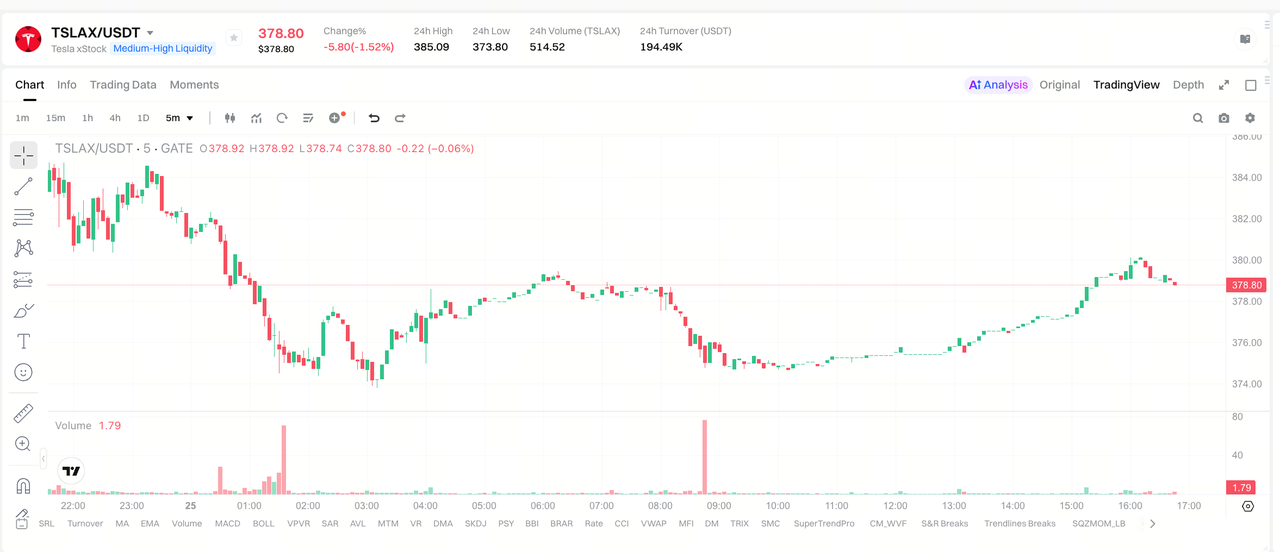
What Is the Asset Structure behind TSLAx?
The value of TSLAx originates from real-world Tesla stock.
Issuance platforms typically hold a corresponding number of Tesla shares through regulated custodians, using these assets as the value backing for the on-chain token.
This model allows TSLAx to circulate on the blockchain while maintaining a direct correspondence with real-world assets.
| Asset Layer |
Corresponding Asset |
Function |
| First Layer |
Tesla Stock |
Underlying Asset |
| Second Layer |
Custody Account |
Holds Reserve Assets |
| Third Layer |
TSLAx |
On-Chain Mapping Token |
This structure is the prevailing model used by most tokenized stock products today.
How Is TSLAx Issued?
The TSLAx issuance process typically involves three stages: asset custody, reserve verification, and token minting.
The issuer first purchases and custodies the corresponding number of Tesla shares, then generates an equivalent number of TSLAx tokens based on the asset size.
Once the assets are verified, the tokens are issued on the blockchain and enter market circulation. If a user initiates a redemption, the corresponding amount of TSLAx is burned according to the rules.
| Stage |
Core Process |
| Stock Purchase |
Hold Tesla Stock |
| Custody Verification |
Confirm Reserve Assets |
| Token Issuance |
Mint TSLAx |
| On-Chain Circulation |
User Trading and Transfer |
| Redemption Burn |
Reclaim Tokens |
This model creates a clear mapping between on-chain tokens and real-world assets.
How Does TSLAx Differ from Traditional Tesla Stock?
Both TSLAx and traditional Tesla stock reflect the value performance of the same underlying asset, but they operate on fundamentally different financial systems.
Traditional stocks depend on stock exchanges, brokerages, and central clearing institutions, whereas TSLAx is built on blockchain networks and smart contracts.
| Comparison Dimension |
Tesla Stock |
TSLAx |
| Asset Form |
Listed Security |
Blockchain Token |
| Method of Holding |
Brokerage Account |
Crypto Wallet |
| Trading Infrastructure |
Stock Exchange |
Blockchain Network |
| Asset Transfer |
Brokerage System |
On-Chain Transfer |
| Smart Contract Compatibility |
Not Supported |
Supported |
| DeFi Application |
Cannot Participate |
Can Be Supported |
These differences enable TSLAx to access on-chain financial scenarios that traditional stocks cannot reach.
What On-Chain Scenarios Can TSLAx Be Used In?
The most basic use of TSLAx is to provide on-chain exposure to Tesla stock price performance.
As the tokenized securities ecosystem evolves, TSLAx has also entered lending protocols, asset management platforms, and liquidity markets. Smart contracts can directly invoke on-chain assets, enabling more flexible financial combinations.
For blockchain users, TSLAx allows traditional securities to integrate with the digital asset ecosystem.
What Risks Does TSLAx Face?
Like all tokenized securities, TSLAx is not without risk.
Regulatory changes may affect the issuance and circulation rules of security tokens. Different countries and regions have varying definitions and regulatory requirements for tokenized securities.
Additionally, custody provider operational risks, market liquidity risks, and smart contract security risks may also impact TSLAx. Because on-chain markets are typically smaller than traditional stock markets, price deviations and insufficient liquidity may occur.
Summary
Tesla Tokenized Stock (TSLAx) is a tokenized securities product issued with Tesla stock as its underlying asset. Through real-world asset custody and blockchain issuance mechanisms, it maps traditional stocks into on-chain tokens. TSLAx allows users to hold asset exposure linked to Tesla stock price performance via a blockchain wallet, and offers on-chain transferability, smart contract compatibility, and DeFi composability.
FAQs
Is TSLAx a tokenized stock?
TSLAx is a tokenized stock product. Its value is typically linked to real-world Tesla stock.
Is TSLAx officially issued by Tesla?
Generally, TSLAx is not issued by Tesla Inc.; it is an on-chain asset created by a compliant tokenized securities platform based on Tesla stock.
Does holding TSLAx equal holding Tesla stock?
TSLAx provides on-chain exposure related to Tesla stock. The exact rights and entitlements depend on the product structure and regulatory framework of the issuance platform.
Can TSLAx be used in DeFi protocols?
Some platforms allow TSLAx to participate in on-chain financial applications such as lending, collateralization, or asset management. Support varies by protocol design.
What is the biggest difference between TSLAx and traditional stocks?
TSLAx operates on a blockchain network, is held in a crypto wallet, and interacts via smart contracts, while traditional stocks rely on brokerage accounts and securities market infrastructure.
What are the main risks facing TSLAx?
TSLAx is primarily exposed to regulatory, custody, liquidity, and smart contract risks. Its operation still depends on real-world assets and associated financial infrastructure.