Reverse solicitation describes a scenario in which EU-based users independently request services from third-country crypto asset service providers, absent any prior active marketing by third parties. Under these circumstances, MiCA Article 61 permits such providers to deliver the requested crypto asset services without needing Article 59 authorization.
The MiCA EU crypto regulatory framework standardizes the requirement for Article 59 authorization for all crypto asset service providers (CASPs) operating in the EU. Article 61 is the sole statutory exception for third-country institutions, and its applicability is extremely limited. For users in the European Economic Area (EEA), compliance centers on verifying whether the contracting legal entity holds MiCA authorization—Gate’s MiCA-compliant services for EU and EEA users are provided by Gate Technology Limited, authorized by the MFSA.
How is reverse solicitation defined under MiCA?
MiCA Article 61(1) states that when an EU-based user initiates contact "on their own exclusive initiative" and requests a third-country institution to provide crypto asset services, Article 59 authorization is not required for that specific service. Third-country institutions are those whose headquarters or registered offices are located outside the EU; entities based within the EU are subject to Article 59. This exception applies exclusively to third-country institutions; EU-based institutions cannot use it to bypass authorization obligations.
Article 61(2) further limits the scope: a user's exclusive initiative does not permit third-country institutions to market new types of crypto assets or services to the user. Subsequent promotion of the same asset or service is only allowed within the same transaction context, as defined by ESMA guidelines.
| Concept |
Legal Position |
Core Conditions |
| Reverse Solicitation (Article 61) |
Exception for third-country institutions without authorization |
User’s independent initiative; no solicitation |
| CASP Authorization (Article 59) |
General rule for EU/EEA institutions |
Article 63 authorization required |
| Passporting Mechanism (Article 65) |
Cross-border rights for authorized CASPs |
Home country authorization + host country notification |
This table outlines three compliance pathways. Reverse solicitation is an exception, not the default rule; ongoing business requires Article 63 authorization in conjunction with the MiCA passporting mechanism.
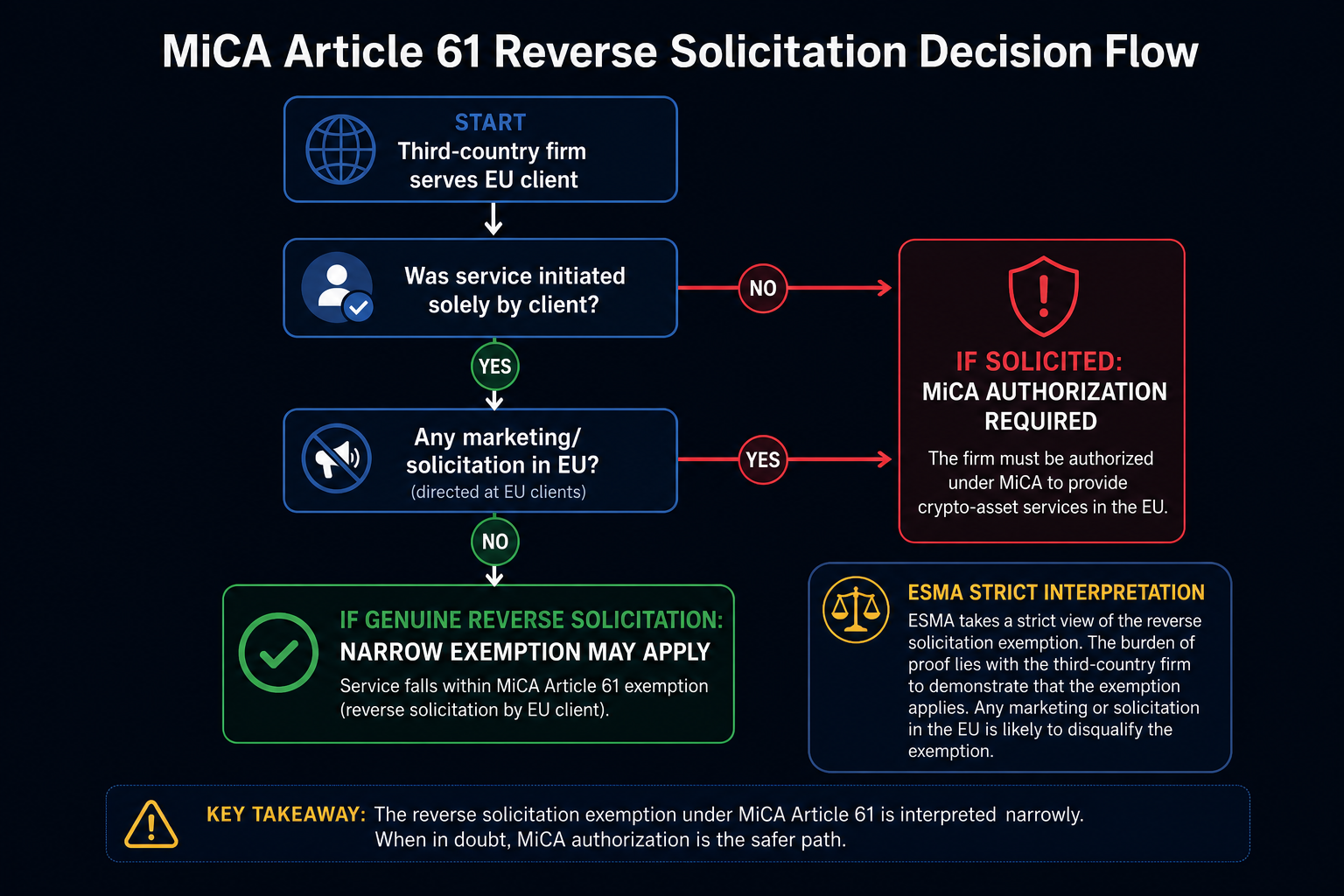
Figure 1. MiCA Article 61 reverse solicitation exemption decision flow: assessing whether the user is located in the EU, whether the initiative is independent, whether solicitation exists, and whether Article 59 authorization is ultimately required.
What behaviors constitute solicitation?
The second paragraph of Article 61(1) specifies that if a third-country institution, its representatives, closely related entities, or persons acting on its behalf solicit customers in the EU by any means, it cannot be considered a user-initiated service. Contract terms or disclaimers cannot override this determination.
ESMA guidelines (ESMA35-1872330276-2030) interpret solicitation broadly, encompassing internet advertising, email/phone/social media promotion, influencer partnerships, EU-targeted SEO or geo-targeted ads, EU language websites, and sponsorship of EU events. Use of country-specific domains like .fr or .de, or unclear differentiation between licensed group entities and third-country offerings, may also constitute solicitation.
| Type of Behavior |
Usually Constitutes Solicitation |
| EU-targeted SEO / geo-targeted ads |
Yes |
| Influencer/affiliate promotion driving traffic to the platform |
Yes |
| Pure technical education, no service redirection |
No |
| User independently searches and visits global websites |
Depends on the facts |
This table provides a preliminary framework; NCAs must assess each case individually based on all relevant facts.
What are the conditions for exemption?
Reverse solicitation exemption requires all of the following: the user is located in the EU; the contact is initiated solely by the user (contract confirmation boxes cannot override contrary facts); no solicitation occurs (including marketing by related group entities); the service scope is limited to the initial request; and verifiable records are maintained. Article 61(2) allows promotion of the same asset or service within the same transaction context, but prohibits proactive promotional pushes weeks or months later.
What is ESMA’s position on reverse solicitation?
ESMA’s December 2024 Final Report and February 2025 formal guidelines offer a unified interpretation of Article 61: reverse solicitation is a narrowly defined exception and must not be used to circumvent MiCA. Whether solicitation occurs must be determined objectively; disclaimers cannot override factual evidence. Both the subject and method of solicitation are interpreted broadly, including third parties, influencers, and all channels. Promotion of the same product type is only permitted within the same transaction context as the initial request. NCAs are required to monitor online activities of third-country institutions targeting the EU and follow up on complaints.
Does user-initiated access equal reverse solicitation?
User-initiated access to a third-country platform does not automatically qualify for reverse solicitation exemption. If the website uses EU languages, country-specific domains, or EU IP-targeted ads, or if the user previously encountered the platform through ads, influencers, or emails, the entire contact chain may be considered solicitation. Push notifications or promotional pushes after registration may also exceed the exemption scope. Even if Article 61’s strict conditions are met, the exemption only applies to the specific service requested by that user.
How to distinguish licensed entities from global entities?
Users must identify the actual legal entity providing the service, not just the brand name or domain: review the contracting entity in the terms of service (Gate EU users are served by Gate Technology Limited); search for the legal entity’s full name or LEI in the ESMA CASP register—see ESMA CASP register verification guide for verification methods; distinguish MiCA-authorized services from non-MiCA products; and be alert to confusion between group offerings.
| Identification Dimension |
MiCA Licensed Entity |
Third-Country Global Entity |
| ESMA Register |
Listed, includes LEI and authorized services |
Usually not listed |
| EU Customer Protection |
Article 70 asset segregation and related rules apply |
MiCA customer protection does not apply |
| Reverse Solicitation Reliance |
Not required, Article 59 authorization already held |
Only available under strict Article 61 conditions |
This table compares key differences between the two types of entities. The list of licensed exchanges in Europe summarizes principal platform authorized entities for reference.
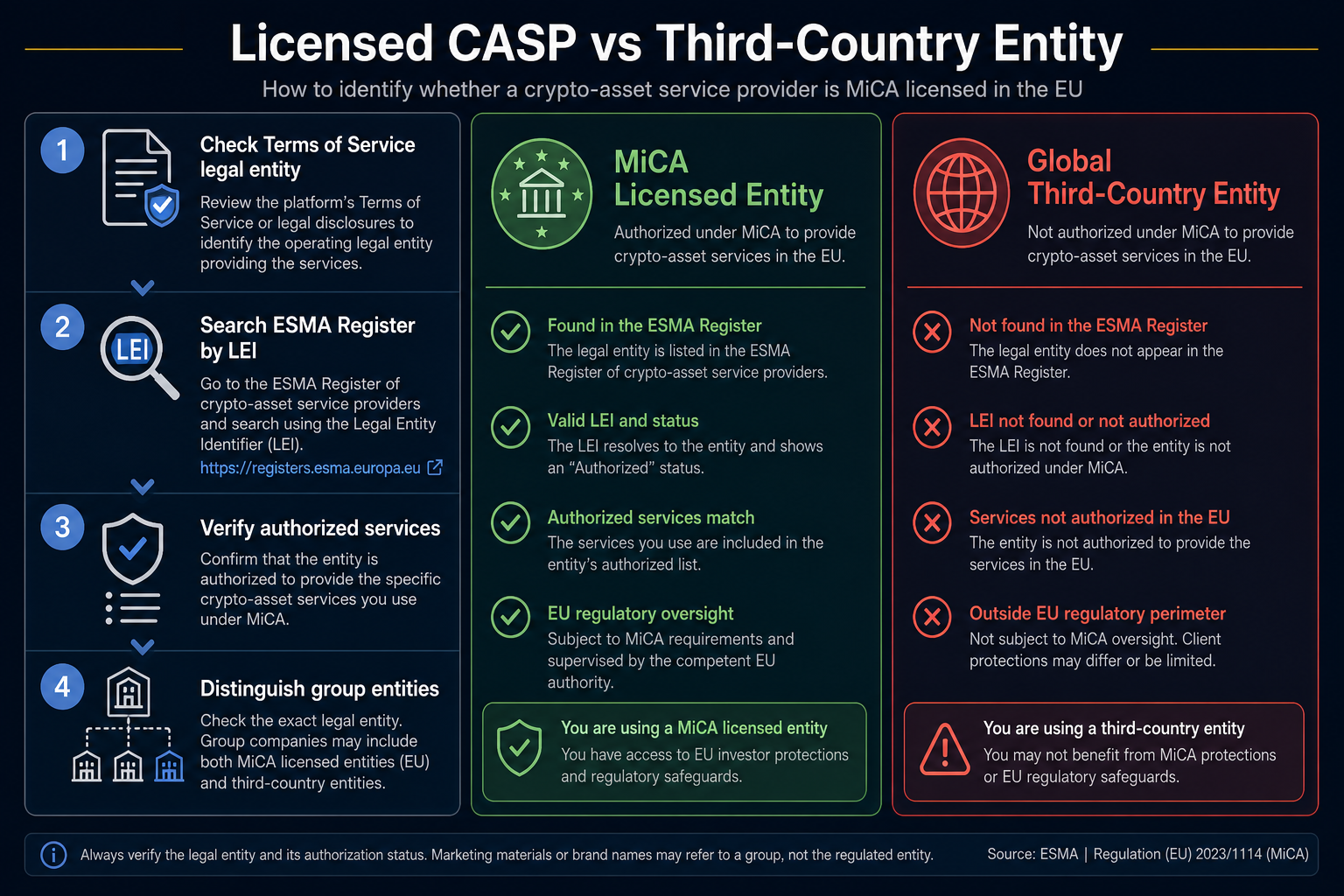
Figure 2. Key steps for EU users to identify MiCA licensed entities versus third-country global entities: legal documentation, ESMA register, authorized services, and passport coverage of member states.
What are the risks and limitations of reverse solicitation?
Reverse solicitation is subject to significant limitations: applicability depends on NCA case-by-case determination and is difficult to standardize; third-country institutions are not subject to MiCA asset segregation (Article 70) or complaint mechanisms; proactive marketing or promotion of new products in the EU is prohibited; any solicitation by group entities in the EU may cause third-country entities to lose exemption. The MiCA passporting mechanism applies to CASPs already authorized by an EEA home country, with fundamentally different legal prerequisites and customer protection levels.
Summary
MiCA Article 61 reverse solicitation allows third-country institutions to provide specific crypto asset services requested by EU users, provided the initiative is independent and no solicitation occurs. ESMA guidelines mandate strict interpretation, with solicitation encompassing SEO, advertising, influencers, and confusion between group offerings. User-initiated website access does not automatically confer exemption. Gate’s MiCA-compliant services for EU and EEA users are provided by Gate Technology Limited; users should verify the entity’s LEI, authorized services, and passport coverage in the ESMA CASP register.
FAQ
What does MiCA reverse solicitation mean?
Reverse solicitation refers to EU users independently requesting specific services from third-country institutions without prior active marketing by the platform. Article 61 allows such institutions to provide the requested services without Article 59 authorization. The scope of this exception is very narrow and cannot be used as a compliance basis for systematic service to the EU market.
Can non-EU exchanges continue serving European users?
Only under strict Article 61 conditions can third-country institutions provide specific services to individual EU users who initiate contact. If any solicitation occurs or there is systematic reliance on reverse solicitation, Article 63 authorization is required.
What behaviors are considered solicitation?
ESMA guidelines broadly define solicitation, including EU-targeted SEO, geo-targeted advertising, social media marketing, influencer promotion, EU language websites, and confusion between group offerings, which can be carried out by third parties.
Does user-initiated website access count as reverse solicitation?
Not necessarily. Determination must be based on all facts, including whether marketing contact occurred before access, whether the website uses EU languages, and whether promotional pushes are received after registration. Contract disclaimers cannot substitute for factual assessment.
What is the difference between reverse solicitation and the MiCA passporting mechanism?
Reverse solicitation is an exception mechanism for third-country institutions responding to user-initiated contact, with limited customer protection. The passporting mechanism is a systematic path for authorized CASPs from EEA home countries to provide services to host countries under Article 65.
Which entity should Gate EU users receive services from?
Gate’s MiCA-compliant services for EU and EEA users are provided by Gate Technology Limited, authorized by the MFSA. Users should verify the entity’s LEI, authorized services, and passport coverage in the ESMA CASP register.