Understanding the definition, working principle, and industry role of MLCC is the gateway to grasping the component sector and passive component supply chain positioning of Samsung Electro-Mechanics.
An MLCC is a chip-type passive component formed by alternately layering ceramic dielectric materials and internal metal electrodes, which are then fired at high temperature to create capacitance. In a circuit, an MLCC does not actively amplify signals—instead, it stores and releases charge to regulate voltage fluctuations, filter high-frequency noise, and maintain power stability.
Compared with electrolytic and tantalum capacitors, MLCCs offer small size, good temperature tolerance, and suitability for mass SMT (Surface-Mount Technology) production. As a result, they are among the most widely used capacitor types in smartphones, servers, automotive electronics, and other devices. Within Samsung Electro-Mechanics' component business segment, MLCCs join inductors, chip resistors, tantalum capacitors, and silicon capacitors to form the passive component product matrix, with MLCCs serving as the most broadly deployed and specification-rich foundational component.
| Capacitor Type |
Dielectric Material |
Typical Characteristics |
Common Applications |
| MLCC |
Ceramic |
Small footprint, SMT-friendly, wide spec range |
Smartphones, servers, automotive ECUs |
| Electrolytic Capacitor |
Electrolyte/Solid Polymer |
Higher per-unit capacitance |
Power modules, industrial equipment |
| Tantalum Capacitor |
Tantalum Metal Oxide |
High capacitance density, good stability |
Telecom gear, portable devices |
| Silicon Capacitor |
Silicon-based structure |
Outstanding high-frequency performance |
High-end RF, advanced packaging |
This comparison shows that MLCCs' core advantage lies in "small size + high integration + broad applicability," not extreme single-unit capacitance. That strength makes MLCCs a staple component across electronic systems and a key focus of Samsung Electro-Mechanics' passive component production capacity and R&D investment.
Working Principle
An MLCC's capacitance comes from a parallel-plate structure formed by alternating layers of ceramic dielectric and internal electrodes. During manufacturing, ceramic powder is printed, laminated, cut, and fired at high temperature. The internal electrodes create many parallel capacitor units between dielectric layers, with external terminations connecting to PCB pads.
When connected in a circuit, the MLCC creates a charge storage path between power and ground: as voltage rises, it absorbs and stores charge; when voltage drops or transient interference occurs, it releases charge to smooth fluctuations. In an AC signal path, the MLCC exhibits low impedance to high-frequency noise, shunting interference to ground. Parameters such as capacitance, voltage rating, equivalent series resistance (ESR), and equivalent series inductance (ESL) collectively determine how effectively it stores energy and filters signals within a given frequency band.
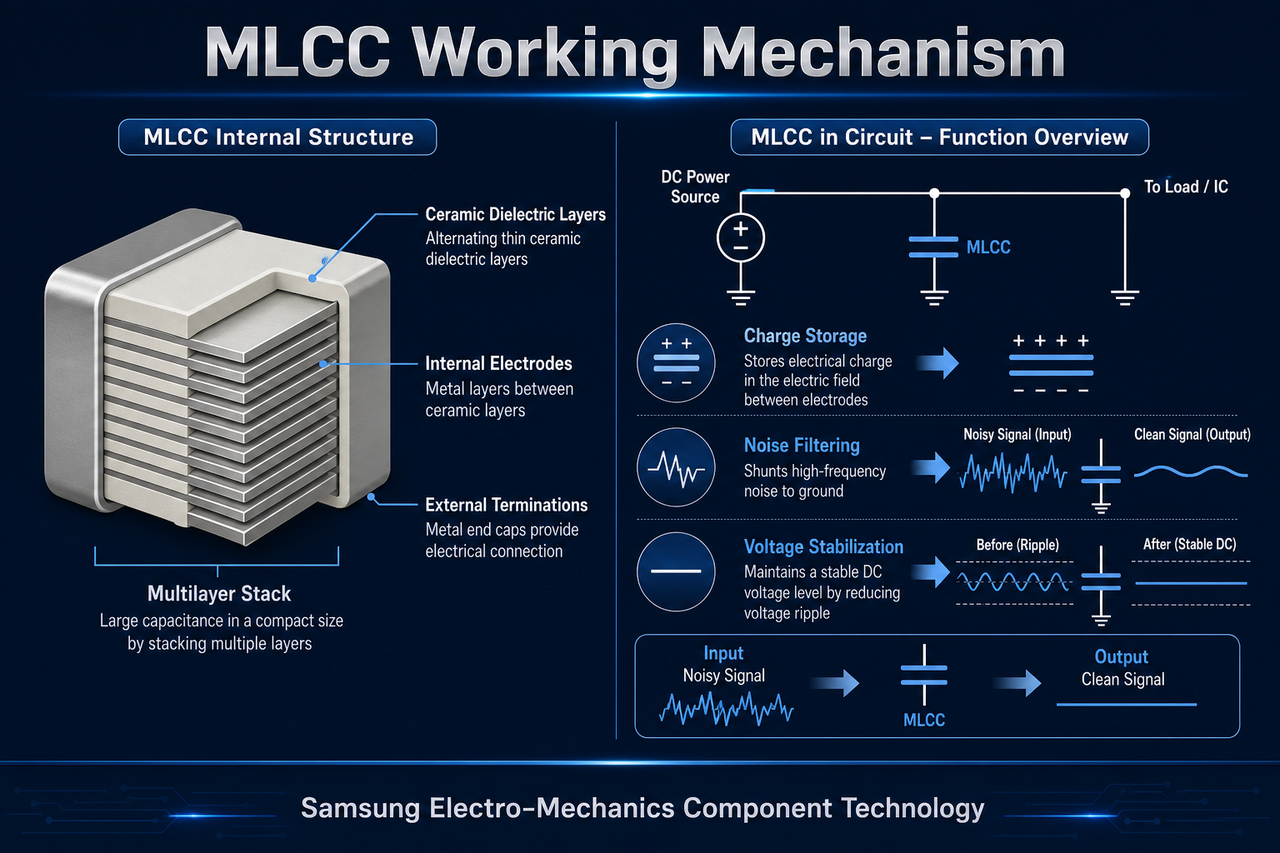 Figure 1. MLCC internal multilayer structure and circuit functions: charge storage, noise filtering, and voltage stabilization.
The MLCC's operating principle can be summed up as "laminated charge storage with frequency-selective gating": its layered architecture delivers effective capacitance per unit volume, while the circuit connection determines whether it performs DC voltage regulation, decoupling, or high-frequency filtering.
Application Scenarios
MLCC applications span four major domains—consumer electronics, data centers, automotive electronics, and communications infrastructure—each with distinct requirements for capacitance, size, temperature tolerance, and reliability.
| Application Field |
MLCC Primary Function |
Spec Focus |
| Smartphones |
Power decoupling, RF filtering |
Ultra-miniaturization (0201/01005), high capacitance density |
| AI Servers / HPC |
CPU/GPU power regulation, high-speed signal integrity |
High capacitance, low ESL, high temperature resistance |
| Automotive Electronics |
ECU power management, ADAS signal filtering |
AEC-Q200 qualification, wide temperature range, high reliability |
| Network & Telecom |
Base station RF, switch power supplies |
High-frequency performance, long-term stability |
In AI servers and HPC environments, a single device can house thousands to tens of thousands of MLCCs. Automotive electronics must meet AEC-Q200 and other vehicle-grade standards, demanding robust thermal cycling and long-term reliability. These varying needs are pushing MLCCs toward higher-end specifications, reinforcing the competitive moats of leading players in materials and process technology.
Samsung Electro-Mechanics' MLCC Strategy
Samsung Electro-Mechanics treats MLCCs as a core pillar of its component business. Since the 2000s, it has steadily invested in foundational technologies such as materials, high-frequency wireless, and precision machinery, building an MLCC product portfolio spanning consumer to automotive grades. Its MLCC lineup includes standard, high-capacity, high-temperature, and automotive-grade series, targeting mobile devices, data centers, automotive electronics, and industrial equipment.
Within Samsung Electro-Mechanics' three major business divisions, MLCCs fall under the Components segment, complementing Package Solutions and Optical Solutions. Its MLCC products cover everything from general consumer electronics to automotive ECUs and AI accelerator cards, with a growing focus on high-capacity, low-ESL, and automotive-certified high-end specs for automotive and AI computing. The core differences between Samsung Electro-Mechanics and Samsung Electronics clarify how components like MLCCs are distinct from finished-device business in the supply chain.
Industry Role and Competitive Structure
The global MLCC market is highly concentrated, with a handful of top manufacturers dominating based on material formulas, lamination processes, sintering techniques, and massive production capacity. Samsung Electro-Mechanics, Murata, TDK, Yageo, and others are the primary global MLCC suppliers, each with different spec coverage, downstream focus, and capacity distribution.
| Competition Dimension |
Core Elements |
Industry Implications |
| Material Technology |
Ceramic powder formulation, dielectric constant control |
Determines capacitance density and temperature stability |
| Manufacturing Process |
Lamination precision, electrode printing, sintering consistency |
Affects yield rate and spec ceiling |
| Production Scale |
Number of lines, spec changeover efficiency |
Impacts delivery capability and cost structure |
| Specification Coverage |
Size, capacitance, voltage rating, automotive certification |
Determines addressable downstream markets |
MLCCs' industry role can be described as "the essential component supplier for electronic systems." Growth in downstream device shipments directly drives total MLCC demand, while trends like AI servers and automotive electrification are increasing the share of high-end MLCC specs. Competition goes beyond pricing—material innovation, process precision, and automotive certifications form deeper technical barriers. Samsung Electro-Mechanics' global production capacity and technological know-how position it as a critical passive component supplier in the supply chain.
Technology Evolution Trends
MLCC technology is progressing along four fronts: miniaturization, higher capacitance, lower ESL, and automotive-grade reliability. Miniaturization is driven by smartphones and wearables; higher capacitance depends on breakthroughs in ceramic materials and thin-layer processes; lower ESL targets AI server power decoupling; and the automotive track meets ECU and ADAS needs for wide temperature range and long life. Samsung Electro-Mechanics continues to invest in materials R&D and process upgrades, covering everything from consumer to automotive ultra-high-capacity MLCCs.
Summary
As a fundamental passive component in electronic circuits, MLCCs use a multilayer ceramic structure to store energy, filter noise, and regulate voltage. Samsung Electro-Mechanics positions MLCCs as a core component business, alongside FC-BGA packaging substrates and optical modules, forming its three major divisions. Understanding the definition, working principle, and competitive landscape of MLCCs is essential for grasping Samsung Electro-Mechanics' passive component business logic.
FAQ
What is an MLCC?
An MLCC (Multilayer Ceramic Capacitor) is a chip-type passive component made by alternately layering ceramic dielectric and internal metal electrodes and firing them. In circuits, MLCCs handle energy storage, filtering, and voltage regulation, and are among the most widely used capacitor types in electronic devices.
How do MLCCs differ from electrolytic capacitors?
MLCCs use ceramic as the dielectric, offering small size, SMT compatibility, and a broad spec range, making them ideal for decoupling and filtering in dense circuits. Electrolytic capacitors typically offer higher per-unit capacitance but have different size and ESR characteristics. The two are often used complementarily in circuits rather than as direct substitutes.
Which business segment does Samsung Electro-Mechanics' MLCC business belong to?
Samsung Electro-Mechanics' MLCCs are part of the Components Business Segment, which also includes inductors, chip resistors, tantalum capacitors, and silicon capacitors. The Components Segment, Package Solutions, and Optical Solutions are the company's three major business divisions.
Why do AI servers require so many MLCCs?
CPUs, GPUs, and high-speed interconnect chips in AI servers demand extremely tight power integrity. Multiple decoupling MLCCs are placed around each chip to suppress transient voltage drops and high-frequency noise. Higher computing power and more chips mean a higher total MLCC count.
What are the key competitive factors in the MLCC industry?
The main competitive dimensions are ceramic material formulation, lamination and sintering process precision, production scale, and breadth of spec coverage. High-end specs such as automotive certification, high capacitance, and low ESL add further technical barriers. Leading manufacturers' accumulated advantages in materials and processes create structural competitive edges.
What are the future directions for MLCC technology?
MLCC technology is evolving toward smaller package sizes, higher capacitance density, lower ESL, and enhanced automotive-grade and high-temperature reliability. Each direction depends on continuous innovation in ceramic materials, lamination processes, and terminal electrode technologies, rather than a single breakthrough parameter.