In the past, most investors gained exposure to real stocks and ETFs by buying them directly through traditional brokers. However, as crypto platforms expand their TradFi offerings and global demand for access to the US stock market continues to grow, more users are beginning to encounter stock CFDs, ETF CFDs, and onchain asset structures.
At the same time, the development of stablecoins and RWA, or real world assets, is also changing the way global assets are traded. Today, users can invest in Apple, NVIDIA, or S&P 500 ETFs through traditional brokers, while also using USDT on crypto platforms to trade price exposure to related assets.
What Are Real Stocks?
Real stocks represent partial ownership in a listed company. For example, when a user buys Apple or Microsoft shares through a traditional broker, they typically hold actual shares of the corresponding company.
Real stocks usually have the following features:
-
Ownership rights as a company shareholder
-
Potential dividend payments
-
Voting rights in some markets
-
Suitable for long term holding
-
Usually traded through traditional securities accounts
For long term investors, real stocks are closer to traditional asset allocation tools.
However, real stock trading usually depends on brokerage accounts, bank settlement, and exchange trading hours, which can make cross border investing relatively more difficult.
What Are US Stock CFDs?
US stock CFDs, or contracts for difference, are products that allow users to trade changes in stock prices without actually holding the underlying shares.
For example, users can trade stock CFDs on:
-
Apple
-
NVIDIA
-
Tesla
-
Amazon
In a CFD structure, the user and the platform settle the price difference rather than transferring the stock itself. As a result, stock CFDs focus more on price trading than on equity ownership.
Because CFDs often support leverage and short selling, they are more suitable for short to medium term market traders.
What Are ETF CFDs?
ETF CFDs are similar to stock CFDs, but their underlying asset is an ETF, or exchange traded fund, rather than a single stock.
For example, users can trade ETF CFDs on:
-
S&P 500 ETFs
-
Nasdaq ETFs
-
Gold ETFs
-
Energy ETFs
The core logic of ETF CFDs is also to trade price movements rather than to actually hold ETF units.
Because ETFs themselves are usually diversified, ETF CFDs are often used for index trading and macro market exposure.
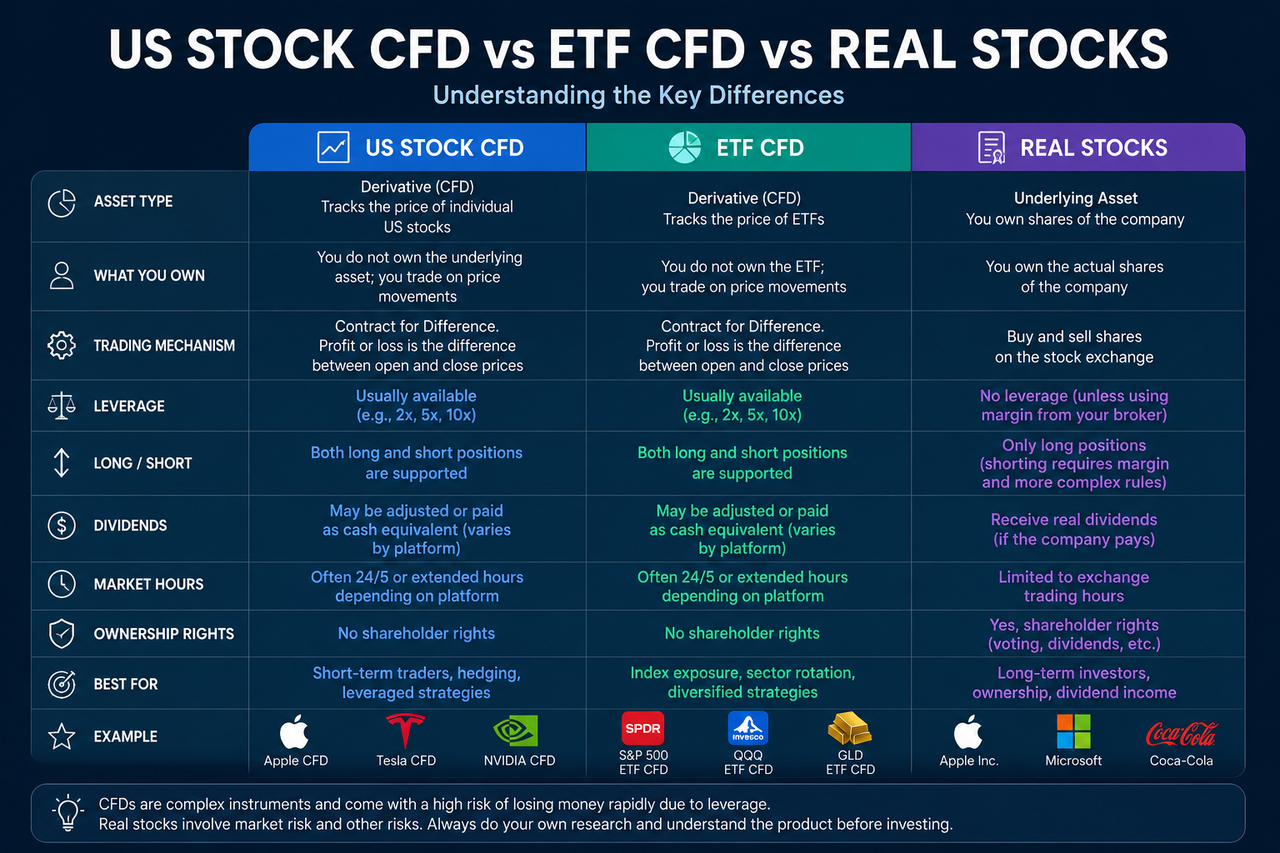
What Is the Biggest Difference Between US Stock CFDs, ETF CFDs, and Real Stocks?
The biggest difference among the three is whether the user actually owns the asset.
Real stocks mean that the user truly owns the securities asset, while CFDs are price derivatives.
This difference affects:
-
Shareholder rights
-
Voting rights
-
Dividend structure
-
Leverage mechanisms
-
Risk models
-
Trading methods
In essence, real stocks are more closely tied to long term asset ownership, while CFDs are more focused on short term price trading.
How Are ETF CFDs Different from Stock CFDs?
Although both are CFDs, their underlying assets are different, so their use cases also differ.
Stock CFDs usually track the price movement of a single company, which means market volatility is more concentrated. For example, NVIDIA or Tesla prices may be affected by earnings reports, AI related themes, or industry news.
ETF CFDs, on the other hand, are more closely linked to index based or portfolio structures. For example, an S&P 500 ETF is better able to represent the broader market trend, so its volatility is usually more diversified.
Therefore:
This is one of the key reasons many users use ETF CFDs for macro market trading.
How Do US Stock CFDs, ETF CFDs, and Real Stocks Differ in Risk?
Real stocks, stock CFDs, and ETF CFDs do not share the same risk structure.
The risks of real stocks mainly come from company performance and market volatility, but they usually do not involve forced leverage risk.
CFDs are different. Because many CFD products support leverage, market movements can magnify both gains and losses. In addition, CFDs usually do not represent actual asset ownership, so users may not have the traditional rights attached to securities.
Although ETF CFDs have some diversification characteristics, their leverage mechanisms can still amplify risk.
For this reason, understanding the product structure is more important than simply focusing on price before participating in related trading.
Conclusion
US stock CFDs, ETF CFDs, and real stocks can all provide exposure to the US capital markets, but they differ fundamentally in asset ownership, trading mechanisms, and risk structure.
Real stocks are better suited for long term holding and shareholder rights based investing. Stock CFDs focus more on individual stock price trading and leverage mechanisms. ETF CFDs are more suitable for index based exposure and macro market allocation.
FAQs
Are Stock CFDs the Same as Real Stocks?
No. Stock CFDs are price derivatives. Users trade price movements, not the real stocks themselves.
What Is the Difference Between ETF CFDs and ETFs?
An ETF CFD is only a contract for difference based on an ETF’s price. It does not mean the user actually holds units of the ETF fund.
Because CFDs are easier to integrate with existing crypto derivatives systems, while also supporting stablecoin margin and leveraged trading.
Can Users Receive Dividends When Trading CFDs?
Some CFD products may provide price adjustments or simulated dividend mechanisms, but they are usually not equivalent to the dividend rights attached to real stocks.
Are Real Stocks Always Safer Than CFDs?
They have different risk structures. Real stocks usually do not involve leverage risk, while CFDs may carry higher volatility risk because they support leverage.
Why Are ETF CFDs More Suitable for Index Trading?
Because ETFs usually represent a basket of assets, ETF CFDs are more suitable for trading broader market or sector trends.