Unlike traditional banks, which focus on deposits and lending, Synchrony Financial’s core value lies in connecting consumers with merchants. Through partnerships with retail brands, healthcare institutions, and service companies, SYF helps consumers access more flexible payment options while helping merchants improve sales efficiency and customer loyalty. This model has gradually turned consumer finance from a simple credit tool into essential infrastructure for the modern retail ecosystem.
Why Consumer Finance Has Become an Important Part of Modern Retail
Competition in the modern retail market is not only about goods and services themselves, but also about the payment experience and financing capability. For consumers, more flexible payment options can reduce the pressure of one-time expenses. For merchants, consumer finance can help improve conversion rates and average order value. As a result, consumer finance has become an important part of the retail system.
In the past, major purchases often required consumers to save in advance or rely on traditional bank loans. Consumer finance institutions, however, provide a more convenient financing channel. Consumers can access installment payment plans directly at the time of purchase, increasing their purchasing power. This model has become one of the mainstream payment methods, especially in areas such as furniture, home appliances, healthcare services, and electronics.
With the development of e-commerce and digital payments, consumer finance has become even more important. Consumers want instant approval and a convenient payment experience, while merchants want to reduce payment barriers and improve conversion rates. Consumer finance has therefore become an important bridge connecting consumer demand with the retail market.
What Are the Application Scenarios for SYF’s Credit Card Services?
Credit cards are one of Synchrony Financial’s core businesses. Unlike general-purpose credit cards issued by traditional banks, SYF focuses more on the retail partner credit card and co-branded credit card markets, building a consumer finance ecosystem through brand partnerships.
In retail consumption scenarios, credit cards are not only payment tools, but also customer management tools. When consumers use partner credit cards, they can usually receive reward points, cash back, or membership benefits, which can increase their willingness to spend and strengthen brand loyalty. For retailers, this model helps companies build long-term customer relationships.
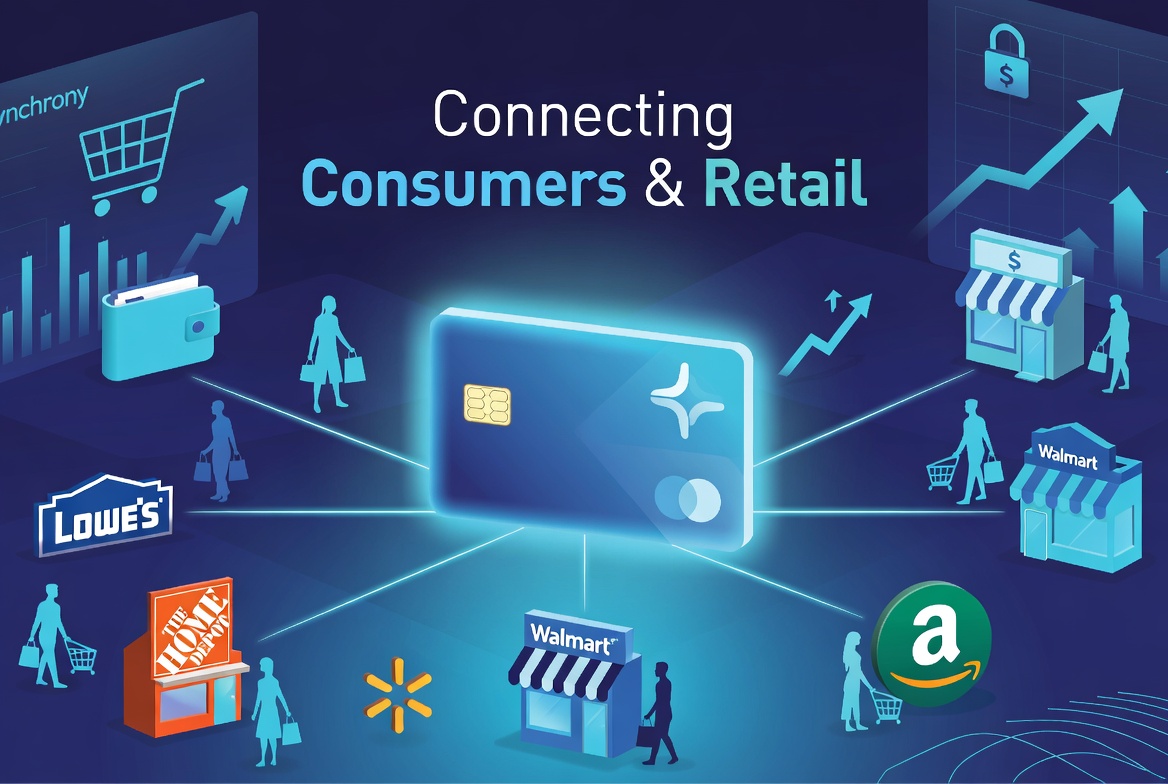
Today, Synchrony Financial’s credit card services cover retail shopping, home improvement materials, electronics, automotive services, e-commerce, and many other areas. Through partnerships with a large number of brands, the company has built a credit card network that spans a broad range of consumer scenarios and has become one of the largest retail credit card service providers in the United States.
How Installment Payment Services Support Major Purchases
Not every purchase is suited to a single upfront payment. For higher-priced goods or services, consumers often prefer installment payments to ease short-term financial pressure. Synchrony Financial’s consumer financing services are built around this demand.
In scenarios such as furniture purchases, home upgrades, electronics purchases, and education or training, installment payments have become an important payment method. Consumers can arrange repayment plans according to their own budgets, while merchants can improve sales conversion and order size. For many industries, installment payments have evolved from an add-on service into an important tool for encouraging consumption.
From a business perspective, consumer financing can expand consumers’ purchasing power and help merchants reach a broader customer base. By working with merchants to provide financing solutions, Synchrony Financial creates a more flexible link between consumer demand and payment capacity.
Why Healthcare and Home Spending Rely on Consumer Finance
Healthcare and home-related spending are among the most widely used areas for consumer finance. These types of expenses are usually relatively large and often tied to real, immediate needs, so consumers tend to require more flexible payment arrangements.
In healthcare, dental treatment, vision care, cosmetic care, and certain medical procedures are often not fully covered by insurance. Many consumers choose consumer loans or installment payments to complete payment and reduce the pressure of a large one-time expense. Consumer finance has therefore become an important supplementary tool within the healthcare services system.
Home spending has similar characteristics. Furniture purchases, kitchen renovations, flooring replacement, and full home improvement projects often require sizable budgets. Through consumer financing services, consumers can complete improvement plans sooner, while merchants can improve sales efficiency. For Synchrony Financial, healthcare and home-related spending have become important business scenarios and sources of growth.
How Digital Payments and Mobile Finance Expand Service Scenarios
Digital transformation is changing how the consumer finance industry develops. As mobile payments, e-commerce, and online financial services become more widespread, consumers increasingly prefer to complete payments and financing applications through digital channels.
Synchrony Financial continues to promote digital financial services, allowing consumers to apply for credit online, view account information, manage repayment plans, and complete payment processes. This digital experience not only improves convenience, but also reduces the operating costs of traditional financial services.
For retailers, digital payment tools can also improve the customer experience. Whether on online shopping platforms or in physical stores, digital financial services can help merchants shorten the payment process and improve transaction efficiency. As mobile internet adoption continues to grow, digital payments have become an important part of the consumer finance ecosystem.
Why the Consumer Finance Ecosystem Has Become a Growth Driver
The value of the consumer finance ecosystem does not come from a single financial product. It comes from the long-term relationships formed among consumers, merchants, and financial institutions. When consumers continue to use credit cards and financing services, merchants gain a more stable source of sales, while financial institutions can accumulate more customer resources and transaction data.
For Synchrony Financial, its partner network is one of its core competitive advantages. By working with a large number of retail brands, healthcare institutions, and service companies, the company can cover a wide range of consumer scenarios and continue expanding its business scale. This ecosystem model means consumer finance is no longer just a lending business. It has evolved into an important platform connecting the consumer market.
As the digital economy and e-commerce continue to develop, the importance of the consumer finance ecosystem keeps rising. Consumer demand for flexible payment methods remains strong, while merchants also continue to need better sales efficiency and stronger customer loyalty. This supply and demand relationship forms an important foundation for the long-term development of the consumer finance industry.
How to Buy SYF (Synchrony Financial) Stock
SYF is the ticker symbol for Synchrony Financial, which is listed and traded on the New York Stock Exchange (NYSE). Traditionally, investors can buy SYF through a securities account that supports U.S. stock trading, allowing them to participate in the development of the U.S. consumer finance industry.
Because Synchrony Financial’s business covers credit cards, consumer loans, and retail financial services, its operating performance is usually closely related to consumer spending levels, the credit environment, and retail market activity. Many market participants regard SYF as one of the important companies for observing the U.S. consumer finance market.
As digital asset markets and traditional financial markets gradually converge, more trading tools linked to stock price movements have appeared in the market. For example, some platforms offer CFD products linked to stock prices, allowing users to participate in the market through price changes without directly holding the underlying stock assets.
Taking Gate TradFi as an example, users can follow different markets, including digital assets, stocks, ETFs, indices, and commodities, within the same account environment. Some markets also offer Gate CFD products, providing more options for cross-market asset allocation and price observation.
Regardless of how they participate in the market, investors should fully understand the product structure, trading rules, and regulatory requirements in their region.
Conclusion
Synchrony Financial connects consumers with the retail market through credit cards, consumer loans, installment payments, and digital financial services. Whether in everyday shopping, healthcare spending, home upgrades, or online payments, consumer finance has become an important part of the modern retail system. Supported by a broad partner network and a wide range of consumer scenarios, SYF has built a distinctive ecosystem advantage in the U.S. consumer finance market and continues to play an important role in connecting consumers with merchants.
FAQs
What Consumer Finance Services Does Synchrony Financial Mainly Provide?
Synchrony Financial mainly provides credit cards, co-branded credit cards, consumer loans, installment payments, and services related to digital payments.
Why Is Consumer Finance Important to the Retail Industry?
Consumer finance can lower payment barriers for consumers and increase purchasing power, while helping merchants improve sales conversion and customer loyalty.
What Are the Main Use Cases for SYF Credit Cards?
SYF credit cards are widely used in retail shopping, home-related spending, electronics purchases, automotive services, e-commerce, and other areas.
Why Is Consumer Finance Often Used for Healthcare Spending?
Healthcare procedures are often relatively expensive, and consumer finance can provide installment payment plans that help consumers arrange spending more flexibly.
How Are Digital Payments Changing the Consumer Finance Industry?
Digital payments improve the efficiency of applications, payments, and account management, allowing consumer finance services to cover more online and mobile scenarios.
What Is the Biggest Difference Between SYF and Traditional Banks?
Synchrony Financial focuses more on financial services for consumer spending scenarios, while traditional banks usually cover a broader range of deposits, lending, and corporate finance services.