Due to its free-float market cap weighting mechanism, the financial and technology Zones have consistently held significant weight in the Nifty 50. Large-cap companies such as HDFC Bank, Reliance Industries, Infosys, and TCS have a notable impact on the index's movements.
In global financial Marketplace, the Nifty 50 stands as one of India's most representative blue-chip indices. The ETFs, index funds, and derivatives built around it make it a key benchmark for international institutions allocating to Indian assets.
How Are Nifty 50 Constituents Selected?
The Nifty 50's constituents are regularly filtered and adjusted by the Index Committee of the National Stock Exchange of India. Inclusion typically requires meeting the following criteria:
- High free-float market cap
- Stable market liquidity
- Significant trading volumes
- Consistent long-term performance
- Industry representation
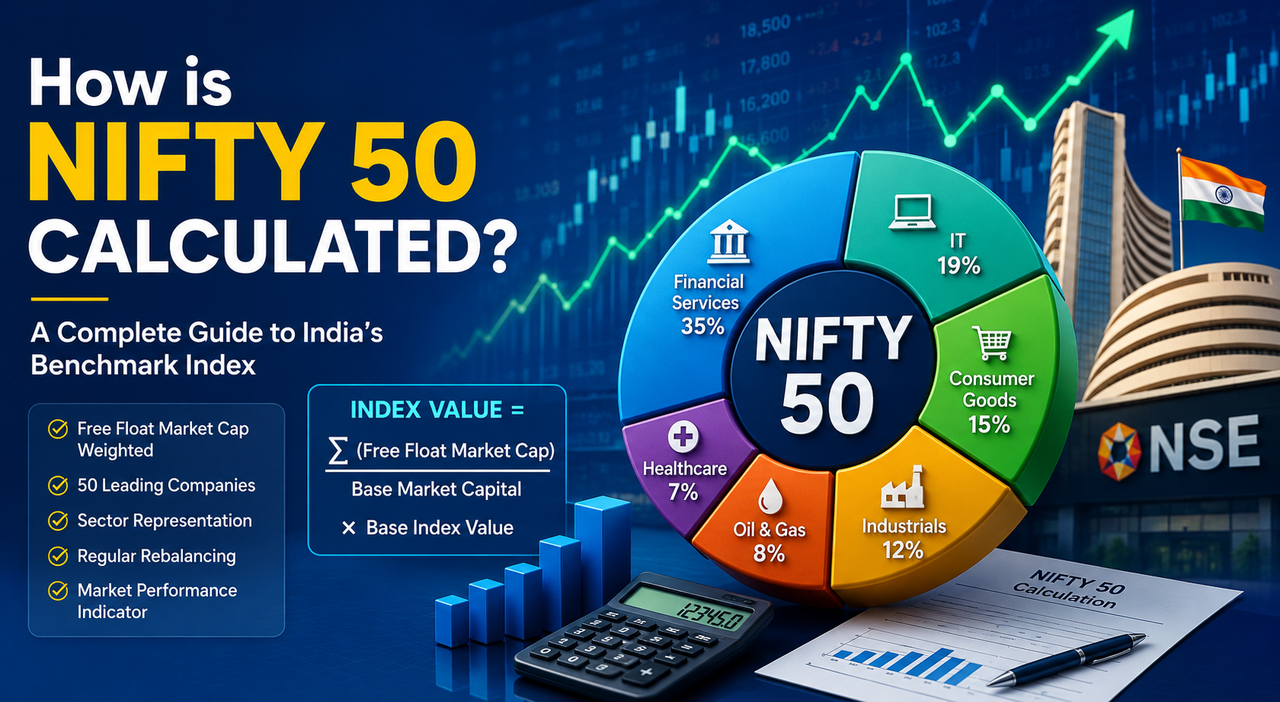
Since the index uses a free-float market cap weighting methodology, large-cap companies naturally carry more weight. Compared to price or total cap filtering, this method more accurately reflects actual trading activity.
The Index Committee also conducts periodic reviews. Companies with declining market cap or falling trading activity may be removed, while emerging large caps may be added.
Which Sectors Does the Nifty 50 Cover?
The Nifty 50's sector breakdown offers a clear window into India's core economic drivers. Financial services, information technology, and energy have long been dominant.
The financial Zone's high weight reflects India's reliance on banks and financial institutions to fuel corporate lending and consumption growth. Meanwhile, IT showcases India's global standing in software services and the digital economy.
The Nifty 50 currently covers these key sectors:
| Sector |
Representative Companies |
Sector Characteristics |
| Financial Services |
HDFC Bank, ICICI Bank |
Highest weight, large capital base |
| Information Technology |
Infosys, TCS, Wipro |
Global software and outsourcing |
| Energy |
Reliance Industries, ONGC |
Energy and industrial infrastructure |
| Consumer Goods |
ITC, Hindustan Unilever |
Consumption upgrades and demographic dividend |
| Pharmaceuticals |
Sun Pharma, Dr. Reddy’s |
Global generics and healthcare |
| Industrial Manufacturing |
Larsen & Toubro |
Infrastructure and engineering |
This multi-sector structure helps the Nifty 50 diversify single-industry risk while maintaining representation of India's core economic sectors.
Why Does Financial Services Hold the Highest Percentage in the Nifty 50?
Financial services has long been the largest component of the Nifty 50. As India's economy grows, its banking system supports massive corporate financing, consumer loans, and infrastructure investment, driving continued expansion of large financial institutions.
HDFC Bank, ICICI Bank, and State Bank of India consistently rank among the top-weighted stocks. Their price movements can directly sway the Nifty 50's overall trajectory.
India's rapidly evolving digital payments and fintech landscape has further elevated the Zone's importance. With mobile payments, online lending, and digital banking becoming mainstream, financial services now wield even greater influence in India's capital Marketplace.
However, this heavy concentration also means that policy shifts or economic slowdowns affecting finance can significantly impact the Nifty 50 as a whole.
Why Are Indian IT Companies So Important to the Nifty 50?
Information technology is one of the most internationally integrated Zones within the Nifty 50. Firms like Infosys, Tata Consultancy Services (TCS), and Wipro have long provided software development, digital transformation, and outsourcing services to global clients.
Given that a large share of their revenue comes from overseas Marketplace, Indian IT companies are closely tied to the global tech cycle. When U.S. and European enterprises ramp up digital spending, Indian IT typically benefits.
The prominence of IT in the Nifty 50 also reflects India's shift from traditional manufacturing toward a digital economy.
Rising demand for artificial intelligence, cloud computing, and enterprise software has further boosted the Zone's visibility in international capital Marketplace.
Why Does Reliance Industries Hold Such Influence?
Reliance Industries is one of India's highest-valued companies and a pivotal Nifty 50 constituent.
Unlike traditional energy players, Reliance operates across petrochemicals, energy, telecom, digital platforms, and retail—spanning multiple core Zones of India's economy.
Following its digital expansion, Reliance is no longer seen as just an energy company but as a key representative of India's digital economy. Consequently, its stock movements often have an outsized effect on the Nifty 50.
Given its high weight, international investors closely monitor Reliance's earnings, capital expenditures, and business growth.
Will the Nifty 50's Sector Structure Change?
The Nifty 50 is not static. As India's economic structure evolves, sector weights will gradually shift.
For instance, over recent decades, financial and IT weights have risen, while some traditional industrial and utility names have lost influence.
Looking ahead, sectors like new energy, digital platforms, e-commerce, and semiconductors may gain prominence in India's capital Marketplace. If their market caps continue to grow, they could eventually be included in the Nifty 50.
This dynamic adjustment mechanism ensures the Nifty 50 stays aligned with the latest trends in India's economic development, rather than being frozen in an outdated industrial structure.
What Risks Does the Nifty 50's Sector Concentration Pose?
While the Nifty 50 spans multiple sectors, the financial and technology Zones still account for a large percentage. This creates notable sector concentration risk.
For example, a global slowdown in tech or liquidity pressures in India's financial system could weigh heavily on the index.
Large-cap stocks also have a disproportionate effect on volatility. Sharp moves in Reliance, HDFC Bank, or Infosys can drag the entire index.
Still, over the long term, this concentration reflects India's most competitive industries. It is both a risk factor and a directional signal for market growth.
Summary
The Nifty 50 consists of India's most representative blue-chip listed companies, spanning finance, technology, energy, consumer goods, and pharmaceuticals.
With financial services and IT holding the highest weights, the index effectively tracks India's economic growth, digital transformation, and consumption upgrade trends. Large caps like Reliance Industries, Infosys, and HDFC Bank remain the core drivers of its performance.
FAQs
How many companies are in the Nifty 50?
The Nifty 50 includes 50 large-cap blue-chip companies listed on the National Stock Exchange of India.
Which sector has the highest weight in the Nifty 50?
Financial services is typically the Zone with the highest weight.
Why are Indian IT companies so important to the Nifty 50?
Because Infosys, TCS, and others have a major global role in software and digital services, generating significant overseas revenue.
Why does Reliance Industries have such a big impact on the index?
Reliance is one of India's most valuable companies, with operations spanning energy, retail, telecom, and digital platforms, giving it a high index weight.
Do the Nifty 50's constituents change?
Yes. The Index Committee periodically reviews and adjusts constituents based on market cap, liquidity, and industry representation.
Does the Nifty 50 reflect the Indian economy?
To a significant extent, yes. Its sector composition mirrors the core trends in India's finance, technology, consumption, and industrial development.