Risk analysis for LS Electric should go well beyond the "power distribution equipment" and "AI data center" labels. The key variables driving LS Electric include SWGR and transformer orders, project delivery cadence, automation product demand, overseas certifications, raw material costs, and the KRW exchange rate.
The most common mistake when evaluating LS Electric is focusing exclusively on stock price action, thematic tags, or single-quarter revenue changes. This approach completely misses the project backlog, delivery quality, automation cycle dynamics, and platform trading mechanics, making it impossible to separate fundamental company risk from order execution risk.
A more robust risk framework must simultaneously cover business, financial, project, and trading metrics. The LS Electric Business Model explains how SWGR, transformers, and automation products form the revenue structure; the Korean Power Equipment Peer Comparison helps distinguish LS Electric from heavy electrical equipment companies and automation-heavy peers.
What Are LS Electric's Core Metrics?
LS Electric's core metrics fall into five categories: power equipment, automation, project, financial, and trading. Each category answers a different question, and no single data point can paint the full picture.
| Metric Category |
Core Observation Points |
Description |
| Power Equipment |
SWGR, transformer, GIS orders and delivery |
Gauge power distribution equipment demand strength |
| Automation |
PLC, servo, inverter sales and cycle dynamics |
Gauge industrial automation demand |
| Project Metrics |
Backlog, overseas projects, data center orders |
Assess revenue visibility |
| Financial Metrics |
Gross margin, cash flow, capex |
Assess operational quality |
| Trading Metrics |
Code, trading hours, fees, liquidity |
Impact actual order placement and position management |
These metrics must be analyzed as a set. An uptick in SWGR orders doesn't automatically mean the automation segment is firing on all cylinders. A signed data center deal doesn't guarantee unconstrained delivery. And just because the trading page is live doesn't mean the company's fundamental risks have vanished.
How Do Order and Delivery Cycles Affect LS Electric?
LS Electric's power equipment business is inherently project-driven. Large-ticket items like SWGR, transformers, and GIS involve a lengthy chain of design, manufacturing, certification, shipping, installation, and final acceptance. A high order backlog does not translate into near-term revenue recognition overnight. Delivery cadence, acceptance milestones, and customer concentration all play a decisive role.
The defining risk here is the lengthy time horizon. Unlike consumer goods or short-cycle manufacturing, power equipment orders can span multiple quarters—or even longer. When analyzing LS Electric, backlog, delivery pacing, and acceptance status should be your first stop, not contract signing headlines.
Why Do Data Centers and SWGR Demand Matter?
AI data centers have supercharged demand for high-density power distribution solutions, vaulting SWGR and transformers to the center of the conversation around LS Electric. Data center projects demand higher reliability, more complex distribution architectures, and faster scalability, raising the bar for supplier project experience and certification credentials.
Key variables to track include project capacity, delivery location, certification standards, client profile, and expansion potential. North American data center power solutions, UL-certified distribution systems, and PDU-type products are all relevant data center indicators. But whether a project actually lands on schedule still requires independent verification.
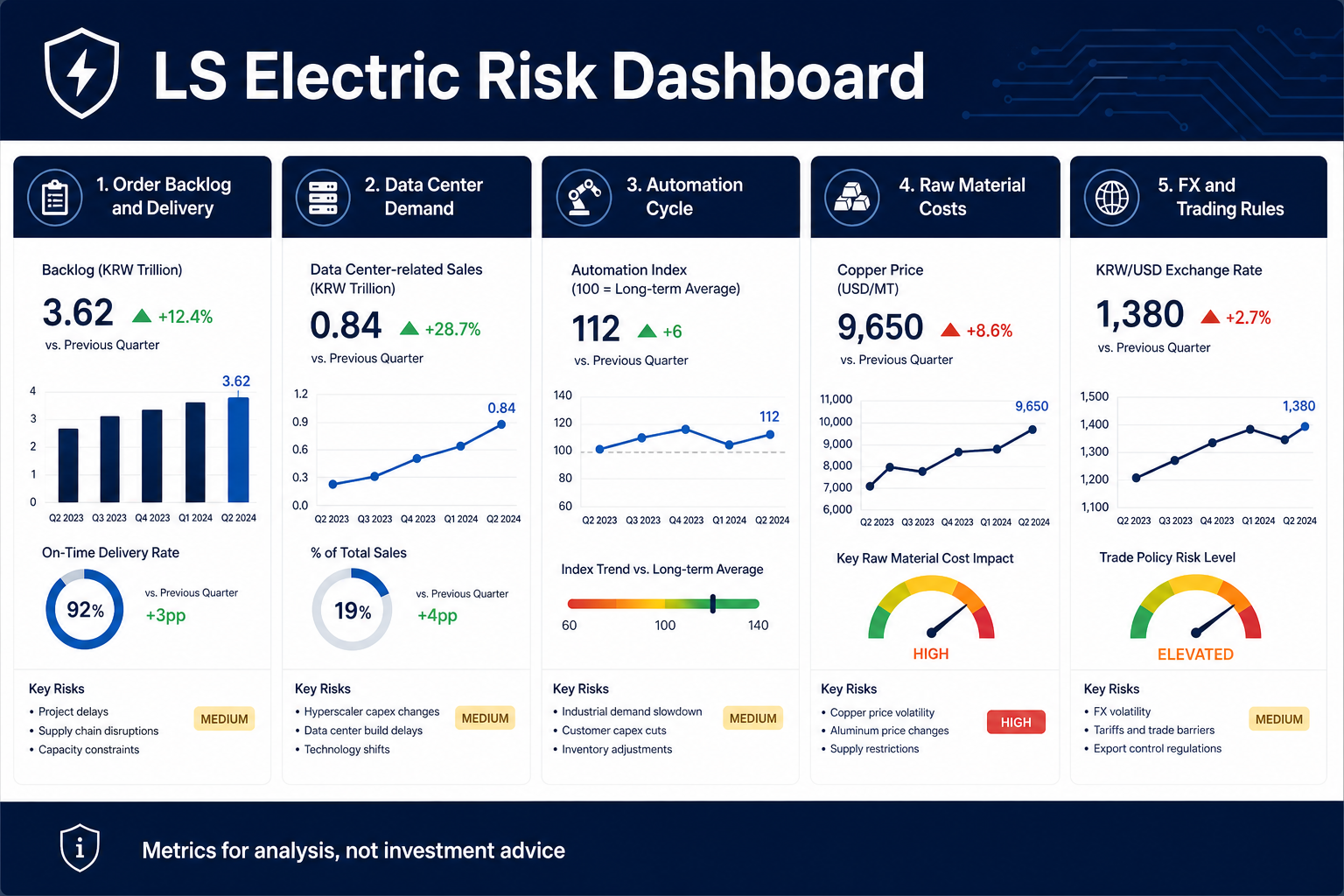 Figure 1. LS Electric Risk Checklist: order delivery, data center demand, automation cycle, raw material costs, and FX exposure form the four core observation layers.
What Metrics Matter for the Automation Segment?
LS Electric's automation segment covers PLCs, servos, inverters, HMIs, and smart factory solutions. Demand here is tied to manufacturing capex, equipment upgrades, export orders, and smart factory adoption. Compared to the power segment, automation is far more sensitive to the industrial cycle.
When tracking the automation segment, watch product sales volumes, regional demand patterns, gross margin trends, inventory levels, and overseas expansion progress. If manufacturing investment slows, automation products will likely feel it first. Conversely, a wave of smart factory or rail projects could provide structural support.
How to Assess Raw Material Costs and Gross Margin?
Both power equipment and automation products consume copper, steel, and electronic components. Rising raw material costs can squeeze gross margins, and a company's pricing power and cost pass-through ability determine whether it can protect earnings quality. LS Electric's large projects run long cycles, meaning cost fluctuations hit the P&L at different stages.
Gross margin, expense ratio, and cash flow are the key lenses for operational quality. If orders are growing but margins are under pressure, you need to diagnose whether it's a product mix shift, cost headwinds, or a project execution issue.
How Do FX Rates and Korean Stock Trading Rules Impact Account Outcomes?
LS Electric trades in Korea, with financials reported primarily in KRW. When cross-border investors use USDT to trade through Gate Stocks, their final account performance is a function of the underlying KRW asset's price movement, the platform's settlement methodology, fees, and FX conversion. The KRW's strength or weakness directly alters the returns an overseas investor sees.
Trading-level risks also include Korean stock trading hours, order types, liquidity, minimum trade sizes, and fee structures. There may be display discrepancies between the KRW-denominated quote and the USDT-denominated account base—every field on the page needs to be checked individually.
What Else Should You Watch When Trading LS Electric on Gate?
Trading risks include stock price volatility, trading hours, order types, fees, liquidity, USDT denomination, and the risk of selecting the wrong code. 010120 represents LS Electric Co., Ltd. and must not be confused with other LS Group entities or Korean power equipment companies.
If you're trading Korean stocks with USDT, pay close attention to fund transfers, available balance, estimated fees, and settlement rules. Start by reviewing the LS Electric Trading Process to walk through search, order placement, and position review. The trading conditions, regional restrictions, and risk disclaimers displayed on the platform page are your definitive operational reference.
How to Layer LS Electric Metrics into Business, Financial, and Trading Buckets?
A cleaner approach is to split the LS Electric risk checklist into three distinct layers. Layer one is business metrics: SWGR, transformers, automation products, and data center projects. Layer two is financial metrics: gross margin, cash flow, capex, and overseas revenue. Layer three is trading metrics: stock code, trading hours, order types, fees, and USDT denomination.
These three layers are not interchangeable. A business improvement doesn't eliminate trade execution risk. A live trading page doesn't mean the company's fundamentals have improved. By layering the metrics, you can first confirm that 010120 corresponds to LS Electric, then independently verify order cycles, project delivery, automation dynamics, and platform rules.
If you're only watching revenue while ignoring backlog, gross margin, and delivery progress, your risk assessment is incomplete.
Summary
LS Electric's risk metrics should be anchored on SWGR orders, project delivery, data center demand, automation cycle conditions, raw material costs, and the KRW exchange rate. The synergy between power equipment and automation provides the business foundation, but real performance hinges on order execution and cost discipline. Before trading, confirm the code and entity, then cross-check using business, financial, and trading metric layers.
FAQ
What is the single most important metric for analyzing LS Electric?
The core metrics are SWGR and transformer orders, project backlog, data center project momentum, PLC and servo demand, gross margin, cash flow, and the KRW exchange rate. Observing five business metrics combined with three financial metrics gives a far truer picture of LS Electric's real risk exposure than watching the stock price or thematic labels.
Where do LS Electric's main risks come from?
LS Electric's primary risks include project delivery delays, data center order execution, automation demand volatility, rising raw material costs, complex overseas certification requirements, and FX and trade execution risks. Business risks and trading risks must be evaluated separately—the fact that the Gate Stocks page is live does not mean the company's fundamentals have improved.
Can data center demand substitute for financial analysis?
No. Data center demand is a critical business driver, but it does not replace financial analysis. AI data center power distribution demand raises LS Electric's profile, but you still need to assess operational quality through the lens of delivery progress, gross margin, cash flow, and capex. A signed deal is not recognized revenue.
Will a downturn in the automation segment affect LS Electric?
Yes. PLC and servo demand are tied to manufacturing capex, so an automation downturn will impact LS Electric. The power and automation segments can move independently—when manufacturing investment slows, automation products typically feel it first. The two segments need to be tracked separately.
What should you watch most carefully when trading LS Electric on Gate?
Before trading, confirm the code 010120, the company name LS Electric, order types, fees, trading hours, and USDT denomination. 010120 corresponds exclusively to LS Electric Co., Ltd. and must not be confused with any other LS Group listed entity or Korean power equipment company.