Interlink fits users who want phone-based face and liveness verification into a Human Node participation model; World / Worldcoin fits users who accept Orb-level iris uniqueness checks so World ID can anonymously prove “unique human” to apps—both are proof of personhood, but verification hardware and credential paths differ.
That split builds on how Interlink Network describes InterLink ID, liveness detection, and the Human Node model. The comparison below focuses on capture devices, privacy handling, and network positioning—not on which project is “better,” and not on investment outcomes.
| Feature |
Interlink |
Worldcoin (World) |
| Verification method |
Smartphone camera face scan + liveness / deepfake checks |
Dedicated Orb iris and face imaging + uniqueness checks |
| Hardware barrier |
Smartphone-first; usually no dedicated terminal |
Full Orb verification usually requires visiting an Orb |
| Credential output |
InterLink ID → Human Node |
World ID (Orb-verified tier) |
| Privacy stance |
Biometric hash / commitment + zero-knowledge proofs; raw face not a public ledger field |
Iris codes deduplicated via MPC shards; images personally custodied; ZK proofs at use |
| Network positioning |
Human-centric blockchain; identity / App / Chain layers |
World Network + World ID protocol layer |
| Token mechanism role |
ITLG / ITL with split functions (governance, utility, partner access, and related roles) |
WLD and related tokens for network incentives and ecosystem coordination (mechanism only) |
The table alone works as a selection frame: at the surface both prove a unique human, but Interlink lands on phone-reachable face liveness and Human Node participation, while World ties high-assurance tiers to Orb iris deduplication and World ID. Compare path differences only—not market cap or yield.
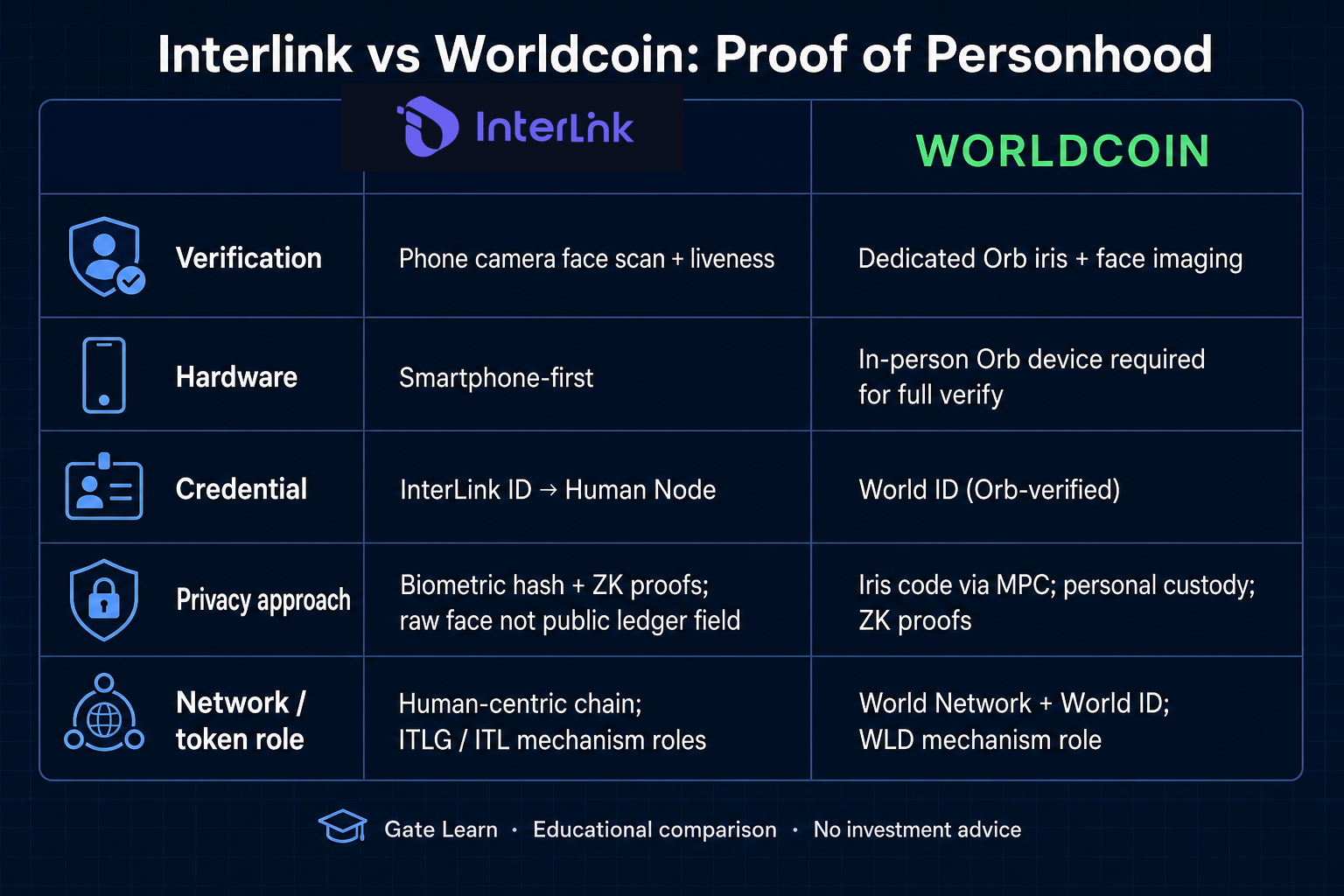
Figure 1. Multidimensional comparison of Interlink and Worldcoin across verification, hardware, credentials, privacy, and network or token roles.
What Is Interlink?
Interlink Network (InterLink) positions itself as a human-centric blockchain centered on proof of personhood. Users complete a face scan with liveness detection to generate an InterLink ID, use cryptographic hashes and zero-knowledge proofs for uniqueness checks, and become a Human Node. That node model raises Sybil costs and connects App, Chain, and mechanism-layer token roles. Public materials emphasize verifying a unique human rather than placing raw face images as public ledger fields.
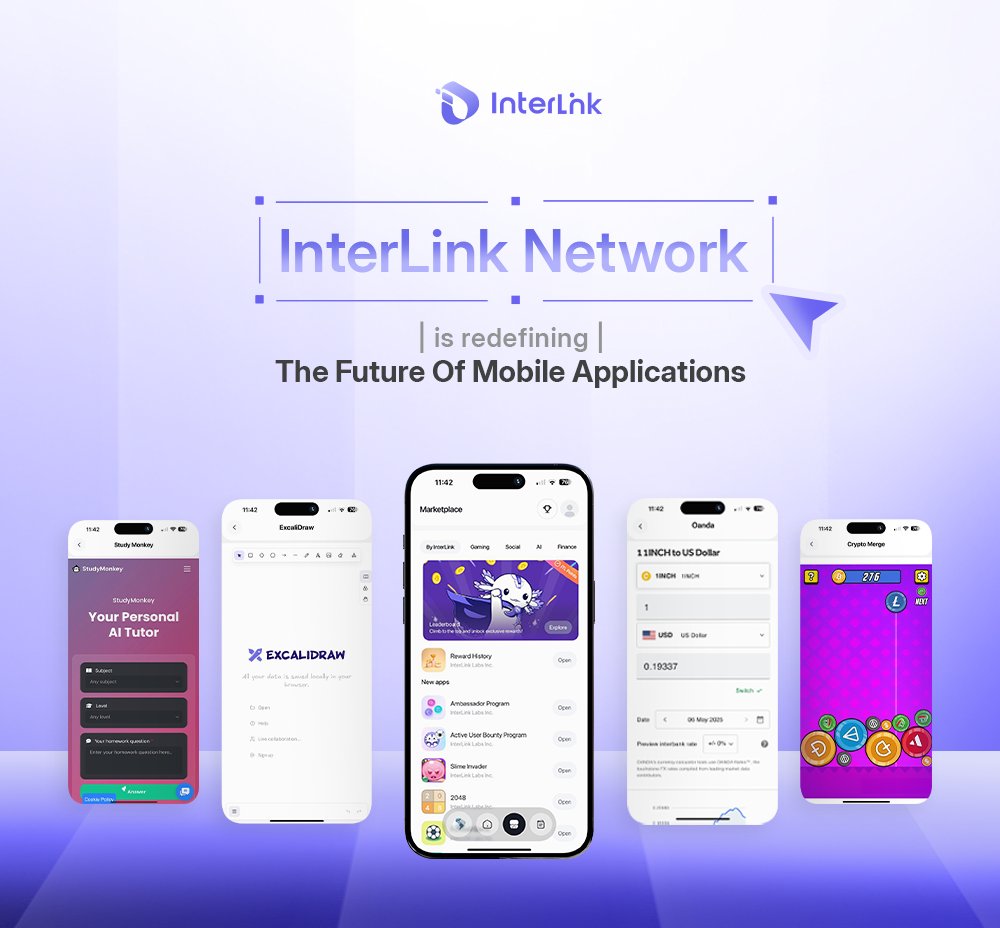
Relative to a “one wallet, one identity” model, Interlink writes the participation premise as “one person, one credential.” When reading the stack, keep InterLink ID, Human Node, and ITLG / ITL functional boundaries separate—face scan is an entry path, not the entire network definition.
For learners comparing Interlink vs Worldcoin, Interlink’s practical signature is reachability: a smartphone camera is the default sensor surface, and the credential feeds a Human Node participation narrative rather than only an app-facing anonymous proof.
What Is Worldcoin?
World (historically often called Worldcoin) provides “proof of personhood” for the internet: World ID lets applications verify that a holder is a unique human rather than a bot or a batch of fake accounts. In public descriptions, the full verification tier typically depends on a dedicated biometric device called the Orb, which captures iris and face imagery to confirm a live person and uniqueness before forming a credential reusable across apps.
On the use side, World ID stresses zero-knowledge proofs: third parties usually receive a proof of a valid World ID rather than iris images or a plaintext identity that is easy to track across applications. Orb, World App, World Network, and token mechanism roles are different components in one ecosystem—do not force-map them onto Interlink’s Human Node vocabulary. The Worldcoin Orb path is the high-assurance entry most people mean when they search “Worldcoin Orb” in a proof of personhood comparison.
World’s practical signature in an Interlink vs Worldcoin frame is hardware and modality: iris-centered uniqueness checks at Orb sites, personal custody packaging after capture, and World ID as a cross-app human verification layer. That is a different product shape from phone-first face liveness feeding a Human Node chain narrative.
How Do Verification Methods and Hardware Differ?
The core hardware difference is immediate: Interlink defaults to a smartphone camera; World’s Orb verification requires the user to visit a location with an Orb for iris and face imaging. Both use biometrics for deduplication, but “who holds the camera” and “can verification finish remotely” diverge.
Interlink’s path can be summarized as: on-device face scan → liveness / deepfake detection → irreversible biometric hash → uniqueness submission with zero-knowledge style proofs → InterLink ID issuance and Human Node status. The barrier skews toward “a phone with a camera.” Geographic reach depends on App and network availability rather than a dedicated imaging terminal fleet.
World’s Orb path can be summarized as: user arrives at an Orb → Orb captures iris and face → iris codes used for uniqueness checks (public materials describe MPC-style sharded processing) → image and related data packaged for personal custody on the user’s device, then deleted from the Orb → World ID moves to a verified state. Full Orb verification usually cannot be replaced by an ordinary phone camera alone.
| Dimension |
Interlink |
World / Worldcoin |
| Default sensor |
Phone camera (face) |
Orb (iris-primary, face also) |
| Dedicated hardware required? |
No (phone-first) |
Yes (for full Orb verification) |
| Geographic constraint |
Depends on App / network reach |
Depends on Orb deployment sites |
| Typical output |
InterLink ID / Human Node |
Orb-verified World ID |
Hardware differences propagate into reachability and threat models. Phone paths are easier to reach, so client integrity, camera permissions, and deepfake resistance become focal checks. Orb paths raise dedicated imaging and travel costs, and introduce terminal supply-chain and site-operation checks. Neither path should be described as absolutely unforgeable. For Sybil resistance design, the question is which barrier and residual risk profile match the application’s threat model—not which brand sounds stricter in marketing copy.
Human verification workflows also differ in failure modes. Phone liveness failures may stem from lighting, camera quality, or client compromise. Orb failures may stem from site availability, device downtime, or eligibility rules at a given location. Selection should include these operational constraints alongside the biometric modality itself.
How Do Privacy and Data Minimization Compare?
On privacy claims, Interlink and World both emphasize proving uniqueness while minimizing exposure of raw biometric data, and both use zero-knowledge proofs to reduce trackability on the application side. Differences sit mainly in capture modality, intermediate processing, and where data is custodied by default.
Interlink’s public path emphasizes converting a face into a hash or commitment after feature extraction, then proving uniqueness with zero-knowledge techniques, with the goal of avoiding replayable imagery as a public ledger field. Even so, camera permissions, client integrity, node or operations logs, and recovery flows can still introduce residual surfaces. “Raw face is not on-chain” is not the same as “zero residual data anywhere in the pipeline.”
World’s public path emphasizes sending a personal custody package to the user’s device after Orb capture, stating that images are not retained long-term on the Orb; uniqueness checks use anonymized iris-code sharding (MPC) and related mechanisms; and World ID use relies on zero-knowledge proofs to show “unique human” to third parties without defaulting to iris image handoff. Biometric regulations vary by jurisdiction—cross-border users should check local law and each product’s data-processing disclosures before enrollment.
If “privacy-friendly” is a selection criterion, separately verify capture modality, default custody location, whether a dedicated terminal is required, and whether revoke or recovery triggers re-capture. There is no single winner formula—only a path that matches the threat model. Biometric identity systems that publish strong privacy slogans still need the same operational checklist: what is collected, where it is processed, what is stored, and what a third party actually sees at verification time.
How Do Network Positioning and Token Roles Differ?
On network positioning, Interlink writes identity layer, InterLink App, InterLink Chain, and Human Node into one human-centric infrastructure narrative. World positions World ID as a reusable “proof of human” protocol layer that sits alongside World Network, World App, and related surfaces; the Orb is the high-assurance verification entrance, not the only component in the story.
Token roles here are mechanism-only—no prices, yields, or buy/sell framing. In Interlink’s public materials, ITLG (InterLink Genesis) sits closer to verified Human Node–side governance, ecosystem incentive coordination, and Mini-App utility; ITL sits closer to institutional or partner access to the Human Layer and related reserve coordination. In World’s ecosystem, WLD and related tokens appear in public narratives as network incentive and ecosystem coordination instruments. Exact allocations and unlocks follow each project’s public disclosures and do not constitute investment advice.
Credentials (InterLink ID / World ID) and tokens (ITLG·ITL / WLD) are different objects. Holding a token does not automatically complete personhood verification; completing personhood verification does not equal a promised return. In an Interlink vs Worldcoin comparison, keep Sybil resistance tooling and token mechanism roles in separate columns so selection criteria stay clear.
Application integration also follows network positioning. Teams evaluating Interlink Network often care whether Human Node credentials map into apps and chain participation rules. Teams evaluating World often care whether World ID is already integrated and whether the Orb-verified tier is required by the target application. Proof of personhood is an access-control and Sybil-cost tool, not a scorecard for which token to hold.
Which Should You Choose? Choose Interlink if / Choose World if
Match constraints—not brand heat.
Choose Interlink if:
- You need a smartphone-camera face and liveness path into a Human Node / InterLink ID participation model.
- Your review focus is “phone-reachable PoP plus human-centric chain / app layering,” and you accept client-side and camera-side risk surfaces.
- You need to separate ITLG / ITL mechanism roles rather than seeking Orb-level iris uniqueness tiers.
Choose World / Worldcoin if:
- You accept traveling to an Orb for full verification and need iris-modality uniqueness checks plus World ID to anonymously prove “unique human” to apps.
- Your review focus is Orb flow, personal custody packages, MPC deduplication, and zero-knowledge use paths.
- Target apps already integrate World ID, or the scenario explicitly requires an Orb-verified tier.
Neither side should be reduced to “the same face-scan product with different branding.” If the only goal is bot suppression, also check whether the application enforces PoP, whether credentials can be revoked, and risks from fake apps or fake Orb sites. Personhood proofs raise Sybil costs; they do not rate investment quality.
A practical decision sequence: (1) confirm whether phone capture is enough or Orb-tier assurance is required; (2) map privacy threat models to capture modality and custody defaults; (3) confirm whether the target app accepts InterLink ID / Human Node or World ID; (4) separate credential completion from any token mechanism narrative. That sequence keeps Interlink vs Worldcoin as a path comparison under proof of personhood, not a popularity contest.
Summary
The substantive Interlink vs Worldcoin difference is the proof of personhood implementation path: Interlink runs phone face plus liveness → InterLink ID / Human Node; World runs Orb iris and face imaging → World ID. On privacy, both emphasize data minimization and zero-knowledge proofs, but capture modality, hardware dependency, and custody models differ. On networks, Interlink maps to a human-centric layered stack while World maps to World ID / World Network narratives; tokens appear only as mechanism roles. Select by hardware reachability, privacy threat model, and application integration needs—not by price comparison or investment judgment.
FAQ
Are Interlink and Worldcoin the same project?
No. Interlink Network and World (historically often called Worldcoin) are different projects. Both sit in the proof of personhood category, but verification hardware, credential names, and network components are not the same. Interlink’s outputs are InterLink ID / Human Node; World’s output is World ID (full tier often depends on the Orb).
What is the main difference between Interlink and Worldcoin?
The main difference is verification method and hardware. Interlink uses a smartphone camera for face scanning and liveness detection; World’s high-assurance verification usually requires visiting an Orb to capture iris and face imagery. Credentials, privacy-processing details, and network or token mechanism roles differ accordingly—do not treat “both use biometrics” as proof that they are the same product.
Which proof of personhood approach is more privacy-focused?
There is no absolute answer. Interlink and World both publicly emphasize zero-knowledge proofs and data minimization: Interlink stresses biometric hashes or commitments without raw face as a public ledger field; World stresses post-Orb personal custody and iris-code MPC deduplication. Compare capture modality, custody location, and local compliance requirements—not slogans alone.
Does Worldcoin use an Orb?
Yes. Public materials describe the Orb as an on-site biometric device used to create or refresh high-assurance World ID: it captures iris and face imagery, completes live-person and uniqueness-related processing, then hands data packages to the user’s device under personal-custody style flows. Full Orb verification usually cannot be replaced by an ordinary phone camera alone.
How does Interlink verify a unique human?
A typical path is: on-device face scan → liveness / deepfake detection → irreversible biometric hash → uniqueness submission with zero-knowledge style proofs → InterLink ID issuance and Human Node status. Public narratives aim to verify a unique human without treating raw face images as public ledger fields. That human verification design supports Sybil resistance for participation models built around Human Nodes.
Is proof of personhood the same as KYC?
Not necessarily. Proof of personhood focuses on uniqueness—“one human, one credential”—often with privacy-preserving proofs to apps. KYC typically collects and verifies legal identity attributes for compliance. Some products may combine workflows, but Interlink vs Worldcoin comparisons should not collapse PoP uniqueness checks into full legal-identity disclosure by default.