Over the past few years, the way global investors participate in capital markets has changed significantly. From U.S. tech stocks and Hong Kong markets to South Korean semiconductors, new energy, and internet companies, more and more investors are exploring cross-market, multi-asset allocation opportunities.
At the same time, the link between digital assets and traditional financial markets is growing stronger. Previously, investing in overseas stocks meant opening a local securities account, handling cross-border remittances, and dealing with complex foreign exchange procedures. Today, global stock investing is becoming far more convenient and unified.
Against this backdrop, Gate Stocks is launching Korean stock trading services, expanding its global stock footprint. Users can now trade stocks listed on the Korea Exchange (KRX) directly with USDT—no need to open a traditional Korean brokerage account or exchange Korean Won. All Korean, U.S., and Hong Kong stock holdings can be managed within a single unified account.
So what exactly is the South Korean stock market? What makes KRX unique? How to trade Korean stocks through Gate? This article offers a comprehensive overview covering market structure, popular companies, trading rules, and the trading process.
What Are Korean Stocks and Why Is the Korean Market Gaining Attention?
Korean stocks generally refer to shares listed on the Korea Exchange (KRX). Although South Korea is geographically small, it holds a strategic position in the global supply chain. It boasts numerous internationally influential companies, particularly in semiconductors, consumer electronics, new energy vehicles, batteries, and internet services.
- Samsung Electronics and SK Hynix have long been leading global memory chip manufacturers.
- LG Chem and Samsung SDI are major forces in the new energy battery industry, while Hyundai Motor occupies a key position in the global automotive market.
- NAVER and Kakao form the backbone of South Korea's internet economy.
With rising demand for AI and advanced computing, global interest in chips, memory, and high-performance computing infrastructure continues to grow. The influence of South Korean semiconductor companies has accordingly expanded. Meanwhile, growth in new energy vehicles, battery supply chains, and internet services has kept the South Korean capital market firmly on the radar of international investors.
As a result, the South Korean stock market has become a vital lens through which many investors assess the health of Asian tech industries and global manufacturing.
What Is KRX?
KRX, or the Korea Exchange, is South Korea's sole securities exchange and a key capital market in Asia.
KRX operates two main stock markets: KOSPI, the main board, which hosts larger, more influential companies such as Samsung Electronics, SK Hynix, and Hyundai Motor; and KOSDAQ, a growth-oriented market with a higher concentration of internet, biopharma, and tech innovation companies. Beyond equities, KRX also runs derivatives and other financial product markets, serving as the core infrastructure of South Korea's capital market.
For everyday investors, the performance of KOSPI and KOSDAQ generally provides a reliable snapshot of both the Korean economy and its corporate landscape.
What Are Gate Korean Stocks and How to Trade Korean Stocks with USDT?
Gate Korean stocks are equity trading products under Gate Stocks, offering exposure to companies listed on the Korea Exchange (KRX). Compared with traditional overseas investment routes, Gate Korean stocks dramatically simplify access to the Korean market.
Users do not need to:
- Open a local South Korean securities account
- Process cross-border wire transfers
- Exchange Korean Won on their own
- Juggle stock accounts across multiple countries or regions
All you need is a Gate stock account and USDT. Moreover, Korean stocks share the same unified stock account as Gate's U.S. and Hong Kong stocks, enabling you to execute trades, manage positions, check assets, and review history—all in one place. This gives you true one-stop global stock portfolio management.
This unified account model reduces the operational friction of cross-market investing and makes global stock trading significantly more user-friendly.
Gate Stocks: From U.S. and Hong Kong Stocks to Korean Stocks
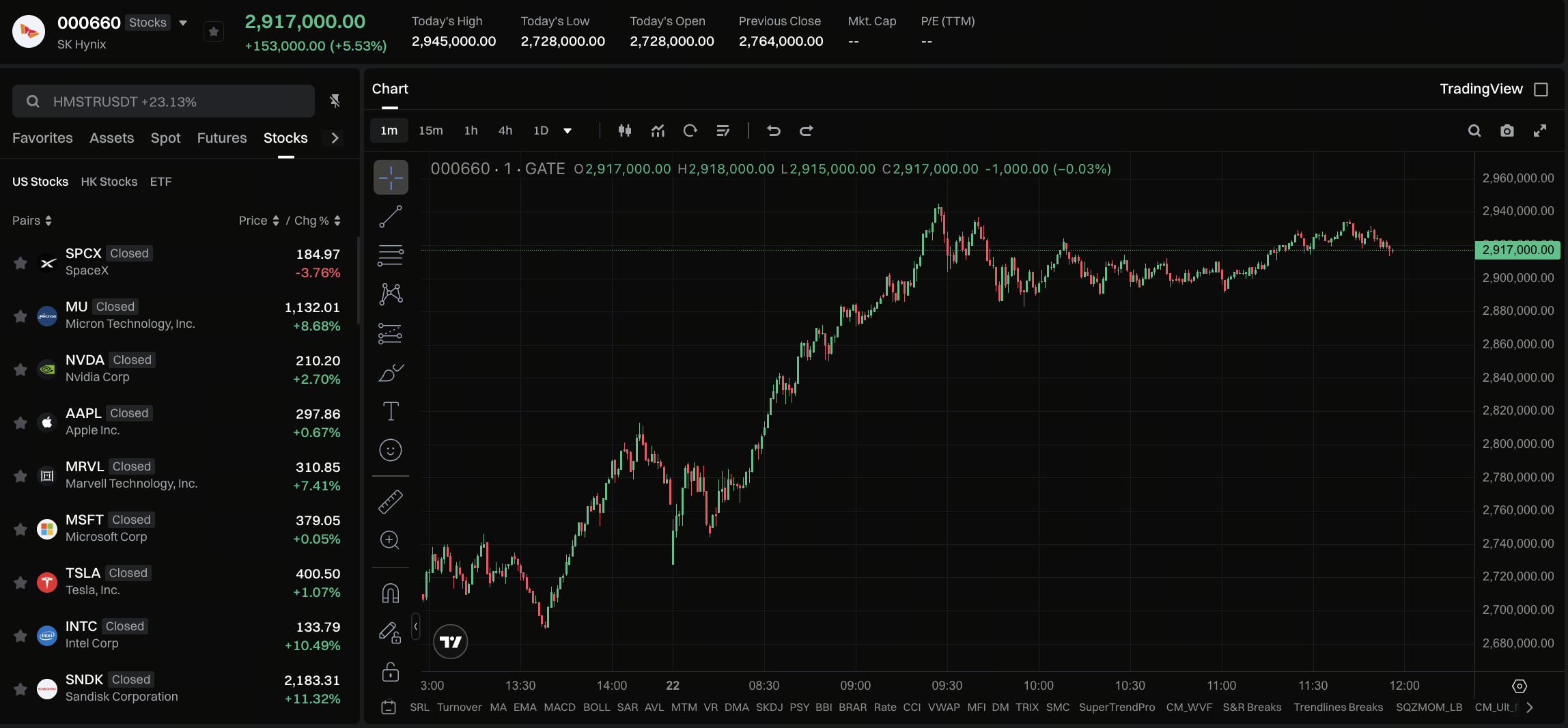
With the addition of Korean stocks, Gate Stocks has rounded out its global equities offering. The platform already supports U.S. stocks and ETFs, covering major U.S. securities exchanges and liquidity networks, as well as Hong Kong-listed equities.
Now, with Korean stocks in the mix, Gate Stocks provides a comprehensive global stock product suite spanning the U.S., Hong Kong, and South Korean markets. Using a single unified account, you can trade across all three markets with USDT, eliminating the need to switch account systems or manage complex inter-market fund transfers.
For investors looking to track global capital markets, this unified trading experience significantly boosts asset management efficiency.
Which Popular Stocks Does Gate Korean Stocks Support?
Gate Korean stocks focus on KRX-listed companies with large market caps and strong liquidity. The full list of tradable stocks is available on the platform page.
Based on the Korean market structure, the following names have long attracted investor attention:
| Stock Code |
Company Name |
Industry |
| 005930.KS |
Samsung Electronics |
Semiconductors |
| 000660.KS |
SK Hynix |
Semiconductors |
| 035420.KS |
NAVER |
Internet |
| 035720.KS |
Kakao |
Internet |
| 051910.KS |
LG Chem |
New Energy |
| 006400.KS |
Samsung SDI |
Batteries |
| 005380.KS |
Hyundai Motor |
Automobiles |
| 068270.KS |
Celltrion |
Biopharmaceuticals |
| 105560.KS |
KB Financial Group |
Financials |
| 066570.KS |
LG Electronics |
Consumer Electronics |
These companies span semiconductors, internet, new energy, biopharma, and consumer electronics—forming the core of South Korea's capital market.
What Are the Trading Hours for Korean Stocks?
The Korean stock market operates on a continuous auction mechanism. When trading Korean stocks through Gate, only regular session continuous auction is currently supported; pre-market and after-hours sessions are not available. Korea Time (UTC+9):
| Session |
Time |
Tradable |
| Continuous Auction |
09:00 – 15:20 |
Tradable |
| After Close |
After 15:20 |
Not tradeable |
During South Korean public holidays or unscheduled KRX closures, trading arrangements will follow both KRX and Gate platform announcements. Before trading Korean stocks, be sure to check market hours and holiday calendars carefully.
How Do Korean Stocks Differ from U.S. and Hong Kong Stocks?
On Gate, Korean, U.S., and Hong Kong stocks share a unified account system, but each market has distinct trading rules.
Trading Hours
U.S. stocks offer pre-market, regular, and after-hours trading, while Korean stocks currently support only regular session continuous auction.
Quote Currency
Korean stocks are denominated in Korean Won (KRW). Therefore, stock prices, position values, and P&L are all displayed in KRW.
You can still fund trades and transfer USDT seamlessly. Trading fees and settlement are converted to USDT at the prevailing exchange rate. In terms of account structure, transaction records, position management, and asset inquiries, Korean stocks are fully aligned with U.S. and Hong Kong stocks, giving you a consistent experience across markets.
How to Start Trading Korean Stocks?
If you already have a Gate account, trading Korean stocks is straightforward.
Step 1: Navigate to the Gate Stocks page.
- Web: Stocks > Korean Stocks
- App: TradFi > Stocks > Quotes > Korean Stocks (requires version 8.25.0 or later)
You can enter the stock market via the TradFi section or the search bar, then select Korean stocks and search for your desired target.
Step 2: Transfer USDT to your stock account.
Transfer USDT from your Spot Account or Unified Account to your stock account as trading capital. No need to exchange Korean Won.
Step 3: Place an order during trading hours.
Korean stocks support continuous auction trading from 09:00 to 15:20 Korea Time. Choose your target stock and submit a buy or sell order.
Once the order is filled, you can view your position details, including size, average cost, real-time P&L, and transaction history. The entire process requires no complex cross-market fund management. You can handle all transfers, trades, and position tracking within the unified stock account, making participation in the South Korean stock market easier than ever.
What Risks Should You Consider When Trading Korean Stocks?
Despite the many well-known names in the Korean market, investors should remain mindful of the following risks:
- Stock prices are subject to fluctuations driven by economic conditions, industry cycles, corporate performance, and market sentiment.
- Since Korean stocks are priced in KRW, changes in the KRW/USDT exchange rate may affect settlement amounts and overall returns.
- Korean stocks are currently only tradeable during regular continuous auction hours. Be aware of Korean market trading hours and holiday schedules to avoid missing trading windows.
Before entering the South Korean stock market, take time to understand the local rules and risk factors. A clear grasp of these elements will help you approach overseas stock investing more rationally.
Conclusion
As global capital markets evolve, the ways investors access overseas stock markets are transforming. South Korea, with its strengths in semiconductors, new energy, internet, and consumer electronics, continues to attract worldwide attention. At the same time, the convergence of digital assets and traditional finance is making global stock investing increasingly accessible. Through Gate Korean stocks, you can use USDT to trade KRX-listed equities, manage U.S., Hong Kong, and Korean stock assets within a single account, and engage with the South Korean capital market more efficiently.
Whether you're tracking the growth of Korean tech industries or studying structural shifts in Asian capital markets, getting to know KRX and Korean stock trading rules is a key step toward understanding the global equity landscape.
FAQs
Q1: What Are Gate Korean Stocks?
Gate Korean stocks are Korean equity trading products offered by Gate Stocks, targeting securities listed on the Korea Exchange (KRX). Trades are executed through your Gate stock account.
Q2: Do I Need to Open a South Korean Securities Account to Trade Korean Stocks?
No. You do not need to open a local Korean brokerage account or exchange Korean Won. Simply use your Gate stock account to participate.
Q3: Which Stocks Does Gate Korean Stocks Support?
The service covers KRX-listed companies with larger market capitalizations and higher liquidity. Refer to the Gate platform page for the most up-to-date list.
Q4: What Are the Trading Hours for Korean Stocks?
Korean stocks trade via continuous auction from 09:00 to 15:20 Korea Time (UTC+9). Pre-market and after-hours sessions are not currently available.
Q5: Why Are Stock Prices Shown in KRW While I Use USDT?
Because Korean stocks are denominated in KRW, prices, position values, and P&L are displayed in KRW. Fees and settlement are converted to USDT based on real-time exchange rates.
Q6: Do I Need Separate Accounts for Korean, U.S., and Hong Kong Stocks?
No. Korean, U.S., and Hong Kong stocks all share the same Gate stock account, allowing you to manage assets across different markets seamlessly.