O treino de grandes modelos de IA requer não só poder de computação das GPU, mas também capacidades maciças de troca de dados a alta velocidade. Se as GPU não conseguirem aceder continuamente aos dados de treino, a eficiência global do sistema de IA cai drasticamente. É por isso que a memória de alto desempenho tornou-se uma infraestrutura essencial na cadeia de fornecimento de IA.
À medida que os centros de dados de IA continuam a escalar, a procura por HBM, DRAM de servidor e SSD empresariais está a aumentar. A Micron é, portanto, mais do que uma empresa tradicional de chips de memória — é um interveniente fundamental na infraestrutura de IA.
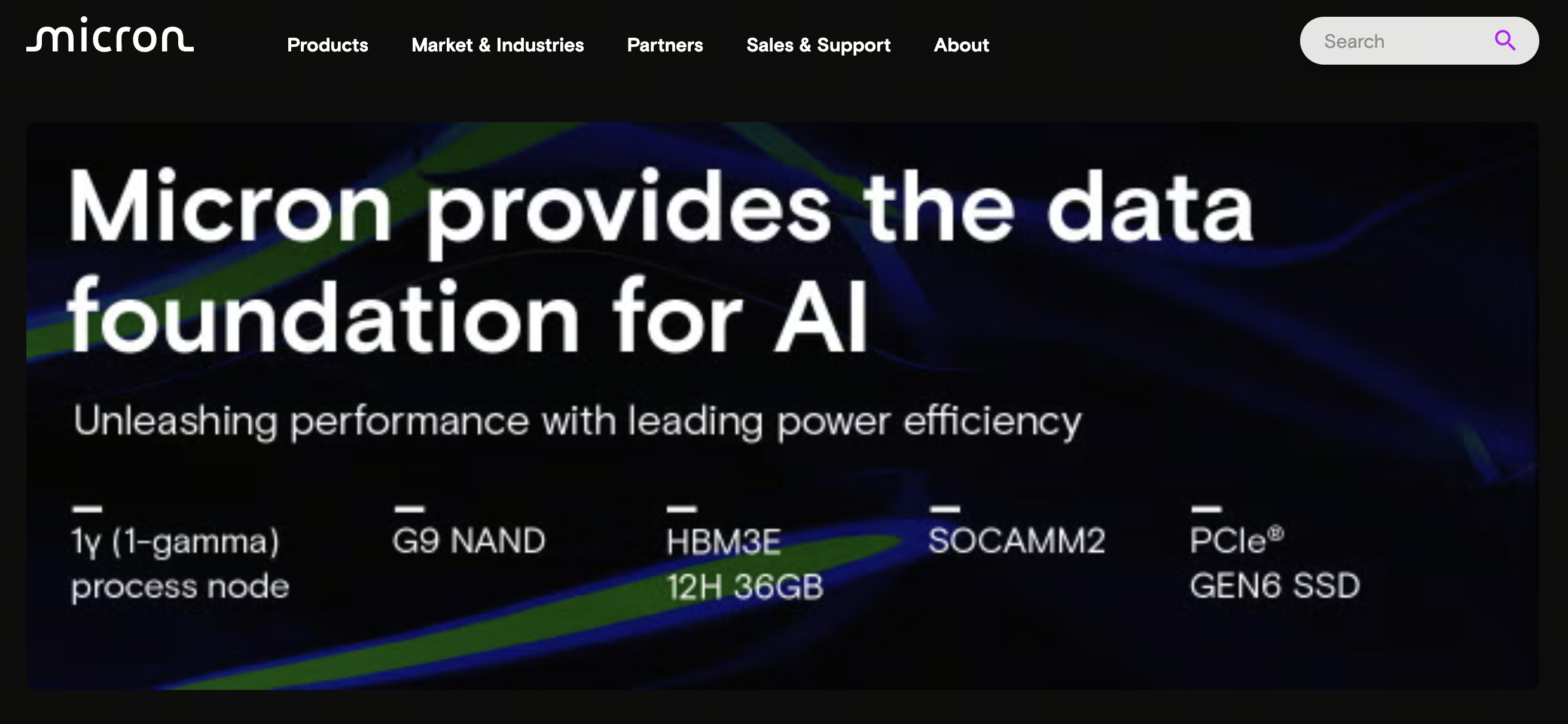
Fonte: micron.com
O papel da Micron no ecossistema de IA
A missão principal da Micron no ecossistema de IA é permitir a transferência e armazenamento de dados a alta velocidade para sistemas de IA. Enquanto as GPU de IA tratam da computação, a DRAM, a HBM e os SSD empresariais gerem o armazenamento em cache, a recuperação e a retenção a longo prazo dos dados. Todo o sistema de IA depende de uma interação perfeita entre computação e armazenamento.
Do ponto de vista do setor, a infraestrutura de IA compreende tipicamente GPU, CPU, redes, servidores e armazenamento. Empresas como a NVIDIA focam-se na computação em GPU, enquanto a Micron especializa-se em memória de alto desempenho e eficiência no fluxo de dados.
Durante o treino, as GPU acedem constantemente a enormes volumes de parâmetros e dados. Se a recuperação de dados for demasiado lenta, mesmo as GPU mais potentes não conseguem manter um alto débito. É por isso que o mercado de IA está a registar uma procura explosiva por HBM e DRAM de servidor.
Em suma, a expansão da infraestrutura de IA impulsiona o crescimento não só das GPU, mas também do armazenamento de alto desempenho.
Porque é que o treino de IA requer memória de alta largura de banda
O treino de modelos de IA exige um enorme débito de dados, tornando os sistemas de armazenamento tradicionais inadequados para cargas de trabalho de grande escala. Em particular, o treino de modelos de linguagem de grande dimensão (LLM) requer que as GPU leiam simultaneamente enormes quantidades de parâmetros, pesos e dados de treino.
Embora a DRAM convencional ofereça cache rápida, as GPU de IA requerem uma largura de banda muito superior à das tarefas de computação típicas. Quando as GPU não conseguem obter dados com rapidez suficiente, os recursos de computação ficam ociosos e a eficiência do treino diminui.
A HBM foi concebida especificamente para colmatar esta lacuna, oferecendo uma largura de banda superior e uma latência mais baixa do que a DRAM padrão. Isto torna a HBM ideal para centros de dados de IA e sistemas de computação de alto desempenho (HPC).
A conclusão: a era da IA exige não só melhores GPU, mas também redes de transferência de dados mais rápidas. A memória de alto desempenho tornou-se, portanto, uma pedra angular da infraestrutura moderna de IA.
Como a HBM se integra nos sistemas de chips de IA
A HBM funciona em estreita coordenação com as GPU de IA. Ao contrário dos módulos de memória tradicionais, instalados separadamente, a HBM enfatiza a integração próxima e as ligações de dados de alta velocidade.
O processo funciona da seguinte forma: primeiro, a GPU trata das tarefas de computação de IA. Em seguida, a HBM fornece rapidamente os dados de treino e a cache de parâmetros. Uma interligação de alta velocidade garante uma troca de dados de baixa latência entre a GPU e a HBM. Isto permite que o sistema de IA mantenha um treino eficiente de modelos de grande escala.
Estruturalmente, a HBM é tipicamente co-empacotada com GPU recorrendo a tecnologias de empacotamento avançadas. Isto minimiza a distância de percurso dos dados, reduzindo tanto a latência como o consumo de energia.
A tabela abaixo mostra a colaboração entre GPU de IA e HBM:
| Módulo |
Função principal |
| GPU |
Computação de IA |
| HBM |
Troca de dados a alta velocidade |
| DRAM |
Cache do sistema |
| SSD |
Armazenamento de dados a longo prazo |
Esta arquitetura significa que o desempenho dos chips de IA depende não só da GPU, mas também da largura de banda da HBM.
Como a Micron alimenta GPU e centros de dados
A Micron suporta GPU de IA e centros de dados através de HBM, DRAM de servidor e SSD empresariais. Em comparação com a eletrónica de consumo, os centros de dados de IA exigem maior estabilidade, largura de banda e tempo de atividade contínuo.
Durante o funcionamento dos servidores de IA, as GPU acedem constantemente a grandes volumes de dados de treino. Os dados são primeiro armazenados em cache na DRAM, depois a HBM permite a troca de dados de alta velocidade com a GPU. Finalmente, os SSD empresariais tratam do armazenamento a longo prazo e da gestão de bases de dados.
Isto significa que os centros de dados de IA requerem uma arquitetura de armazenamento de vários níveis. Sem memória de alta velocidade, mesmo as melhores GPU verão a sua eficiência de treino significativamente reduzida.
À medida que os modelos de IA crescem, a procura por HBM e DRAM de servidor por centro de dados continua a aumentar.
Porque é que os servidores de IA dependem de armazenamento de alto desempenho
Os servidores de IA necessitam de armazenamento de alto desempenho principalmente porque processam conjuntos de dados massivos. Em comparação com os servidores empresariais tradicionais, os sistemas de IA têm de lidar com muito mais parâmetros, pesos de modelo e dados de treino.
O fluxo de trabalho é simples: o treino de modelos de IA lê continuamente dados massivos. As GPU tratam da computação, enquanto a DRAM e a HBM fornecem cache de alta velocidade e transferência de dados. Se o armazenamento não conseguir acompanhar a velocidade da GPU, a eficiência do treino é prejudicada.
Além disso, o treino de modelos de grande escala é frequentemente executado continuamente durante longos períodos. Os sistemas de armazenamento devem, portanto, oferecer não só velocidade, mas também estabilidade e capacidade de carga sustentada.
Em suma, a competição na infraestrutura de IA não é apenas sobre GPU — é igualmente sobre sistemas de memória e armazenamento de alto desempenho.
Como a expansão da infraestrutura de IA impacta a Micron
A expansão da infraestrutura de IA está a alimentar um crescimento rápido no negócio de memória de alto desempenho da Micron. Em particular, a procura dos centros de dados de IA está a tornar-se um motor chave para os mercados de HBM e DRAM de servidor.
Os mercados tradicionais de eletrónica de consumo são cíclicos, ligados a smartphones e PCs. Em contraste, os centros de dados de IA focam-se na expansão da computação a longo prazo e na construção de servidores empresariais, criando um perfil de procura fundamentalmente diferente.
À medida que as remessas de GPU de IA aumentam, a procura por HBM cresce em sincronia. As GPU precisam de grandes quantidades de memória de alta largura de banda, e o desempenho dos chips de IA está estreitamente ligado à eficiência da troca de dados da HBM.
Ao mesmo tempo, os fornecedores de cloud e as grandes empresas tecnológicas estão continuamente a construir centros de dados de IA, impulsionando ainda mais a procura por DRAM de servidor e SSD empresariais.
Onde são utilizados os produtos de armazenamento de IA da Micron?
Os produtos de armazenamento de IA da Micron são principalmente implantados em centros de dados de IA, computação em cloud, servidores de alto desempenho e treino de modelos de grande escala. À medida que os sistemas de IA escalam, a memória de alto desempenho tornou-se um componente crítico da infraestrutura moderna de IA.
Os centros de dados de IA são o principal caso de uso para HBM e DRAM de servidor. Durante o treino, as GPU leem constantemente dados massivos, pelo que a velocidade da memória afeta diretamente a eficiência do treino.
As plataformas de cloud também dependem fortemente de SSD empresariais e armazenamento de servidor. As grandes plataformas de IA precisam não só de treino de modelos, mas também de retenção de dados a longo prazo e suporte de inferência online.
Além disso, mercados como a condução autónoma, a IA de borda e a HPC estão a aumentar a sua procura por armazenamento de alto desempenho. As exigências dos sistemas de IA modernos em termos de largura de banda de dados e capacidade de armazenamento estão apenas a aumentar.
Resumo
O papel principal da Micron (MU) no ecossistema de IA é fornecer memória e armazenamento de alto desempenho para GPU, centros de dados e servidores de IA. A HBM, a DRAM e os SSD empresariais tornaram-se, assim, infraestruturas essenciais de IA.
O treino de grandes modelos de IA depende não só da computação das GPU, mas também da transferência de dados a alta velocidade. A HBM ajuda as GPU a melhorar o débito de dados, impulsionando o crescimento rápido da procura do mercado de IA por memória de alto desempenho.
À medida que os centros de dados de IA continuam a expandir-se, os fabricantes de chips de memória como a Micron estão a tornar-se cada vez mais vitais para a infraestrutura de IA.
Perguntas Frequentes
O que é a memória de alta largura de banda HBM?
A HBM é uma tecnologia de memória de alto desempenho concebida para GPU de IA e sistemas HPC, oferecendo maior largura de banda e menor latência do que a memória convencional.
Porque é que a Micron está envolvida no ecossistema de IA?
A Micron fornece DRAM, HBM e SSD empresariais, tornando-se um fornecedor chave de armazenamento para centros de dados de IA e sistemas GPU.
Porque é que as GPU de IA precisam de HBM?
As GPU de IA precisam de ler grandes quantidades de dados continuamente durante o treino. A HBM aumenta a velocidade de troca de dados, melhorando a eficiência do treino.
Qual é a relação entre a Micron e a NVIDIA?
A NVIDIA fornece poder de computação gráfica para IA, enquanto a Micron fornece HBM e memória de servidor. Juntas, formam uma parte crítica da infraestrutura de IA.
Porque é que os centros de dados de IA precisam de armazenamento de alto desempenho?
Os centros de dados de IA processam parâmetros de modelos massivos e dados de treino, necessitando de DRAM rápida, HBM e SSD empresariais para uma troca de dados eficiente e armazenamento a longo prazo.