Tokenization of Real-World Assets (RWA) goes beyond simply mapping traditional assets to blockchain—it digitizes the entire asset lifecycle. From investor onboarding and asset issuance to income distribution and redemption, every step must balance blockchain efficiency with traditional financial regulatory requirements. As a result, the operational process of institutional-grade RWA products is typically more complex than that of ordinary crypto assets.
As BlackRock's tokenized money market fund, BUIDL demonstrates how institutional financial products can achieve digital operations via blockchain. Built on the digital securities infrastructure provided by Securitize, BUIDL retains the investment logic of a traditional fund while using on-chain tokens to register and manage fund shares, making it an important case study in institutional on-chain finance.
How Does BUIDL Operate?
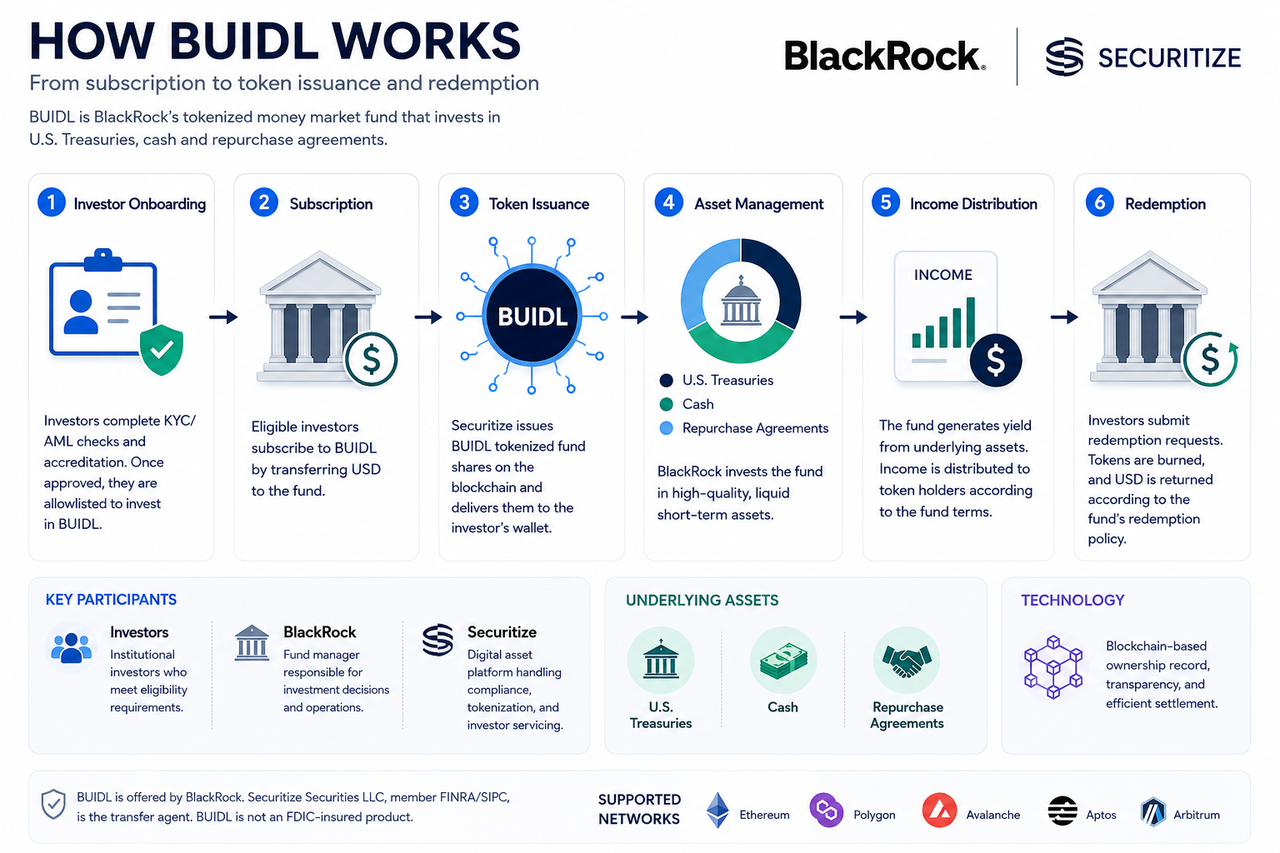
BUIDL is essentially a money market fund invested in U.S. short-term Treasury bills, cash, and repurchase agreements. The key difference from a traditional fund is that fund shares are not recorded in a traditional securities registration system but are managed as blockchain-based digital tokens.
The full lifecycle still follows the traditional fund management model—capital raising, asset investment, net asset value (NAV) calculation, income distribution, and investor redemption—with blockchain technology applied only to share registration, position management, and certain operational processes.
Step 1: Investor Eligibility Verification
Since BUIDL is a regulated securities product, not every user can purchase it directly.
Investors must first pass the identity verification system provided by Securitize, which includes:
- KYC (Know Your Customer)
- AML (Anti-Money Laundering screening)
- Accredited investor verification
- Legal and jurisdictional eligibility checks
After passing verification, investors are placed on the fund's whitelist and become eligible to subscribe.
| Process |
Key Content |
| Identity Verification |
Submit KYC information |
| Compliance Screening |
AML and sanctions list checks |
| Investor Verification |
Confirm accredited investor status |
| Whitelist Management |
Grant fund participation rights |
This process ensures the fund complies with securities regulations and that on-chain assets are held only by eligible investors.
Step 2: Fund Subscription and Capital Entry
Once eligibility is confirmed, investors can submit a subscription request to the fund.
Investment capital is credited to BUIDL's fund account according to the fund's rules. BlackRock then allocates the capital to underlying assets based on the fund's investment strategy, including U.S. Treasuries, cash, and short-term repurchase agreements.
This phase is essentially the same as a traditional money market fund. Blockchain does not directly participate in asset investment; instead, it handles the subsequent digital management of fund shares.
After the capital is confirmed, the fund calculates the corresponding number of fund shares in preparation for digital token issuance.
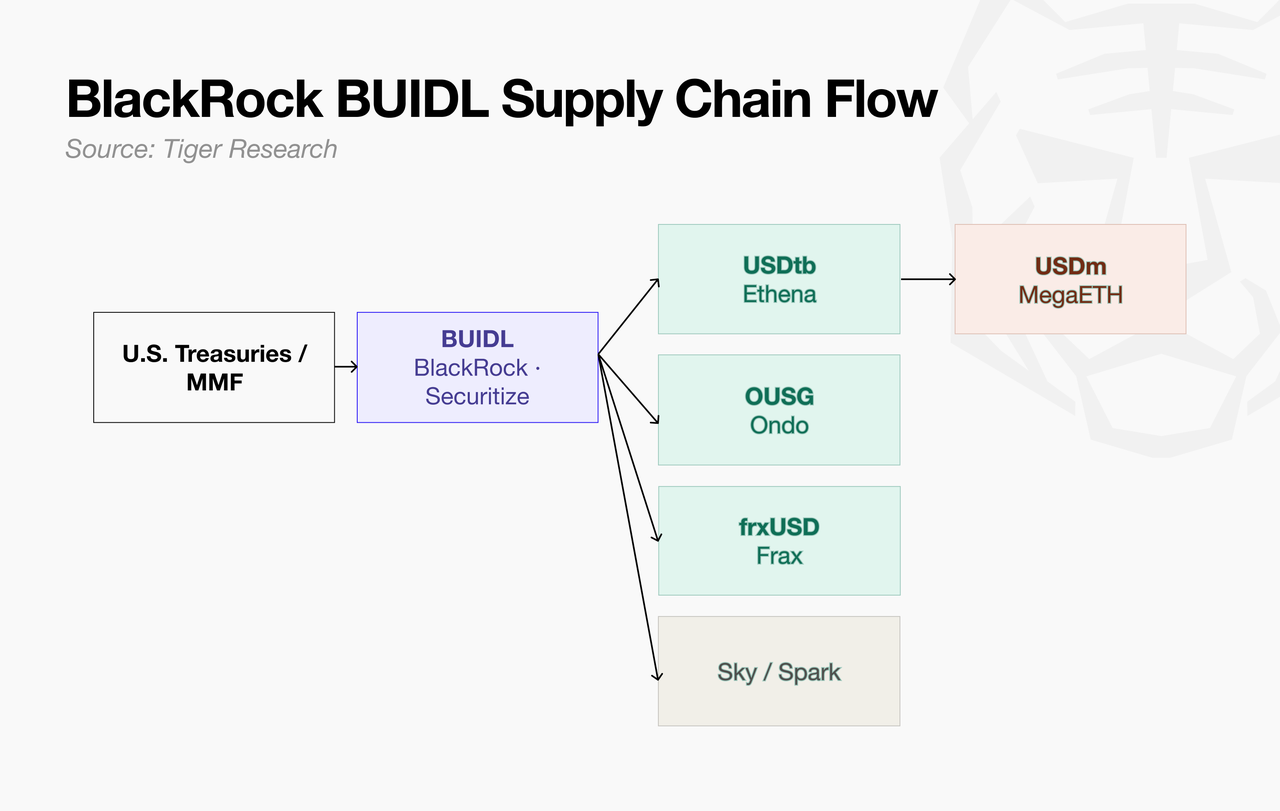
Step 3: On-Chain Issuance of Digital Fund Shares
After subscription confirmation, Securitize issues the corresponding number of digital fund shares (tokenized fund shares) on the blockchain network based on the investment amount.
These digital tokens represent fund equity, not an independent cryptocurrency.
Each token corresponds to a proportional share of the fund's assets; holding the token gives the investor ownership of the corresponding fund share.
The process can be summarized as follows:
| Phase |
On-Chain Change |
| Capital Confirmation |
Fund receives investment capital |
| Share Calculation |
Calculate fund shares based on NAV |
| Token Minting |
Issue corresponding tokens on-chain |
| Wallet Allocation |
Investor receives digital fund shares |
By using blockchain registration, changes in fund share ownership can be recorded more transparently, while reducing the manual costs associated with traditional securities registration.
Step 4: Ongoing Fund Asset Operations
After investment, BlackRock manages the asset portfolio according to the money market fund strategy.
The fund primarily holds:
- U.S. short-term Treasury bills
- Cash
- Repurchase agreements (Repo)
These assets continuously generate interest income, forming the fund's returns.
Meanwhile, Securitize maintains the digital securities register, manages investor accounts, controls permissions, and provides fund administration services, ensuring that on-chain fund shares always remain aligned with the underlying real-world fund assets.
The number of tokens in an investor's wallet typically stays unchanged, but the fund's NAV and cumulative returns are updated continuously.
Step 5: How Are Returns Distributed?
BUIDL's returns come from interest generated by the underlying assets, not from on-chain protocol rewards.
The fund manager calculates the daily NAV according to the fund's operating rules and distributes returns to investors based on the fund's performance.
The distribution process still follows traditional fund management practices, but because investor equity records have been digitized, share confirmation and return calculation can be handled more efficiently.
This marks a key distinction between BUIDL and DeFi yield protocols: BUIDL's returns come from real-world financial assets, not from on-chain lending, staking, or liquidity mining.
Step 6: Investor Redemption
When an investor needs to exit the fund, they can submit a redemption request in accordance with the fund's rules.
The redemption process typically includes:
- Submit a redemption request;
- Fund confirms the shares to be redeemed;
- On-chain digital fund shares are burned;
- Fund pays the corresponding cash amount.
The entire process remains subject to fund management rules and securities regulatory requirements, and does not allow the same free circulation as ordinary crypto assets.
After the digital tokens are burned, the corresponding fund equity is reduced accordingly, ensuring that the number of on-chain shares always aligns with the fund's actual assets.
BUIDL's Full Lifecycle
Overall, BUIDL combines traditional fund operations with blockchain technology.
| Lifecycle Stage |
Responsible Entity |
Key Activities |
| Investor Onboarding |
Securitize |
KYC, AML, investor verification |
| Fund Subscription |
BlackRock |
Receive capital, confirm shares |
| Token Issuance |
Securitize |
Issue fund shares on-chain |
| Fund Management |
BlackRock |
Invest in U.S. Treasuries and cash assets |
| Returns Management |
BlackRock + Securitize |
NAV update, return distribution |
| Fund Redemption |
Both parties collaborate |
Token burn, capital return |
This model preserves the mature risk management framework of traditional funds while leveraging blockchain to improve asset registration and operational efficiency, providing a replicable reference framework for future tokenization of more real-world assets.
Summary
BUIDL's operational process illustrates the direction of real-world asset tokenization. After completing identity verification through Securitize, investors can subscribe to a money market fund managed by BlackRock and receive on-chain digital fund shares. The fund continues to invest in U.S. Treasuries, cash, and repurchase agreements in the traditional manner, while blockchain handles fund share registration, investor management, and digital operations. When an investor requests redemption, the on-chain tokens are burned, and the corresponding capital is returned according to fund rules. The entire workflow demonstrates how traditional financial products can leverage blockchain to achieve more efficient and transparent asset management.
FAQs
What do BUIDL tokens represent?
BUIDL tokens represent the fund shares held by investors. Each token corresponds to a proportional share of fund equity, not an independent cryptocurrency.
How does BUIDL complete on-chain issuance?
After investors complete their subscription, Securitize issues the corresponding number of digital fund shares on the blockchain based on the share amount confirmed by the fund, and distributes them to investors' wallets.
Where do BUIDL's returns come from?
BUIDL's returns come primarily from interest income generated by underlying assets such as U.S. short-term Treasury bills, cash, and repurchase agreements, not from blockchain protocols or crypto asset price fluctuations.
Can BUIDL be freely traded?
BUIDL is a regulated digital securities product. On-chain transfers typically require satisfying investor eligibility verification and relevant regulatory requirements, so it does not allow the free circulation of ordinary cryptocurrencies.
What is the biggest difference between BUIDL and a traditional money market fund?
Both invest in low-risk cash management assets, but BUIDL digitizes fund shares and uses blockchain for share registration, investor management, and certain operational processes, thereby improving asset management efficiency and transparency.