gStocks, Ondo Stocks, and xStocks are three tokenized stock product lines under Gate TokenStocks. gStocks emphasizes Gate-native 1:1 fully backed stock reserves; Ondo uses a Total-Return Tracker for whole-economic exposure; xStocks are Backed Finance on-chain securities. All three usually track underlying U.S. equity prices, but issuer, backing or tracking design, ticker suffix, and Gate filter path differ. Start by aligning mechanism and suffix—not by ranking a single “best” line.
For a sector overview of definitions, shared risks, and entry points, see the TokenStocks section. The sections below focus on structural differences among gStocks, Ondo, and xStocks and how to match a line to trading conditions. Per Gate Help Center guidance, tokenized stocks generally are not direct equity shares and typically carry no shareholder voting rights or cash dividends paid to holders.
| Feature |
gStocks |
Ondo Stocks |
xStocks |
| Issuer / operator |
Gate native tokenized securities |
Ondo Global Markets |
Backed Finance issuance stack |
| Mechanism |
1:1 fully backed native stock reserves |
Total-Return Tracker |
On-chain tokenized securities |
| Typical ticker cue |
G suffix (e.g., AAPLG) |
ON suffix (e.g., SPYON) |
x suffix (e.g., SPYx) |
| Common Gate entry |
TokenStocks filter · gStocks |
TokenStocks filter · Ondo |
TokenStocks filter · xStocks |
| Cash dividend / voting |
Usually none |
Usually none |
Usually none |
The table is a quick three-way map, not a substitute for per-instrument checks. Before any order, confirm ticker suffix, full instrument name, and issuer disclosures on the product page—suffix confusion is a frequent operational error.
What Are gStocks, Ondo Stocks, and xStocks?
gStocks is Gate's own tokenized securities line, built around 1:1 fully backed native stock reserves with tickers commonly ending in G. gStocks tokenized securities focus on that reserve structure and trading rules.

Ondo Stocks come from Ondo Global Markets and use a Total-Return Tracker: dividends and interest on the underlying may be reinvested after tax at the mechanism layer so token value tracks whole economic return rather than paying cash to holders; tickers commonly end in ON. The Ondo tokenized stocks section lists common ON instruments and the dedicated browse path.
xStocks are issued under the Backed Finance stack as on-chain tokenized securities; tickers commonly end in x. The xStocks on-chain equity network explains how assets map on-chain.
The split is "who issues, how price is anchored or tracked, which Gate entry to use, and how tickers are labeled"—all three offer on-chain price-tracking exposure to U.S. equities on Gate, not registered brokerage shares.
gStocks vs Ondo vs xStocks: Core Comparison Dimensions
Side-by-side review should cover five dimensions: issuer identity, reserve or tracking mechanism, ticker identification, Gate trading entry, and rights or return design. gStocks anchors through fully backed stock reserves; 1:1 backing and conversion explains how shares map to tokens. Ondo emphasizes Total-Return Tracker reinvestment paths; xStocks rely on Backed issuer mechanics and market quotes.
During regular U.S. equity hours (09:30–16:00 ET), underlying liquidity is typically higher and price updates for all three lines are more active. Pre-market, after-hours, and holiday sessions still allow 24/7 on-chain trading, but peg deviation and bid-ask spread risk may rise—a pattern that applies equally across gStocks, Ondo, and xStocks.
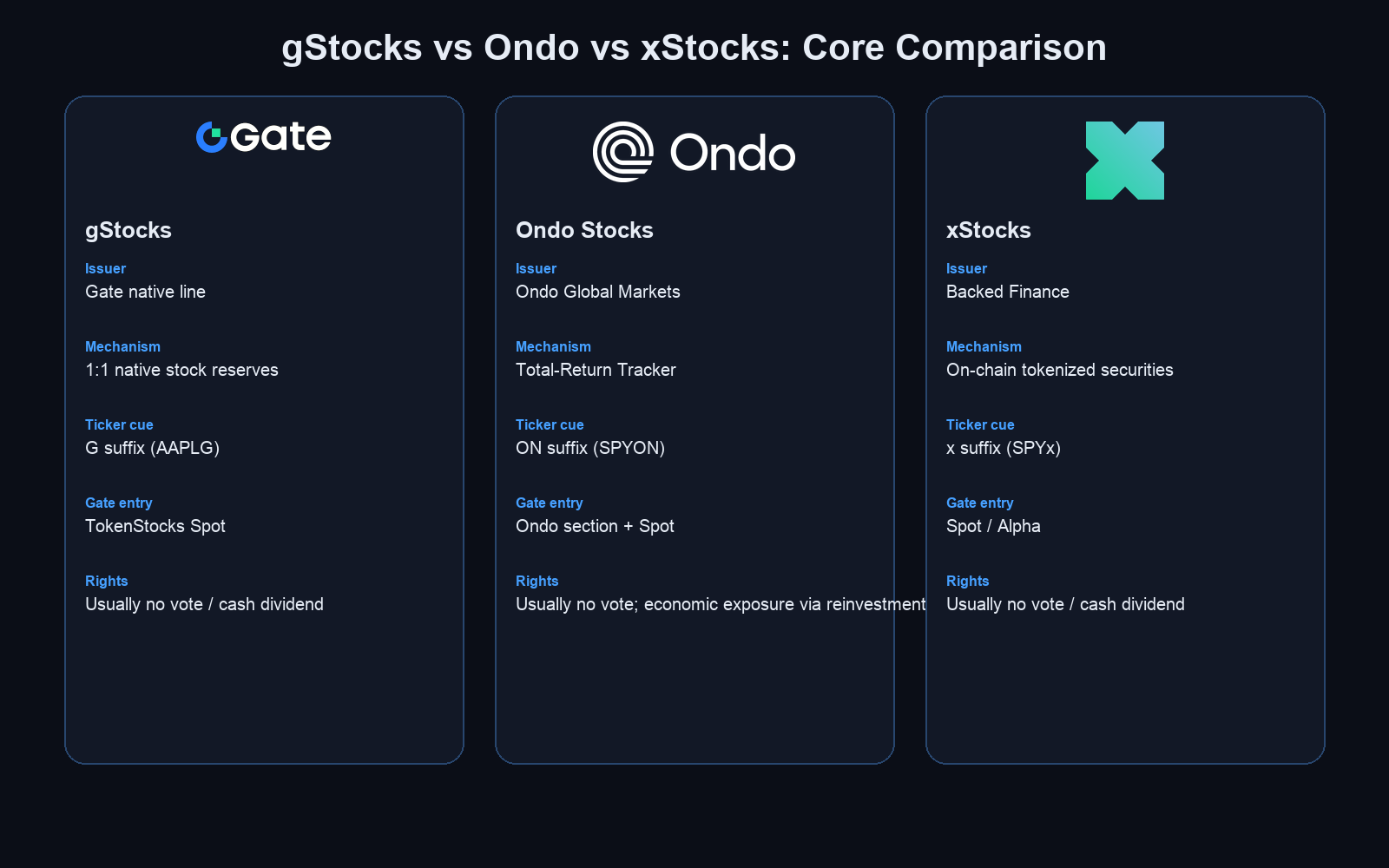
Figure 1. Core comparison of gStocks, Ondo Stocks, and xStocks across issuer, backing mechanism, ticker suffix, and Gate entry.
How Do Issuer and Backing or Tracking Mechanisms Differ?
For gStocks, users should verify reserve scale, conversion rules, and disclosure updates—and distinguish "published reserve backing" from "price equals the live stock at every moment," which still depends on liquidity and session timing. For Ondo, read Tracker documentation to see how reinvestment enters token value rather than assuming cash dividends hit the wallet. For xStocks, cross-check Backed / xStocks disclosures with Gate page fields for corporate-action handling.
If an issuer faces insolvency, default, or liquidity stress, tokens may de-peg or thin out. Gate Help Center FAQs note that the platform publishes updates after issuer notices but does not remove underlying counterparty risk.
| Dimension |
gStocks |
Ondo Stocks |
xStocks |
| Price link |
Native stock reserve backing |
Tracker + reinvestment path |
Issuer on-chain + market quote |
| Key doc to read |
Reserve and conversion rules |
Total-Return Tracker terms |
Backed issuance and corporate actions |
| Common misread |
Backing = zero deviation anytime |
Reinvestment = cash dividend |
On-chain tradable = direct share ownership |
Each row highlights a different failure mode in due diligence, not a quality ranking.
How Do Trading Paths and Use Conditions Differ?
gStocks: Open the TokenStocks market list (or App Spot → TokenStocks), filter gStocks, and search by G suffix. Fits users who want Gate's native reserve line and standard spot ticker checks on TokenStocks.
Ondo Stocks: Filter Ondo inside TokenStocks or search ON suffix. Fits users who want Total-Return Tracker exposure and ON suffix verification; mechanism explainers remain in the Ondo tokenized stocks section.
xStocks: Filter xStocks inside TokenStocks or search x suffix. Fits users who need Backed on-chain securities paths and can verify spot fields before ordering.
For USDT funding, ticker search, and order-field checks, follow the USDT spot order steps. Whichever line is chosen, confirm suffix, full name, USDT balance, and displayed fees before submitting.
How Should Dividends, Returns, and Rights Be Understood?
Per Gate Help Center · Tokenized Stocks FAQs, tokenized stocks do not pay cash dividends to holders and usually grant no voting rights; split or similar adjustments follow issuer rules. All three TokenStocks lines share that direction—the difference is how economic exposure enters token value: gStocks through reserve-backed price tracking; Ondo through possible post-tax reinvestment in the Tracker; xStocks through issuer corporate-action rules.
Registered shares held at a traditional broker confer voting, corporate-action participation, and cash dividends when declared. gStocks, Ondo, and xStocks are on-chain price-tracking tokens on Gate, not shares issued directly by the underlying company.
Which Line Matches Which Conditions?
Use a conditional "Choose … if …" frame—mechanism and entry fit, not buy/sell advice.
Choose gStocks if… the focus is Gate-native 1:1 reserves and G suffix instruments, with USDT spot orders on TokenStocks after standard ticker checks.
Choose Ondo if… the focus is Total-Return Tracker design and filtering ON suffix names under TokenStocks → Ondo, with separate reading of reinvestment terms.
Choose xStocks if… the focus is Backed Finance on-chain securities and filtering x suffix tickers under TokenStocks → xStocks.
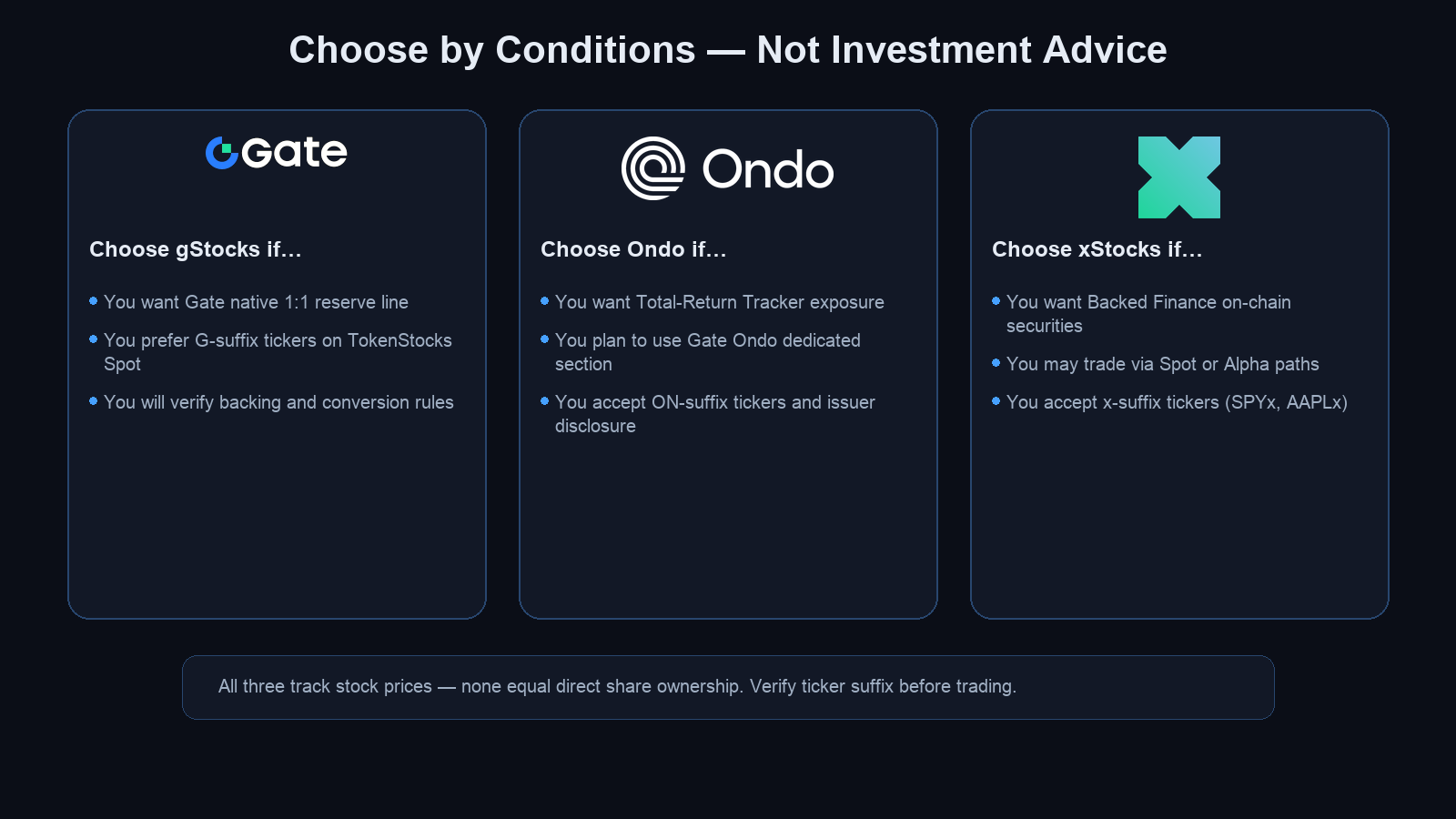
Figure 2. Selection framework for gStocks, Ondo, and xStocks by backing mechanism, ticker suffix, and Gate entry conditions.
Regardless of match, a four-step pre-order check helps: suffix matches the intended product line; full instrument name matches expectation; mechanism docs are read; session timing and liquidity are factored in.
| Self-check |
gStocks |
Ondo Stocks |
xStocks |
| Suffix |
G |
ON |
x |
| Mechanism doc |
Reserve and conversion |
Tracker / reinvestment |
Issuer and on-chain path |
| Preferred entry |
TokenStocks · gStocks |
TokenStocks · Ondo |
TokenStocks · xStocks |
| Frequent misread |
Backing = zero deviation always |
Reinvestment = cash payout |
Tradable on-chain = direct stock |
The checklist is for order verification, not product ranking.
Summary
gStocks, Ondo Stocks, and xStocks differ mainly in issuer, reserve or Tracker mechanism, ticker suffix (G / ON / x), and TokenStocks filter path. All three offer on-chain price-tracking exposure to U.S. equities but generally are not direct shares and usually lack voting rights and cash dividends. Match mechanism and suffix first, then trading path; watch peg deviation, off-hours liquidity, issuer events, and ticker mix-ups.
FAQ
What is the difference between gStocks, Ondo, and xStocks?
gStocks is Gate's own line with 1:1 fully backed native stock reserves and G suffix tickers. Ondo Stocks come from Ondo Global Markets via Total-Return Tracker with ON suffix tickers. xStocks are Backed Finance on-chain tokenized securities with x suffix tickers. Issuer, mechanism, and Gate entry differ; prices usually track the underlying stock but the tokens are not direct equity.
How should you choose among gStocks, Ondo, and xStocks?
Align mechanism and entry to needs. For Gate-native reserves and G suffix on TokenStocks, compare gStocks. For Total-Return Tracker exposure and the Ondo filter with ON suffix, compare Ondo Stocks. For Backed on-chain securities and the xStocks filter with x suffix, compare xStocks. Every choice requires suffix and full-name verification plus reading the relevant mechanism disclosure.
Are tokenized stocks the same as real stocks?
No. Gate Help Center FAQs describe tokenized stocks as on-chain assets priced against an underlying, not shares issued by the company. Holders typically lack voting rights, cash dividends, and governance participation. gStocks, Ondo, and xStocks sit under TokenStocks as price-tracking products—legally and structurally distinct from broker-registered shares.
Do tokenized stocks pay dividends or carry voting rights?
Cash dividends are not paid to holders and voting rights are usually absent. Gate FAQs state tokenized stocks do not distribute dividends to wallets. Ondo's Total-Return Tracker may reinvest after-tax distributions into token value—a different path from cash payout. Split or similar adjustments follow issuer rules per instrument.
What risks apply when trading tokenized stocks?
Key risks include peg and liquidity stress (especially off-hours or thin volume), limited rights (no vote or cash dividend), issuer events (insolvency or default may de-peg or drain liquidity), and operational errors (wrong suffix or ticker). Gate displays matching and fees on trade pages; underlying counterparty risk remains with the issuer structure.
What do you need to buy gStocks, Ondo, or xStocks with USDT on Gate?
A Gate account with applicable KYC, a USDT balance, and the TokenStocks market list (or App Spot → TokenStocks) filtered to gStocks / Ondo / xStocks. Search the proper suffix, then confirm the full instrument name, order type, and fees before you submit. Field checks match the trading-path section above.