Why More Crypto Users Are Turning Their Attention to the U.S. Stock Market
For much of the past, the crypto market and traditional financial markets seemed like two separate worlds. But as institutional capital continues to pour into digital assets, the link between them is tightening. On one hand, Bitcoin spot ETFs have made it easier for traditional capital to access the digital asset space. On the other, a growing number of crypto investors are now looking to the U.S. stock market, aiming to build more resilient asset management through cross-market diversification.
Since 2026, artificial intelligence has remained one of the most dominant investment themes in global capital markets. From chip design and cloud computing to data center construction, the entire AI supply chain continues to benefit. Tech giants like Nvidia, Broadcom, Microsoft, and Meta keep surpassing market expectations, driving sustained attention to the Nasdaq and S&P 500 indices.
At the same time, demand for high-quality global assets remains strong. Compared to many regional markets, the U.S. capital market still hosts a vast number of world-leading companies, making it a key destination for long-term asset allocation. For investors who have weathered the high-volatility cycles of crypto, holding just one asset class no longer satisfies the need for diversification. More and more are now exploring allocations across digital assets, U.S. stocks, and ETFs simultaneously.
How to Participate in the U.S. Stock Market
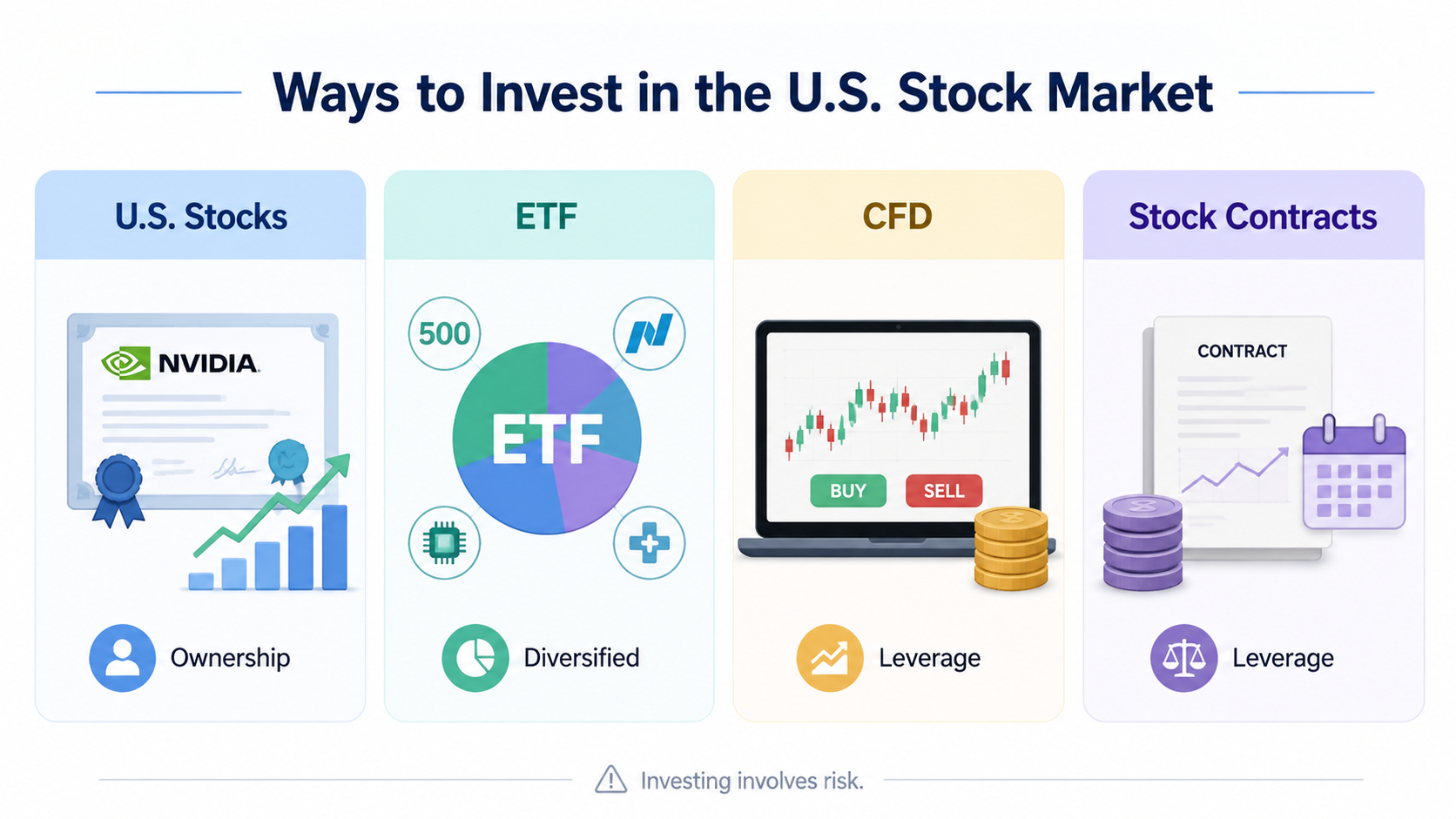
When investors decide to enter the U.S. stock market, the first step is understanding the available options.
Although many refer to them all as "buying U.S. stocks," the logic behind each product is quite different.
Spot U.S. Stocks
Spot U.S. stocks are the most straightforward and intuitive investment method. When you buy shares, you actually own a piece of the company and gain shareholder rights. As the company grows and its valuation rises, you stand to benefit from capital appreciation. For instance, buying Nvidia stock means owning part of that company.
For investors focused on long-term value and corporate growth dividends, spot U.S. stocks are usually the go-to choice.
ETFs
An ETF (Exchange-Traded Fund) is a pooled investment vehicle. Instead of picking a single company, you invest in a basket of assets through one ETF — like an S&P 500 ETF, Nasdaq 100 ETF, or an AI-themed ETF.
ETFs offer built-in diversification and reduce the difficulty of stock selection, making them popular among long-term investors.
CFD U.S. Stocks
CFDs (Contracts for Difference) are derivative products. You don't actually own the stock; you profit from price movements. Because they typically offer leverage, both potential gains and losses are amplified.
CFDs are better suited for experienced traders who focus on short-term price swings.
U.S. Stock Futures
U.S. stock futures are also derivative instruments. Unlike spot trading, you participate via a margin mechanism, often with leverage, and some contracts have expiration dates and settlement rules.
Futures can boost capital efficiency but also demand stricter risk management.
Spot U.S. Stocks vs. CFD U.S. Stocks vs. U.S. Stock Futures: Key Differences
While all three let you trade U.S. stock price movements, their underlying mechanics differ significantly here.
| Feature |
Spot U.S. Stocks |
CFD U.S. Stocks |
U.S. Stock Futures |
| Do you own the stock? |
Yes |
No |
No |
| Do you get shareholder rights? |
Yes |
No |
No |
| Leverage available? |
Usually low or none |
Yes |
Yes |
| Expiration date? |
No |
No |
For some products |
| Suitable for long-term holding? |
Yes |
Generally |
Generally |
| Risk level |
Relatively low |
Higher |
Higher |
| Primary use |
Long-term investment |
Short-term trading |
Leveraged trading |
In short, spot U.S. stocks are more about investing, while CFDs and futures are trading tools. As the AI sector continues to attract attention, more investors are turning back to the spot market to directly participate in the long-term growth of high-quality companies.
This is one key reason why demand for spot U.S. stock investing is steadily rising in global markets.
How Fractional Shares Are Lowering the Barrier to U.S. Stock Investing
In the past, many top tech stocks had high share prices, making a full share purchase a significant hurdle for smaller investors.
For example:
- Nvidia
- Broadcom
- Amazon
- Tesla
These popular stocks have all been priced high at various points. The rise of fractional share trading has dramatically lowered the entry bar.
Fractional shares let you buy a portion of a stock instead of a full share.
For instance:
- 0.1 shares of Nvidia
- 0.05 shares of Amazon
- 0.01 shares of Tesla
This model allows investors to allocate flexibly based on their available capital.
For beginners building a portfolio gradually, fractional shares not only lower the entry barrier but also make dollar-cost averaging and diversification much easier.
From Crypto to Global Asset Allocation
As the market matures, more investors are shifting from a single-asset mindset to an asset allocation approach.
Different assets serve different roles:
- Crypto assets offer growth potential and exposure to innovative markets.
- Spot U.S. stocks provide corporate growth and long-term value opportunities.
- ETFs deliver diversified investment vehicles.
- Safe-haven assets like gold help balance risk.
- Cash and fixed-income products handle liquidity management.
Recent market volatility has made many realize that relying on a single market often means higher risk. Building a cross-market, multi-asset portfolio is now a growing focus. For digital asset investors, the U.S. stock market is especially attractive because it hosts many of the world's leading tech, consumer, and innovation companies.
Digital Assets and Traditional Finance Are Converging
A clear trend has emerged in recent years: the line between digital asset markets and traditional financial markets is blurring. Traditional institutions are entering the digital asset space, while crypto platforms are expanding into traditional financial products.
For many users, the biggest challenge in cross-market investing isn't the investment logic itself — it's managing accounts, transferring funds, and navigating market entry barriers.
Traditional U.S. stock investing involves multiple steps: opening a brokerage account, managing cross-border funds, and allocating assets across different platforms.
As the market evolves, more investors want to manage both digital and securities assets on a single platform, improving capital efficiency and the overall investment experience.
How Gate Stock Trading Bridges Digital Assets and Global Securities Markets
In line with this trend, Gate Stock Trading offers crypto users a new gateway to global securities markets. Currently, Gate Stock Trading supports trading over 10,000 U.S. stocks and ETFs with USDT, covering NYSE, Nasdaq, NYSE Arca, NYSE American, BATS, and other major U.S. exchanges and liquidity networks.
For investors who have long tracked U.S. tech stocks, consumer stocks, and ETFs, this means accessing a broader range of global assets within a familiar digital asset ecosystem.
Additionally, Gate Stock Trading supports fractional shares from as low as 0.01 shares. This allows investors to participate in popular stocks without committing large capital. For example, users looking to allocate to Nvidia, Microsoft, or Amazon can significantly lower the entry barrier and enhance capital flexibility.
Most importantly, Gate Stock Trading connects digital assets and traditional financial markets, enabling users to monitor both crypto and global securities on one platform — opening up more possibilities for global asset allocation.
Conclusion
Whether driven by AI-powered tech rallies or sustained global interest in high-quality companies, the U.S. stock market remains a cornerstone of the global investment landscape.
For crypto investors, understanding the differences between spot U.S. stocks, ETFs, CFDs, and futures is a key step toward global asset allocation.
As digital assets and traditional finance continue to merge, investors have more channels than ever to participate. Through Gate Stock Trading, users can stay active in the digital asset market while using USDT to allocate over 10,000 U.S. stocks and ETFs — and with fractional shares starting at 0.01 units, they can engage with global capital markets in a more flexible way.
In a constantly shifting market, building your own long-term asset allocation framework may be more important than chasing the next hot trend.
Risk Disclaimer: This article is for educational and informational purposes only and does not constitute investment advice. Stocks, ETFs, digital assets, and derivatives all carry market risk. Investors should fully understand product characteristics and make decisions carefully based on their own risk tolerance.