À medida que os Agentes de IA emergem como uma direção importante na inteligência artificial, um número crescente de projetos explora como a blockchain pode potenciar ecossistemas de IA abertos. Ao contrário das plataformas tradicionais da Internet, que dependem de empresas centralizadas para a alocação de recursos e distribuição de receitas, as redes de IA descentralizadas exigem um modelo económico capaz de medir contribuições, incentivar a participação e alinhar os interesses das partes interessadas. O COAI foi concebido precisamente neste contexto — para impulsionar o crescimento contínuo da Economia dos Agentes de IA através de incentivos on-chain.
Do ponto de vista da convergência entre Web3 e IA, o COAI é muito mais do que um Token de pagamento; é uma infraestrutura crítica para toda a rede inteligente. Através da Prova de Inteligência, de um Mercado de Agentes, de uma rede de computação distribuída e de um sistema de governança on-chain, a ChainOpera AI visa integrar capacidades de IA, recursos de dados e poder computacional numa rede de valor unificada — permitindo que os serviços inteligentes sejam criados, negociados, compostos e recompensados como ativos digitais.
Funções principais e utilizações do Token COAI
Para qualquer rede descentralizada, os tokens não servem apenas como instrumentos de troca de valor, mas também como motores essenciais das operações do ecossistema.
No ecossistema da ChainOpera AI, o COAI foi concebido como a espinha dorsal económica.
Atualmente, o COAI desempenha as seguintes funções principais:
Pagamentos de serviços de IA
Os utilizadores podem pagar com COAI ao invocar Agentes de IA, comprar serviços de modelo ou aceder a funcionalidades premium.
À medida que a Economia dos Agentes amadurece, mais serviços de IA podem adotar o COAI como unidade de liquidação predefinida.
Taxas de invocação e execução de agentes
Os Agentes de IA consomem recursos de inferência de modelo, poder computacional e dados ao executar tarefas.
Estes custos de recursos são liquidados em COAI.
Negociação de recursos computacionais
Os operadores de nodos GPU podem fornecer recursos computacionais à rede e ganhar recompensas em COAI.
Este modelo ajuda a construir infraestruturas de IA descentralizadas.
Recompensas para programadores
Os programadores recebem recompensas em COAI por criarem Agentes, treinarem modelos, construírem plugins ou contribuírem com ferramentas.
Governança de rede
Os titulares podem participar na governança do ecossistema ao votar nas direções de desenvolvimento futuro.
Assim, o COAI desempenha um papel triplo como camada de pagamento, camada de incentivo e camada de governança.
Distribuição e mecanismo de libertação do Token COAI
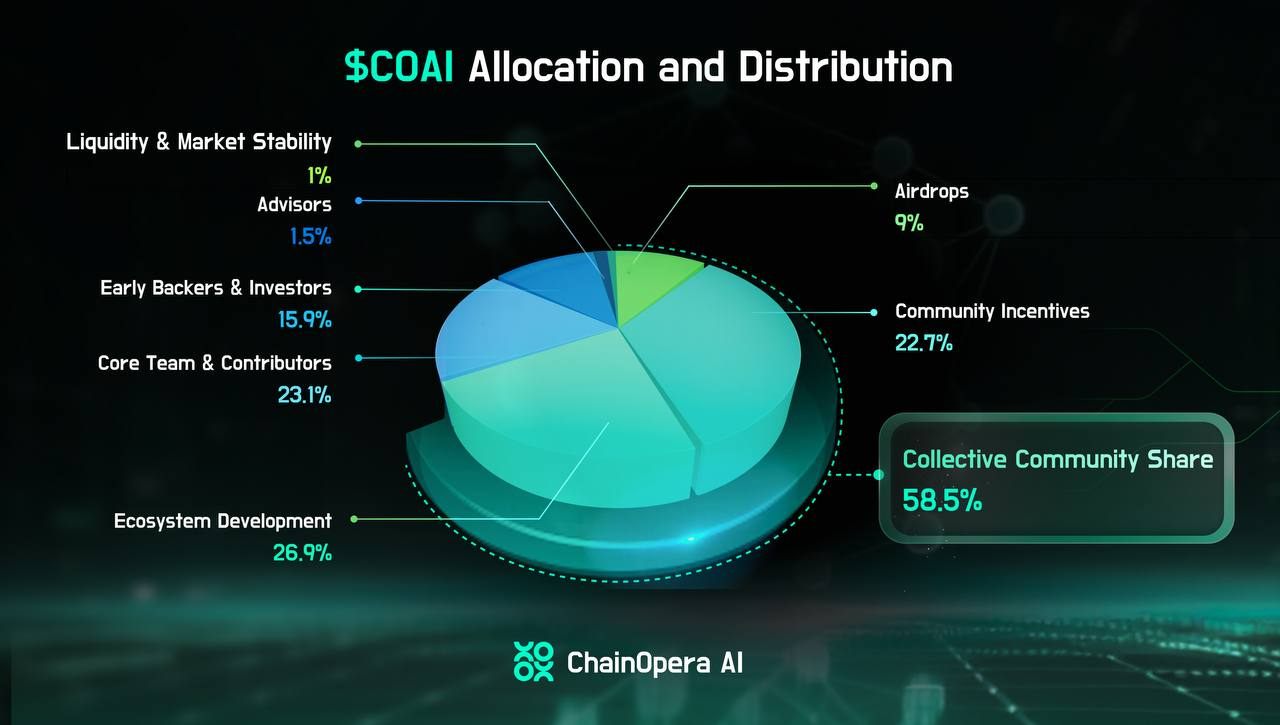
A saúde de uma economia de token depende em grande parte da sua estrutura de oferta e calendário de libertação. De acordo com as informações públicas do projeto, a oferta total do COAI está fixada em 1000 milhões de tokens.
A alocação abrange as seguintes categorias:
-
Incentivos à comunidade e ao ecossistema
-
Equipa e principais contribuidores
-
Instituições de investimento
-
Reserva da fundação
-
Fundo de desenvolvimento de mercado
-
Suporte de liquidez
-
Investigação e desenvolvimento tecnológico
Do ponto de vista do design, a parte dos incentivos ao ecossistema representa uma parcela significativa.
A justificação é que a ChainOpera AI pretende atrair mais através de incentivos de longo prazo:
para se juntarem à rede. Entretanto, as alocações da equipa e dos investidores estão normalmente sujeitas a períodos de bloqueio e desbloqueios faseados. Este design ajuda a reduzir a pressão de venda de curto prazo, mas os investidores devem ainda assim monitorizar de perto os futuros calendários de desbloqueio de tokens.
Para projetos focados em IA, as alterações na oferta em circulação afetam frequentemente diretamente a valorização de mercado e o desempenho do preço.
Como o COAI conecta Agentes de IA, programadores e utilizadores
O objetivo da ChainOpera AI não é construir um único produto de IA, mas estabelecer uma Economia de Agentes completa. Neste ecossistema, o COAI serve como o meio de fluxo de valor. O ciclo económico pode ser dividido em quatro etapas:
-
Os utilizadores submetem pedidos.
-
Os Agentes de IA recebem tarefas.
-
Os modelos e recursos computacionais executam tarefas.
-
Os contribuidores ganham recompensas em COAI.
Por exemplo, quando um utilizador precisa de gerar um relatório de investigação setorial:
-
O Agente de Pesquisa recolhe informações.
-
O Agente de Análise processa dados.
-
O Agente de Redação gera conteúdo.
-
Os modelos subjacentes e os nodos GPU tratam da inferência.
O utilizador paga COAI, e vários participantes no ecossistema recebem recompensas proporcionais com base nas suas contribuições. Este modelo promove a colaboração entre diferentes funções, em vez de depender de uma única plataforma para controlo centralizado.
À medida que o número de Agentes cresce, os cenários de circulação do COAI continuarão a expandir-se.
Como a Prova de Inteligência impulsiona os incentivos do Token
A Prova de Inteligência (PoI) é considerada um dos mecanismos mais distintivos da ChainOpera AI.
As blockchains tradicionais dependem de:
-
Prova de trabalho (PoW)
-
Proof of Stake (PoS)
para incentivos de rede. Numa rede de IA, no entanto, medir apenas o poder computacional ou as participações em tokens não reflete com precisão as contribuições reais.
É por isso que a ChainOpera AI introduziu a Prova de Inteligência. O seu propósito central é registar e verificar o valor inteligente criado pelos participantes do ecossistema.
As contribuições específicas podem incluir:
Desenvolvimento de Agentes
Os programadores que constroem Agentes de alta qualidade podem ganhar recompensas.
Contribuição de Modelos
As equipas que fornecem modelos de alto desempenho frequentemente utilizados pelos utilizadores podem gerar receita.
Suporte de Computação GPU
Os operadores de nodos que oferecem recursos computacionais estáveis recebem COAI.
Contribuição de Dados
Conjuntos de dados de alta qualidade são vitais para o treino de modelos e também podem ser incentivados.
Participação de Utilizadores
Certas atividades do ecossistema, tarefas de teste e mecanismos de feedback podem também ser incorporados no sistema de recompensas.
Este mecanismo estabelece efetivamente um sistema de prova de valor para a rede de IA. À medida que a Economia dos Agentes se expande, a PoI pode tornar-se um padrão chave para medir contribuições inteligentes.
O papel do COAI na governança
A governança é uma componente crítica do valor de longo prazo do COAI. Nas plataformas tradicionais da Internet, as atualizações de produtos, as estruturas de taxas e as regras do ecossistema são tipicamente decididas unilateralmente pela empresa. A ChainOpera AI pretende construir gradualmente um sistema de governança impulsionado pela comunidade.
Os titulares de COAI podem eventualmente participar em:
Votação de atualizações de protocolo
Decidir sobre roadmaps técnicos e atualizações de funcionalidades.
Ajustes de regras de incentivo
Otimizar os mecanismos de recompensa do ecossistema.
Gestão do Mercado de Agentes
Rever ou ajustar as regras do mercado.
Alocação de recursos da Fundação
Determinar a utilização de certos fundos do ecossistema.
Decisões de parcerias estratégicas
Participar em discussões sobre iniciativas de cooperação importantes.
Este modelo de governança aumenta o envolvimento da comunidade e apoia o crescimento do ecossistema a longo prazo.
No entanto, deve ser mantido um equilíbrio entre a eficiência da governança e a descentralização na prática.
Principais fatores que influenciam o valor do Token COAI
O valor de longo prazo do COAI é principalmente impulsionado pelo desenvolvimento do ecossistema.
Crescimento no número de Agentes de IA
Mais Agentes levam a uma maior procura de serviços e a mais cenários de pagamento.
Expansão da base de utilizadores
Um aumento de utilizadores ativos aumenta a frequência de utilização da rede.
Adoção do Terminal de IA
Se o Terminal de IA se tornar um portal de alto tráfego, a procura pelo token aumentará.
Escala da rede GPU
Mais recursos computacionais permitem serviços de ecossistema mais fortes.
Vitalidade do ecossistema de programadores
Programadores talentosos introduzem continuamente novos Agentes e aplicações.
Volume de negociação do Mercado de Agentes
A atividade do mercado determina a eficiência da circulação do Token.
Tendências gerais da indústria da IA
O ritmo de crescimento dos setores dos Agentes de IA e da IA descentralizada influencia diretamente as expectativas do mercado.
Assim, o valor de longo prazo do COAI depende, em última análise, da procura real, não apenas das narrativas de mercado.
Riscos a considerar ao investir em COAI
Apesar do elevado potencial de crescimento do setor dos Agentes de IA, investir em COAI acarreta múltiplos riscos.
Risco de implementação tecnológica
A rede de inteligência colaborativa ainda está em fases iniciais. O desempenho real e a viabilidade comercial permanecem por provar.
Risco de concorrência na indústria
Vários projetos de IA descentralizada já surgiram no mercado, incluindo:
-
Bittensor
-
0G
-
Virtuals Protocol
-
Fetch.ai
-
SingularityNET
A concorrência está a intensificar-se rapidamente.
Risco de libertação de tokens
Futuros aumentos na oferta em circulação podem causar volatilidade de preços.
Risco de sentimento de mercado
Os ativos relacionados com IA são tipicamente voláteis, e os preços de curto prazo podem ser influenciados pelo sentimento.
Risco regulatório
Os quadros regulamentares globais para IA e ativos digitais ainda estão a evoluir. Futuras alterações políticas podem impactar o desenvolvimento do projeto.
Portanto, avaliar o COAI deve focar-se mais no crescimento do ecossistema e na adoção real do que nos movimentos de preços de curto prazo.
Potencial de desenvolvimento de longo prazo do ecossistema COAI
Numa perspetiva de longo prazo, o valor central da ChainOpera AI não reside na emissão de um Token, mas na construção de uma rede económica inteligente e aberta.
Se os Agentes de IA se tornarem uma parte fundamental da Internet, as redes subjacentes que suportam a colaboração de agentes, a troca de valor e a coordenação de recursos verão oportunidades de crescimento significativas.
A ChainOpera AI está a trabalhar para estabelecer:
-
Mercado de Agentes
-
Rede GPU Descentralizada
-
Ponto de Entrada do Terminal de IA
-
Protocolo de Prova de Inteligência
-
Sistema de Economia de Agentes
Estes componentes formam juntos um ecossistema de inteligência colaborativa completo. Nos próximos anos, à medida que as exigências de automação empresarial aumentam, os cenários de aplicação de IA se expandem e a infraestrutura Web3 amadurece, as redes de IA descentralizadas provavelmente atrairão cada vez mais atenção do mercado.
Para a ChainOpera AI, a capacidade de atrair continuamente programadores, expandir o ecossistema de Agentes e gerar procura comercial real será decisiva para o valor de longo prazo do COAI.
Resumo
O COAI é o veículo central de valor do ecossistema ChainOpera AI e um elo vital que conecta Agentes de IA, programadores, utilizadores e recursos computacionais. Através de funções que abrangem pagamento, incentivos, governança e coordenação de recursos, o COAI fornece uma base económica completa para a rede de inteligência colaborativa.
Ao contrário das plataformas tradicionais de IA que dependem de operações centralizadas, a ChainOpera AI aproveita a Prova de Inteligência e os incentivos on-chain para construir uma Economia de Agentes aberta, permitindo que os serviços inteligentes partilhem valor e cresçam colaborativamente. À medida que os setores dos Agentes de IA e da IA descentralizada continuam a desenvolver-se, o potencial do COAI dependerá cada vez mais da procura de aplicações no mundo real, da escala do ecossistema de programadores e da atividade da rede. Para investidores focados na convergência entre IA e Web3, compreender o modelo económico do COAI é essencial para avaliar o potencial de longo prazo da ChainOpera AI.