Microsoft Stock (MSFT) represents shares of Microsoft Corporation, a U.S.-listed technology company known for software, cloud computing, enterprise services, productivity tools, gaming, and AI-related infrastructure. On Gate, eligible users can access Microsoft Stock (MSFT) through Gate Stocks by using USDT as the funding and settlement asset.
USDT settlement matters because many crypto users already hold stablecoin balances and may prefer a stock-access flow that stays inside a crypto-native account environment. Before using Gate Stocks, users should understand account requirements, identity verification, funding steps, order confirmation, fees, product rules, price differences, and risks. Buying Microsoft Stock (MSFT) with USDT on Gate gives users stock price exposure through Gate’s product structure, but it should not be treated as identical to every feature of a traditional brokerage account.
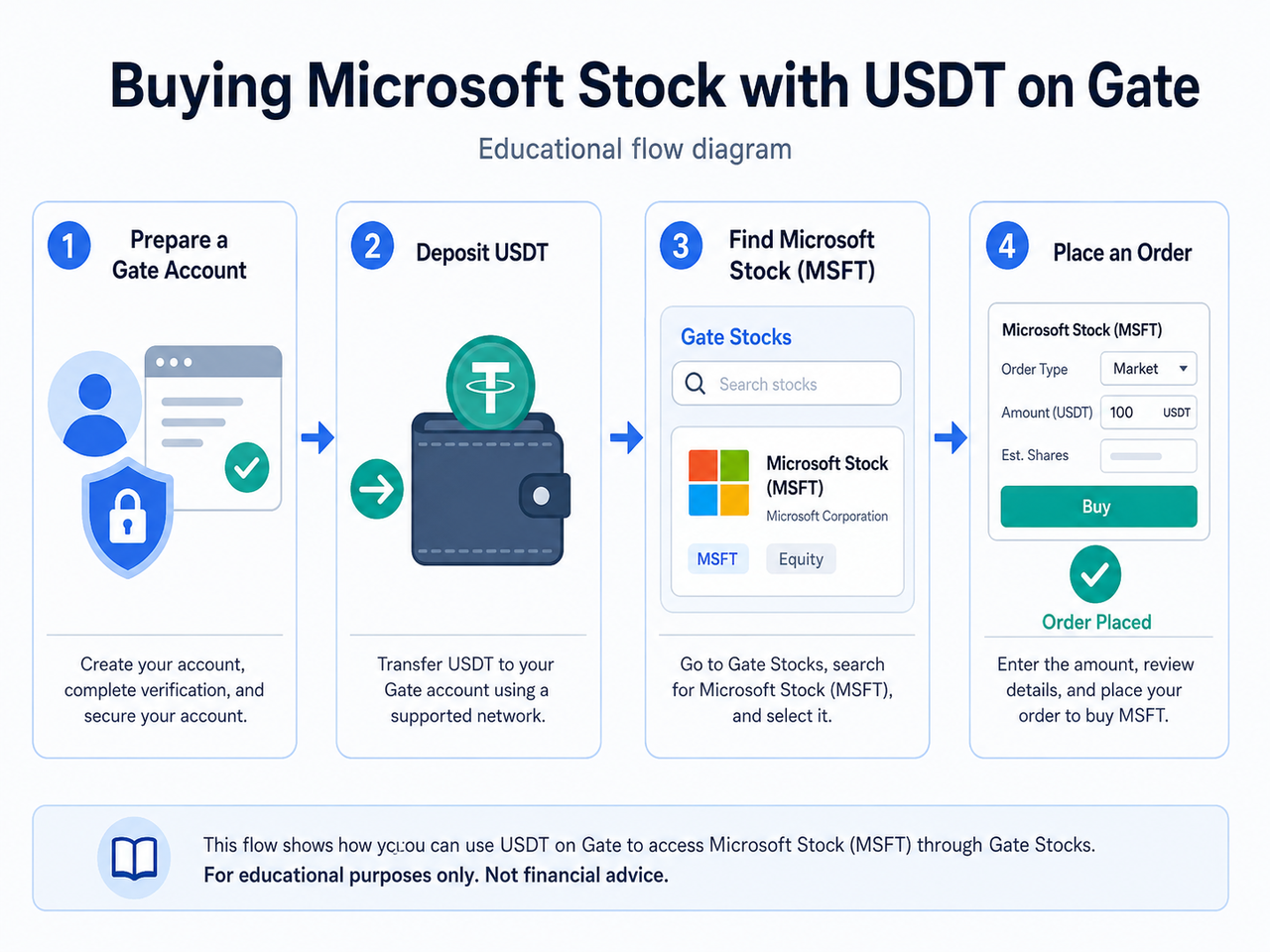
What Do You Need Before Buying Microsoft Stock on Gate?
Before buying Microsoft Stock (MSFT) on Gate, users need an eligible Gate account, access to Gate Stocks, and enough USDT to cover the intended order amount and visible costs. Identity verification may be required depending on the user’s account status, region, and current Gate product rules.
Gate Stocks availability should be checked before trading (As of June 2026). Stock products can be affected by regional eligibility, compliance requirements, supported-market rules, and changes to Gate’s product coverage. A user may be able to view market information but still need to complete additional account steps before placing an order.
Users also need a basic understanding of how Gate Stocks works. The product connects USDT balances with access to U.S. stock and ETF products, but order execution, rights treatment, transfers, and product notices should always be checked from the current Gate interface.
| Requirement |
What It Means |
User Check |
| Gate account |
A user must access Gate through an eligible account |
Confirm login, account status, and product access |
| Identity verification |
Verification may be required before using stock services |
Complete any required checks before trading |
| USDT balance |
USDT is used as the funding and settlement asset |
Make sure the balance covers the order and visible costs |
| Gate Stocks access |
The stock product area must be available to the user |
Confirm Microsoft Stock (MSFT) is available before trading |
| Product-rule awareness |
Stock access may differ from a traditional broker |
Review fees, rights, transfers, and risk notices |
This preparation table separates operational readiness from investment choice. Having access to Microsoft Stock (MSFT) on Gate does not mean a user should buy it; it only means the user can evaluate the product flow and decide independently.
Step 1: How to Deposit USDT on Gate
To buy Microsoft Stock (MSFT), users first need USDT available in their Gate account. A user who already holds USDT on Gate may not need an external deposit, but may still need to move funds into the relevant stock account before trading.
For users depositing USDT from an external wallet or another service, the deposit process usually requires selecting USDT, choosing the correct network, copying the deposit address, and sending funds from the external wallet. Network selection is important because sending USDT through an unsupported or incorrect network can lead to asset loss. Users should always check the deposit address, memo or tag requirements if shown, and network details before sending funds.
After sending USDT, users should wait until the deposit is credited to the relevant Gate account balance. Processing time can vary by network and confirmation status, so users should verify received funds inside their account before attempting to place a Microsoft Stock (MSFT) order.
Some Gate Stocks flows may require users to transfer USDT from a spot or unified account into a dedicated stock account. In that case, the stock account balance must be checked before order placement. A user may see Microsoft Stock (MSFT) market data before the stock account is funded, but order placement generally requires the required funds to be available in the correct account area.
Step 2: How to Find Microsoft Stock on Gate
After the account is funded, users can enter the Gate Stocks section and search for Microsoft Stock (MSFT). The ticker is MSFT, and users should confirm both the company name and ticker before opening the order page.
Search accuracy matters because some assets may have similar names, related themes, or overlapping technology-sector descriptions. The correct product should clearly identify Microsoft Stock (MSFT), not a different stock, fund, contract, or crypto asset.
Product availability for Microsoft Stock (MSFT) should be verified in Gate Stocks before trading (As of June 2026). Supported assets may change, and availability can depend on account eligibility, region, and current product rules. Before placing an order, users should check the asset page, trading status, order panel, fee information, and any notices attached to the product.
The difference between stock access through Gate and direct brokerage access should also be understood before trading. USDT stock trading without a brokerage account uses a different account and funding path from a traditional broker that settles through a securities account and bank-linked fiat rails.
Step 3: How to Place an Order for Microsoft Stock
Once Microsoft Stock (MSFT) is selected, users can review the order panel and choose an available order type. Market orders are commonly used to execute at the available market price, while limit orders allow users to set a specific price if supported by the current Gate Stocks interface. Users should check the live order form because available order types may change by product, market condition, and account eligibility.
Before confirming an order for Microsoft Stock (MSFT), users should review the estimated price, quantity, USDT amount, fee estimate, order type, and total cost. The displayed quote and final execution price may differ because market prices move, liquidity changes, and execution happens after order submission.
Order placement is not the same as guaranteed final execution at the first displayed price. A submitted order may fill, partially fill, remain open, or fail depending on order type, market conditions, available liquidity, and product rules. Users should check the order history and stock account balance after submitting the order.
What Are the Trading Fees for Microsoft Stock on Gate? (As of June 2026)
Gate’s public stock trading page describes transparent fees from 0.023% (As of June 2026). Users should verify the latest fee schedule on Gate before placing a Microsoft Stock (MSFT) order (As of June 2026).
The trading fee is only one part of the final cost (As of June 2026). Users should also consider spreads between buy and sell quotes, possible differences between displayed quote and execution price, minimum order rules, and any cost shown on the order confirmation screen (As of June 2026).
Gate Stocks supported assets and fee information should be checked from the live product interface before trading (As of June 2026). Old screenshots, third-party summaries, or outdated articles may not reflect current costs, asset availability, or order rules.
| Cost Item |
What It Means |
Verification Note |
| Trading fee |
A fee may apply when an order is executed |
Check the live order page (As of June 2026) |
| Spread |
The buy quote and sell quote may differ |
Review the quote before confirmation (As of June 2026) |
| Execution price |
Final price may differ from the first displayed estimate |
Check order status after submission (As of June 2026) |
| Minimum order size |
Small fractional orders may be subject to product rules |
Confirm limits on the order page (As of June 2026) |
| Funding costs |
Moving USDT before or after trading may involve separate network or account considerations |
Check current funding details (As of June 2026) |
The table shows why users should check the order page rather than relying only on a headline fee. A Microsoft Stock (MSFT) order should be reviewed as a complete transaction, including price, quantity, USDT amount, fee display, spread, and execution status.
What Risks Should You Understand Before Buying Microsoft Stock?
Buying Microsoft Stock (MSFT) with USDT on Gate involves market risk. The price of Microsoft Stock (MSFT) can rise or fall due to earnings results, business performance, interest rates, sector conditions, regulatory changes, broader U.S. equity-market movement, and investor sentiment.
Stock-specific risk is also relevant. Microsoft operates across cloud services, software, productivity tools, gaming, enterprise products, and AI-related infrastructure. Changes in competition, capital expenditure, product demand, regulation, or earnings expectations may affect MSFT pricing.
Liquidity risk and price difference risk should also be considered. Gate Stocks may reference U.S. market pricing, but displayed prices, spreads, and execution prices may not always match a live exchange quote exactly. Timing, order type, trading hours, liquidity, and product structure can all affect the final result.
Product-structure risk matters because buying through Gate Stocks should not be assumed to provide the same rights as direct brokerage-based shareholding unless current official rules clearly confirm it. Users comparing stock price exposure with direct shareholding should understand how stock economic rights and shareholder rights may differ across product structures.
Regulatory, regional eligibility, platform, and USDT-related risks are also part of the decision. Users need to consider whether Gate Stocks is available in their region, whether their account meets product requirements, and whether they understand stablecoin-related risk when USDT is used as the settlement asset.
The difference between Gate Stocks, brokers, and stock CFDs is especially important for users comparing product structures. Gate Stocks, traditional brokers, and CFD-style products may differ in settlement, rights, fees, leverage, risk exposure, and account documentation.
Summary
Buying Microsoft Stock (MSFT) with USDT on Gate is a step-by-step process that begins with account readiness and USDT funding. Users then enter Gate Stocks, search for Microsoft Stock (MSFT), review the order page, confirm the available order type, and check execution details after submission.
The tutorial flow is simple, but the product mechanics deserve careful review. Users should check Gate account eligibility, regional availability, supported asset status, fee information, spread, order type, product rights, dividend handling, transfer rules, and risk notices before trading. All changing product information should be verified from Gate’s current interface (As of June 2026).
FAQs
Is the Microsoft Stock purchased on Gate the same as buying through a traditional broker?
Microsoft Stock (MSFT) purchased through Gate Stocks gives users access to Microsoft price exposure through Gate’s product structure. It may differ from traditional brokerage-held shares in account setup, rights treatment, dividend handling, voting rights, transfer options, and product documentation.
What is the minimum amount required to buy Microsoft Stock?
Microsoft Stock (MSFT) minimum order requirements should be checked on the Gate Stocks order page before trading (As of June 2026). Gate’s public stock page describes fractional access from 0.01 shares, but the live order page should be treated as the current reference for the actual minimum.
Can I sell my Microsoft Stock position at any time?
Microsoft Stock (MSFT) sell availability depends on Gate Stocks trading status, account eligibility, supported trading hours, liquidity, order type, and current product rules (As of June 2026). Users should check the order page and product notices before assuming that a position can be sold at a specific time or price.
Are dividends available when holding Microsoft Stock on Gate?
Microsoft Stock (MSFT) dividend handling should be verified from Gate’s latest official product rules (As of June 2026). Users should not assume dividend treatment is identical to traditional brokerage-held shares unless current Gate documentation clearly confirms the arrangement.
Does Gate charge custody or account maintenance fees?
Microsoft Stock (MSFT) account-related costs should be checked from Gate’s latest fee and product information (As of June 2026). If custody fees, account maintenance fees, or other charges apply, they should be visible in the current official fee rules or product interface.
Can I transfer Microsoft Stock from Gate to another broker?
Microsoft Stock (MSFT) positions on Gate should not be assumed transferable to an external brokerage account unless Gate’s latest official product rules clearly support such transfers (As of June 2026). Users who need broker transfer flexibility should confirm this requirement before placing an order.
Stock investing involves market risk, and prices may fluctuate significantly. Please make decisions carefully based on your own risk tolerance. This article does not constitute investment advice.







