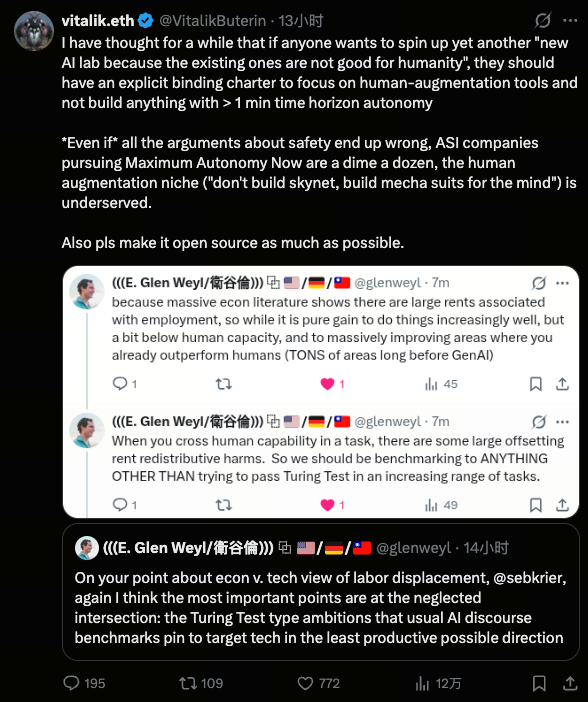
Source de l’image : https://x.com/VitalikButerin
Contexte de la dernière perspective
Selon des rapports récents, Vitalik Buterin, cofondateur d’Ethereum, affirme que l’avenir de l’intelligence artificielle doit s’orienter vers le renforcement des capacités humaines, plutôt que la recherche de systèmes superintelligents totalement autonomes (ASI). À travers ses interventions sur les réseaux sociaux et dans l’espace public, il insiste sur la nécessité pour les nouveaux laboratoires d’IA de définir des chartes claires, en privilégiant la collaboration homme-machine et le développement d’outils d’augmentation. Il recommande également d’éviter la création de systèmes capables de fonctionner de façon autonome pendant plus d’une minute.
Cette position s’inscrit dans un débat mondial croissant sur la sécurité de l’IA, les risques liés à l’autonomie et les cadres réglementaires. Alors que l’IA générale (AGI) et la superintelligence artificielle (ASI) occupent une place centrale dans les discussions publiques, les enjeux du remplacement de la prise de décision humaine par l’IA et du dépassement du contrôle humain deviennent des sujets majeurs dans le secteur technologique comme dans la société.
Arguments centraux de Vitalik
La réflexion de Vitalik s’articule autour de deux axes principaux :
- L’IA doit viser l’augmentation humaine — une orientation qu’il considère comme véritablement bénéfique pour la société et encore insuffisamment développée ;
- Le développement de systèmes dotés d’une autonomie décisionnelle prolongée doit être évité. Il propose de limiter l’autonomie, par exemple à une minute maximum, afin de garantir que l’humain conserve toujours la maîtrise des comportements de l’IA.
Il observe que, si de nombreuses entreprises ASI poursuivent actuellement des niveaux élevés d’autonomie, les outils d’IA destinés à soutenir le raisonnement humain, à accroître la productivité et à favoriser le progrès social restent rares. Il préconise donc de réorienter la recherche technique et l’attention sociétale vers le renforcement de la cognition et des capacités humaines.
Autonomie de l’IA vs. augmentation humaine
L’IA entièrement autonome désigne généralement des systèmes qui fonctionnent hors du contrôle humain immédiat, prenant des décisions et agissant de manière indépendante. Ces systèmes présentent une grande complexité et un potentiel important, mais soulèvent également des questions éthiques, de sécurité et de perte de contrôle.
À l’inverse, l’IA conçue pour l’augmentation humaine vise à accompagner la réflexion, la prise de décision et les tâches physiques humaines — par exemple, optimiser le traitement de l’information, soutenir la création ou améliorer l’analyse de systèmes complexes. Ces outils disposent de limites d’utilisation précises et reposent sur l’intervention et la supervision humaines, intégrant la collaboration homme-machine dans les processus opérationnels réels.
La valeur future de la collaboration homme-machine
La perspective de Vitalik ne consiste pas à rejeter l’autonomie de l’IA, mais à redéfinir ses apports. Il souligne que l’IA offre un bénéfice sociétal maximal lorsqu’elle accroît les capacités humaines, sans remplacer la prise de décision humaine, contribuant ainsi à renforcer l’efficacité, la sécurité et l’éthique.
À l’avenir, la collaboration humain-IA pourrait devenir un pilier de la transformation de la productivité et une voie essentielle pour concilier stabilité sociale et éthique technologique. Ce modèle fait de l’IA un outil d’augmentation, non un agent indépendant, ce qui limite le risque de perte de contrôle dans la prise de décision.
Défis de l’équilibre entre technologie et éthique
Dans le développement de l’IA, les exigences éthiques et les contraintes techniques sont tout aussi essentielles. Il s’agit, par exemple, de garantir que les systèmes d’IA soient suffisamment performants pour des tâches complexes, tout en intégrant des « contraintes » robustes pour prévenir les abus, les détournements ou la perte de contrôle. Cela implique la transparence algorithmique, la promotion de la culture open source et la mise en place de mécanismes de supervision sociale.
Vitalik défend le développement de projets d’IA open source pour accroître la transparence des processus et de la logique algorithmique. Cette démarche favorise la collaboration entre développeurs de divers horizons et organismes de contrôle, limite les risques de monopole et de sécurité liés au développement fermé, et encourage une évolution saine de la technologie.
Enjeux pour le développement du secteur
Les analyses de Vitalik offrent des repères précieux pour l’industrie de l’IA :
- Inciter davantage d’entreprises à investir dans le développement d’outils d’augmentation humaine, plutôt que de viser uniquement une autonomie extrême ;
- Mettre en place des lignes directrices éthiques afin que l’IA améliore l’efficacité tout en restant sûre et contrôlable ;
- Promouvoir une culture open source pour renforcer la transparence de la technologie IA, faciliter la supervision sociale et encourager une large participation.
Cette approche rejoint les alertes des principaux chercheurs en sécurité de l’IA, qui estiment qu’une autonomie excessive accroît l’incertitude et les risques, alors qu’une IA d’assistance renforce le contrôle humain et l’implication dans la prise de décision.
Conclusion et tendances futures
En résumé, la réflexion de Vitalik Buterin sur l’IA dépasse l’évaluation technique et traduit une préoccupation profonde pour l’impact social de l’IA et l’avenir de l’humanité. À mesure que la technologie progresse et que les capacités de l’IA augmentent, préserver la primauté humaine et garantir que la technologie serve l’humain constituent des défis majeurs pour la communauté technologique mondiale et la société dans son ensemble.
À l’avenir, le développement de l’IA devrait s’orienter davantage vers la co-évolution de l’humain et des systèmes intelligents. Cette dynamique pourrait devenir un moteur central de transformation pour la technologie, l’éducation, la gouvernance et les modèles économiques.