Bitcoin has long been regarded as one of the most secure and decentralized networks in the blockchain industry, but its scripting capabilities are limited. This makes it difficult for Bitcoin to directly support complex smart contracts and on chain applications. As DeFi, NFTs, and on chain finance continue to develop, the market is looking for ways to give BTC more application layer functionality while preserving Bitcoin’s strong security.
Stacks was created as a Bitcoin scaling network in this context. Unlike most standalone blockchains, Stacks does not aim to replace BTC. Instead, it works alongside the Bitcoin mainnet, giving developers an environment for smart contracts and decentralized applications. Its technical architecture is built around “Bitcoin security + programmable application layer,” making it a key part of the Bitcoin Layer ecosystem.
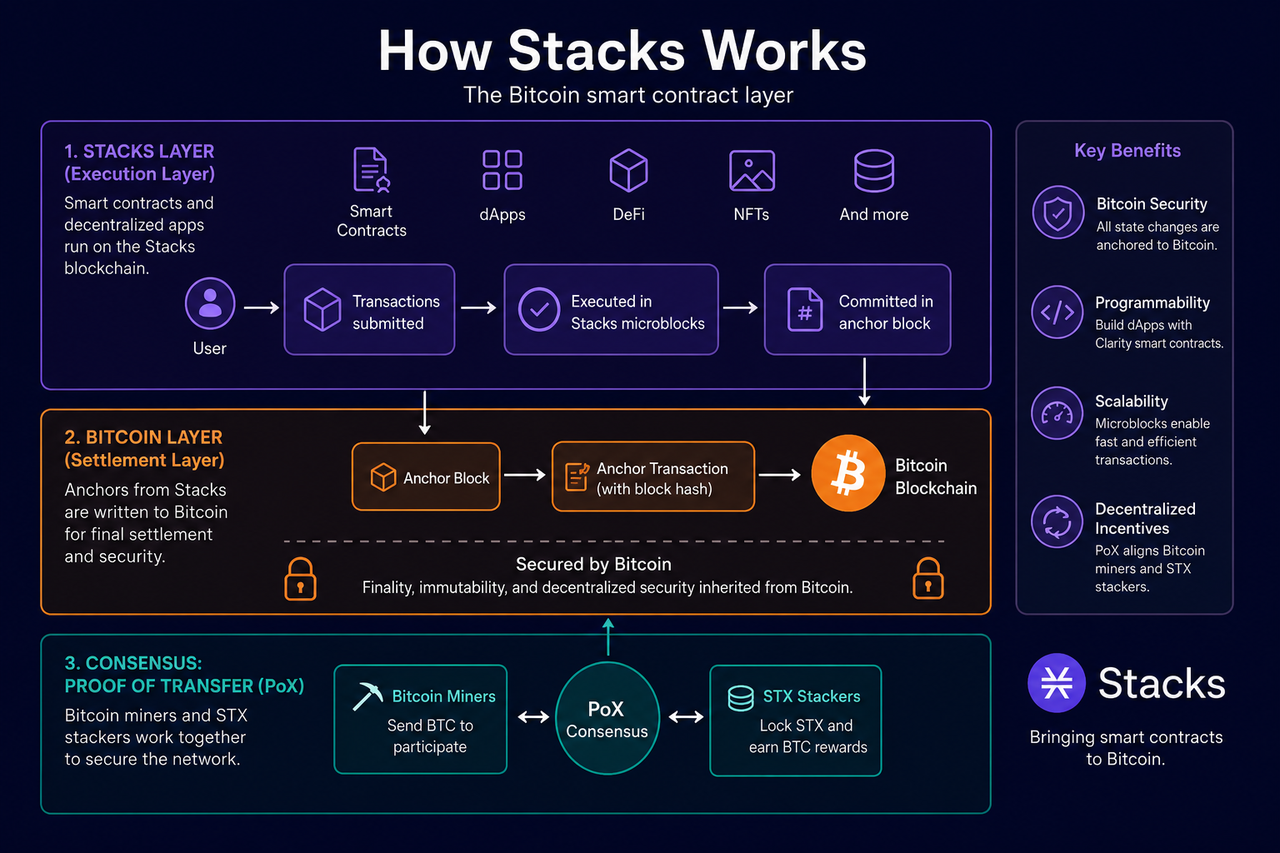
Stacks uses a two layer architecture made up of an execution layer and a Bitcoin settlement layer.
In this model, the Stacks network handles smart contract execution, transaction processing, and application logic, while the Bitcoin mainnet serves as the final settlement layer and security anchor. Applications do not run directly on the BTC network. Instead, key states are periodically recorded on the Bitcoin blockchain, allowing them to use BTC’s security for final confirmation.
This design allows Stacks to provide developers with a flexible on chain application environment without changing Bitcoin’s core protocol. It also avoids the need to rely entirely on a separate security framework, as traditional sidechains often do.
From an architectural perspective, Stacks is better understood as a “Bitcoin application layer” rather than a completely separate blockchain.
Within the Stacks network, smart contracts and dApps primarily run on the execution layer. When users submit transactions, nodes first process and validate them inside Stacks.
Stacks then anchors essential block information to the Bitcoin mainnet, usually by embedding the block hash into a BTC transaction. This ensures that the network state benefits from Bitcoin level security guarantees.
This approach means Stacks does not need to execute all computation directly on the Bitcoin network. Instead, BTC functions as the final trusted settlement layer.
For developers, this structure balances application flexibility with foundational security. For users, it means their assets and transaction states remain connected to the BTC network.
Proof of Transfer (PoX) is Stacks’ core consensus mechanism. It is designed to use Bitcoin’s established value and security rather than create a separate PoW hash power system.
In traditional PoW networks, miners compete for block production by spending hash power. In Stacks, miners participate in block selection by sending BTC. Those who successfully win the right to produce a block receive STX rewards.
Meanwhile, STX holders who take part in Stacking receive BTC as an incentive for supporting the network’s operation.
This creates a value cycle between BTC and STX: miners pay BTC to earn STX, while Stackers lock STX to receive BTC.
The main feature of PoX is that it makes Bitcoin itself part of the network’s security and incentive model, allowing Stacks to form a deeper connection with the BTC network.
To improve transaction efficiency, Stacks uses two types of block structures: Anchor Blocks and Microblocks.
Anchor Blocks are linked to Bitcoin blocks and provide final confirmation of transaction states. This data is anchored to the BTC mainnet, which strengthens security, although confirmation speed is still affected by Bitcoin’s block time.
To improve responsiveness, Stacks introduces Microblocks, which can process transactions quickly between two Anchor Blocks and create an application experience that feels closer to real time.
This structure balances security and performance:
Anchor Blocks provide final settlement security
Microblocks enable faster transaction responses
As a result, Stacks can improve dApp usability and interaction speed without changing Bitcoin’s block production process.
When a user submits a transaction on the Stacks network, it is first validated by Stacks nodes. The related smart contract logic then executes on the execution layer.
Once confirmed, the transaction state is included in a Microblock and eventually aggregated into an Anchor Block. Stacks then anchors the relevant block information to the Bitcoin mainnet.
This process does not require any changes to Bitcoin’s network rules, but it can still achieve final security confirmation through Bitcoin.
For users, this mechanism allows Stacks applications to support smart contract interactions while maintaining a strong connection with the BTC network.
Stacks uses Clarity as its smart contract programming language. Unlike Solidity, Clarity is intentionally designed to be “predictable,” allowing developers to analyze a contract’s outcomes before execution.
Clarity is interpreted directly rather than compiled into bytecode, which makes contract logic more transparent and easier to audit for security.
This approach is especially valuable in the Bitcoin ecosystem, where the community generally prioritizes security and stability over complex feature expansion.
Developers can use Clarity to deploy DeFi protocols, NFT platforms, and DAO applications while reducing the risk of vulnerabilities commonly seen on some other smart contract platforms.
Stacks is often classified as part of the Bitcoin Layer2 ecosystem, but its architecture differs from traditional Rollups or state channel based Layer2 protocols.
Ethereum Layer2 solutions typically focus on increasing transaction throughput and reducing transaction fees, while Stacks focuses on enabling smart contracts and application layer features for BTC.
Stacks also has an independent execution environment and its own native token, STX. Its network design is closer to an independent application layer than to a simple scaling protocol.
Therefore, Stacks’ core positioning is not to “make BTC faster,” but to “make BTC programmable.”
With the rise of Bitcoin DeFi, Ordinals, and BTC native asset ecosystems, demand for a “Bitcoin application layer” is increasing.
Stacks provides a way to extend Bitcoin’s functionality without changing its protocol, allowing developers to build more advanced on chain economic systems around BTC.
This model not only broadens BTC’s use cases, but also supports the development of the “Bitcoin Economy,” where Bitcoin evolves from a simple store of value asset into a foundation for on chain applications and financial activity.
As competition in the Bitcoin Layer sector continues to grow, Stacks has become one of the most prominent smart contract ecosystems for Bitcoin.
By combining an execution layer with the Bitcoin settlement layer, Stacks gives BTC smart contract and decentralized application capabilities. Its core mechanisms include PoX consensus, Anchor Block and Microblock structures, and the Clarity smart contract language.
Unlike most standalone blockchains, Stacks prioritizes collaboration with the Bitcoin network and seeks to expand BTC’s application functionality without modifying the BTC protocol. As Bitcoin DeFi and BTC native asset ecosystems continue to grow, Stacks’ role in enabling Bitcoin based applications may continue to expand.
No. Stacks operates an independent execution layer and anchors key states to the Bitcoin mainnet.
PoW relies on hash power competition, while PoX works by sending BTC to compete for block production and uses the value cycle between BTC and STX to sustain the network.
STX is used to pay gas fees, participate in consensus, and enable Stacking.
Anchor Blocks provide final confirmation and Bitcoin anchoring, while Microblocks improve transaction processing speed and user experience.
Because developers can analyze contract outcomes before execution, reducing the risk of certain smart contract vulnerabilities.