Zcash core team resigns en masse! Governance conflict between ECC and Bootstrap triggers 20% drop in ZEC price — Analysis

Beginner
Quick Reads
Last Updated 2026-03-26 04:57:25
Reading Time: 1m
The entire Zcash core development team at ECC has left, causing market turmoil following governance disputes with the nonprofit organization Bootstrap. As a result, ZEC's price dropped by almost 20% at its lowest. This article delivers an in-depth examination of the causes, consequences, and potential future developments.

Background and Latest Developments
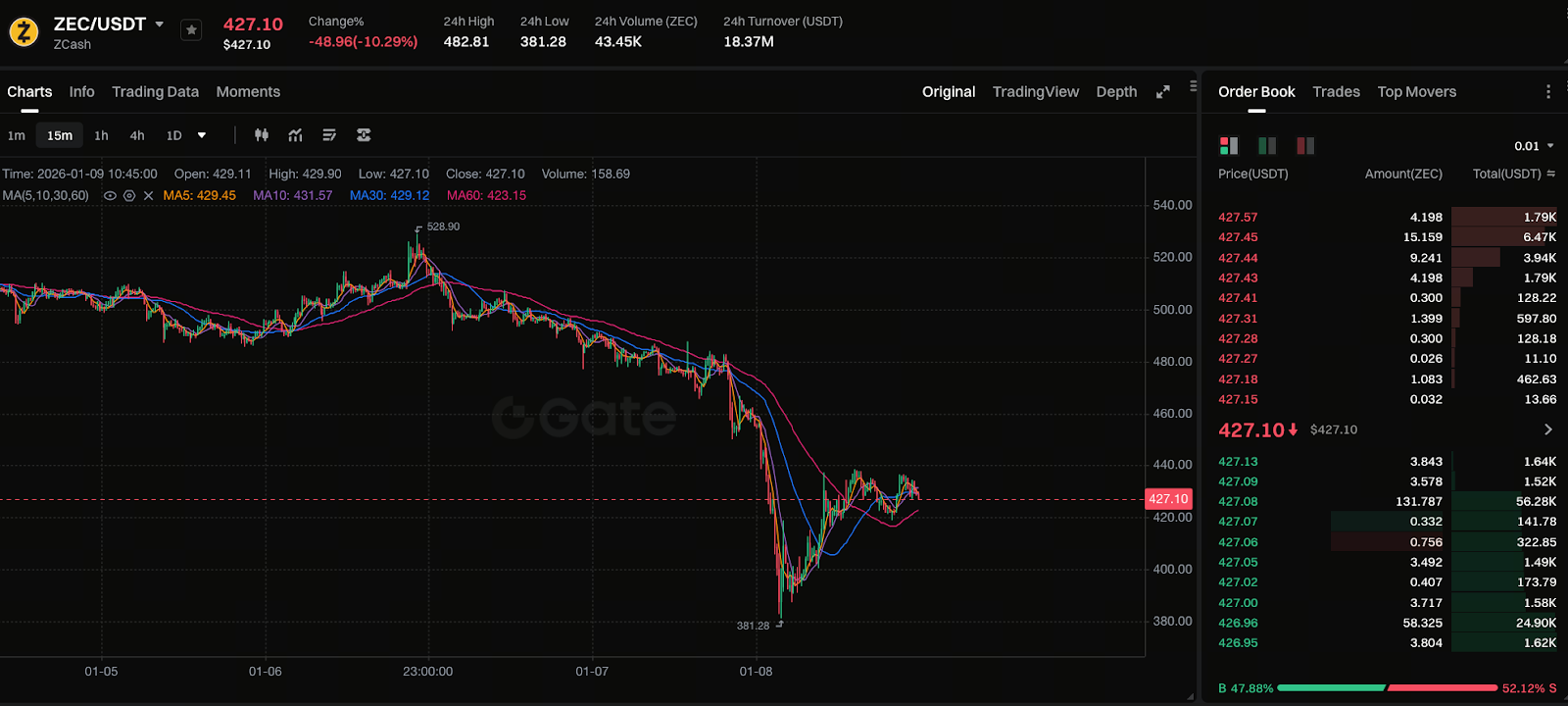

Image: https://www.gate.com/trade/ZEC_USDT

Recently, the crypto community was rocked by major news: the entire core development team behind privacy coin Zcash (ZEC) at Electric Coin Company (ECC) announced their resignation, resulting in a complete split from Bootstrap, the US 501(c)(3) nonprofit overseeing Zcash governance. Following the announcement, panic selling swept the market. ZEC’s price plunged nearly 20% in a short period, making it one of the weakest-performing crypto assets of the day.

Why Did the Entire ECC Team Leave?

According to then-ECC CEO Josh Swihart, most members of Bootstrap’s board had “significant disagreements” with the team over the project’s mission and changed the team’s working conditions, effectively resulting in “constructive discharge.” Swihart stated these governance changes made it impossible for the team to fulfill their responsibilities, leaving collective resignation as the only option.

Swihart specifically named several Bootstrap board members, including Zaki Manian, Christina Garman, Alan Fairless, and Michelle Lai. The team stressed that they are not abandoning the project, but must pursue independent development to protect Zcash’s core values.

Internal communications indicate the ECC team will form a new entity to continue advancing Zcash’s privacy technology and protocol development. The decision to resign does not affect the Zcash protocol itself, as it remains open source.

Why Did ZEC’s Price Drop Nearly 20%?

Zcash’s sharp price decline was primarily driven by market panic and sentiment-driven selling. The resignation of the core development team created uncertainty about the project’s future, and in a market with thin liquidity, this concern quickly magnified the drop. Trading data shows ZEC fell nearly 20% from its recent high. Although it showed signs of rebounding, short-term price pressure remains.

Forced liquidations of leveraged positions in derivatives markets further intensified the decline. With limited trading depth, selling quickly pushed the price below key support levels, amplifying the downward move.

Key Points of Disagreement Between Bootstrap and ECC

Tensions between ECC and Bootstrap had been building for months. The primary conflicts centered on governance models and the project’s future direction. ECC believed Bootstrap’s management was overly conservative and that certain key decisions ran counter to the team’s philosophy. Bootstrap responded that, as a nonprofit, it must adhere to public interest and legal requirements, which limit flexibility in some strategic choices.

Another reported source of conflict involved the privatization of the Zcash ecosystem product “Zashi.” The team sought a more flexible business model, while Bootstrap emphasized the need to operate within nonprofit constraints. This strategic disagreement ultimately led to a public split.

Is the Zcash Network Affected?

Despite the core team’s departure, the Zcash protocol remains open source, decentralized, and fully operational. Zcash founder Zooko Wilcox-O’Hearn stressed that the resignations will not affect the network’s technical security or block production. The protocol will continue to be maintained by global nodes, miners, and developers.

In short, from a technical standpoint, Zcash has not “ceased operations,” but the uncertainty brought by the team’s departure remains a significant factor for market confidence.

Potential Impacts and Outlook for ZEC

This governance rift highlights several points:

  • Decentralized project governance remains fragile—even established privacy coins can face core team exit risks due to institutional structures.
  • Development resources may shift or be restructured; whether the new entity can stabilize Zcash’s technical roadmap remains to be seen over time.
  • Price volatility risk persists; short-term investor sentiment may continue to drive ZEC fluctuations, while the long-term outlook will depend on market momentum and ecosystem vitality.

For investors, reassessing the project’s governance framework and team stability will be essential for evaluating future trends.

Risk Warning and Summary

Although the core team’s departure appears dramatic, Zcash’s open-source nature provides fundamental protection. This incident exposes challenges in governance and organizational structure rather than any failure of the protocol’s technology. Whether ZEC can return to growth under the new structure will depend on ecosystem development, market sentiment, and broader industry trends.

Disclaimer
* The information is not intended to be and does not constitute financial advice or any other recommendation of any sort offered or endorsed by Gate.
* This article may not be reproduced, transmitted or copied without referencing Gate. Contravention is an infringement of Copyright Act and may be subject to legal action.

Related Articles

The ve(3,3) Flywheel Explained: How AERO Tokenomics Powers Aerodrome’s DeFi Economy
Beginner

The ve(3,3) Flywheel Explained: How AERO Tokenomics Powers Aerodrome’s DeFi Economy

In the competition for DeFi liquidity, high-inflation mining alone is no longer enough to build lasting advantages. Aerodrome applies the ve(3,3) economic model to redesign token emissions, voting mechanisms, and revenue distribution, creating a liquidity flywheel centered on governance and cash flow. This article examines AERO tokenomics, the veAERO locking mechanism, and protocol revenue models to explain how Aerodrome builds a sustainable DeFi economic system.
2026-03-25 06:41:58
AI-Native Settlement Layers: How United Stables Is Building the Next Financial Rail
Beginner

AI-Native Settlement Layers: How United Stables Is Building the Next Financial Rail

Stablecoins were originally designed as dollar substitutes within exchanges, primarily used for asset pricing and trade settlement. As on-chain financial ecosystems have matured, their role has expanded beyond simple payments to include collateral assets, cross-chain liquidity mediums, and unified settlement units. In particular, as AI systems and automated agents begin to participate directly in economic activity, demand has risen sharply for programmable value units capable of instant settlement. This shift is pushing stablecoins toward the role of foundational financial infrastructure.
2026-03-25 03:16:17
Aerodrome Tokenomics: How ve(3,3) Powers Base's Most Profitable DEX
Beginner

Aerodrome Tokenomics: How ve(3,3) Powers Base's Most Profitable DEX

AERO is the native token of Aerodrome Finance, a core decentralized exchange and liquidity protocol in the Base ecosystem. It is primarily used for liquidity incentives and ecosystem operations. veAERO is a governance NFT that users receive by locking AERO, representing both voting power and the right to share protocol revenue. Through a dual track structure of AERO as a utility token and veAERO as a governance credential, Aerodrome separates liquidity usage value from long term governance power, allowing participants to act as liquidity providers, governance decision makers, and revenue sharers within the same system.
2026-03-25 06:40:31
How Does PAXG Work? In-Depth Overview of the Physical Gold Tokenization Mechanism
Beginner

How Does PAXG Work? In-Depth Overview of the Physical Gold Tokenization Mechanism

PAXG (Pax Gold) is a tokenized asset backed by physical gold, issued by the fintech company Paxos and traded on the Ethereum blockchain as an ERC-20 token. The core concept is to tokenize physical gold on-chain, with each PAXG token representing ownership of a certain amount of gold. This structure enables investors to hold and trade gold in the form of a digital asset.
2026-03-24 19:12:51
How is the price of PAXG determined? Pegging mechanism, trading depth, and influencing factors
Beginner

How is the price of PAXG determined? Pegging mechanism, trading depth, and influencing factors

PAXG (Pax Gold) is a tokenized asset backed by physical gold reserves, launched by fintech firm Paxos and issued as an ERC-20 token on the Ethereum blockchain. The core concept is to digitally represent real-world gold assets, allowing investors to hold and trade gold via the blockchain network. Because each PAXG token corresponds to a specific quantity of physical gold, its price is theoretically expected to closely track the global gold market.
2026-03-24 19:11:40
DePIN Identity Network and Real World Applications: How Humanity Protocol Brings on-chain Identity Into the Physical World
Beginner

DePIN Identity Network and Real World Applications: How Humanity Protocol Brings on-chain Identity Into the Physical World

Most Web3 identity systems remain confined to on-chain environments and struggle to achieve meaningful adoption in real world settings. Through a DePIN architecture and physical verification hardware, Humanity Protocol aims to bring decentralized identity into access control systems, hospitality, public services, and offline events, allowing on-chain identity to function not just as a digital credential, but as foundational infrastructure for real world access.
2026-03-25 07:40:53





