ZBT / USDT: Current Market Performance and Trending Background
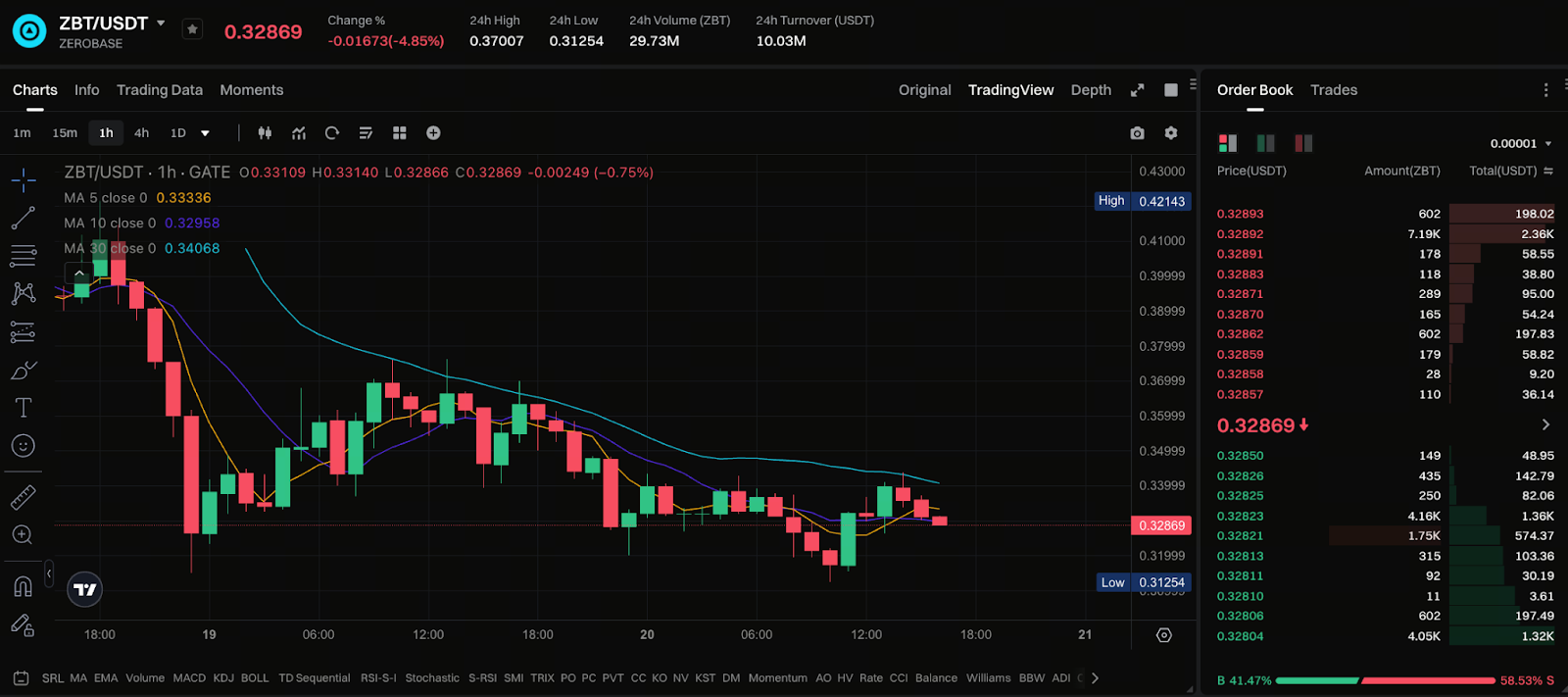
Chart: https://www.gate.com/trade/ZBT_USDT
Crypto market sentiment has recently turned more bullish, with increased activity among newly listed projects and smaller market cap tokens. ZBT / USDT has emerged as a favored pair for short-term traders. ZBT, the token for the ZEROBASE project, was recently listed on major exchanges, attracting concentrated market attention. The early phase of a new token typically sees heightened volatility, presenting both significant short-term opportunities and risks.
Currently, ZBT / USDT trades in a range from 0.33 to 0.37 USDT, with steadily rising volume. Increased trading volume signals short-term capital inflows, and greater price swings often precede new trend formation. For newcomers, this is an ideal period to observe market behavior and experiment with short-term trading strategies.
Technical Perspective: Assessing Support and Resistance Levels
Technical analysis is the most accessible starting point for beginners. For ZBT / USDT, define your initial trading range using the 24-hour high and low. If the price repeatedly finds support in the 0.31–0.32 USDT zone, it signals active buying interest; conversely, heavy selling near 0.37–0.38 USDT marks a short-term resistance area. A volume-backed breakout above resistance often indicates a new market rally, while a volume-backed breakdown below support suggests a correction is underway.
Trading volume trends are also crucial for reading market direction. Rising prices with shrinking volume can be a “false breakout”; sustainable trends require both price and volume to grow in tandem. Beginners don’t need complicated indicators—mastering the core principle of “volume-price synergy” can quickly improve accuracy in market judgment.
Practical Tactics: Actionable Short-Term Strategies for Beginners
With newly launched tokens showing high volatility, discipline—not prediction—is the key to successful trading. Here are two classic short-term strategies:
(1) Breakout Momentum Strategy
If ZBT / USDT breaks out above 0.37 USDT on strong volume and the short-term moving average (e.g., 7-day) starts to trend upward, consider entering with small, staggered positions. Limit each entry to no more than 20% of your total capital, with a stop-loss 3%–5% below the breakout level. This trend-following tactic is best suited to bullish sentiment and active trading periods. Should prices continue rising on strong volume, gradually lock in profits by reducing your position with each 5%–8% gain.
(2) Buy-the-Dip Strategy
During brief pullbacks around the support level of 0.32 USDT, if trading volume starts to recover, you may buy in batches. This approach carries relatively lower risk but requires patience for clear stabilization signals—such as long lower candlestick shadows, rising volume, or a rebound in technical indicators like RSI. After entering, set two profit targets: first at 0.35, then at 0.37. If the price breaks below support on higher volume, exit immediately to limit risk.
Position Management and Risk Controls: Core Skills for Beginners
Many novice losses stem not from poor market calls, but from outsized positions or weak stop-loss discipline. When trading new tokens like ZBT / USDT, rigorous position management is crucial:
- Never allocate more than 5% of your total capital to a single trade;
- Avoid leverage, or keep leverage to ≤ 2x;
- Set clear stop-loss points for every trade and never hesitate due to short-term price rebounds.
For additional safety, beginners should use spot accounts for new token trading, keeping losses manageable even with wrong calls. To build skills, practice technical chart reading and sentiment analysis with small positions.
Mindset and Market Rhythm: Guarding Against Emotional Trading
ZBT / USDT exhibits extreme volatility, with swings of 10%–20% often occurring over short periods in the early token phase. In such conditions, a steady mindset is more important than accuracy in forecasts. Don’t chase sudden spikes, and don’t panic sell in downturns. The right approach is to predefine your buy zones, stop-loss thresholds, and profit targets, and to execute these rules without exception.
New traders should also monitor exchange announcements, community updates, and capital flows. Exchange promotions or listing incentives often trigger short-term inflows and brief price surges. However, such sentiment-driven trends are usually fleeting, so act decisively and keep positions light during these events.
Conclusion
ZBT / USDT is currently in a phase of high volatility and intense capital activity. For newcomers, this is an excellent opportunity to learn short-term trading, but building discipline and risk awareness is even more critical. Whether you’re trading breakouts or buying dips, strict stop-losses and small position sizes must be your foundation. Remember: risk control is more important than forecasting price moves. Only within a robust risk framework can short-term opportunities translate into sustainable returns.







