YZY MONEY: Can Kanye West’s New Token Become the Next Hotspot in Crypto Payments?

Beginner
Quick Reads
Last Updated 2026-03-29 14:52:43
Reading Time: 1m
YZY MONEY is the YZY token launched by Kanye West on Solana. It is designed to support the Ye Pay and the YZY Card. In this article, we analyze its tokenomics, payment applications, and associated risks.

Introduction to YZY MONEY
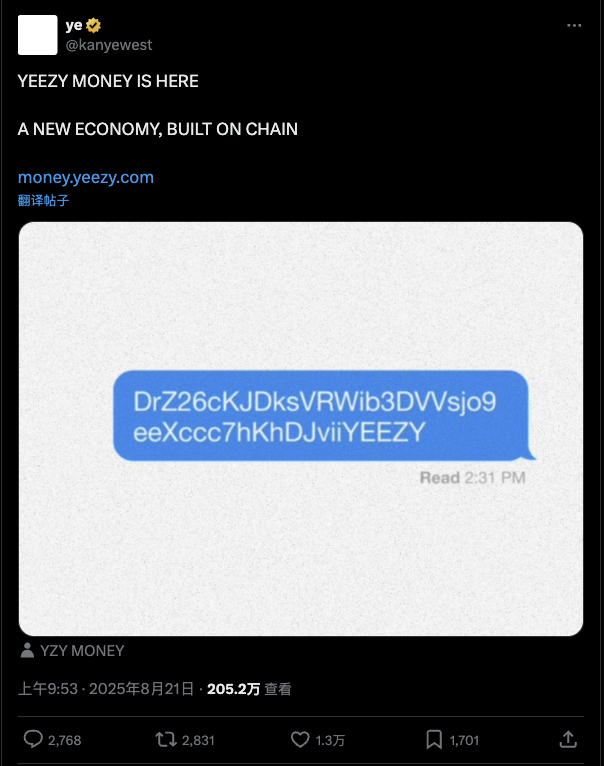

Image: https://x.com/kanyewest/status/1958346810801697237

On August 21, 2025, rapper Kanye West introduced YZY MONEY and its token, YZY, launching the project on the Solana blockchain. Following the announcement, YZY’s market cap skyrocketed to $3 billion within 30 minutes before stabilizing around $1.7 billion. Leveraging Kanye’s celebrity status, YZY quickly rose to prominence in the crypto market.

YZY Tokenomics and Distribution Model
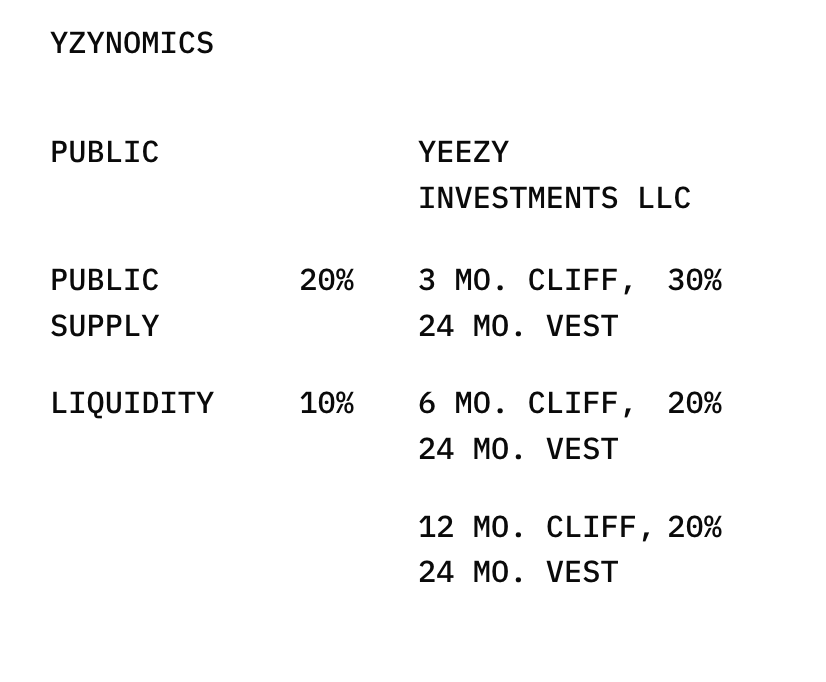

Image: https://money.yeezy.com/

According to the official website, YZY’s token allocation is structured as follows:

  • Public Sale: 20%
  • Liquidity Pool: 10%
  • Issuer: Yeezy Investments LLC (30%), locked for 3 months and then released linearly over 24 months
  • Team: 20%, locked for 6 months and then released linearly over 24 months
  • Ecosystem Development Fund: 20%, locked for 12 months and then released linearly over 24 months

This allocation shows a high proportion held by the team and institutional investors, with a long vesting period. While this secures long-term funding for the project, it also raises concerns about token concentration risk.

Ye Pay: A New Direction for Crypto Payments

Ye Pay, launched alongside YZY, is a payment solution offering low transaction fees and user convenience. Unlike the typical 3.5% merchant fee for traditional payments, Ye Pay offers lower transaction costs and can be easily integrated into e-commerce platforms or apps.

Currently, Kanye’s official store, yeezy.com, accepts crypto payments, and there are plans to introduce direct YZY payments.

YZY Card: Bridging Crypto and Real-World Payments

The YZY Card is designed to enable holders to use YZY and USDC at millions of merchants globally. It operates similarly to a crypto debit card. Unlike conventional offerings, the YZY Card is non-custodial, allowing users to spend directly without intermediaries. The waitlist is open prior to the official release.

Insider Capital and Market Controversy

Despite the project’s high profile, skepticism remains. Data shows that initially, YZY’s liquidity pool contained only YZY tokens, with no USDC, giving developers the ability to remove liquidity and withdraw funds at any time.

Furthermore, several suspected “insider wallets” reportedly purchased tokens prior to the official announcement and quickly sold them after the surge, realizing profits that exceeded $1 million. Such incidents have heightened concerns within the community about token concentration.

Key Risks for Investors

A Coinbase executive noted that around 94% of all YZY tokens are currently held by insiders, most of which are stored in a single multi-signature wallet. While the project team says it has deployed 25 contract addresses to prevent sniping bots, this approach has not eliminated concerns about potential market manipulation. For retail investors, celebrity-backed projects may generate significant attention. Early-stage price volatility is extreme. Caution is recommended.

Conclusion

YZY MONEY represents Kanye West’s innovative move into crypto payments, but also stands as a controversial token project. Combining celebrity appeal, payment utility, and DeFi concepts, it faces ongoing transparency issues in token distribution and market operations. For new investors, it is advisable to exercise caution and avoid being influenced by short-term hype.

YZY MONEY (YZY) is now listed for spot trading on Gate. The token exhibits high volatility. Please exercise caution and manage your risk.
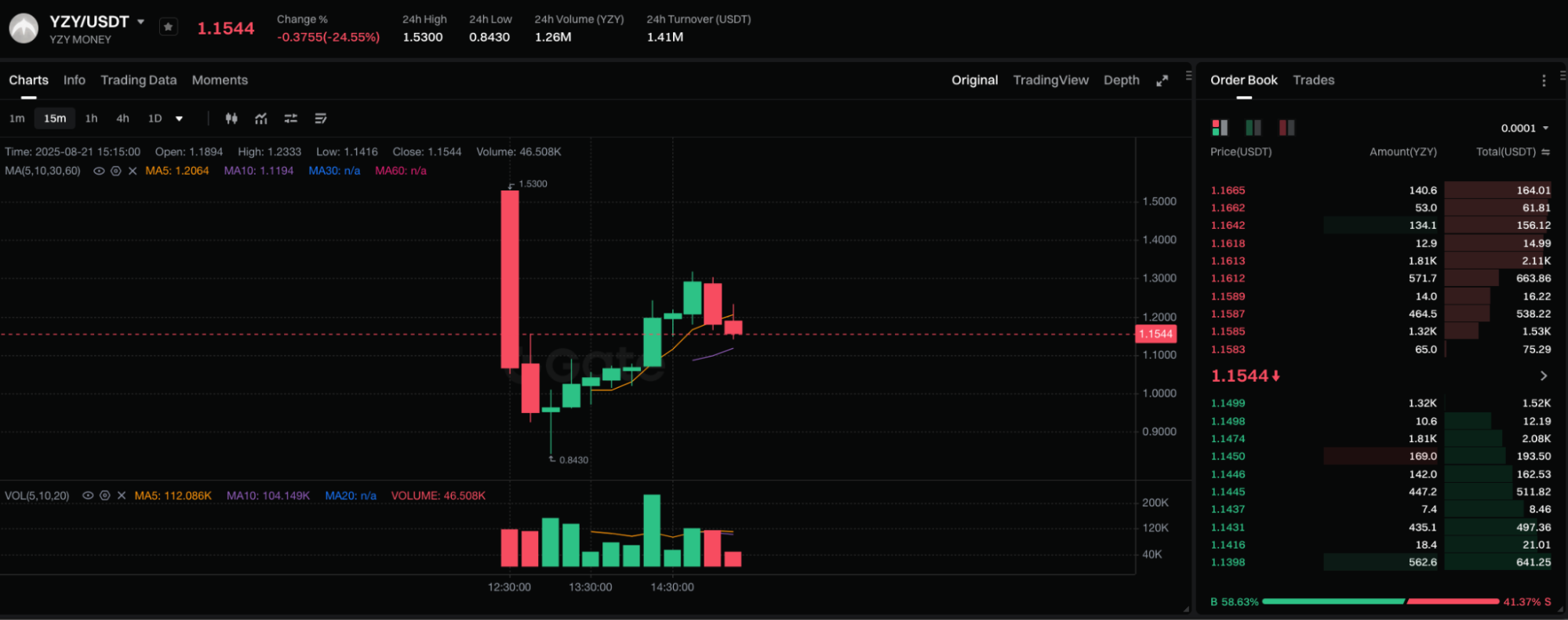

Image: https://www.gate.com/trade/YZY_USDT

Author: Max
Disclaimer
* The information is not intended to be and does not constitute financial advice or any other recommendation of any sort offered or endorsed by Gate.
* This article may not be reproduced, transmitted or copied without referencing Gate. Contravention is an infringement of Copyright Act and may be subject to legal action.

Related Articles

The ve(3,3) Flywheel Explained: How AERO Tokenomics Powers Aerodrome’s DeFi Economy
Beginner

The ve(3,3) Flywheel Explained: How AERO Tokenomics Powers Aerodrome’s DeFi Economy

In the competition for DeFi liquidity, high-inflation mining alone is no longer enough to build lasting advantages. Aerodrome applies the ve(3,3) economic model to redesign token emissions, voting mechanisms, and revenue distribution, creating a liquidity flywheel centered on governance and cash flow. This article examines AERO tokenomics, the veAERO locking mechanism, and protocol revenue models to explain how Aerodrome builds a sustainable DeFi economic system.
2026-03-25 06:41:58
AI-Native Settlement Layers: How United Stables Is Building the Next Financial Rail
Beginner

AI-Native Settlement Layers: How United Stables Is Building the Next Financial Rail

Stablecoins were originally designed as dollar substitutes within exchanges, primarily used for asset pricing and trade settlement. As on-chain financial ecosystems have matured, their role has expanded beyond simple payments to include collateral assets, cross-chain liquidity mediums, and unified settlement units. In particular, as AI systems and automated agents begin to participate directly in economic activity, demand has risen sharply for programmable value units capable of instant settlement. This shift is pushing stablecoins toward the role of foundational financial infrastructure.
2026-03-25 03:16:17
Aerodrome Tokenomics: How ve(3,3) Powers Base's Most Profitable DEX
Beginner

Aerodrome Tokenomics: How ve(3,3) Powers Base's Most Profitable DEX

AERO is the native token of Aerodrome Finance, a core decentralized exchange and liquidity protocol in the Base ecosystem. It is primarily used for liquidity incentives and ecosystem operations. veAERO is a governance NFT that users receive by locking AERO, representing both voting power and the right to share protocol revenue. Through a dual track structure of AERO as a utility token and veAERO as a governance credential, Aerodrome separates liquidity usage value from long term governance power, allowing participants to act as liquidity providers, governance decision makers, and revenue sharers within the same system.
2026-03-25 06:40:31
How Does PAXG Work? In-Depth Overview of the Physical Gold Tokenization Mechanism
Beginner

How Does PAXG Work? In-Depth Overview of the Physical Gold Tokenization Mechanism

PAXG (Pax Gold) is a tokenized asset backed by physical gold, issued by the fintech company Paxos and traded on the Ethereum blockchain as an ERC-20 token. The core concept is to tokenize physical gold on-chain, with each PAXG token representing ownership of a certain amount of gold. This structure enables investors to hold and trade gold in the form of a digital asset.
2026-03-24 19:12:51
How is the price of PAXG determined? Pegging mechanism, trading depth, and influencing factors
Beginner

How is the price of PAXG determined? Pegging mechanism, trading depth, and influencing factors

PAXG (Pax Gold) is a tokenized asset backed by physical gold reserves, launched by fintech firm Paxos and issued as an ERC-20 token on the Ethereum blockchain. The core concept is to digitally represent real-world gold assets, allowing investors to hold and trade gold via the blockchain network. Because each PAXG token corresponds to a specific quantity of physical gold, its price is theoretically expected to closely track the global gold market.
2026-03-24 19:11:40
DePIN Identity Network and Real World Applications: How Humanity Protocol Brings on-chain Identity Into the Physical World
Beginner

DePIN Identity Network and Real World Applications: How Humanity Protocol Brings on-chain Identity Into the Physical World

Most Web3 identity systems remain confined to on-chain environments and struggle to achieve meaningful adoption in real world settings. Through a DePIN architecture and physical verification hardware, Humanity Protocol aims to bring decentralized identity into access control systems, hospitality, public services, and offline events, allowing on-chain identity to function not just as a digital credential, but as foundational infrastructure for real world access.
2026-03-25 07:40:53





