Why Is Ethereum Falling? In-Depth Analysis of the Drop Below $2,200 and Market Trends

Beginner
Quick Reads
Last Updated 2026-03-25 13:27:49
Reading Time: 1m
Explore the reasons behind Ethereum’s decline. This article offers an in-depth analysis of the factors driving Ethereum’s price drop—including market sentiment, macroeconomic conditions, technical indicators, and competitive pressures—to help investors better understand ETH’s current trajectory.

1. Current Ethereum Market Performance Overview
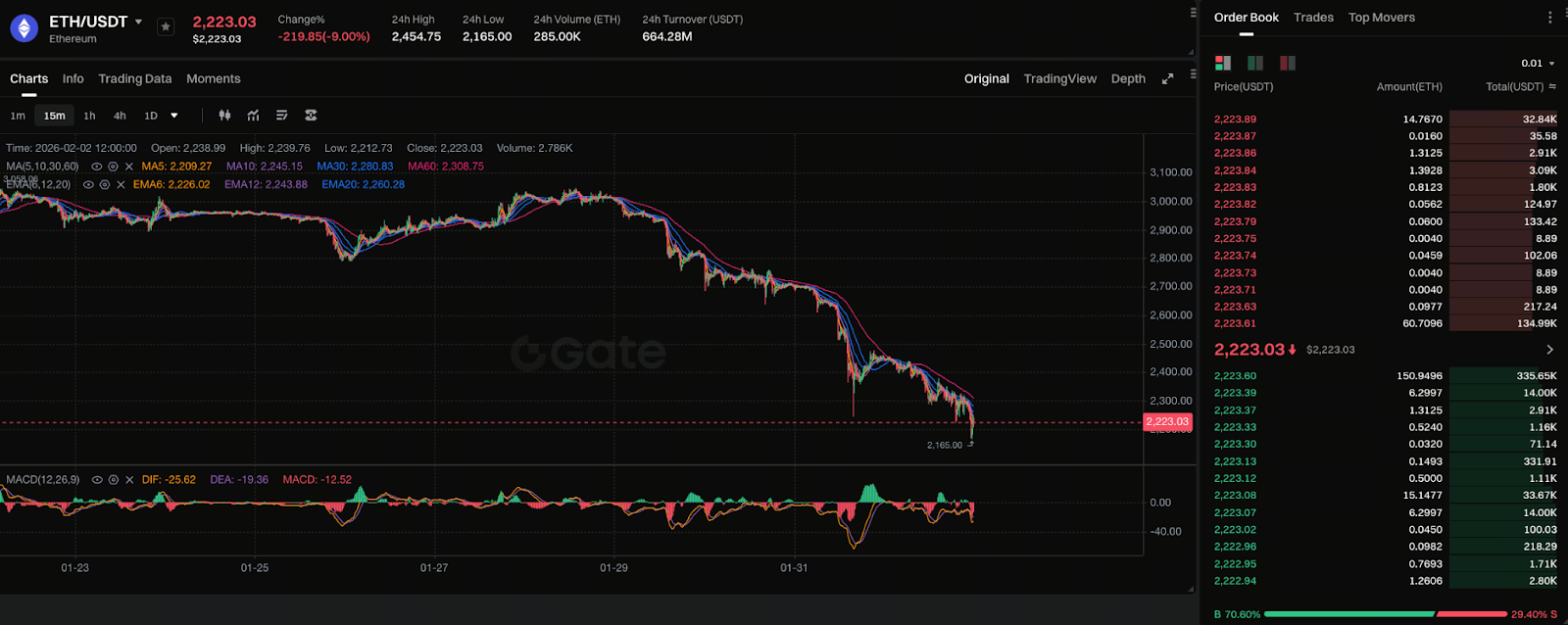

Chart: https://www.gate.com/trade/ETH_USDT

Recently, the cryptocurrency market—including Bitcoin and Ethereum—has experienced a sharp downturn, with ETH breaking below key support levels and overall market panic intensifying. Data indicates that Ethereum’s price has retreated significantly from multi-month highs, and the balance of bullish and bearish forces has shifted. As of February 1, 2026, based on the 15-minute interval data above, ETH/USDT is trading around $2,223, down approximately 9% over the past 24 hours, with a low of $2,165. This marks a classic high-volume sell-off. The price has successively breached crucial psychological levels at $2,500, $2,400, and $2,300, with the overall structure showing a clear downward trend as both highs and lows continue to fall. Technically, ETH is trading below the MA5, MA10, MA30, and MA60 moving averages, which are aligned in a standard bearish formation, and any rebound faces strong selling pressure. Trading volume has surged during the decline, while rebound volume remains weak, reflecting that sellers are currently dominating the market. The MACD indicator is below the zero line, with brief signs of convergence but no confirmed bullish crossover, and no clear signals of a trend reversal. Order book depth reveals concentrated sell orders above and scattered buy orders below, with no evident support forming around the $2,200 level. Overall, this ETH decline is primarily driven by sentiment release and technical breakdowns. In the near term, the market remains defensive, and attention should focus on further support in the $2,160–$2,100 range.

2. Downward Pressure Across the Crypto Market as the Main Driver

Why is Ethereum dropping? From a broader perspective, ETH’s price movement is highly correlated with Bitcoin. When Bitcoin declines, Ethereum typically faces pressure as well, which is especially pronounced in the current market. Macroeconomic uncertainty, global equity volatility, and trade tensions have weighed on risk assets, reducing investor risk appetite and impacting crypto prices.

3. ETH’s Growing Sensitivity to Macroeconomic Factors

As the correlation between crypto and traditional financial markets deepens, macro factors such as Federal Reserve policy shifts, interest rate expectations, and dollar trends have an increasingly significant impact on Ethereum’s price. For instance, a more cautious Fed and slower rate cut expectations have heightened pressure on the already volatile crypto market. These macroeconomic shifts are among the key reasons for ETH’s recent price decline.

4. Technical Factors and Supply Dynamics

Technical indicators also signal downward pressure. After ETH lost multiple key support levels, technical traders have reduced their positions, amplifying price volatility. Additionally, Ethereum’s supply dynamics have shifted. While the transition to Proof of Stake (PoS) initially produced deflationary effects, recent changes in network activity and upgrade outcomes have resulted in renewed supply growth, weakening expectations of scarcity.

5. Intensified Competition and Evolving Network Activity

Another critical factor is ecosystem competition. Ethereum continues to face challenges from other blockchains such as Solana and BNB Chain, while Layer-2 scaling solutions have diverted substantial transaction volume and fee revenue. These shifts mean that, even though the Ethereum mainnet remains vital, structural changes in market demand and network activity may exert downward pressure on its price.

6. Investor Sentiment and Derivatives Market Impact

On-chain data shows declining participation in the ETH derivatives market, with open interest falling and trader confidence weakening. A negative funding rate—where short sellers pay long holders—also reflects a bearish market bias. Investor sentiment indices, such as the Fear and Greed Index, indicate an extreme fear phase, further driving selling activity.

Conclusion: Outlook and Risk Advisory

In summary, the question “why is Ethereum dropping?” cannot be attributed to a single cause. Instead, it results from the combined effects of market structure, macroeconomic conditions, and technical factors. In the short term, ETH is likely to remain volatile until the broader market stabilizes. Over the long term, Ethereum’s core position, ecosystem development, and technical upgrades continue to underpin its value. Investors should remain vigilant about risks and monitor for potential signs of recovery, such as improvements in the derivatives market, growth in Layer-2 businesses, and shifts in macroeconomic trends.

Author: Max
Disclaimer
* The information is not intended to be and does not constitute financial advice or any other recommendation of any sort offered or endorsed by Gate.
* This article may not be reproduced, transmitted or copied without referencing Gate. Contravention is an infringement of Copyright Act and may be subject to legal action.

Related Articles

The ve(3,3) Flywheel Explained: How AERO Tokenomics Powers Aerodrome’s DeFi Economy
Beginner

The ve(3,3) Flywheel Explained: How AERO Tokenomics Powers Aerodrome’s DeFi Economy

In the competition for DeFi liquidity, high-inflation mining alone is no longer enough to build lasting advantages. Aerodrome applies the ve(3,3) economic model to redesign token emissions, voting mechanisms, and revenue distribution, creating a liquidity flywheel centered on governance and cash flow. This article examines AERO tokenomics, the veAERO locking mechanism, and protocol revenue models to explain how Aerodrome builds a sustainable DeFi economic system.
2026-03-25 06:41:58
AI-Native Settlement Layers: How United Stables Is Building the Next Financial Rail
Beginner

AI-Native Settlement Layers: How United Stables Is Building the Next Financial Rail

Stablecoins were originally designed as dollar substitutes within exchanges, primarily used for asset pricing and trade settlement. As on-chain financial ecosystems have matured, their role has expanded beyond simple payments to include collateral assets, cross-chain liquidity mediums, and unified settlement units. In particular, as AI systems and automated agents begin to participate directly in economic activity, demand has risen sharply for programmable value units capable of instant settlement. This shift is pushing stablecoins toward the role of foundational financial infrastructure.
2026-03-25 03:16:17
Aerodrome Tokenomics: How ve(3,3) Powers Base's Most Profitable DEX
Beginner

Aerodrome Tokenomics: How ve(3,3) Powers Base's Most Profitable DEX

AERO is the native token of Aerodrome Finance, a core decentralized exchange and liquidity protocol in the Base ecosystem. It is primarily used for liquidity incentives and ecosystem operations. veAERO is a governance NFT that users receive by locking AERO, representing both voting power and the right to share protocol revenue. Through a dual track structure of AERO as a utility token and veAERO as a governance credential, Aerodrome separates liquidity usage value from long term governance power, allowing participants to act as liquidity providers, governance decision makers, and revenue sharers within the same system.
2026-03-25 06:40:31
How Does PAXG Work? In-Depth Overview of the Physical Gold Tokenization Mechanism
Beginner

How Does PAXG Work? In-Depth Overview of the Physical Gold Tokenization Mechanism

PAXG (Pax Gold) is a tokenized asset backed by physical gold, issued by the fintech company Paxos and traded on the Ethereum blockchain as an ERC-20 token. The core concept is to tokenize physical gold on-chain, with each PAXG token representing ownership of a certain amount of gold. This structure enables investors to hold and trade gold in the form of a digital asset.
2026-03-24 19:12:51
How is the price of PAXG determined? Pegging mechanism, trading depth, and influencing factors
Beginner

How is the price of PAXG determined? Pegging mechanism, trading depth, and influencing factors

PAXG (Pax Gold) is a tokenized asset backed by physical gold reserves, launched by fintech firm Paxos and issued as an ERC-20 token on the Ethereum blockchain. The core concept is to digitally represent real-world gold assets, allowing investors to hold and trade gold via the blockchain network. Because each PAXG token corresponds to a specific quantity of physical gold, its price is theoretically expected to closely track the global gold market.
2026-03-24 19:11:40
DePIN Identity Network and Real World Applications: How Humanity Protocol Brings on-chain Identity Into the Physical World
Beginner

DePIN Identity Network and Real World Applications: How Humanity Protocol Brings on-chain Identity Into the Physical World

Most Web3 identity systems remain confined to on-chain environments and struggle to achieve meaningful adoption in real world settings. Through a DePIN architecture and physical verification hardware, Humanity Protocol aims to bring decentralized identity into access control systems, hospitality, public services, and offline events, allowing on-chain identity to function not just as a digital credential, but as foundational infrastructure for real world access.
2026-03-25 07:40:53





