In Web3 projects, tokenomics are crucial for ensuring a project's long-term value. While many projects issue tokens, their value often depends heavily on market sentiment due to a lack of genuine revenue backing. As soon as the market cools, both token prices and ecosystem activity can quickly decline.
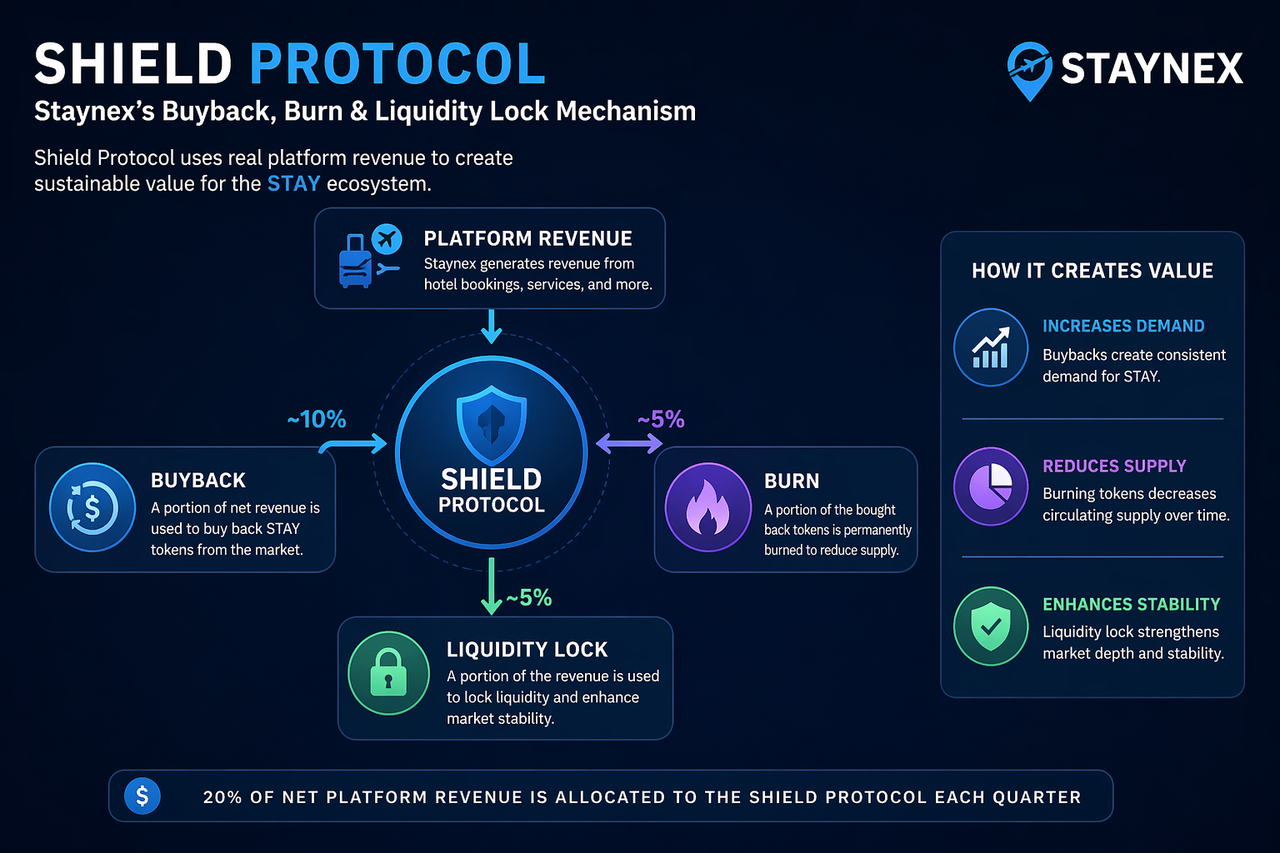
The Shield Protocol, introduced by Staynex, is a mechanism that ties platform revenue directly to token value. By allocating a portion of the platform’s net income to buy back STAY, burn tokens, and lock liquidity, Shield Protocol aligns platform growth with the token’s supply and demand dynamics.
Shield Protocol is a value support model developed by Staynex for the STAY token. Its primary goal is to continuously allocate a portion of platform revenue to the token market, reinforcing STAY’s long-term value. Officially, Staynex dedicates 20% of its net income to buybacks, burning, and liquidity lockup.
This structure effectively turns platform business growth into increased token demand. As platform revenue rises, more funds are used to buy back STAY, driving sustained buy-side demand. Simultaneously, a portion of repurchased tokens is burned, reducing circulation and increasing scarcity.
Through this approach, Shield Protocol directly links STAY’s value to actual business performance, rather than relying solely on secondary market sentiment.
The buyback mechanism is the most direct method of value support within Shield Protocol. Staynex uses part of its net income to repurchase STAY on the market, creating tangible buy-side demand every time the platform generates revenue.
Buybacks serve two key purposes. First, they increase market demand, providing additional support for STAY. Second, they convert platform revenue into token demand, tying token value to business growth. As bookings and revenue grow, buybacks theoretically intensify, creating a positive value cycle.
For users, this means STAY’s long-term value is not driven solely by speculation—it is supported by real demand generated from platform growth.
After buying back STAY, Staynex burns a portion of the tokens. Burning permanently removes these tokens from circulation, making them unusable and untradeable. This mechanism’s primary function is to decrease STAY’s circulating supply, strengthening value support from the supply side.
If market demand remains stable or increases while circulating supply drops, the token becomes more scarce, which may positively impact long-term supply-demand dynamics. Compared to buybacks alone, burning produces a more pronounced supply contraction.
For STAY, combining burning with revenue growth enables a dynamically decreasing total supply, providing stronger long-term value support.
In addition to buybacks and burning, Shield Protocol allocates some funds to liquidity pool lockup. Locking liquidity enhances STAY’s market stability and reduces price volatility caused by insufficient liquidity.
In many projects, even with buybacks, low liquidity can cause sharp price swings from large trades. By locking liquidity, Staynex increases market depth and creates a more stable trading environment for STAY.
This benefits overall market performance and boosts user and investor confidence in the tokenomics, making Shield Protocol’s design more robust.
Shield Protocol’s core value is its complete closed-loop structure: platform revenue growth leads to more buyback funds, buybacks increase demand, burning reduces supply, and liquidity lockup stabilizes the market. Together, these elements enable platform growth to translate into long-term value support for STAY.
The closed-loop model’s advantage is its direct linkage between token value and business performance. Changes in platform operations affect the mechanism’s effectiveness; the more stable the token, the greater user participation. This positive feedback loop helps ensure ecosystem sustainability.
Such income-driven, closed-loop token models are rare in Web3, making Shield Protocol a key innovation in Staynex’s token design.
For Staynex, Shield Protocol is more than just a buyback and burn tool—it is central to the platform’s long-term value model. It connects travel business income with token value, positioning STAY as a genuine ecosystem asset tied to platform growth, not merely a reward token.
This mechanism enables Staynex to achieve three objectives: first, to establish long-term value support for STAY; second, to motivate users to hold and stake; and third, to enhance overall ecosystem stability. In the competitive Web3 landscape, this income-driven approach strengthens the connection between the token model and business performance.
While Shield Protocol provides a comprehensive token adjustment mechanism through buybacks, burning, and liquidity lockup, its effectiveness depends on Staynex’s actual revenue. If revenue growth is limited, available funds for buybacks and burning will also be limited, reducing the mechanism’s impact. Additionally, while buybacks and lockups influence supply and demand, they cannot guarantee price stability—market sentiment and liquidity fluctuations may still cause volatility.
Shield Protocol is Staynex’s core value support mechanism for the STAY token, allocating 20% of net income to buybacks, burning, and liquidity lockup to create a closed-loop, income-driven value growth model. This directly ties STAY’s value to platform performance, enhancing its long-term value.
For the STAYNEX ecosystem, Shield Protocol means token value is no longer solely reliant on market sentiment—it is supported by real income. As the platform evolves, Shield Protocol will continue to shape STAY’s supply-demand structure and liquidity.
It boosts market demand by using platform income to buy back STAY, reduces circulating supply through burning, and stabilizes the market via liquidity lockup, strengthening STAY’s long-term value.
Burning reduces STAY’s circulating supply and increases scarcity, allowing business growth to translate into stronger value support.
Regular buybacks only increase market demand, while Shield Protocol integrates buybacks, burning, and liquidity lockup for a more comprehensive value closed loop.