
What Is Eclipse? Building the Supercomputer of the Blockchain World

Beginner
Quick Reads
Last Updated 2026-03-30 03:23:46
Reading Time: 1m
Eclipse is a Layer 2 Blockchain project based on SVM architecture, dedicated to achieving "GigaCompute" supercomputing performance through collaborative design of software and hardware, providing high-performance infrastructure for AI, gaming, and DePIN.

What is Eclipse?


Figure:https://www.eclipse.xyz/

Eclipse is a Layer 2 Blockchain protocol built on the Solana Virtual Machine (SVM). It differs from traditional Layer 1 public chains by adopting an Optimistic Rollup architecture, delegating security to the underlying L1 while focusing on extreme performance optimization.

The core goal of Eclipse: to create the strongest SVM Layer 2.

Although SVM itself has high efficiency, Eclipse aims to enhance on-chain computing power by introducing a new client GSVM (GigaCompute SVM), hoping to achieve several orders of magnitude improvement and truly realize decentralized application support at the level of “super computing.”

The Four Design Principles of Eclipse

  1. Co-design of hardware and software: Optimize networking, storage, and runtime to enhance overall efficiency;
  2. Cross-layer Optimization: For example, reducing storage latency by pre-fetching transaction data;
  3. Non-interference: DEX and blockchain games can operate without affecting each other.
  4. Elasticity: Dynamically add CPU/GPU cores and storage resources based on application requirements.

Eclipse’s innovation in hardware acceleration

Eclipse boldly utilizes modern hardware components such as SmartNIC, FPGA, and GPU to offload part of the transaction preprocessing and even execution to the network layer, achieving latency performance close to that of network cards. At the same time, its caching mechanism and multi-threaded scheduling system can dynamically create “hotspot islands” to allocate independent resources for popular applications, avoiding system congestion.

What can GigaCompute bring?

In GSVM mode, Eclipse can far exceed the current TPS limits of public chains, while introducing Compute Units as a measurement unit to more accurately assess on-chain activities with high computational density, such as AI inference, real-time interactions in on-chain games, and DePIN network control.

Future Prospects and Ecological Applications

Eclipse’s performance advantages make it naturally suitable for high concurrency and high throughput application types, including AI model hosting, on-chain competitive games, real-time control of edge devices, and other emerging fields. When public chains like Ethereum struggle to meet these scenarios, Eclipse provides a performance breakthrough.
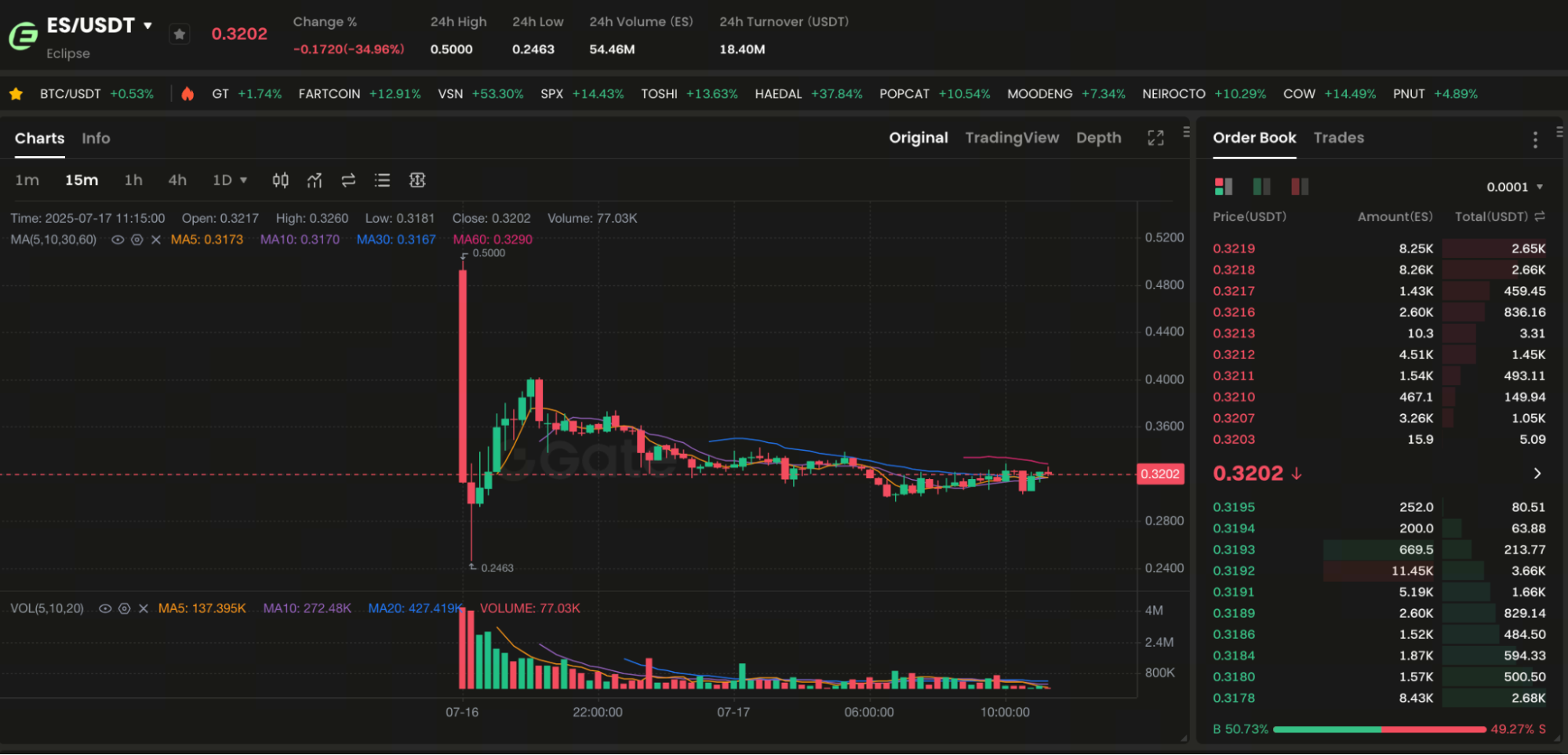

Figure:https://www.gate.com/trade/ES_USDT

ES has launched on Gate spot Block, on July 17, 2025, the ES price is approximately $0.32.

Author: Max
Disclaimer
* The information is not intended to be and does not constitute financial advice or any other recommendation of any sort offered or endorsed by Gate.
* This article may not be reproduced, transmitted or copied without referencing Gate. Contravention is an infringement of Copyright Act and may be subject to legal action.

Related Articles

AI-Native Settlement Layers: How United Stables Is Building the Next Financial Rail
Beginner

AI-Native Settlement Layers: How United Stables Is Building the Next Financial Rail

Stablecoins were originally designed as dollar substitutes within exchanges, primarily used for asset pricing and trade settlement. As on-chain financial ecosystems have matured, their role has expanded beyond simple payments to include collateral assets, cross-chain liquidity mediums, and unified settlement units. In particular, as AI systems and automated agents begin to participate directly in economic activity, demand has risen sharply for programmable value units capable of instant settlement. This shift is pushing stablecoins toward the role of foundational financial infrastructure.
2026-03-25 03:16:17
The ve(3,3) Flywheel Explained: How AERO Tokenomics Powers Aerodrome’s DeFi Economy
Beginner

The ve(3,3) Flywheel Explained: How AERO Tokenomics Powers Aerodrome’s DeFi Economy

In the competition for DeFi liquidity, high-inflation mining alone is no longer enough to build lasting advantages. Aerodrome applies the ve(3,3) economic model to redesign token emissions, voting mechanisms, and revenue distribution, creating a liquidity flywheel centered on governance and cash flow. This article examines AERO tokenomics, the veAERO locking mechanism, and protocol revenue models to explain how Aerodrome builds a sustainable DeFi economic system.
2026-03-25 06:41:58
Aerodrome Tokenomics: How ve(3,3) Powers Base's Most Profitable DEX
Beginner

Aerodrome Tokenomics: How ve(3,3) Powers Base's Most Profitable DEX

AERO is the native token of Aerodrome Finance, a core decentralized exchange and liquidity protocol in the Base ecosystem. It is primarily used for liquidity incentives and ecosystem operations. veAERO is a governance NFT that users receive by locking AERO, representing both voting power and the right to share protocol revenue. Through a dual track structure of AERO as a utility token and veAERO as a governance credential, Aerodrome separates liquidity usage value from long term governance power, allowing participants to act as liquidity providers, governance decision makers, and revenue sharers within the same system.
2026-03-25 06:40:31
DePIN Identity Network and Real World Applications: How Humanity Protocol Brings on-chain Identity Into the Physical World
Beginner

DePIN Identity Network and Real World Applications: How Humanity Protocol Brings on-chain Identity Into the Physical World

Most Web3 identity systems remain confined to on-chain environments and struggle to achieve meaningful adoption in real world settings. Through a DePIN architecture and physical verification hardware, Humanity Protocol aims to bring decentralized identity into access control systems, hospitality, public services, and offline events, allowing on-chain identity to function not just as a digital credential, but as foundational infrastructure for real world access.
2026-03-25 07:40:53
How is the price of PAXG determined? Pegging mechanism, trading depth, and influencing factors
Beginner

How is the price of PAXG determined? Pegging mechanism, trading depth, and influencing factors

PAXG (Pax Gold) is a tokenized asset backed by physical gold reserves, launched by fintech firm Paxos and issued as an ERC-20 token on the Ethereum blockchain. The core concept is to digitally represent real-world gold assets, allowing investors to hold and trade gold via the blockchain network. Because each PAXG token corresponds to a specific quantity of physical gold, its price is theoretically expected to closely track the global gold market.
2026-03-24 19:11:40
How Does PAXG Work? In-Depth Overview of the Physical Gold Tokenization Mechanism
Beginner

How Does PAXG Work? In-Depth Overview of the Physical Gold Tokenization Mechanism

PAXG (Pax Gold) is a tokenized asset backed by physical gold, issued by the fintech company Paxos and traded on the Ethereum blockchain as an ERC-20 token. The core concept is to tokenize physical gold on-chain, with each PAXG token representing ownership of a certain amount of gold. This structure enables investors to hold and trade gold in the form of a digital asset.
2026-03-24 19:12:51





