In the decentralized finance (DeFi) ecosystem, the idea of borrowing substantial funds without collateral may sound implausible, but that's exactly the innovative mechanism enabled by Aave through Flash Loans. Unlike traditional lending, Flash Loans bypass collateral requirements by leveraging the blockchain's “atomic transaction” property—borrow and repayment must occur within the same transaction. If repayment fails, the transaction automatically rolls back as if nothing ever happened.
Flash Loans break the traditional reliance on collateral assets, significantly lowering barriers for arbitrage, asset swaps, and self-liquidation. Fundamentally, they are programmable, complex instructions whose successful execution depends on transaction finality verification by virtual machines like Ethereum. As a result, Flash Loans are sometimes exploited by hackers, leading to multiple DeFi attack incidents and making them a focal point in industry security discussions.
Flash Loan Workflow and Features
On Aave, any developer can invoke a smart contract to complete the following steps within a single transaction:
- Borrow assets from the liquidity pool
- Execute a series of custom operations (arbitrage, liquidation, etc.)
- Repay principal plus fees; if repayment fails, the transaction is automatically revoked and funds return to the liquidity pool.
Flash Loans differ fundamentally from traditional DeFi lending in asset operation logic:
- Capital Efficiency: Flash Loans use “atomicity” technology to achieve zero-collateral lending, greatly boosting capital utilization. Their lifecycle is limited to a single transaction block.
- Risk Model: Traditional lending is exposed to market volatility and liquidation risk; Flash Loan risks mainly center on smart contract logic flaws or execution failures.
- Positioning: Flash Loans are technology-driven, functioning as instant financial tools, while traditional lending is strategy-driven, serving as long-term financial leverage.
| Dimension |
Flash Loan |
Traditional DeFi Lending |
| Collateral Requirement |
None |
Overcollateralization required |
| Loan Duration |
Within a single transaction |
Long-term holding possible |
| Risk Exposure |
Smart contract execution risk |
Market volatility + liquidation risk |
| Use Cases |
Arbitrage, liquidation, restructuring |
Investment, leveraged positions |
Flash Loan Technical Execution on Aave
Flash Loan execution relies heavily on programmable smart contract instructions, following strict logical steps:
- Trigger: User initiates a smart contract call with the
executeOperation() function, requesting a specific amount from the Aave pool.
- Execution:
- Fund Transfer: Aave checks the pool balance, then transfers tokens to the borrowing contract upon confirmation.
- Custom Operations: The borrowing contract executes preset logic in the same transaction (such as trades or liquidation on a DEX).
- Repayment Check: At the end of the function, Aave checks whether “principal + fees” have been repaid (Aave V3 Flash Loan fees are typically 0.05%).
- Result: If repayment succeeds, the transaction is confirmed and written to the block; if the balance is insufficient, the execution fails and funds revert to the pool.
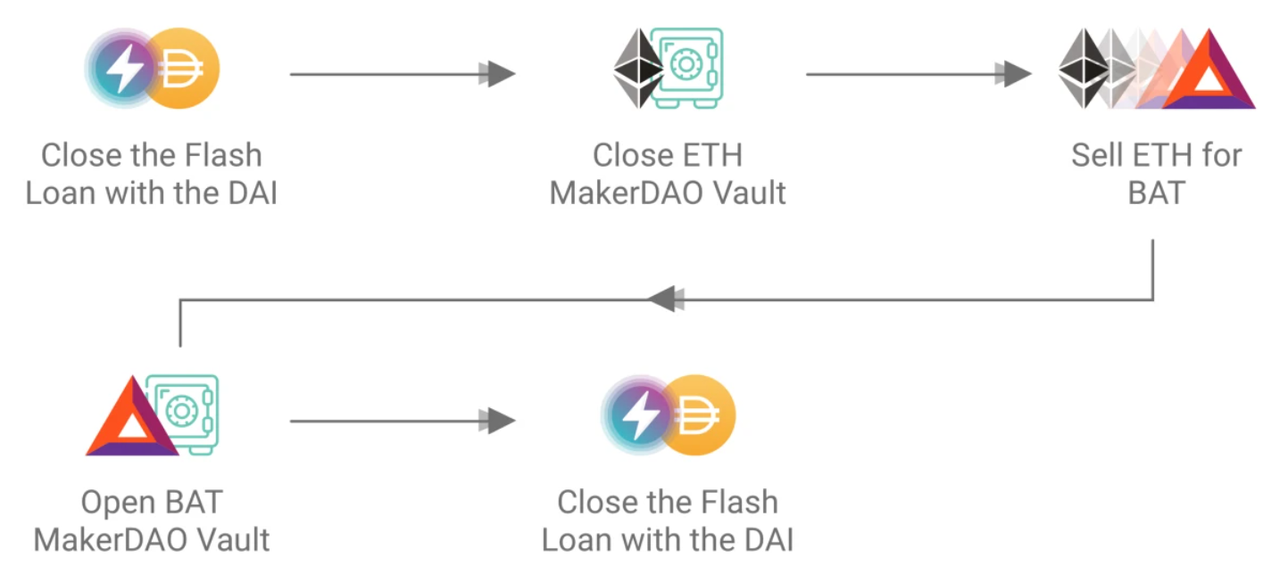 Image Source: Book Crifan, Flash Loan
The Aave protocol does not determine the legality of user operations; it simply ensures funds are repaid. As such, Flash Loans are best viewed as “programmable liquidity tools.”
Typical Use Cases
Flash Loans are a core financial primitive in DeFi, not because of their “no collateral” novelty, but because they dramatically enhance capital efficiency, enabling complex on-chain financial operations without personal capital or cross-block risks. In the Aave ecosystem, Flash Loans have become essential tools for arbitrageurs, liquidation bots, professional traders, and protocol developers.
Practically, Flash Loans are most commonly used for cross-platform arbitrage, collateral structure optimization, liquidation execution, and debt restructuring. These operations typically require significant capital and time windows in traditional finance, but on Aave, they can be automated via smart contracts.
Cross-Platform Arbitrage: Profiting Without Principal
Cross-platform arbitrage is the classic Flash Loan application. When temporary price discrepancies arise between decentralized exchanges, arbitrageurs can execute “buy low, sell high” loops within a single transaction. For example, a trader borrows ETH with a Flash Loan, buys an asset on a lower-priced DEX, then sells it on a higher-priced DEX, repays the loan and fee, and retains the profit.
Since the entire process occurs in one transaction, arbitrageurs avoid price volatility risk and need no upfront capital. This approach boosts market price discovery efficiency and compresses arbitrage opportunities, leading to greater market equilibrium.
Collateral Restructuring: Optimizing Collateral and Capital Efficiency
In DeFi lending protocols, users must usually overcollateralize assets. When market conditions or interest rates change, users may want to adjust collateral types or reduce borrowing costs. Flash Loans allow users to repay debt, release collateral, swap assets, and repledge—all within a single block.
For example, a user can temporarily repay existing debt with a Flash Loan, unlock original collateral, switch to assets with lower volatility or better rates, rebuild their position, and finally repay the Flash Loan. This process eliminates the risk window between “repay and reborrow,” greatly improving fund management flexibility.
Liquidation Execution: Enhancing System Stability
When a borrower’s collateral ratio drops below a safety threshold, protocols trigger liquidation. Liquidators must repay part of the debt to claim discounted collateral. Flash Loans allow liquidators to participate without their own capital.
Liquidation bots monitor on-chain health factors in real time, and when they detect a liquidatable position, they borrow needed funds via Flash Loan, complete the liquidation, and earn rewards. The transaction must be profitable to cover fees, otherwise it rolls back—creating automated market competition and improving lending system stability.
Debt Restructuring: Rate Switching and Asset Conversion
On Aave, borrowers can choose between different interest rate models (variable or stable). When rates change, borrowers may want to restructure debt. Flash Loans enable repayment of old debt and establishment of new debt within a single transaction for seamless transitions.
Additionally, users wishing to switch their borrowing asset from one token to another (such as ETH to AAVE) can use Flash Loans for asset swaps without preparing extra funds. This debt restructuring functionality gives Aave high composability and capital efficiency in complex asset management scenarios.
Historical Attack Case Analysis
Flash Loans can instantly mobilize massive liquidity, making them a tool for hackers to manipulate oracle prices or exploit logic flaws in vulnerable projects.
On December 29, 2025, BlockSec Phalcon monitoring reported a Flash Loan attack on an unknown MSCST smart contract on BSC, causing approximately $130,000 in losses. The vulnerability was due to the lack of access control (ACL) in the releaseReward() function, allowing attackers to manipulate GPC token prices in PancakeSwap’s liquidity pool (0x12da).
Flash Loans are neutral financial tools; such attacks stem from protocol flaws in oracle mechanisms or business logic, not from Flash Loan technology itself.
Aave Flash Loan Risks and Limitations
Despite their extreme efficiency, users and developers must be aware of the following risks:
- Technical Risk: Code bugs or smart contract logic errors can lead to unexpected fund loss during execution, or result in expensive gas fees (gas must be paid even if the transaction fails).
- Market Manipulation: Malicious actors may use large amounts of capital to instantly alter market depth.
- Misconceptions: Flash Loans are not a “free lunch”—they demand extremely rigorous programming logic, and non-professional users risk losses from improper use.
Summary
Flash Loans are a collateral-free, instant, on-chain lending model that must be repaid within the same transaction. Their foundation is blockchain “atomicity”—multiple operations in a transaction either all succeed or all fail and roll back.
In summary, Aave Flash Loans are a landmark innovation in DeFi, breaking traditional capital constraints and enabling collateral-free, risk-free asset mobility. However, they also heighten systemic risk, demanding higher standards for protocol design and security models.
FAQs
Is there a fee for using Aave Flash Loans?
Yes. In the Aave V3 protocol, Flash Loans typically incur a fixed fee of 0.05%.
What happens if I fail to repay within the same transaction?
The entire transaction fails and rolls back. Your borrowing, trading, and repayment instructions are wiped, and your account returns to its pre-loan state, but you must still pay the gas fees for executing the transaction.
Can regular users use Flash Loans without coding?
Currently, mainstream Flash Loans require execution via smart contract coding. However, some visual protocols and platforms let regular users combine Flash Loan instructions through graphical interfaces.
Do Flash Loans impact AAVE token value?
Indirectly, as they increase protocol usage and fee revenue.







