Vitalik Buterin: Ethereum’s core philosophy isn't about saving the world; it’s about building a digital space that stands up to pervasive surveillance and control.

Last Updated 2026-03-24 21:25:00
Reading Time: 1m
Ethereum co-founder Vitalik Buterin asserts that although Ethereum cannot address every global challenge, the technology offers an opportunity to reshape the digital world’s power dynamics in the face of expanding government and corporate influence. He calls on the community to prioritize privacy and autonomy, advocating for the development of resilient sanctuary technologies capable of resisting external pressure.

Not Claiming the Role of Savior

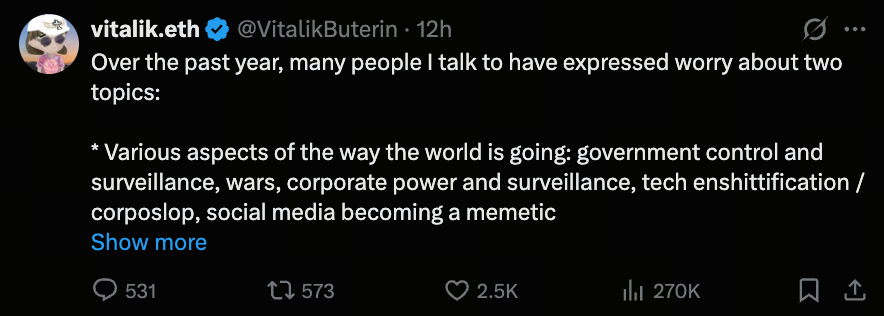
Vitalik Buterin recently made it clear that he doesn't see Ethereum as a cure-all for the world's problems. Still, amid growing concerns about unchecked power by governments and major corporations, he believes blockchain technology has real potential to shift the balance of power in the digital realm. In his view, reducing cryptocurrency to just an industry—or treating Ethereum as merely a business project—grossly undervalues its true potential.

Ethereum’s Role: Creating Digital Spaces
(Source: VitalikButerin)

Buterin wrote on social media that Ethereum’s core mission is to build an open "digital space" where diverse communities can collaborate and interact.

He stressed:

  • The crypto industry shouldn't be defined solely by efficiency or flashy technology

  • There's no need to emulate the growth strategies of tech giants like Apple or Google

  • The industry should refocus on decentralization and the public good

He believes now is a pivotal moment for clearly defining these principles.

Addressing Social Criticism: Is Ethereum Driving Real Change?

Buterin acknowledged he's heard plenty of criticism that Ethereum hasn't made a tangible impact on real-world issues. Whether it's surveillance capitalism, armed conflict, or social media polarization, some question whether Ethereum is truly advancing core values like freedom, privacy, and community autonomy. In response, he says Ethereum needs to redefine its role.

Building Sanctuary Technologies

Buterin introduced the idea that Ethereum should be part of a "sanctuary technologies" ecosystem.

Such technologies are characterized by:

  • Being open-source and free

  • Supporting individuals’ daily lives and work

  • Enhancing digital privacy and asset security

  • Enabling community self-organization

  • Remaining resilient under external pressures

In other words, these technologies should prioritize resilience and autonomy over sheer efficiency.

De-Totalization: Reducing Power Concentration

Buterin introduced "de-totalization"—the goal of limiting the chance that any single government, corporation, or dominant entity can take total control.

He compared this to lowering the stakes in a battle for paradise: preventing winners from seizing overwhelming power and losers from being entirely excluded. In this framework, the digital world moves away from zero-sum competition toward coexistence among many stakeholders.

Echoing the Cypherpunk Ethos of the 1990s

Buterin’s perspective echoes the cypherpunk movement of the 1990s, whose advocates championed cryptographic tools to resist centralized surveillance and abuses of power, framing privacy and autonomy as digital age essentials. Now, he calls on developers to organize around shared values, making Ethereum more than a technology platform—it should be the backbone for resisting excessive centralization.

Summary

For Buterin, Ethereum isn’t about saving the world—it's about reshaping digital power structures. As governments and corporations amass increasing digital control, he believes blockchain offers a real alternative: open, decentralized systems that make absolute dominance by any single party nearly impossible.

Author:  Allen
Disclaimer
* The information is not intended to be and does not constitute financial advice or any other recommendation of any sort offered or endorsed by Gate.
* This article may not be reproduced, transmitted or copied without referencing Gate. Contravention is an infringement of Copyright Act and may be subject to legal action.

Related Articles

AI-Native Settlement Layers: How United Stables Is Building the Next Financial Rail
Beginner

AI-Native Settlement Layers: How United Stables Is Building the Next Financial Rail

Stablecoins were originally designed as dollar substitutes within exchanges, primarily used for asset pricing and trade settlement. As on-chain financial ecosystems have matured, their role has expanded beyond simple payments to include collateral assets, cross-chain liquidity mediums, and unified settlement units. In particular, as AI systems and automated agents begin to participate directly in economic activity, demand has risen sharply for programmable value units capable of instant settlement. This shift is pushing stablecoins toward the role of foundational financial infrastructure.
2026-03-25 03:16:17
The ve(3,3) Flywheel Explained: How AERO Tokenomics Powers Aerodrome’s DeFi Economy
Beginner

The ve(3,3) Flywheel Explained: How AERO Tokenomics Powers Aerodrome’s DeFi Economy

In the competition for DeFi liquidity, high-inflation mining alone is no longer enough to build lasting advantages. Aerodrome applies the ve(3,3) economic model to redesign token emissions, voting mechanisms, and revenue distribution, creating a liquidity flywheel centered on governance and cash flow. This article examines AERO tokenomics, the veAERO locking mechanism, and protocol revenue models to explain how Aerodrome builds a sustainable DeFi economic system.
2026-03-25 06:41:58
Aerodrome Tokenomics: How ve(3,3) Powers Base's Most Profitable DEX
Beginner

Aerodrome Tokenomics: How ve(3,3) Powers Base's Most Profitable DEX

AERO is the native token of Aerodrome Finance, a core decentralized exchange and liquidity protocol in the Base ecosystem. It is primarily used for liquidity incentives and ecosystem operations. veAERO is a governance NFT that users receive by locking AERO, representing both voting power and the right to share protocol revenue. Through a dual track structure of AERO as a utility token and veAERO as a governance credential, Aerodrome separates liquidity usage value from long term governance power, allowing participants to act as liquidity providers, governance decision makers, and revenue sharers within the same system.
2026-03-25 06:40:31
How Does PAXG Work? In-Depth Overview of the Physical Gold Tokenization Mechanism
Beginner

How Does PAXG Work? In-Depth Overview of the Physical Gold Tokenization Mechanism

PAXG (Pax Gold) is a tokenized asset backed by physical gold, issued by the fintech company Paxos and traded on the Ethereum blockchain as an ERC-20 token. The core concept is to tokenize physical gold on-chain, with each PAXG token representing ownership of a certain amount of gold. This structure enables investors to hold and trade gold in the form of a digital asset.
2026-03-24 19:12:51
How is the price of PAXG determined? Pegging mechanism, trading depth, and influencing factors
Beginner

How is the price of PAXG determined? Pegging mechanism, trading depth, and influencing factors

PAXG (Pax Gold) is a tokenized asset backed by physical gold reserves, launched by fintech firm Paxos and issued as an ERC-20 token on the Ethereum blockchain. The core concept is to digitally represent real-world gold assets, allowing investors to hold and trade gold via the blockchain network. Because each PAXG token corresponds to a specific quantity of physical gold, its price is theoretically expected to closely track the global gold market.
2026-03-24 19:11:40
Aster vs Hyperliquid: Which Perp DEX Will Prevail?
Beginner

Aster vs Hyperliquid: Which Perp DEX Will Prevail?

Aster and Hyperliquid are the two representative protocols of the "purpose-built L1 path" within the current decentralized perpetual exchange (Perp DEX) sector. As a pioneer in the field, Hyperliquid has built a deep liquidity moat through its highly mature order book architecture and strong community consensus. Conversely, Aster, as a rising challenger, seeks to leapfrog the competition in high-performance trading through more aggressive multi-chain aggregation logic, private transaction modules, and an underlying execution environment optimized for 2026 market demands.
2026-03-24 11:58:33





