US Senate Passes Government Funding Bill — Awaits Final Vote in the House

Beginner
Quick Reads
Last Updated 2026-03-27 21:35:11
Reading Time: 1m
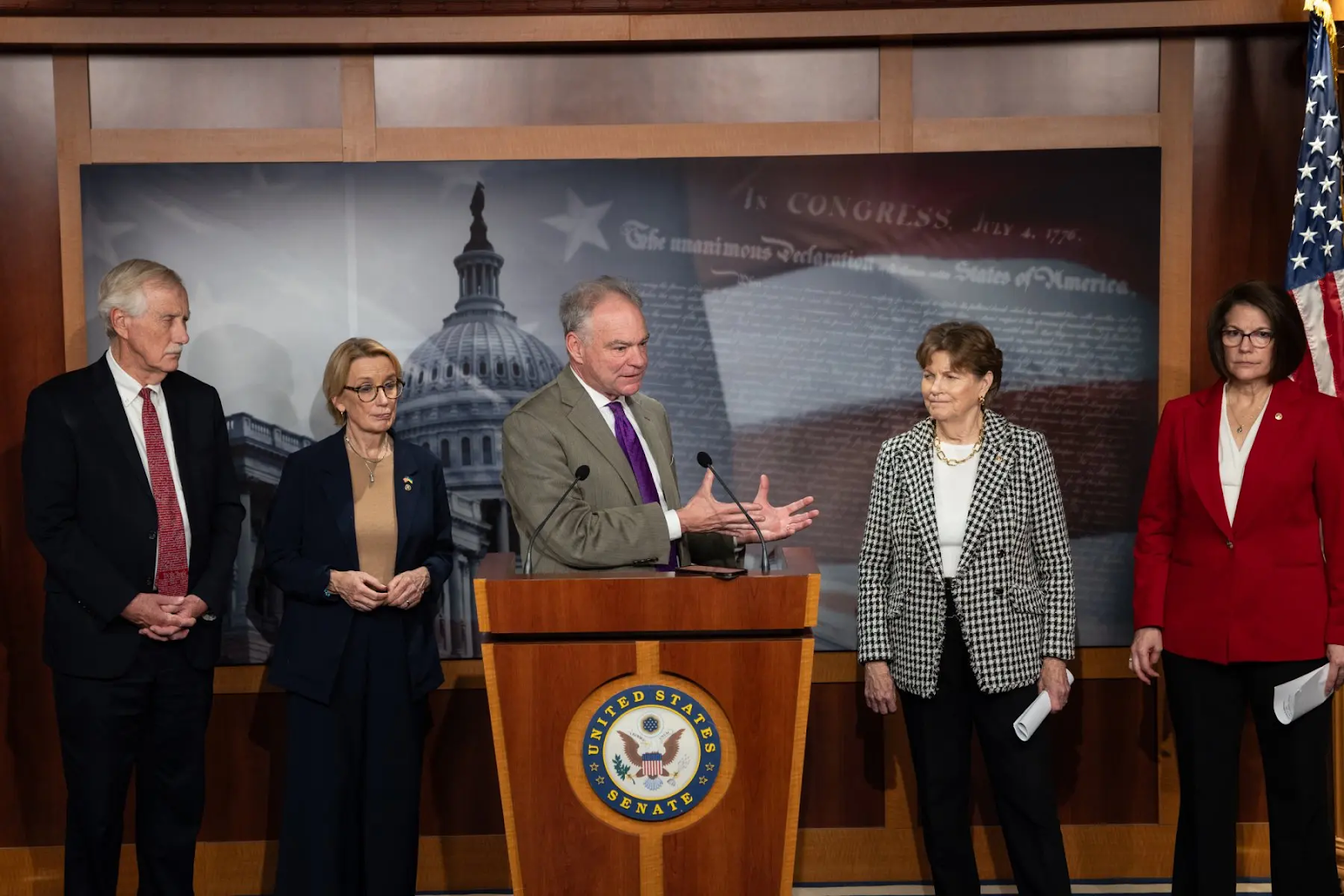
The U.S. Senate approved a significant appropriations bill with a 60–40 vote, paving the way to resume federal government operations. The legislation now heads to the House of Representatives for a vote and could potentially end the longest government shutdown in U.S. history.


Image: https://time.com/7332610/8-senators-broke-with-democrats-to-end-government-shutdown/

On November 10, 2025, after weeks of gridlock, the United States Senate passed a stopgap funding bill by a 60-40 vote, marking a pivotal stage in efforts to restart the federal government. The bill provides government funding through January 30, 2026, and includes full-year appropriations for select departments.

Background: Causes of the Government Shutdown

The 2025 government shutdown began on October 1 after Congress failed to pass a Continuing Resolution or other budget measures for the new fiscal year. The shutdown’s broad impacts included missed paychecks for federal workers, widespread flight cancellations, and disruptions to food assistance programs like SNAP.

Key Highlights of the Senate Funding Bill

The most notable aspects of this funding measure include:

  • The Senate cleared the 60-vote threshold needed to overcome a filibuster.
  • Government operations are funded through January 30, 2026, with full-year appropriations for departments such as Agriculture, Veterans Affairs, and the Legislative Branch.
  • The bill guarantees SNAP will operate at least through September 2026.
  • Importantly, the bill excludes continued Affordable Care Act (ACA) subsidies, a key driver of opposition.

House Voting Timetable and Prospects

The bill now moves to the House of Representatives, with a vote expected soon. Reports indicate the House may begin voting at approximately 4:00 p.m. (UTC) on Wednesday. Speaker Mike Johnson has urged members to return to Washington to ensure a smooth vote.

However, opposition persists—especially among Democrats—who criticize the bill for lacking essential social safety net provisions. If the House fails to secure enough votes, the government reopening could be delayed again.

Impact Analysis: Federal Employees, Public Services, Economy

  • Federal Employees: Prolonged missed paychecks and furloughs may be resolved once the bill is enacted.
  • Public Services: Restoring programs like SNAP will directly benefit millions of Americans.
  • Economic Effects: Data already show losses from canceled flights, delayed contracts, and reduced consumer spending. Reopening should ease these impacts.

Risk Outlook: What Could Still Disrupt Reopening?

  • While the Senate has passed the bill, amendments or rejection by the House could stall the process.
  • The exclusion of ACA subsidy extensions has prompted opposition and could spark further negotiations or amendments.
  • Although funding extends until January 30, 2026, future budget hurdles remain and fiscal risk is not fully eliminated.

In summary, Senate approval of the government funding package marks major progress, but the final outcome still rests with the House. If passed and signed, government operations will resume; if not, further political and economic turbulence may follow. We will continue to monitor developments as the vote approaches.

Author: Allen
Disclaimer
* The information is not intended to be and does not constitute financial advice or any other recommendation of any sort offered or endorsed by Gate.
* This article may not be reproduced, transmitted or copied without referencing Gate. Contravention is an infringement of Copyright Act and may be subject to legal action.

Related Articles

The ve(3,3) Flywheel Explained: How AERO Tokenomics Powers Aerodrome’s DeFi Economy
Beginner

The ve(3,3) Flywheel Explained: How AERO Tokenomics Powers Aerodrome’s DeFi Economy

In the competition for DeFi liquidity, high-inflation mining alone is no longer enough to build lasting advantages. Aerodrome applies the ve(3,3) economic model to redesign token emissions, voting mechanisms, and revenue distribution, creating a liquidity flywheel centered on governance and cash flow. This article examines AERO tokenomics, the veAERO locking mechanism, and protocol revenue models to explain how Aerodrome builds a sustainable DeFi economic system.
2026-03-25 06:41:58
AI-Native Settlement Layers: How United Stables Is Building the Next Financial Rail
Beginner

AI-Native Settlement Layers: How United Stables Is Building the Next Financial Rail

Stablecoins were originally designed as dollar substitutes within exchanges, primarily used for asset pricing and trade settlement. As on-chain financial ecosystems have matured, their role has expanded beyond simple payments to include collateral assets, cross-chain liquidity mediums, and unified settlement units. In particular, as AI systems and automated agents begin to participate directly in economic activity, demand has risen sharply for programmable value units capable of instant settlement. This shift is pushing stablecoins toward the role of foundational financial infrastructure.
2026-03-25 03:16:17
Aerodrome Tokenomics: How ve(3,3) Powers Base's Most Profitable DEX
Beginner

Aerodrome Tokenomics: How ve(3,3) Powers Base's Most Profitable DEX

AERO is the native token of Aerodrome Finance, a core decentralized exchange and liquidity protocol in the Base ecosystem. It is primarily used for liquidity incentives and ecosystem operations. veAERO is a governance NFT that users receive by locking AERO, representing both voting power and the right to share protocol revenue. Through a dual track structure of AERO as a utility token and veAERO as a governance credential, Aerodrome separates liquidity usage value from long term governance power, allowing participants to act as liquidity providers, governance decision makers, and revenue sharers within the same system.
2026-03-25 06:40:31
How Does PAXG Work? In-Depth Overview of the Physical Gold Tokenization Mechanism
Beginner

How Does PAXG Work? In-Depth Overview of the Physical Gold Tokenization Mechanism

PAXG (Pax Gold) is a tokenized asset backed by physical gold, issued by the fintech company Paxos and traded on the Ethereum blockchain as an ERC-20 token. The core concept is to tokenize physical gold on-chain, with each PAXG token representing ownership of a certain amount of gold. This structure enables investors to hold and trade gold in the form of a digital asset.
2026-03-24 19:12:51
How is the price of PAXG determined? Pegging mechanism, trading depth, and influencing factors
Beginner

How is the price of PAXG determined? Pegging mechanism, trading depth, and influencing factors

PAXG (Pax Gold) is a tokenized asset backed by physical gold reserves, launched by fintech firm Paxos and issued as an ERC-20 token on the Ethereum blockchain. The core concept is to digitally represent real-world gold assets, allowing investors to hold and trade gold via the blockchain network. Because each PAXG token corresponds to a specific quantity of physical gold, its price is theoretically expected to closely track the global gold market.
2026-03-24 19:11:40
DePIN Identity Network and Real World Applications: How Humanity Protocol Brings on-chain Identity Into the Physical World
Beginner

DePIN Identity Network and Real World Applications: How Humanity Protocol Brings on-chain Identity Into the Physical World

Most Web3 identity systems remain confined to on-chain environments and struggle to achieve meaningful adoption in real world settings. Through a DePIN architecture and physical verification hardware, Humanity Protocol aims to bring decentralized identity into access control systems, hospitality, public services, and offline events, allowing on-chain identity to function not just as a digital credential, but as foundational infrastructure for real world access.
2026-03-25 07:40:53





