


In-Depth Examination of TON Technical Architecture: How Sharding Drives High-Performance Scalability
TON (The Open Network) is a high-performance blockchain that originated from Telegram’s open source initiative. It was designed to provide decentralized, fast, secure, and sustainably scalable infrastructure for hundreds of millions of users.
TON’s technical architecture carries particular significance in the blockchain space. Traditional single-chain designs often encounter performance bottlenecks when faced with large-scale adoption, including TPS limits and network congestion. Future large-scale Web3 applications, public-chain social platforms, and payment systems all depend on underlying infrastructure that can deliver both high throughput and low latency in order to support real commercial usage.
This article systematically examines TON’s overall network structure, dynamic sharding model, and consensus mechanism. It also compares TON’s architecture with leading public chains such as Ethereum and Solana, analyzing its technical strengths, challenges, and future direction to provide developers and researchers with a deeper understanding of its underlying design.
TON’s Overall Network Architecture
At its core, TON adopts a multi-layered chain structure consisting of three levels: Masterchain, Workchains, and Shardchains.
- The Masterchain acts as the coordination hub of the entire network, recording protocol parameters, validator sets, and index information for Workchains and Shardchains.
- Workchains operate as independent chain systems with their own rules.
- Shardchains exist beneath Workchains as dynamically split chains, each maintaining a subset of the blockchain state to enable parallel processing and scalability.
In effect, this creates a “blockchain of blockchains” architecture. It allows TON to dynamically adjust the number of shards based on network load, theoretically enabling near-infinite throughput. When network demand increases, Shardchains can split further; when demand decreases, they can merge. This dynamic adjustment helps maintain efficient resource utilization.
Understanding the Dynamic Sharding Mechanism
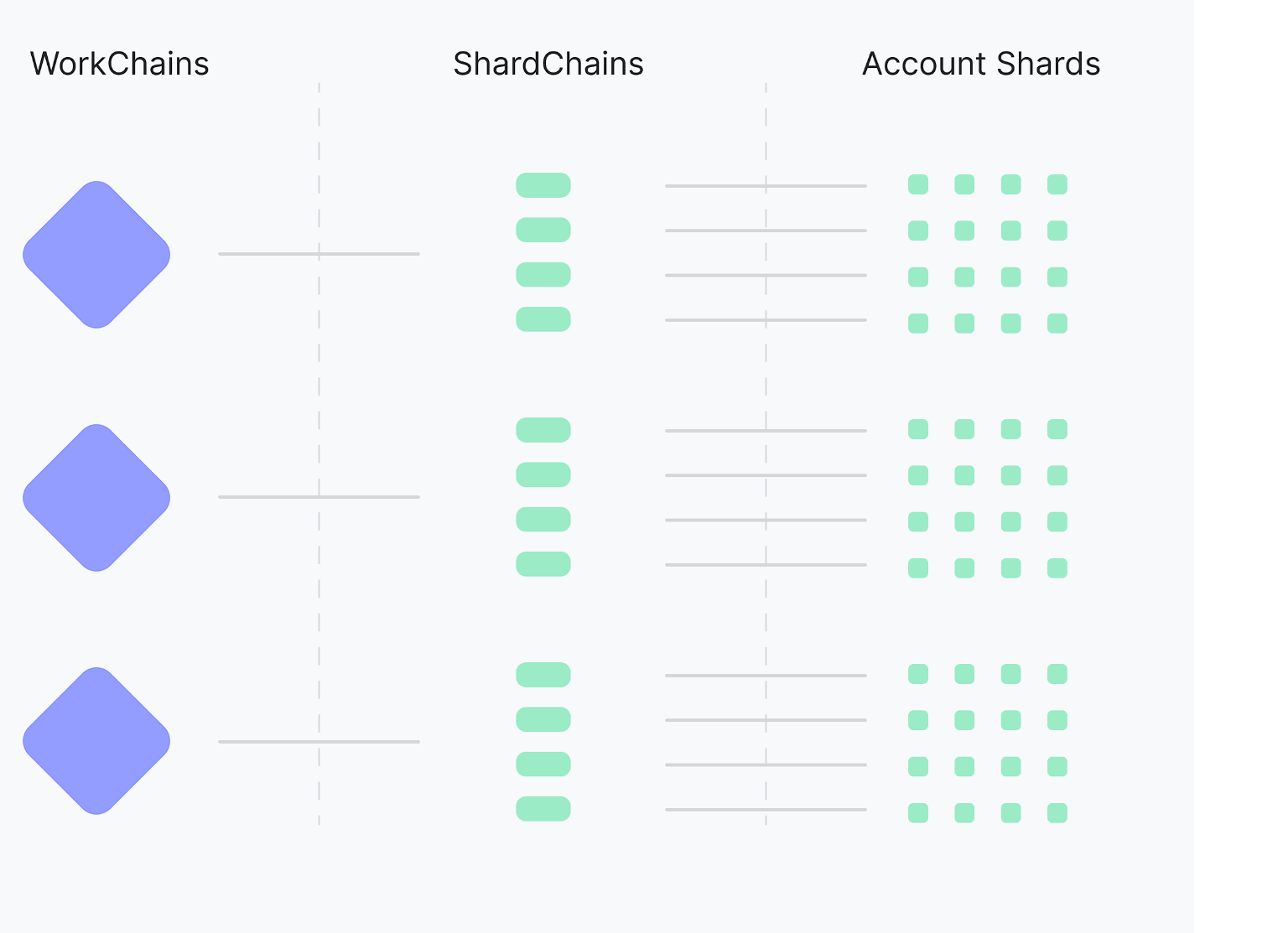
Image source: TON official documentation
Dynamic sharding is TON’s core scalability mechanism. It divides the overall network state into multiple independent processing units, or Shardchains. Each shard is responsible for handling transactions and data associated with specific address prefixes, enabling parallel execution across the network. Shard allocation can follow static mapping rules or adapt dynamically based on account interaction patterns.
- The primary advantage of dynamic sharding is flexibility. When a shard becomes overloaded, it can automatically split or merge to maintain performance balance.
- TON also incorporates a bottom-up design philosophy. Accounts that frequently interact can be grouped within the same shard, reducing cross-shard messaging overhead and improving execution efficiency.
Cross-shard communication remains one of the major technical challenges in sharded systems. TON addresses this by registering cross-shard message queues in the Masterchain to coordinate and track message delivery. While this approach introduces some latency overhead, it ensures that messages are neither lost nor improperly confirmed, preserving overall consistency and security.
How TON’s Consensus Mechanism Works
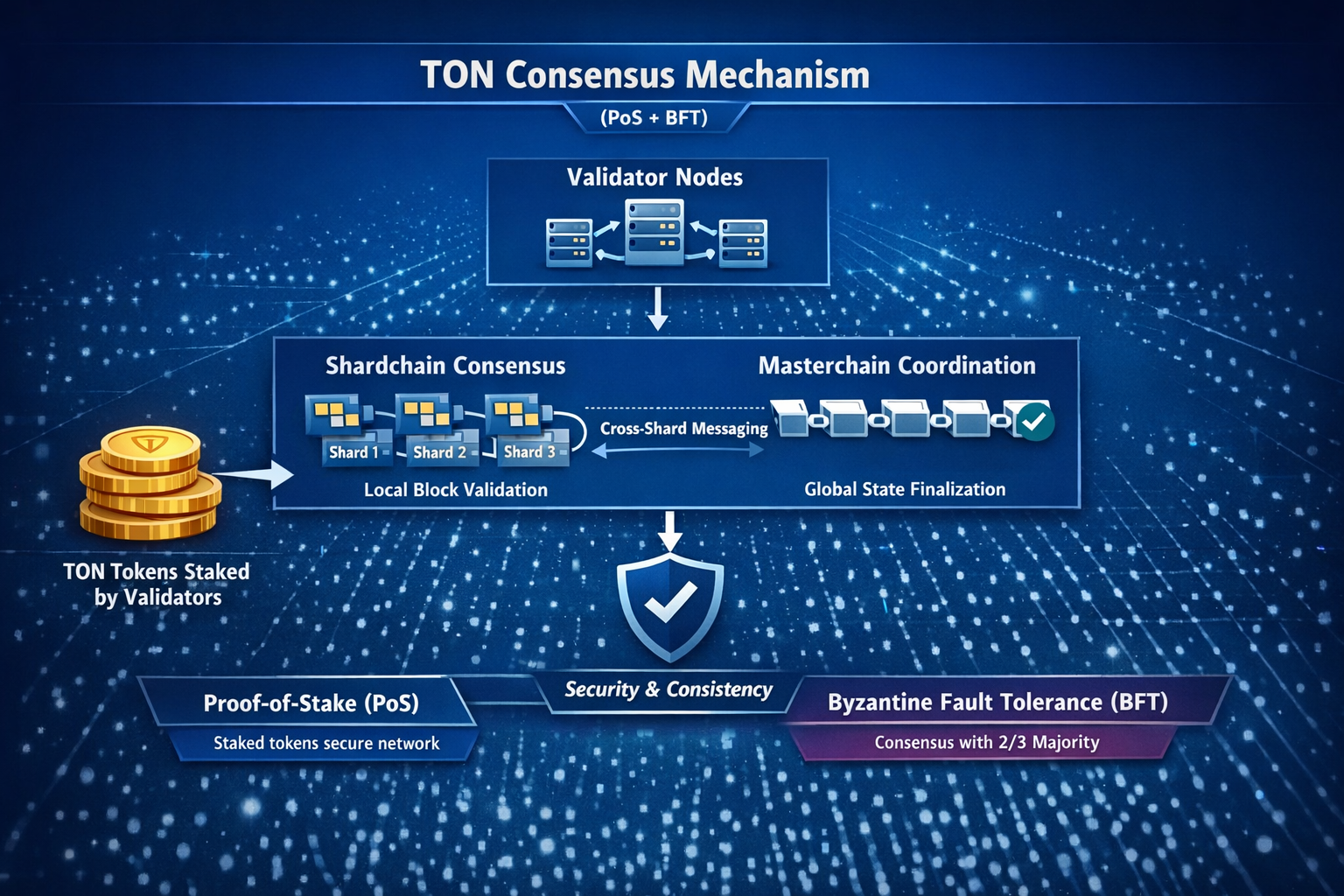
TON uses a Proof-of-Stake, or PoS, consensus model combined with a Byzantine Fault Tolerant protocol to achieve distributed agreement. Validators stake TON tokens to participate in block production and validation, ensuring both security and consistency. Compared to traditional Proof-of-Work systems, PoS significantly reduces energy consumption while improving operational efficiency.
In a sharded environment, each shard reaches consensus independently, while the Masterchain is responsible for confirming global state and shard indexing. This layered consensus design balances shard autonomy with overall network consistency, forming a critical foundation for TON’s scalability and security.
Achieving High Throughput and Low Latency
High performance is one of TON’s defining characteristics. Through dynamic sharding, multiple Shardchains can process transactions in parallel, substantially increasing the network’s overall TPS capacity. According to official documentation, TON’s architecture, with optimized sharding and load balancing, is theoretically capable of handling extremely high levels of concurrent transactions.
In addition, TON typically maintains short block times, enabling confirmations at the scale of seconds or faster. This reduces perceived latency for end users. Although cross-shard operations may incur additional delay due to Masterchain coordination, overall transaction finality remains relatively fast.
Architectural Comparison: TON, Ethereum, and Solana
| Contrast dimension | TON | Ethereum | Solana |
|---|---|---|---|
| Underlying architecture | Multi-layer, multi-chain structure, Masterchain + Workchains + Shardchains | Single-chain mainnet with Layer 2 scaling solutions | Single-chain high-performance architecture |
| Expansion mode | Dynamic sharding that can automatically split and merge | Layer 2 scaling centered on Rollups, with planned data sharding | Single-chain parallel execution with account-level parallelization |
| Sharding mechanism | Native dynamic sharding with theoretically unlimited scalability | Sharding was planned early on; currently focused on a modular roadmap | No sharding design |
| Consensus mechanism | PoS + BFT | PoS, Gasper, Casper + LMD-GHOST | PoS + PoH, Proof-of-History |
| Theoretical TPS limit | Theoretically extremely high, scaling with the number of shards | Low TPS on the mainnet, relies on Rollups for improvement | Thousands of TPS, high throughput on a single chain |
| Block confirmation speed | Confirmation within seconds | Approximately 12 seconds per block on the mainnet | Sub-second block production |
| Cross-chain or cross-sharding communication | Message queues coordinated through the Masterchain | Rollups interact with the main chain via bridging | No cross-shard communication needed within a single chain |
| Smart contract virtual machine | TON VM | EVM | Sealevel runtime |
| Ecosystem maturity | Growing, supported by Telegram’s user base | Most mature ecosystem, with a comprehensive DeFi and NFT landscape | Active ecosystem in high-frequency trading and blockchain gaming |
| Design philosophy | Elastic scalability designed for hundreds of millions of users | Prioritizes modularity and decentralization | Prioritizes extreme performance |
Compared with Ethereum, TON’s multi-chain sharding and parallel execution provide clear advantages in handling large-scale TPS demands. While Ethereum 2.0 also introduces sharding, its cross-shard interactions remain relatively complex, and scalability is constrained by a fixed number of shards.
In contrast, Solana takes a different approach. Rather than relying on multi-chain sharding, it focuses on optimizing performance within a single chain through a combination of Proof-of-History (PoH) and PoS. Solana’s single-chain high-performance design offers advantages in low-latency scenarios, but its sharding capability is comparatively weaker than TON’s.
Overall, TON demonstrates extremely high theoretical scalability in terms of throughput, potentially reaching millions of TPS. At the same time, Solana’s single-chain performance and Ethereum’s extensive ecosystem each offer distinct advantages depending on the application scenario.
Smart Contracts and Development Environment
TON supports smart contract development and provides its own virtual machine, TON VM, along with contract programming languages such as FunC. This forms the foundation for building decentralized applications.
Unlike Ethereum’s EVM-compatible ecosystem, TON requires developers to adapt to its unique runtime environment and tooling framework.
The TON community continues to improve SDKs, test networks, deployment tools, and other ecosystem components to attract more developers and strengthen ecosystem growth.
Challenges Behind the Technical Advantages
While TON’s dynamic sharding and multi-chain architecture deliver strong performance benefits, they also introduce increased complexity in cross-shard coordination. Cross-shard execution requires additional message confirmation processes, adding to overall system complexity.
Moreover, compared with more mature ecosystems, TON’s development tools, contract security auditing infrastructure, and supporting services are still evolving. The size of its developer community and number of ecosystem projects also lag behind those of Ethereum and Solana.
Future Technical Upgrades for TON
Looking ahead, TON’s development may focus on:
- Further optimizing cross-shard communication
- Improving compatibility within the development ecosystem
- Enhancing shard autonomy and routing efficiency
- Promoting bridging and interoperability solutions with major public chains such as Ethereum
to strengthen ecosystem connectivity and integration.
Conclusion
As a high-performance Layer 1 blockchain built for large-scale applications, TON (The Open Network) achieves high throughput, low latency, and scalability through its multi-layered network structure, dynamic sharding mechanism, and PoS consensus model. These features give it a distinct advantage in supporting the demands of hundreds of millions of users.
Although it still faces challenges in ecosystem maturity and cross-shard complexity, TON’s innovative architecture offers valuable insights into future blockchain scalability. As both its technology and ecosystem continue to evolve, TON has the potential to become a foundational infrastructure layer for high-performance blockchain applications.
Share
Content
TON’s Overall Network Architecture
Understanding the Dynamic Sharding Mechanism
How TON’s Consensus Mechanism Works
Achieving High Throughput and Low Latency
Architectural Comparison: TON, Ethereum, and Solana
Smart Contracts and Development Environment
Challenges Behind the Technical Advantages
Future Technical Upgrades for TON
Conclusion


Related Articles

The Future of Cross-Chain Bridges: Full-Chain Interoperability Becomes Inevitable, Liquidity Bridges Will Decline

Solana Need L2s And Appchains?

Sui: How are users leveraging its speed, security, & scalability?

Navigating the Zero Knowledge Landscape

What is Tronscan and How Can You Use it in 2025?
