


Stable vs Plasma: Comparing Two Tether Ecosystem Stablecoin Payment Blockchains
This article provides a structured comparison between Stable and Plasma across multiple dimensions, including the stablecoin market landscape, technical architecture, token economics, ecosystem development, and application scenarios, to examine opportunities in the emerging category of stablecoin payment blockchains.
The Stablecoin Market: Payment Infrastructure Competition Under USDT Dominance
As of early 2026, the stablecoin market is characterized by a highly concentrated structure at the top, alongside intense competition among multiple protocols.
- Total stablecoin market capitalization exceeds 300 billion USD. USDT accounts for approximately 186 to 187 billion USD, representing more than 60% market share and firmly holding the leading position.
- USDC has a market capitalization of approximately 73 to 75 billion USD, representing around 25% of the market, forming a dual-dominance structure with USDT.
- Other stablecoins, including decentralized, algorithmic, and synthetic stablecoins, lag significantly in market capitalization and liquidity, but continue to innovate in yield mechanisms, compliance models, and product design.
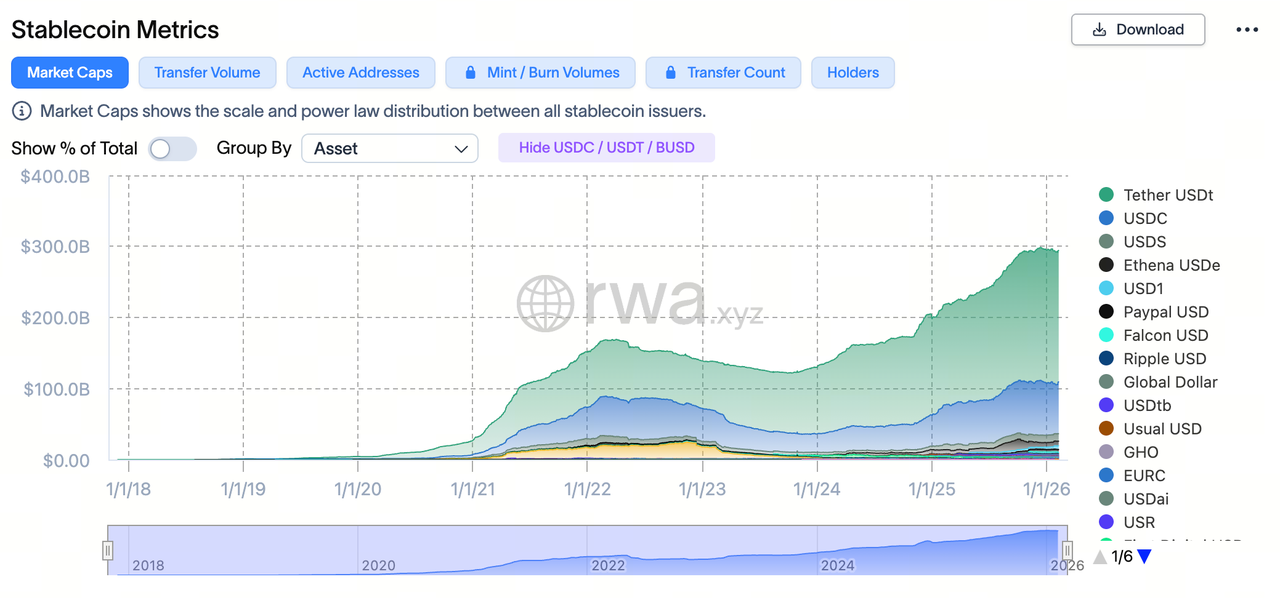
At the infrastructure level, specialized payment blockchains such as Stable and Plasma are competing with general-purpose L1 and L2 networks such as Ethereum and Solana for stablecoin settlement volume. The core areas of competition include transaction costs, settlement speed, compliance integration, and developer ecosystem support.
Stable Project Overview: A Dedicated Stablechain With USDT As Native Gas
Stable is a high-performance Layer 1 blockchain built specifically for USDT. Its goal is to provide a fast, low-cost, and low-latency network for stablecoin transactions. Unlike general-purpose blockchains, Stable focuses on payment and settlement use cases for USDT, aiming to give USDT a cash-like on-chain experience suitable for cross-border payments, e-commerce transactions, and enterprise settlement.
Core Features of Stable:
- USDT0 as native gas: Through the v1.2.0 mainnet upgrade, Stable replaced gUSDT with the cross-chain version USDT0 as its native gas asset. Users can pay transaction fees directly with stablecoins, removing the need for wrapping or unwrapping and significantly simplifying wallet and merchant integration.
- Optimized payment experience: The protocol is designed around “USDT as the core experience asset,” including gas-free transfers and stablecoin-denominated fees, reducing complexity for end users.
- EVM compatibility: Stable supports Ethereum tooling and smart contracts, allowing existing DeFi and payment applications to migrate with minimal friction.
Plasma Project Overview: A High-Performance Stablecoin L1 And DeFi-Native Infrastructure
Plasma is an EVM-compatible Layer 1 blockchain optimized for stablecoin payments and DeFi applications. Its design emphasizes high performance, low fees, and support for multiple assets.
Core Features of Plasma:
- PlasmaBFT consensus: Plasma uses a high-performance BFT-style consensus mechanism, enabling fast block times and near-instant transaction finality to support high-frequency payments and DeFi use cases.
- Stablecoin-native design: Plasma supports zero-gas USDT transfers through a built-in paymaster mechanism, enabling applications to sponsor gas fees for users. It also allows applications to register custom gas tokens, including ERC-20 assets such as USDT.
- Native Bitcoin bridge: Plasma provides a non-custodial BTC bridge, allowing users to transfer BTC into the Plasma ecosystem and participate in DeFi and payment applications using pBTC.
- Institutional-grade features: These include confidential payments, compliance tooling, and custody integration, designed for institutions and large enterprise users.
Stable vs Plasma: Key Metrics Comparison
The following sections provide a detailed comparison between Stable and Plasma across technical architecture, business models and supporting institutions, token market performance, and ecosystem development.
Technical Architecture Comparison: Payment Simplicity vs Functional Breadth
| Dimension | Stable | Plasma |
|---|---|---|
| Consensus Mechanism | Payment-optimized Proof of Stake | PlasmaBFT high-performance BFT consensus |
| Gas Model | USDT0 as native gas, supports gas-free transfer experience | Custom gas tokens with built-in paymaster, supports paying gas with USDT |
| Finality | Sub-second settlement optimized for payment use cases | Near-instant (sub-second) finality |
| Compatibility | Fully EVM compatible | EVM compatible with native Bitcoin bridge |
| Privacy Features | No privacy modules publicly disclosed | Supports confidential payments and institution-grade privacy tools |
From the comparison, it can be observed that both Stable and Plasma are optimized around EVM compatibility and stablecoin payments. Plasma offers a broader range of openly documented technical features and greater functional complexity, while Stable chooses to hide complexity at the protocol level and focuses on a simplified “USDT-as-experience” path tailored for payment use cases.
Business Models And Tether / Bitfinex Support
Both Stable and Plasma receive support from Tether and Bitfinex. However, Plasma’s investor base is more diversified and includes traditional financial institutions such as Founders Fund. Plasma has also raised a larger amount of capital than Stable, indicating stronger backing from capital markets.
| Metric | Stable | Plasma |
|---|---|---|
| Funding Raised | 28 million USD | 75.8 million USD |
| Key Investors | Bitfinex, Hack VC, and others | Bitfinex, Framework, Founders Fund, Bybit, and others |
| Revenue Model | No clearly disclosed on-chain revenue data to date | On-chain fees and revenue are already observable, with daily revenue in the hundreds of USD range (as recorded by Token Terminal) |
| Integration With Tether | Deeply integrated with USDT0 as native gas, positioned as a “USDT payment main chain” | Leverages USDT and stablecoin liquidity to form a large-scale DeFi and yield-focused ecosystem |
Market Performance And Risk Indicators
| Metric | Stable | Plasma |
|---|---|---|
| Token Price | $0.02 | $0.08 |
| Circulating Market Cap | $323 million | $171 million |
| FDV (Fully Diluted Valuation) | $1.79 billion | $793 million |
| TVL (Total Value Locked) | $34,671 (ATH $100 million – Dec 2025) | $2.93 billion |
The above data is sourced from DeFiLlama and Token Terminal as of February 9.
Based on the table, several observations can be made:
- Plasma’s TVL significantly exceeds that of Stable, indicating broader asset adoption and capital participation.
- Plasma’s valuation multiples appear relatively conservative, with observable daily revenue and a stable stablecoin supply base.
- Since mid-December 2025, Stable’s TVL has experienced a sharp decline, and current data appears abnormal.
Ecosystem Partners And Application Scenarios: Payment Chain vs DeFi Anchor
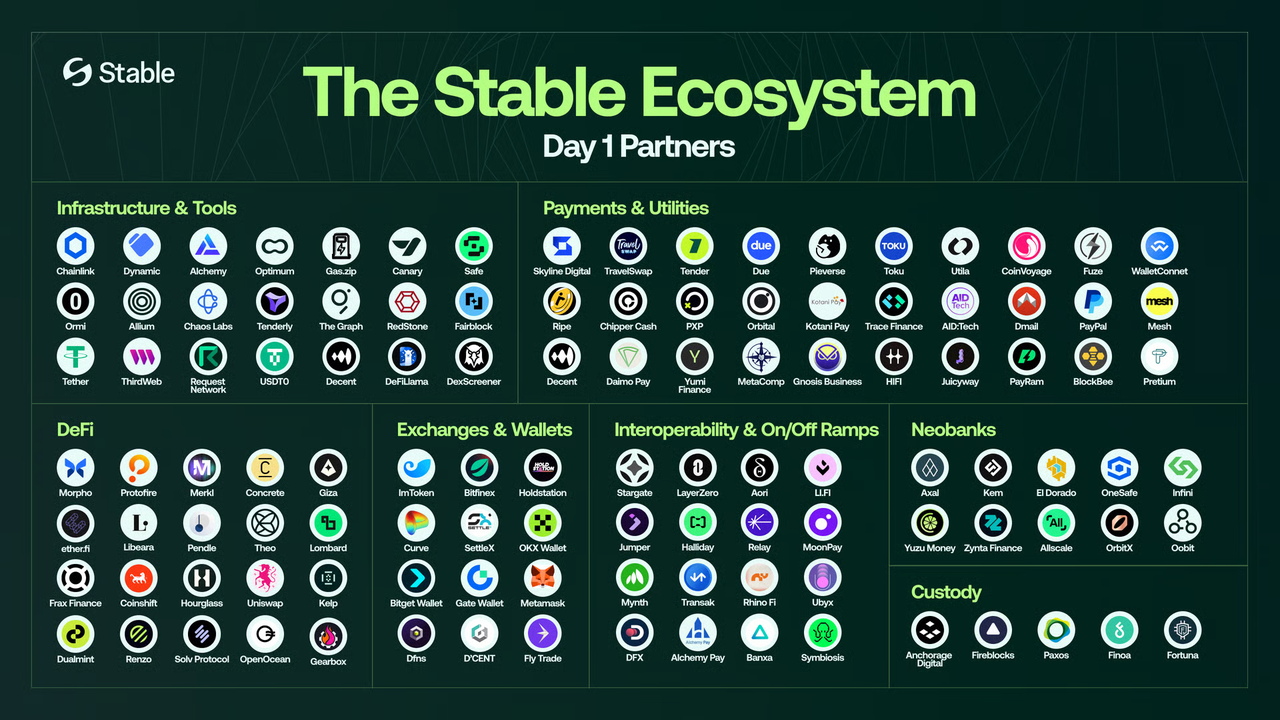
In terms of ecosystem partnerships and real-world deployment, Stable and Plasma emphasize different directions.
Stable focuses more heavily on integration with payment institutions, wallets, and merchant systems:
- USDT0 is used as the sole native gas asset, reducing merchant integration complexity and aligning network usage directly with stablecoin payments.
- Suitable for e-commerce payments, cross-border remittances, on-chain payroll, and B2B settlement, abstracting blockchain infrastructure into a stablecoin payment channel.
- Synergies with Tether’s stablecoin payment expansion in emerging markets such as Africa and Latin America may allow Stable to capture part of on-chain settlement demand.
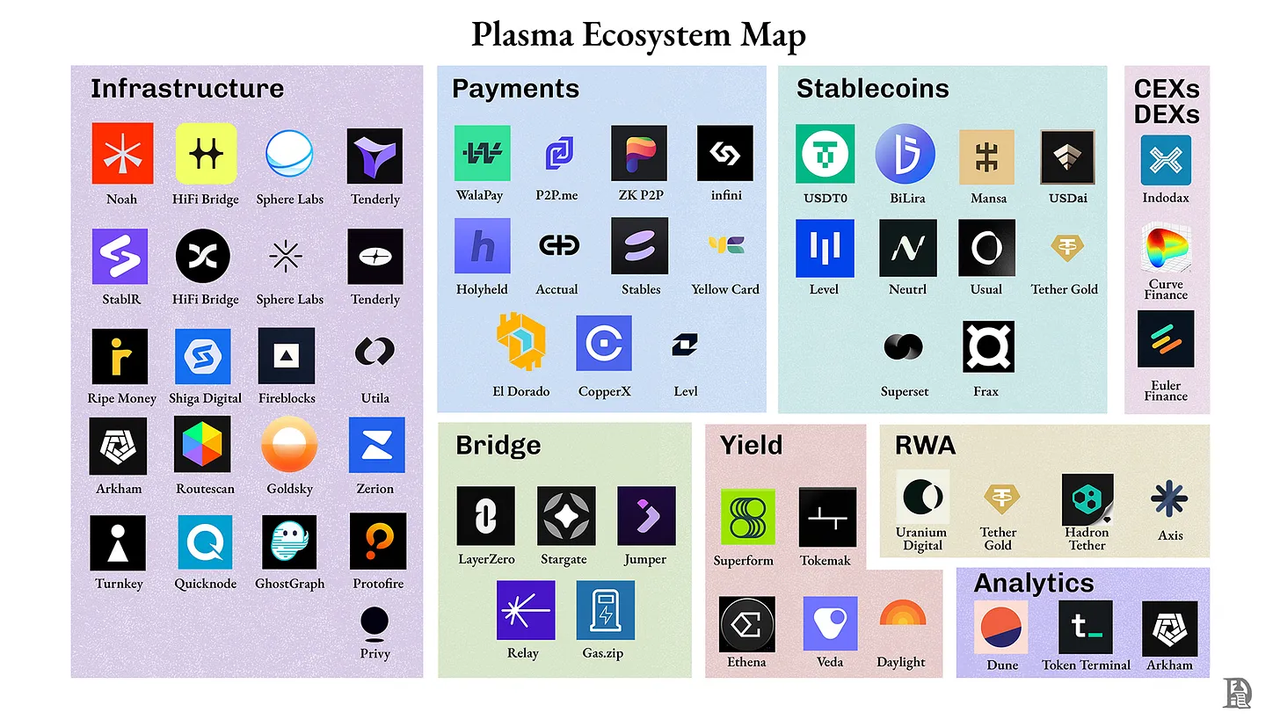
Plasma positions itself more as a foundational chain for stablecoin DeFi and yield ecosystems:
- Deep integration with centralized exchanges and custodial partners enables distribution through established user channels.
- Supports cross-chain strategies and yield products involving BTC and stablecoins, attracting DeFi protocols, liquidity pools, and lending platforms.
- Built-in confidential payments, compliance tooling, and institutional access controls make it suitable for asset managers, payment companies, and financial institutions building compliant products.
Summary
Within the current competition for stablecoin payment infrastructure, Stable and Plasma represent two distinct development paths within the Tether ecosystem.
Stable targets a payment-focused narrative centered on “USDT as the user experience,” leveraging USDT0 as native gas, gas-free transfers, and deep EVM compatibility. However, its current TVL remains relatively small, and its revenue and value capture mechanisms require further validation.
By contrast, Plasma has already established stronger ecosystem connections with decentralized protocols and applications, supported by faster expansion and revenue-generating products, demonstrating greater competitive strength and adoption momentum.
FAQs
Are Stable And Plasma Direct Competitors In The Same Segment?
Both belong to the category of stablecoin-native payment or DeFi blockchains and both collaborate with Tether and Bitfinex. Strategically, Stable focuses more on USDT payment experience, while Plasma emphasizes stablecoin DeFi and institutional finance.
How Can Users Purchase STABLE Or XPL Tokens?
Users can currently purchase both tokens through centralized exchanges that support trading pairs for these assets or via decentralized exchanges where USDT or USDC can be swapped for STABLE or XPL.
How Does Tether’s Support Differ Between Stable And Plasma?
Both are considered part of the broader Tether ecosystem. Stable is deeply integrated with USDT0 at the gas asset level, while Plasma focuses on providing high-performance infrastructure, BTC bridging, and institutional integrations to support stablecoin liquidity.
Which Metrics Should Be Monitored Going Forward?
Key indicators include TVL growth, stablecoin supply, daily transaction counts, active addresses, on-chain revenue, number of ecosystem partners, and the impact of regulatory developments on stablecoin-related activities.
Share
Content


Related Articles

In-depth Explanation of Yala: Building a Modular DeFi Yield Aggregator with $YU Stablecoin as a Medium

Exploring 8 Major DEX Aggregators: Engines Driving Efficiency and Liquidity in the Crypto Market

Sui: How are users leveraging its speed, security, & scalability?

What Is Copy Trading And How To Use It?

What Is Technical Analysis?
