Pi Price Prediction: Pi Network Joins ISO 20022 Standard Price Could Fall to 0.2 USD in 2026

Last Updated 2026-03-27 14:46:39
Reading Time: 1m
Pi Network announced it is launching its ISO 20022 compliance initiative, aiming to compete with Ripple and Stellar in the cross-border payments arena. The company seeks to achieve this before SWIFT’s global migration on November 22, 2025.

Pi Network Joins ISO 20022 Standard

Recent reports show that Pi Network is joining the ISO 20022 standardization effort, a move that could position it alongside blockchain payment leaders like Ripple and Stellar. The global transition deadline for ISO 20022 is November 22, 2025. While this presents new opportunities for Pi Network, it also brings the challenge of meeting the rigorous requirements set by the world’s top financial institutions.

The Importance of ISO 20022 for Blockchain Payments

ISO 20022 is a unified financial messaging standard. It enables banks and payment systems to exchange richer, faster, and more structured data. The legacy SWIFT MT system will be replaced by ISO 20022, and over 11,000 institutions worldwide have already adopted it.

After the November 2025 deadline, the SWIFT network will accept only ISO 20022-compliant messages. This marks a permanent shift in cross-border payment processing. Ripple and Stellar have already aligned with the standard, securing an early lead in real-world payment integration. For Pi Network, following ISO 20022 could open the door to bridging traditional banking and digital assets.

Pi Network’s Challenges and Opportunities

Pi Network’s vision extends beyond payments. It aims to integrate decentralized computing, mobile-first finance, and artificial intelligence within a single ecosystem. This combination—a payment network, computing platform, and financial gateway—shows potential that Ripple and Stellar have not yet fully explored.

If successful, Pi Network could show how a community-driven project can transition from mobile mining to a compliant, globally recognized payment infrastructure. Achieving ISO 20022 compatibility will require meeting the strict data and messaging standards of traditional finance.

Can Pi Compete with Industry Leaders?

Whether Pi Network can translate its vast user base into institutional adoption remains a key question for the market. Its main advantage lies in its dedicated global community, which actively supports ecosystem growth—from the OpenMind AI project to decentralized finance initiatives. To succeed under the ISO 20022 framework, Pi will need to develop robust technical and compliance systems. Only then can it match Ripple and Stellar.

PI spot trading is available at: https://www.gate.com/trade/PI_USDT
PI Token Price Outlook

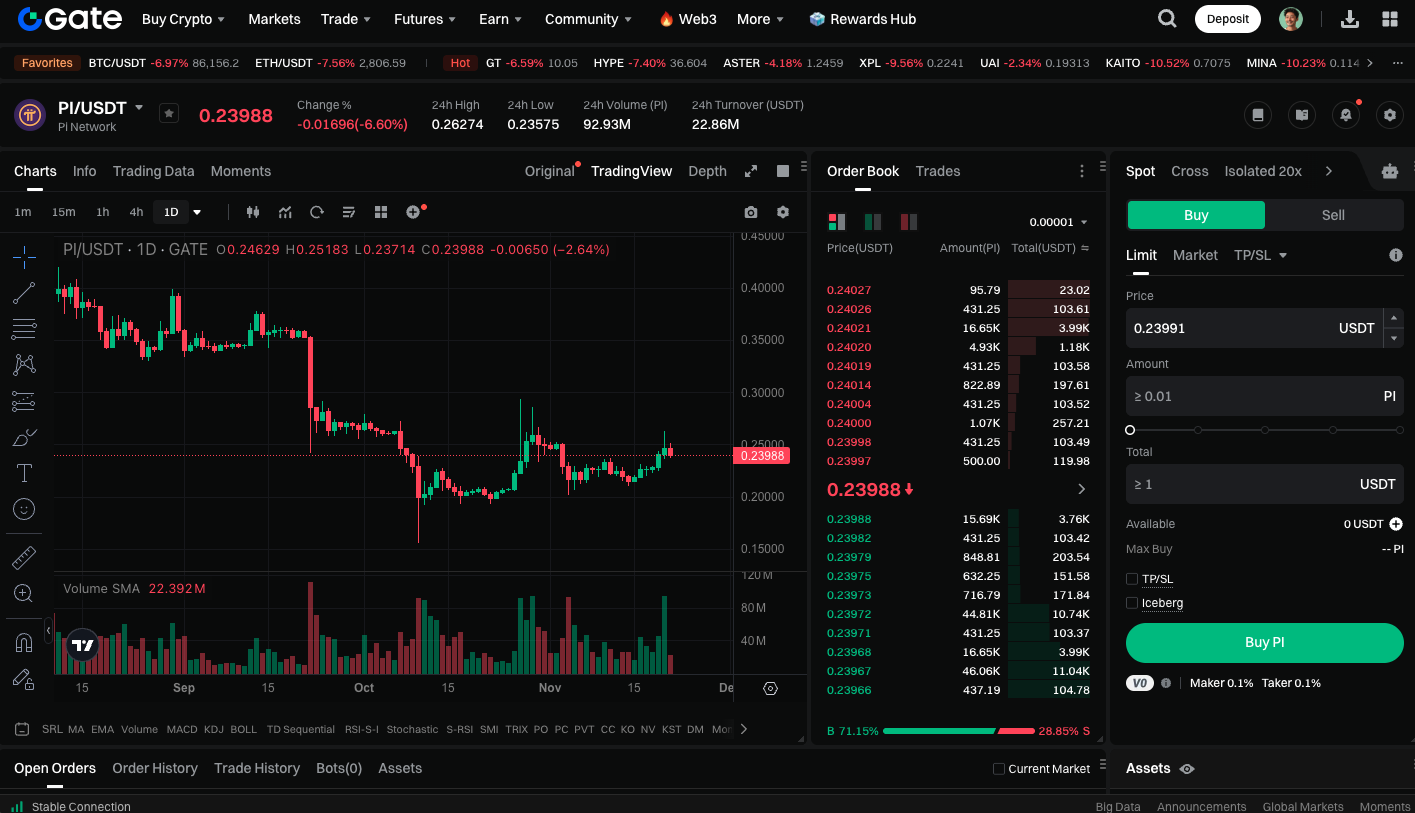
Most crypto analysts remain bearish on PI token’s price outlook. Structural economic weaknesses and limited liquidity could cause PI’s price to drop sharply by 2026, with the worst-case scenario seeing it fall to $0.20. Investors should consider market volatility and use robust risk management strategies.

Disclaimer
* The information is not intended to be and does not constitute financial advice or any other recommendation of any sort offered or endorsed by Gate.
* This article may not be reproduced, transmitted or copied without referencing Gate. Contravention is an infringement of Copyright Act and may be subject to legal action.

Related Articles

The ve(3,3) Flywheel Explained: How AERO Tokenomics Powers Aerodrome’s DeFi Economy
Beginner

The ve(3,3) Flywheel Explained: How AERO Tokenomics Powers Aerodrome’s DeFi Economy

In the competition for DeFi liquidity, high-inflation mining alone is no longer enough to build lasting advantages. Aerodrome applies the ve(3,3) economic model to redesign token emissions, voting mechanisms, and revenue distribution, creating a liquidity flywheel centered on governance and cash flow. This article examines AERO tokenomics, the veAERO locking mechanism, and protocol revenue models to explain how Aerodrome builds a sustainable DeFi economic system.
2026-03-25 06:41:58
AI-Native Settlement Layers: How United Stables Is Building the Next Financial Rail
Beginner

AI-Native Settlement Layers: How United Stables Is Building the Next Financial Rail

Stablecoins were originally designed as dollar substitutes within exchanges, primarily used for asset pricing and trade settlement. As on-chain financial ecosystems have matured, their role has expanded beyond simple payments to include collateral assets, cross-chain liquidity mediums, and unified settlement units. In particular, as AI systems and automated agents begin to participate directly in economic activity, demand has risen sharply for programmable value units capable of instant settlement. This shift is pushing stablecoins toward the role of foundational financial infrastructure.
2026-03-25 03:16:17
Aerodrome Tokenomics: How ve(3,3) Powers Base's Most Profitable DEX
Beginner

Aerodrome Tokenomics: How ve(3,3) Powers Base's Most Profitable DEX

AERO is the native token of Aerodrome Finance, a core decentralized exchange and liquidity protocol in the Base ecosystem. It is primarily used for liquidity incentives and ecosystem operations. veAERO is a governance NFT that users receive by locking AERO, representing both voting power and the right to share protocol revenue. Through a dual track structure of AERO as a utility token and veAERO as a governance credential, Aerodrome separates liquidity usage value from long term governance power, allowing participants to act as liquidity providers, governance decision makers, and revenue sharers within the same system.
2026-03-25 06:40:31
How Does PAXG Work? In-Depth Overview of the Physical Gold Tokenization Mechanism
Beginner

How Does PAXG Work? In-Depth Overview of the Physical Gold Tokenization Mechanism

PAXG (Pax Gold) is a tokenized asset backed by physical gold, issued by the fintech company Paxos and traded on the Ethereum blockchain as an ERC-20 token. The core concept is to tokenize physical gold on-chain, with each PAXG token representing ownership of a certain amount of gold. This structure enables investors to hold and trade gold in the form of a digital asset.
2026-03-24 19:12:51
How is the price of PAXG determined? Pegging mechanism, trading depth, and influencing factors
Beginner

How is the price of PAXG determined? Pegging mechanism, trading depth, and influencing factors

PAXG (Pax Gold) is a tokenized asset backed by physical gold reserves, launched by fintech firm Paxos and issued as an ERC-20 token on the Ethereum blockchain. The core concept is to digitally represent real-world gold assets, allowing investors to hold and trade gold via the blockchain network. Because each PAXG token corresponds to a specific quantity of physical gold, its price is theoretically expected to closely track the global gold market.
2026-03-24 19:11:40
DePIN Identity Network and Real World Applications: How Humanity Protocol Brings on-chain Identity Into the Physical World
Beginner

DePIN Identity Network and Real World Applications: How Humanity Protocol Brings on-chain Identity Into the Physical World

Most Web3 identity systems remain confined to on-chain environments and struggle to achieve meaningful adoption in real world settings. Through a DePIN architecture and physical verification hardware, Humanity Protocol aims to bring decentralized identity into access control systems, hospitality, public services, and offline events, allowing on-chain identity to function not just as a digital credential, but as foundational infrastructure for real world access.
2026-03-25 07:40:53





