Pi Price Prediction: Can It Reach 1.65 to 3 Amid Legal Challenges in 2026?

Last Updated 2026-03-26 19:41:27
Reading Time: 1m
SocialChain, the parent company of Pi Network, is being sued by Arizona resident Harro Moen, who accuses the founders of unlawfully transferring his 5,137 Pi tokens. Industry experts, however, challenge the $307 valuation, viewing it as an unregulated IOU price rather than a true market value. Pi price outlook: If ecosystem demand stays robust, Pi could surpass $0.81, with targets set at $1.00 to $1.65, and potentially reach $2.00 to $3.00 in late 2026.

Lawsuit Draws Attention

SocialChain Inc., the parent company of Pi Network, is currently facing a lawsuit filed by Arizona resident Harro Moen in the U.S. District Court for the Northern District of California. Moen alleges that the company and Pi Network founders Nicolas Kokkalis and Chengdiao Fan unlawfully transferred his 5,137 Pi tokens, resulting in an estimated $2 million in financial losses.

$307 Price Dispute

The lawsuit references a $307 value per Pi token, a figure that industry experts have widely questioned. Analysts highlight that since Pi began trading on centralized exchanges, its price has never surpassed $3. The cited $307 value comes from unregulated IOU markets and does not represent actual market value.

Token Theft Allegation

Moen asserts that his 5,137 Pi tokens were transferred without his authorization. However, experts maintain that unless there is direct evidence of wallet access by the Pi Core Team, the chances of substantiating this claim are slim. Most wallet-related issues stem from phishing attacks or inadequate user security.

Token Migration Delays

Moen also complains that some tokens have not yet migrated from the legacy mining app to the mainnet, which restricts liquidity. Analysts note that this is a widespread issue affecting users globally and does not constitute sufficient grounds for fraud allegations.

Lawsuit Unlikely to Succeed, but Pressures for Transparency Grow

Experts consider the probability of this lawsuit succeeding to be low. However, it may drive the Pi Core Team to improve transparency, especially regarding migration schedules, user support, and mainnet development updates.

Pi Token Price Outlook

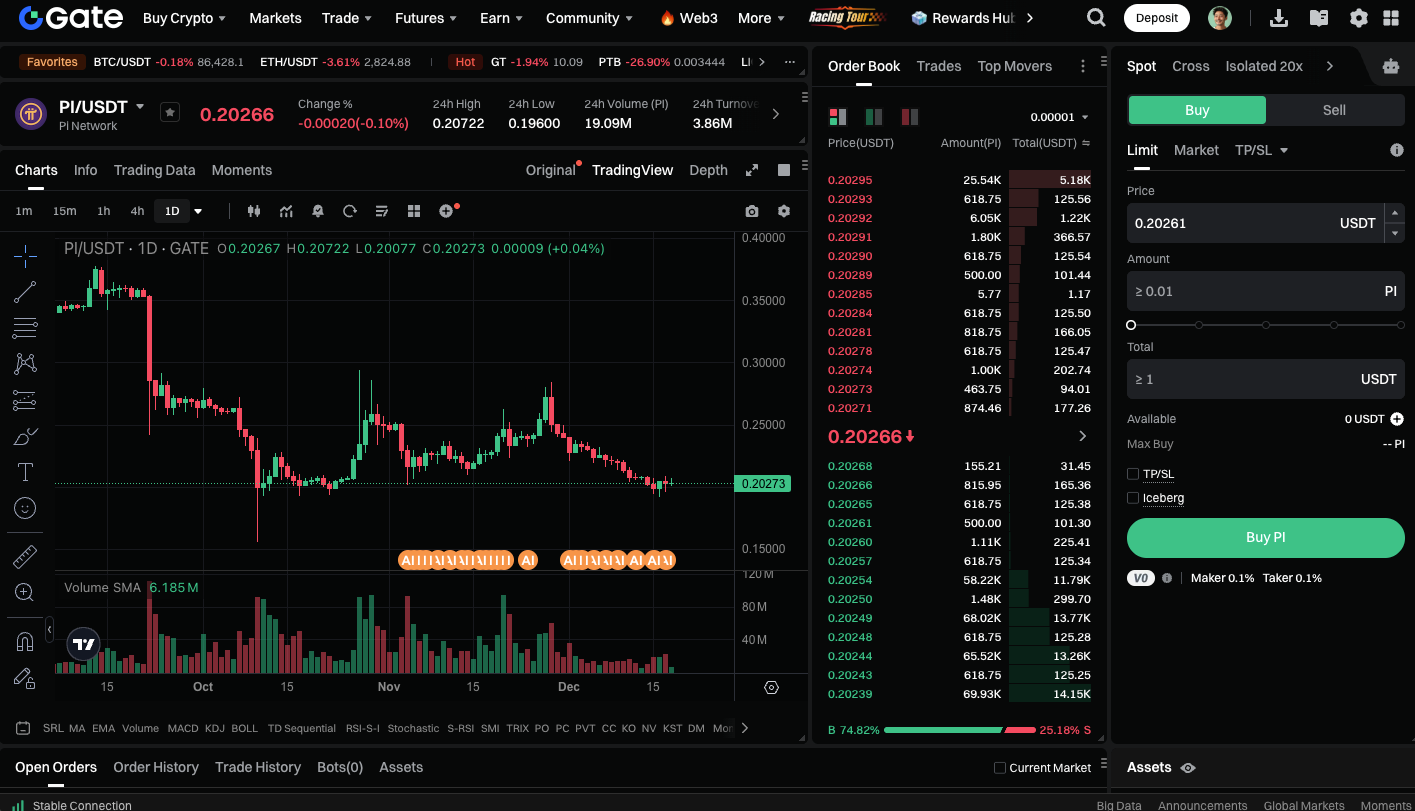
If Pi can deliver real utility within its ecosystem and boost on-chain demand, its price could climb quickly. Technical analysis suggests that breaking through key resistance levels could trigger a trend reversal, setting a short-term target at $0.81 and potentially challenging the $1.00–$1.65 range. Should the ecosystem experience robust growth, Pi could reach $2.00–$3.00 as early as late 2026.

Start trading PI spot now: https://www.gate.com/trade/PI_USDT
Summary

While the lawsuit and historical price disputes create uncertainty for Pi Network, the market remains focused on the project’s ecosystem development and on-chain demand. If Pi continues to expand real-world use cases and attract more users, its token could see substantial growth in 2026, potentially ushering in a bullish market phase.

Author: Allen
Disclaimer
* The information is not intended to be and does not constitute financial advice or any other recommendation of any sort offered or endorsed by Gate.
* This article may not be reproduced, transmitted or copied without referencing Gate. Contravention is an infringement of Copyright Act and may be subject to legal action.

Related Articles

The ve(3,3) Flywheel Explained: How AERO Tokenomics Powers Aerodrome’s DeFi Economy
Beginner

The ve(3,3) Flywheel Explained: How AERO Tokenomics Powers Aerodrome’s DeFi Economy

In the competition for DeFi liquidity, high-inflation mining alone is no longer enough to build lasting advantages. Aerodrome applies the ve(3,3) economic model to redesign token emissions, voting mechanisms, and revenue distribution, creating a liquidity flywheel centered on governance and cash flow. This article examines AERO tokenomics, the veAERO locking mechanism, and protocol revenue models to explain how Aerodrome builds a sustainable DeFi economic system.
2026-03-25 06:41:58
AI-Native Settlement Layers: How United Stables Is Building the Next Financial Rail
Beginner

AI-Native Settlement Layers: How United Stables Is Building the Next Financial Rail

Stablecoins were originally designed as dollar substitutes within exchanges, primarily used for asset pricing and trade settlement. As on-chain financial ecosystems have matured, their role has expanded beyond simple payments to include collateral assets, cross-chain liquidity mediums, and unified settlement units. In particular, as AI systems and automated agents begin to participate directly in economic activity, demand has risen sharply for programmable value units capable of instant settlement. This shift is pushing stablecoins toward the role of foundational financial infrastructure.
2026-03-25 03:16:17
Aerodrome Tokenomics: How ve(3,3) Powers Base's Most Profitable DEX
Beginner

Aerodrome Tokenomics: How ve(3,3) Powers Base's Most Profitable DEX

AERO is the native token of Aerodrome Finance, a core decentralized exchange and liquidity protocol in the Base ecosystem. It is primarily used for liquidity incentives and ecosystem operations. veAERO is a governance NFT that users receive by locking AERO, representing both voting power and the right to share protocol revenue. Through a dual track structure of AERO as a utility token and veAERO as a governance credential, Aerodrome separates liquidity usage value from long term governance power, allowing participants to act as liquidity providers, governance decision makers, and revenue sharers within the same system.
2026-03-25 06:40:31
How Does PAXG Work? In-Depth Overview of the Physical Gold Tokenization Mechanism
Beginner

How Does PAXG Work? In-Depth Overview of the Physical Gold Tokenization Mechanism

PAXG (Pax Gold) is a tokenized asset backed by physical gold, issued by the fintech company Paxos and traded on the Ethereum blockchain as an ERC-20 token. The core concept is to tokenize physical gold on-chain, with each PAXG token representing ownership of a certain amount of gold. This structure enables investors to hold and trade gold in the form of a digital asset.
2026-03-24 19:12:51
How is the price of PAXG determined? Pegging mechanism, trading depth, and influencing factors
Beginner

How is the price of PAXG determined? Pegging mechanism, trading depth, and influencing factors

PAXG (Pax Gold) is a tokenized asset backed by physical gold reserves, launched by fintech firm Paxos and issued as an ERC-20 token on the Ethereum blockchain. The core concept is to digitally represent real-world gold assets, allowing investors to hold and trade gold via the blockchain network. Because each PAXG token corresponds to a specific quantity of physical gold, its price is theoretically expected to closely track the global gold market.
2026-03-24 19:11:40
Aster vs Hyperliquid: Which Perp DEX Will Prevail?
Beginner

Aster vs Hyperliquid: Which Perp DEX Will Prevail?

Aster and Hyperliquid are the two representative protocols of the "purpose-built L1 path" within the current decentralized perpetual exchange (Perp DEX) sector. As a pioneer in the field, Hyperliquid has built a deep liquidity moat through its highly mature order book architecture and strong community consensus. Conversely, Aster, as a rising challenger, seeks to leapfrog the competition in high-performance trading through more aggressive multi-chain aggregation logic, private transaction modules, and an underlying execution environment optimized for 2026 market demands.
2026-03-24 11:58:33





